How to Import Winter Coats From Bangladesh in 2026: Complete Buyer Guide
Step-by-step buyer guide to importing winter coats from Bangladesh: define the shell and insulation in testable numbers, classify under HS 6201/6202, check the 10% US duty, approve samples, set the AQL plan and land 1,000 cotton parkas in New York with a worked cost example.
Short answer
To import winter coats from Bangladesh, define the coat in numbers first: hydrostatic head and MVTR for the shell, fill power and fill weight for the insulation. Classify each style under heading 6201 or 6202; a men's cotton coat pays 10 per cent US duty under 6201.12.20. Approve a pre-production sample in bulk materials, set the AQL inspection plan in the order, and clear US customs with the full ten-digit line and the Bangladesh export file.
On this page
Key takeaways
A men's cotton coat enters the US at 10% duty under line 6201.12.20; the down-filled line 6201.12.10.00 is 0%, while a women's man-made fibre coat under 6202.13.40 pays 30%.
Specify the shell by hydrostatic head and MVTR and the fill by fill power, fill weight and down cluster percentage, and test all of them.
A 1,000-piece lot inspected at General Inspection Level II takes an 80-piece sample: accept 5, reject 6 major defects at AQL 2.5.
Example figures put 1,000 cotton parkas CIF New York at $22,540 all in, or $22.54 per piece, including the 10% duty.
A winter coat is judged in bad weather, not on a rail. A buyer who orders on price alone learns the result in January, when a leaking shell or a failed zip comes back as returns. This guide walks through the seven steps, with the duty, the inspection plan and a worked example for 1,000 cotton parkas to New York.
Start with what the coat must survive
A coat must keep rain and wind out and hold warmth in. Put both jobs in the specification as numbers, because a number can be tested.
For the shell, the number is the hydrostatic head, in millimetres: how tall a column of water the fabric holds back. A rating from 1,500 to 5,000mm suits light showers, 10,000 to 20,000mm suits heavy rain, and 20,000mm or more suits extreme weather.1 The second number is the moisture vapour transmission rate (MVTR), in grams per square metre in 24 hours: below 10,000g/m2 suits low-intensity use and 10,000 to 20,000g/m2 suits general outdoor use.1 Ask for both numbers and check that the seams are taped.
For the fill, the number depends on the type. Down is rated by fill power, the volume in cubic inches one ounce fills: 700 fill power is 700 cubic inches per ounce.2 Fill power alone does not describe a coat: two coats can share a fill power and carry different fill weights, so ask for fill power, fill weight and down cluster percentage together.2 Where down is used, ask whether it is certified to the Responsible Down Standard (RDS), which bars live-plucking and force-feeding.2
Which code and duty apply to winter coats
Winter coats are woven outerwear in Harmonized System chapter 62: men's and boys' coats sit under heading 6201 and women's and girls' coats under heading 6202, each split by fibre.3 4
For a men's cotton coat, the US line is 6201.12.20, "Other", at 10.00 per cent.3 The same heading holds a down line: a cotton coat with 15 per cent or more down and waterfowl plumage, of which down forms 35 per cent or more, and at least 10 per cent down overall, takes line 6201.12.10.00 at 0.00 per cent.3 Women's cotton mirrors the men's: 6202.12.20 at 10.00 per cent, and the down line 6202.12.10.00 at 0.00 per cent.4 A women's man-made fibre coat under 6202.13.40 carries 30.00 per cent.4
Coat | US line | General duty |
|---|---|---|
Men's cotton coat, other | 6201.12.20 | 10.00% |
Men's cotton coat, down-filled | 6201.12.10.00 | 0.00% |
Women's cotton coat, other | 6202.12.20 | 10.00% |
Women's man-made fibre coat, other | 6202.13.40 | 30.00% |
These general rates come from the Harmonized Tariff Schedule of the United States, Revision 15 (2025).3 4 Bangladesh does not appear among the countries that take the special free rate on these lines.3 Confirm the ten-digit line and the current rate with your broker.
The import in seven steps
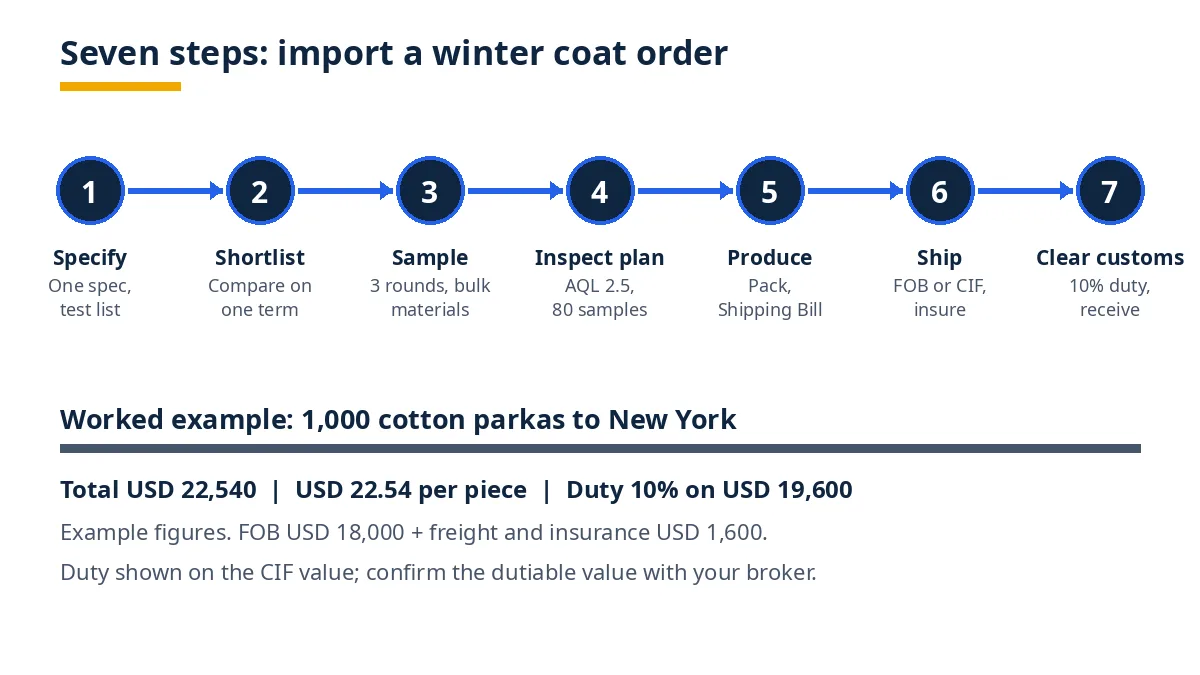
Write the specification and the test list. 2. Shortlist makers and compare quotations on one delivery term. 3. Approve the sample in the right order. 4. Set the inspection plan before production starts. 5. Produce, pack and file the Bangladesh export documents. 6. Ship, insure and track. 7. Clear US customs and receive the goods.
Step 1: Write the specification and the test list
Draft the specification before any maker is contacted: style and length, shell cloth with its ratings, insulation with fill power and weight, lining, hood and trims, size chart, colours, labels, packing, quantities, tests and delivery term. Send the same document to every candidate.
Attach a test list to the specification: hydrostatic head and MVTR, fill power and composition, seam strength, zip cycles, colour fastness and down leakage.
Step 2: Shortlist makers and compare quotations on one delivery term
Shortlist three to five makers whose range covers woven outerwear, and check pattern, fusing, taped-seam work and down handling before price. Our winter coats manufacturers guide sets out the checks. Compare quotations line by line, and ask each maker for the minimum per style and per colour.
The Incoterms 2020 rules run to 11, each splitting cost, risk and duties between the two sides.5 FOB Chattogram means the seller puts the coats on board and you sort the sea leg and insurance; CIF means the seller sorts carriage and insurance to your port; DAP means the seller brings the coats to your warehouse.5 A CIF price carries the sea leg and insurance inside it, while an FOB price stops at the vessel, so put one Incoterms rule and one named place on every quotation. Our Incoterms guide compares the rules in full.
Step 3: Approve the sample in the right order
Take the sample through three rounds, signing off each. First a fit sample in a substitute cloth, to settle the pattern, length and hood. Then a size-set sample, to settle the grading. Then a pre-production sample in the bulk shell, insulation, lining, trims and labels, washed, then measured, and tested for hydrostatic head, MVTR and down leakage before bulk is released.
Keep one sealed, washed pre-production sample as the reference for bulk and inspection. Never let bulk start on a sample in substitute cloth or an unwashed coat.
Step 4: Set the inspection plan before production
Name the inspector, timing and references in the order, before any cloth is cut. Take the sample size from ISO 2859-1: level II is the usual choice, and the AQL column sets the accept and reject numbers.6 A 1,000-piece lot at level II takes code letter J, an 80-piece sample: at AQL 2.5 it accepts 5 and rejects 6 major defects, and at AQL 4.0 it accepts 7 and rejects 8 minor defects.6 Critical defects take AQL 0, so one fails the lot.6 Name the edition, ISO 2859-1:2026, in the order.6
Settle the defect classes in writing and pull the sample at random. For a winter coat, add cold-weather checks: down leaking through seams, taped seams lifting, zips catching and fill weight below specification. Our winter coats quality control checklist lists the inspector checks.
Step 5: Production, packing and the Bangladesh export file
Check the cut panels and finished coats before packing, and weigh the fill on finished coats. Pack as the order states: fold or hang as agreed, bag each coat, sort cartons by size and colour and mark each carton.
Goods cannot load until Bangladesh Customs has approved a Shipping Bill. Next comes the EXP form, certified by an Authorized Dealer, with the invoice, the packing list, the Export Registration Certificate, the certificate of origin, the VAT registration certificate and the taxpayer identification number.7 Last comes the payment proof: an export letter of credit, a telegraphic transfer, a purchase order or a contract or guarantee the negotiating bank has approved.7 Ask for the export file as part of the order.
Step 6: Ship, insure and track
Under FOB, you book the freight and insurance. Under CIF, read the insurance certificate before the vessel sails: the default cover is Institute Cargo Clauses (C).5 The carrier issues the bill of lading to the shipper: the receipt for the goods and the contract to carry them.7 Get the bill of lading and container numbers the moment they exist. Transit time from Chattogram varies by sailing, so use your forwarder's schedule.
Step 7: Clear US customs and receive the goods
Hand your broker the ten-digit line, the invoice, the packing list and the bill of lading before the vessel arrives. Duty runs at the rate for the line: a cotton parka under 6201.12.20 pays 10 per cent, while the same coat in man-made fibre can pay 30 per cent.3 4 On receipt, measure a sample across the size range, test the zips and hood, and weigh the fill on down coats against the sealed sample, before the balance is paid.
Worked example: 1,000 cotton parkas to New York
Example figures: 1,000 men's cotton parkas, CIF New York, delivered to a New Jersey warehouse, duty at 10 per cent for line 6201.12.20.3
Cost element | USD |
|---|---|
Product price, FOB Chattogram | 18,000 |
Freight and insurance | 1,600 |
Customs value (CIF) | 19,600 |
Duty at 10% of 19,600 | 1,960 |
Customs broker fee | 250 |
Port handling | 320 |
Delivery to warehouse | 410 |
Total cash outlay | 22,540 |
Cost per piece | 22.54 |
Check it: 18,000 plus 1,600 is 19,600, 10 per cent of 19,600 is 1,960, and the lines add to 22,540, or 22.54 per piece. For the FOB lines behind the product price, see our winter coats price breakdown.
Labels: fibre, origin and care for the US market
A textile label in the United States must carry the fibre content, the country of origin and the business responsible, with care labels under a separate rule.8 The country shown is where the product was processed or manufactured.8 Check that the fibre percentages match the coat as made, not as first quoted. If the coat carries a fur trim, look at the fur labelling rules before the label run. Check every label element on a printed proof.
Six mistakes that cost coat importers money
Ordering on a shell rating the factory never tested. A hydrostatic head figure is a claim until a lab report backs it, so ask for the test report on the bulk shell.
Letting the fibre change the duty. A polyester shell can take a 30 per cent line where a cotton shell takes 10 per cent.4 Any change of shell cloth after the quotation needs a fresh classification check.
Approving a sample in substitute materials. A coat approved in a substitute shell or a lighter fill is a different coat, so bulk must start only on a pre-production sample in the bulk materials.
Comparing an FOB price with a CIF price. The CIF figure carries the sea leg and insurance inside it, so restate every quotation on the same rule and named place before you compare.5
Filing the entry on the six-digit code. A US entry needs the full ten-digit line: a cotton parka and a man-made fibre parka share the first digits and pay different rates.3 4
Settling the balance before the inspection report arrives. Write the plan, the sample size and the accept and reject numbers into the order before production starts.6
Import checklist
Keep the evidence for each line on file.
Coat defined as numbers: shell ratings, fill power and weight, trims, hood, sizes, colours, packing.
US line settled: heading 6201 or 6202, full ten-digit line, duty rate.
Three to five makers shortlisted; quotations compared on one rule and named place.
Three sample rounds signed off in writing, in bulk materials.
Lab tests named, with pass marks.
Inspection plan in the order: level, AQL values, sample size, accept and reject numbers.
Order confirmed: specification version, quantities, price, payment terms, packing, shipment date.
Export file ready: Shipping Bill papers, EXP form, origin certificate, invoice, packing list.
Freight and insurance booked, sailing tracked.
Broker holds the entry papers before the vessel arrives; goods checked against the sealed sample on receipt.
FAQs
What duty do winter coats from Bangladesh pay in the US?
A men's cotton coat under 6201.12.20 pays 10.00 per cent, and a women's cotton coat under 6202.12.20 pays the same.3 4 A down-filled cotton coat under 6201.12.10.00 pays 0.00 per cent, while a women's man-made fibre coat under 6202.13.40 pays 30.00 per cent.3 4
What waterproof rating should I ask for?
Ask for a hydrostatic head of 10,000 to 20,000mm for heavy rain, and a breathability of 10,000 to 20,000g/m2 for general outdoor use.1
Do I need a certificate of origin?
You need one for the Bangladesh export file. The EPB or a Chamber of Commerce and Industry issues it.7
Next steps on Exportain
Confirm the code for your coat in our HS code guide for winter coats, read how to buy, and post an RFQ with the coat specification, the insulation details and the target delivery term.
Sources
- Waterproof Jacket Buying Guide: Find Your Shell. Cotswold Outdoor (accessed )
- Our Down: Fill Power, RDS Sourcing & Lot Tracking. Feathered Friends (accessed )
- HTS Code 6201.12 - Men's or boys' overcoats, raincoats, car coats, capes, cloaks and similar articles, of cotton. Credlix (accessed )
- HTS Code 6202 - Women's or girls' overcoats, car coats, capes, cloaks, anoraks, incl. ski jackets, windcheaters, wind-jackets and similar articles. Credlix (accessed )
- Incoterms® 2020. International Chamber of Commerce (ICC) (accessed )
- AQL Chart 2.5 and 4.0: Sample Size Tables Explained. ClearLoad (accessed )
- Bangladesh Trade Portal FAQ: Export Registration Certificate (ERC). Bangladesh Trade Portal (accessed )
- Threading Your Way Through the Labeling Requirements Under the Textile and Wool Acts. Federal Trade Commission (accessed )
About the author
Sourcing from Bangladesh?
Post a request for quotation and suppliers on Exportain can send you their quotes directly.
Post an RFQ