Quality Control Checklist for Winter Coats From Bangladesh
Winter coats quality control checklist for Bangladesh orders: heavy fabric and lining, hood and collar, storm placket and combined closures, insulation distribution, measurements over layers, taped seams, lab evidence, labels, and bulky packing, with a numbered checklist, failure fixes, and a summary table.
Short answer
This winter coats quality control checklist covers heavy outer fabric and lining, hood and collar shaping, storm placket and combined zip-plus-button or snap closures, insulation distribution by zone, measurements over layers, taped seams, lab evidence, labels, and bulky-coat packing. Use it on samples, during production, and on finished, packed goods, with the approved sample, heavy-coat specification, measurement method, defect list, and buyer-specified sampling plan agreed before inspection.
On this page
A winter coat that looks correct on a hanger can still fail when worn over layers or packed for shipment. Bulk hides faults: a heavy shell can mask insulation, a hood can sit well flat and pull once raised, and a storm placket can look straight until the second closure is fastened. This checklist starts with the heavy outer fabric and lining, hood and collar, storm placket and combined closures, and insulation distribution, then measurements, seams, lab evidence, labels, and packing.
Why this checklist matters
Winter-coat faults are often covered faults. A jacket production account describes seven checkpoints, from incoming fabric and insulation inspection through cutting, sewing, filling, hardware, finishing, and final inspection, with a written or photographic record at each checkpoint.1 Several faults cannot be judged from the finished coat alone: lining faults are decided before the coat is closed up, shade banding is decided in the cutting room, and a zipper tape that looks acceptable flat can pull a front panel out of alignment once the coat is worn.1
Fit must be judged as it will be worn. A winter outerwear sourcing account advises fitting samples while wearing realistic base and mid layers, checking arm mobility, hood range of motion, cuff adjustability, and pocket access with gloved hands.2
Before you start
Approved sample and tech pack. The sealed, approved winter coat with its tech pack: outer fabric, lining and interlining, hood, collar, placket, closures, pockets, and finishing route.1 2
Heavy-coat specification in writing. Outer fabric, lining, and interlining by layer, hood and collar construction, placket width and overlap, the combined closure, and insulation zones, each as a buyer-specification item.
Insulation specification in writing. Insulation type and weight per size band and per zone, as buyer-specification items with a named test, a stated method, and a recorded result. Weight is checked per garment and per zone, not by total alone, because a coat can carry the correct total and still be thin in one zone.1
Measurement method in writing. Each point, the condition of the coat when measured, whether it is measured open or closed, and what layers the fit check assumes.
Defect list with classes. Which faults count as critical, major, or minor for this coat, with photos for borderline cases.3
Sampling plan in writing. The standard, inspection level, and AQL values the buyer has specified per defect class, plus the action on a fail. AQL figures here are buyer-specified values only, never a universal rule.3
Light, wash, and test details. Light source for color, wash cycle where specified, and lab method for each test.
The full checklist (numbered, printable)
Mark each item pass, fail, or not applicable, and photograph every fail.
Heavy outer fabric. Outer fabric matching the sample in type, weave, hand, and finish; no holes, slubs, stains, or coating damage.1
Lining and interlining. Lining and interlining matching the sample, correctly placed, lying flat without twisting or bunching.
Fabric and lining shade. Shade matching between panels, sleeves, hood, collar, and lining under the agreed light; rolls grouped by shade before cutting.1
Hood shape and depth. Hood shape, depth, and attachment matching the sample; even when lowered, covering as specified when raised.2
Hood adjustment. Drawcords, toggles, and fastenings adjusting through their full range and holding, cord ends finished and secure.1
Collar and lapel shaping. Collar and lapel shape matching the sample on both sides, with no skewed collar, rolled edge, or mismatched tips.
Storm placket. Placket width and overlap even from collar to hem, lying flat over the zip, with even topstitching and no gaping, rolling, or step at the hem.
Main zip operation. Main zipper run the full length several times, straight when closed, tape flat, hem meeting without a step; no catching or tape distortion.1
Second closure alignment. Where a button or snap closure covers the zip, each button or snap meets its own buttonhole or socket when the zip is closed.
Button and snap attachment. Buttons and snaps secure, with no loose thread or cracked button; snaps tested for engagement and release force.1
Insulation distribution. Insulation even across body, sleeves, hood, and lower hem zones, checked zone by zone; no empty, clumped, or overfilled zone.1 2
Insulation migration. Press and flex seams, lining openings, pocket edges, and hood joins; no insulation escaping after handling.
Chest width. Chest width in the agreed condition, against the chart and buyer-specified tolerance.
Body length. Body length front and back the same way, front not riding up when closed.
Shoulder and sleeve. Shoulder width and sleeve length, left and right, against the chart and tolerance, both sleeves matching, arm movement checked in the worn condition.2
Pocket placement and function. Pocket height, size, and position matching left and right, pockets opening and closing cleanly, access checked with gloved hands where specified.2
Cuff adjustment. Cuffs adjusting through their full range and holding, elastic recovering after gentle stretch, even on both sides.1 2
Seams and surface. No open seams, skipped stitches, broken thread, holes, snags, or stains at stress points, pocket corners, armholes, and hood joins.
Taped seams, where specified. Where seams are taped, tape bonded along the seam with no lifting, bubbles, or gaps, checked at seam crossings and tape ends.1 2
Colorfastness and coating evidence. Lab reports covering colorfastness and coating tests under the named methods, against the buyer specification.
Water-repellency evidence, where specified. Where the buyer specification names a water-repellency test, the lab report names the test, states the method, and records the result. The spray test rates the wetting pattern from a controlled spray against a photographic scale; it measures surface wetting, not penetration.4
Needle control. Needle detection record confirmed, any alarmed piece quarantined.1
Labels and barcodes. Content, spelling, and position correct; size label matching the measured size; barcodes scanning.
Bulky packing. Packing method as specified: compression packing or hanging, each with its documented method, rest period where compression is used, and recovery check against the sample.
Carton and marks. Carton assortment, dimensions, gross weight, and shipping marks against the packing instructions.
Sampling decision. Agreed plan applied to the finished, packed lot, decided only on counts against the agreed acceptance and rejection numbers.
Common failures and how to fix them
Hood that pulls or blocks movement. Check hood attachment, cord length on both sides, and toggle hold before adjusting the shell.2
Storm placket that gapes or rolls. Check placket width, overlap, and topstitching against the sample with the zip closed and the second closure fastened.
Zip closed but snaps missing their sockets. Re-measure button and snap positions on the same closed coat, zip first, then second closure.
Insulation thin at shoulders or lower hem. The fault is distribution, not total weight: re-check the filling record by zone and re-check after handling.1
Taped seam lifting at a crossing. Tape adhesion fails first at seam crossings and tape ends.1 Re-check bond strength there, correct the taping setting, and re-test the repaired seam.
Coat creased or flattened after bulky packing. Compare the coat zone by zone with the sample after the agreed rest period, and check the packing method against the buyer specification.
Downloadable template / summary table
No file download is offered with this article. Copy the table below into your own inspection sheet, add your buyer-specified tolerances and AQL values, and use one row per group.
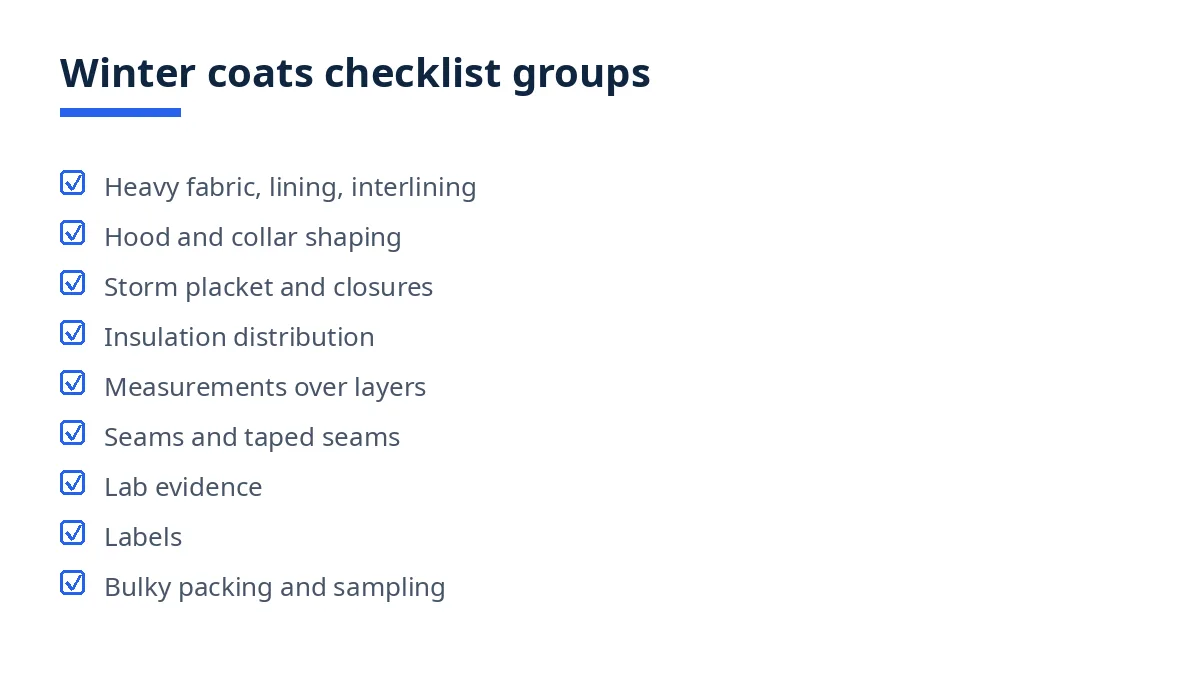
Checklist group | What to record | Decision |
|---|---|---|
Heavy fabric, lining | Sample match, coating, shade | Match or variation |
Hood and collar | Shape, depth, adjustment, shaping | Pass or correct |
Placket and closures | Width, overlap, zip, snap alignment | Pass or correct |
Insulation | Type, weight, distribution, migration | Against buyer specification |
Measurements | Chest, length, shoulder, sleeve, pockets, cuffs | Inside or outside tolerance |
Seams, taped seams | Stress points, tape bond at crossings | Pass or rework |
Lab evidence | Colorfastness, coating, spray test | Against buyer specification |
Labels, packing | Labels, barcode, packing, recovery, carton | Match list or correct |
Sampling decision | Lot, sample, defects, Ac/Re | Accept or reject |
Use the standard table values for your agreed plan. As a published example only, for a lot of 151 to 280 units at General Inspection Level II, sample size 32, acceptance and rejection 2 and 3 for major defects at AQL 2.5 and 3 and 4 for minor defects at AQL 4.0.3 AQL numbers are agreed in the purchase order, not mandated by the standard, and a pre-shipment inspection samples finished, mostly packed goods, not every piece.5
How Exportain helps
Exportain does not inspect goods itself, and its supplier checks are document and photo reviews, not factory inspections.5 Use Exportain to put the checklist into the order: post the requirement, including hood and placket construction, closure combination, insulation zones, measurement method, defect list, lab methods, packing method, and sampling plan, so suppliers reply against the same specification. Note that the Exportain inspection services category page currently renders "No services published in this category yet", so arrange inspection directly with a provider and record the booking in the purchase order.
FAQs
When should this checklist be used?
Use it at three points: on the first sample, during production when a fault can still be corrected, and on finished, packed goods before shipment.1
Who should complete it?
The buyer, the supplier, and any third-party inspector should all work from the same checklist: the supplier checks its own work, while the buyer, or an inspector working to the buyer's checklist, makes the sampling decision.5
What are the most common failures?
The most common failures here are a hood that pulls, a placket that gapes, a zip closed with snaps missing their sockets, insulation thin at shoulders or hem, a taped seam lifting at a crossing, and a coat flattened after packing. Each is listed above with its fix.
Can a third party do it?
Yes. A pre-shipment inspection is usually arranged through an independent third-party firm, and whoever books it is the firm's client and receives the report, so if you book it, the inspector works to your checklist and pass criteria.5 Give the firm the purchase order, specification, sample details, hood and placket construction, closure combination, insulation zones, measurement chart, and packing requirements.
Next steps on Exportain
Write the winter coat specification, hood and placket construction, closure combination, insulation zones, measurement method, defect list, and sampling plan into one requirement, then read the AQL guide and the pre-shipment inspection guide before you set values. Post the requirement through RFQs.
Sources
- Jacket Production Quality Checkpoints. Ginwenwear (accessed )
- Winter Menswear Sourcing: How Private Label Brands Evaluate MOQ, Lead Time & Supplier Capability?. Clothing Accessory Blog (accessed )
- AQL Meaning: Acceptance Quality Limit, Tables. Exportain (accessed )
- Water Repellency Test Of Fabric By Spray Rating Tester. TextileTuts (accessed )
- Pre-Shipment Inspection (PSI). Exportain (accessed )
About the author
Sourcing from Bangladesh?
Post a request for quotation and suppliers on Exportain can send you their quotes directly.
Post an RFQ