

Top Winter Coats Manufacturers in Bangladesh: How to Find and Verify Them
How to find and verify a winter-coat manufacturer in Bangladesh: eight checks covering construction, fabric lots, fit, sampling, registration, certificates, capacity, and commercial terms, plus price and MOQ drivers.
Short answer
To find a winter-coat manufacturer in Bangladesh, write one specification covering construction, shell, lining, insulation, sizes, colours, and packing, shortlist woven outerwear suppliers, and run eight checks on each: construction, material lots, fit, sampling, registration, certificate scope, capacity, and commercial terms. Approve a pre-production sample and agree inspection terms before paying.
On this page
Key takeaways
Winter coats are multi-layer woven garments, so judge suppliers on woven outerwear they are making now, not on catalogue claims or photographs.
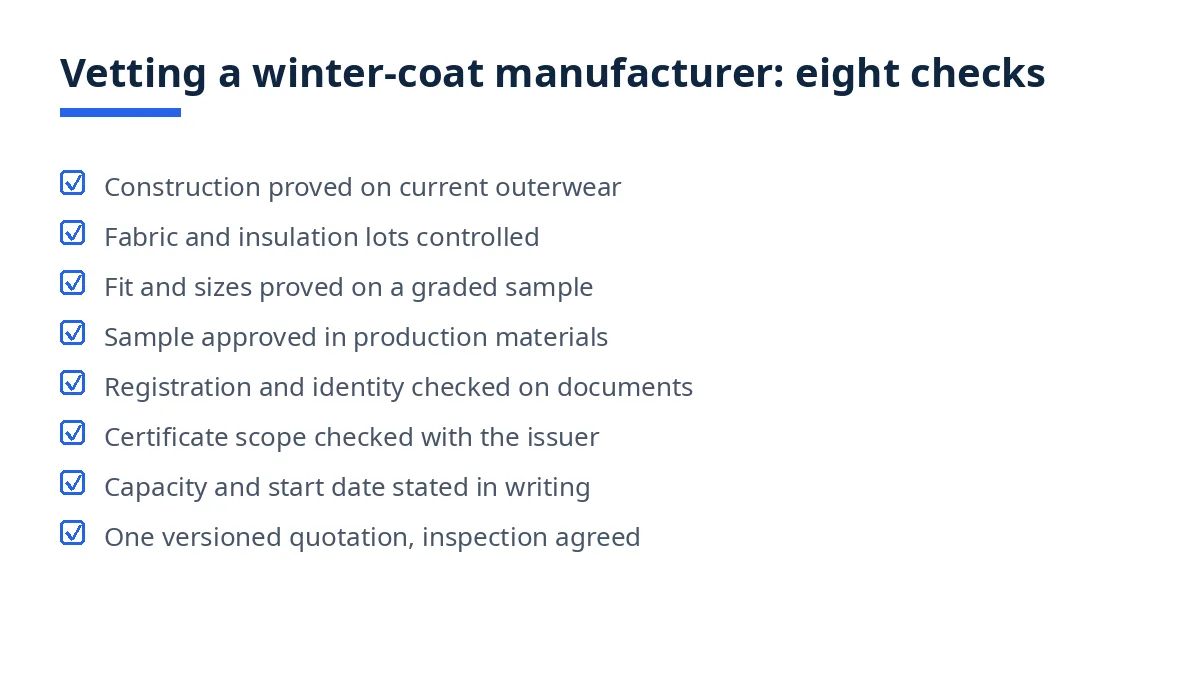
Run eight checks on each shortlisted supplier: construction, fabric and insulation lots, fit and grading, sampling, registration, certificate scope, capacity, and commercial terms.
Exportain badges record document and photo checks reviewed by the Exportain team; they are not factory inspections or quality guarantees, so check the documents yourself.
Price and MOQ are set per style, colour, and counting basis, and every figure in this article is labelled Example figures; compare quotations only on the same specification and terms.
A winter coat is a woven garment of several layers: an outer shell, a lining, insulation or padding, closures, and trims. A factory that sews shirts or knitwear well may never have controlled all of those layers at once, so finding a winter-coat manufacturer in Bangladesh means finding a specific capability, not a name on a list. Woven garments, the category winter coats fall into, earned US$4,614.80 million in the first quarter of fiscal 2026-27, within ready-made garment exports of US$10,578.56 million, according to Export Promotion Bureau (EPB) data reported by The Financial Express.1 The United States took US$2,220.86 million of Bangladesh's apparel in that quarter, the European Union took US$4,904.02 million as a bloc, and exports to the United Arab Emirates rose 18.67 per cent to US$74.34 million.1 The eight checks below separate the factories in that sector that can make your coat from the ones that can only describe one.
The list: eight checks for finding and verifying a winter-coat manufacturer
Run the eight checks below in order on each shortlisted supplier, and keep the evidence in one file per supplier. No single check is enough on its own.
1. Woven outerwear construction, proved on current work
What it is. Demonstrated ability to build a multi-layer woven coat: cutting and sewing a shell, setting a lining, fixing insulation so it stays in place, and fitting closures and pocket work that survive use.
Why it matters. Most coat failures are construction failures: lining that pulls, padding that shifts, seams that open, and closures that fail after washing. A catalogue photograph cannot show these. Only garments the factory is making now, handled and measured, show whether the construction holds.
How to check it. Ask which woven coats the supplier has in production in the current season, and ask for a physical sample of a comparable coat rather than a photograph. Check seam finishes, lining attachment, padding distribution, and closure operation on that sample, and get in writing which stages are done in the named facility and which are sent elsewhere.
2. Fabric and insulation lots kept under control
What it is. Control of the shell, lining, and insulation lots, including shade matching across the body, sleeves, hood, and pocket fabric.
Why it matters. Fabric and insulation are bought and dyed in lots. One colour is one dye lot, and a second lot can differ in shade. Insulation from a different lot can differ in loft and warmth. When lots change without a new approval, the bulk shipment can differ from the approved sample.
How to check it. Ask whether the shell, lining, and insulation for your coat are in stock or must be bought or dyed for the order, and which lot each will come from. Ask how shade is approved across all coat parts. Record the lot position in the order terms, and require a new sample approval if any lot changes after approval.
3. Pattern, fit, and size range proved on a graded sample
What it is. Evidence that the supplier can grade a coat pattern across your full size range and hold fit at each size, not only at the sample size.
Why it matters. A coat that fits at a medium can fail at the smallest and largest sizes. Fit problems found after bulk cutting are expensive to correct, because the fabric is already cut.
How to check it. Send a specification with a size chart and tolerances, and ask for the fit sample in your base size plus graded measurements for the full range. Measure it against your chart, require corrections in writing, and keep the corrected sample as the shipment reference.
4. Sampling discipline before bulk production starts
What it is. A prototype or fit sample, then a pre-production sample made from the bulk shell, lining, insulation, trims, and labels, approved in writing before cutting starts.
Why it matters. The pre-production sample is the only point where the coat exists in its final form before the full order is cut. Washing and closure checks on that sample catch faults a paper specification cannot: shrinkage, shade change, padding movement, and zip failure. Skipping it moves those discoveries to the finished shipment.
How to check it. Require the pre-production sample in the production shell, lining, and insulation, with the production trims and labels attached. Wash it, test the closures, and measure it against the size chart. Keep one sealed sample as the reference for inspection, and state in the order terms that bulk production starts only after your written sample approval.
5. Registration and identity checked on the documents themselves
What it is. Confirmation that the company quoting is a registered exporter, that its legal name and address match on every document, and that membership claims can be confirmed with the trade body.
Why it matters. A quotation, an invoice, and a certificate that name different companies cannot be relied on together, and a payment sent to an account under a different name is hard to trace. Membership claims are easy to type and easy to check: the Bangladesh Garment Manufacturers and Exporters Association (BGMEA) runs an online Membership Management System through which member factories can generate an e-certificate of membership.2 The Bangladesh Knitwear Manufacturers and Exporters Association (BKMEA) states that it represents approximately 2,540 knitwear member factories.3
How to check it. Ask for the trade licence and the ERC, and check the name and address on each against the quotation. If the supplier claims BGMEA or BKMEA membership, confirm the record with the association.2 On Exportain, the Exportain Verified and Export Verified badges record staff checks of identity, registration, and the ERC; both are document and photo reviews, not factory inspections.4 Treat a badge as a starting filter, then check the documents and the bank account name yourself.4
6. Certificate and label scope checked with the issuer
What it is. Confirmation that any certificate the supplier relies on covers the right company, site, product, and dates, and that label proofs match each sales market.
Why it matters. A certificate name on a profile is a claim, not a check. Certificates are issued for a defined scope, and a certificate for one site or product range does not cover a coat made elsewhere or a fibre it does not list. In the European Union, a textile product must be labelled or marked with the name and percentage by weight of all constituent fibres in descending order, under Regulation (EU) No 1007/2011.5 A label approved from a photograph cannot be checked word for word.
How to check it. Hold the certificate itself, check the number with the issuing body, and confirm the company, site, product category, standard, and expiry date. On Exportain, a reviewed certification shows only while approved and not past expiry, and anything only typed in is marked as declared by the seller.4 Approve each label proof word for word for each market before the label run.
7. Capacity and workload stated with dates
What it is. A dated statement of current production, your start date, the capacity your order would take, and whether any stage is subcontracted.
Why it matters. A factory that can make your coat in principle may have no line free in the weeks you need, and a supplier that quietly subcontracts cutting or sewing has handed control of quality to a facility you have not checked. Delivery promises made without a workload statement are guesses, and guesses become missed seasons for winter coats,
How to check it. Ask for the current production list, the start date for your order, the expected production window, and a written statement of every stage done outside the named facility. Record the answer with the date it was given, and tie it to the quotation version. If the workload or the subcontracting position changes, ask for the change in writing and a new start date.
8. Commercial terms settled in one versioned quotation
What it is. A single quotation version stating unit price, minimum order quantity (MOQ) and how it is counted, lead time, Incoterm and named place, payment terms, and validity date, with the inspection standard agreed before production.
Why it matters. The Incoterms 2020 rules give a clear allocation of cost, risk, and obligations across 11 rules, used globally since 1936 and updated in 2020.6
How to check it. Ask every shortlisted supplier to quote the same specification, Incoterm, named place, and packing. On Exportain, every quotation is versioned and states unit price, MOQ, lead time, Incoterm, payment terms, and validity for each version.7 Agree the inspection standard in the same document: ISO 2859-1:2026 provides sampling schemes indexed by acceptance quality limit (AQL) for lot-by-lot inspection, and AQL is the maximum percentage of defective items considered acceptable in a lot.8 Name the AQL, inspection level, and defect classifications in the order terms.
Summary table
Check | What good looks like | Evidence to file |
|---|---|---|
1. Construction | Current woven coats in production, handled sample | Sample record, facility stages in writing |
2. Fabric and insulation lots | Stock or lot position stated, shade approval agreed | Lot note, shade approval record |
3. Pattern, fit, size range | Graded measurements against your chart | Measured sample, correction list |
4. Sampling discipline | Pre-production sample in production materials, washed | Sealed sample, written approval |
5. Registration and identity | Licence, ERC, membership record, one legal name | Document copies, membership confirmation |
6. Certificate and label scope | Certificate checked with issuer, label proofs approved | Certificate, issuer check note, label proofs |
7. Capacity and workload | Dated workload, start date, subcontracting stated | Dated statement tied to quotation version |
8. Commercial terms | One versioned quotation, inspection standard agreed | Quotation version, AQL terms in writing |
What moves price and MOQ for winter coats
No single price or MOQ applies to winter coats. Shell fabric and weight, lining, insulation type and weight, size range, colour count, trims, and packing each move the quote, and each supplier counts its minimum differently: per order, per style, per colour, or per size. Ask for the counting basis in writing before comparing suppliers. All figures in this section are Example figures, used only to show the arithmetic.
Example figures: a quotation shows a unit price for 1,000 coats in one colour and a lower unit price from 2,000 coats, and ordering 1,900 coats at the first tier costs more in total than ordering 2,000 coats at the second tier, because the lower unit price applies to the whole order. Example figures: a second colour at half the quantity each can fail a per-colour minimum even when the order total passes it. Compare quotations only on the same specification, counting basis, Incoterm, and packing.
How to run the search, from specification to order
Start with one written specification before contacting any supplier, naming construction, shell fabric and weight, lining, insulation type and weight, size range, colours, trims, labels, packing, markets, quantity per style and colour, destination, and Incoterm.
Shortlist on Exportain by searching published products by keyword and category, filtering by badge, sample availability, and OEM or ODM capability, and sorting by MOQ or lead time.7 Send the identical specification to each shortlisted supplier, and ask each one the eight checks above in writing. Suppliers that answer with documents, samples, and dates stay on the list.
Compare the versioned quotations on the same fields, approve the pre-production sample, and agree the AQL inspection terms. The Harmonized System comprises more than 5,000 commodity groups, each identified by a six-digit code, used by more than 200 countries and economies for customs tariffs and trade statistics, so treat any heading as indicative and confirm the full code for the destination tariff before filing.9 Keep the specification, sample record, certificate checks, and quotation versions in one file per supplier.
What is the biggest mistake buyers make when finding winter-coat manufacturers?
Choosing by the quoted price before checking construction, lots, and sampling. A trading company quoting another factory's capacity, a knitwear factory quoting a woven coat, and a woven outerwear factory quoting its own shell and lining are three different offers. The price only means something once the construction, materials, and inspection terms behind it are the same.
How can I avoid choosing the wrong manufacturer?
Send one specification to every supplier, run the same eight checks on each, and record the evidence. Approve a washed pre-production sample in the production materials, check the documents yourself, and agree the inspection standard and commercial terms in one versioned quotation before paying. If a supplier cannot produce a document, a sample, or a date for any check, treat that check as open and do not order until it is closed.
Who is responsible for verifying a manufacturer?
The buyer owns the verification decision; the supplier must supply the documents, samples, and written answers that make it possible. Exportain staff review the documents and photos behind each trust badge, and a badge records only the checks staff have reviewed and approved.4 An inspection provider can check the finished goods, and a certificate issuer can confirm a certificate, but neither can create the specification. The buyer keeps the decision and the file that supports it.
Where can I get help finding manufacturers?
Start with the records that exist: the BGMEA and BKMEA membership systems, the certificate issuer, and an inspection provider for the pre-shipment check.2 3 On Exportain, search the supplier catalogue, read each profile's trust and verification checklist, and message suppliers through their profiles so questions and answers stay in one thread.7 The guide to how supplier verification works on Exportain sets out what each badge does and does not cover.4
Next steps on Exportain
Browse Bangladeshi suppliers, filter by badge, MOQ, and OEM or ODM capability, then run the eight checks on your shortlist before accepting any quotation. Read the guide to MOQ meaning so the counting basis on each quotation is clear before you compare prices.
Post a free RFQ on Exportain and get quotes from Bangladeshi suppliers → https://exportain.com/rfqs
Sources
- RMG exports rise 6.10pc to US$10.58b in July-Sept of FY27. The Financial Express, (accessed )
- BGMEA launches Membership Management System to provide faster and simpler services. BGMEA (accessed )
- BKMEA at a Glance. BKMEA (accessed )
- How Supplier Verification Works on Exportain. Exportain, (accessed )
- Regulation (EU) No 1007/2011 on textile fibre names and related labelling and marking of the fibre composition of textile products. European Union, (accessed )
- Incoterms® 2020. International Chamber of Commerce (ICC) (accessed )
- How to source and buy from Bangladesh. Exportain (accessed )
- ISO 2859-1:2026 — Sampling for Inspection by AQL. American National Standards Institute (ANSI) (accessed )
- What is the Harmonized System (HS)?. World Customs Organization (accessed )
About the author
Sourcing from Bangladesh?
Post a request for quotation and suppliers on Exportain can send you their quotes directly.
Post an RFQ


