

Winter Coats Price in Bangladesh: FOB Cost Breakdown for Buyers
No single winter-coat FOB price applies in Bangladesh. Read the price as cost lines in construction order, see how one coat change moves the total with example figures, and agree the term, evidence and inspection in writing.
Short answer
A winter coat FOB price from Bangladesh is the sum of the cost lines that end when the coats are loaded on board at the named port of shipment: shell cloth, insulation, lining and interlining, trims and closures, cutting and sewing, setup and testing, packing, and inland transport and port handling. No single typical figure exists. Compare quotations line by line, on one coat specification, one quantity basis and one delivery term.
On this page
Key takeaways
There is no single typical FOB price for winter coats from Bangladesh: the price is the sum of cost lines up to loading on board at the named port of shipment.
Example figures show the structure: in a 100-unit example, shell cloth is 30 units and insulation is 20 units, and raising the lining and trims lines together raises the total to 108 units.
Coat construction moves the lines: length, shell cloth, insulation, lining and interlining, and closures must match across every quotation compared.
Under FOB the buyer carries freight, insurance and import costs beyond loading, and FCA may fit container movement better than FOB.
Agree the evidence in writing before payment: an itemized quotation, a sample in production cloth, test reports and an inspection standard. A badge is a document and photo review only.
Buyers who ask for the winter coats price in Bangladesh usually receive one figure per quotation and little else. That figure hides the coat: length, shell cloth, insulation, lining, closures and size range all sit inside it. This guide reads the winter coats price in Bangladesh as a set of free on board (FOB) cost lines, and shows how a change to the coat moves the total.
Woven garment exports reached US$4.614 billion in July to September of fiscal 2026-27, up 5.11 percent year on year, within ready-made garment exports of US$10.578 billion, on Export Promotion Bureau (EPB) data reported by United News of Bangladesh.1
Winter coats price in Bangladesh: what the FOB total is made of
A winter coat is built in layers, and the FOB price follows the layers: shell cloth, insulation, lining and interlining, and trims and closures. Each layer is bought, cut and sewn on its own terms.
FOB line | What sits inside the line | What to ask |
|---|---|---|
Shell cloth | Cloth type, weight, finish, dye lot | Cloth spec, colour standard, stocked or dyed to order |
Insulation | Type and weight per size, test evidence | Insulation spec, weight by size, tests included |
Lining and interlining | Body and sleeve lining, fusible interlining | Lining cloth, interlining type, parts lined |
Trims and closures | Buttons, zips, toggles, belts, labels | Trim list, standard or custom trims |
Cutting and sewing | Marker use, seam work, pressing | Size curve, length, construction details |
Setup, testing and inspection | Samples, tests, label runs | Tests and sample rounds included, separate setup lines |
Packing | Polybags, cartons, hangers | Packing spec, pieces per carton |
Inland transport and port handling | Transport to port, handling, export documents | Named port, handling lines inside FOB |
Shell cloth often carries the greatest share, because a long coat uses a large area of cloth per piece and the cloth is bought in dye lots. A heavier cloth, a longer length or a wider range all raise the cloth used per coat. Insulation follows the same logic differently: the weight per size and its test evidence decide the warmth of the coat and the cost of proving it.
Lining and interlining are easy to overlook and costly to change late: a fully lined coat and an unlined coat are different garments for costing purposes. Cutting and sewing is where length and range show up as cloth use and labour, while setup, testing and packing are fixed lines spread over the run.
How one change to the coat moves the total
Example figures show the structure of an FOB price. They are not market prices. The example divides an example FOB unit price of 100 units across the lines in construction order.
FOB line | Example units |
|---|---|
Shell cloth | 30 |
Insulation | 20 |
Lining and interlining | 9 |
Trims and closures | 11 |
Cutting and sewing | 16 |
Setup, testing and packing | 7 |
Inland transport and port handling | 7 |
Total | 100 |
Example figures: if the lining and interlining line rises from 9 to 13 units and the trims and closures line rises from 11 to 15 units, the example total rises from 100 to 108 units. Example figures: if instead only the shell cloth line rises, from 30 to 37 units, the example total rises to 107 units. Use the same arithmetic on real quotations. Change one line at a time and check whether the difference in the totals matches the difference in the specification. A total that moves without a line moving needs an explanation before the order is confirmed. Length deserves its own check: shortening a coat saves cloth on every piece, while adding a size can change the marker and the cloth use for the whole order.
Why the breakdown matters for buyers and sellers
For the buyer, the breakdown decides how an assortment is budgeted. A programme is rarely one coat in one colour: cloth and insulation follow the size curve, trims and labels follow the colour and style count, and setup lines follow the number of distinct coats. A buyer who sees only totals cannot tell whether a longer coat, a second colour or a wider range caused a price rise.
For the seller, the breakdown fixes where its cost stops and protects the specification the price was built on. Cloth and lining are bought in lots, trims per style, and samples and setup are fixed whether the run is short or long. Changes need a new quotation version showing which lines they touch.
Reading a quotation line by line
Read a quotation in construction order, from the coat itself to the evidence for it.
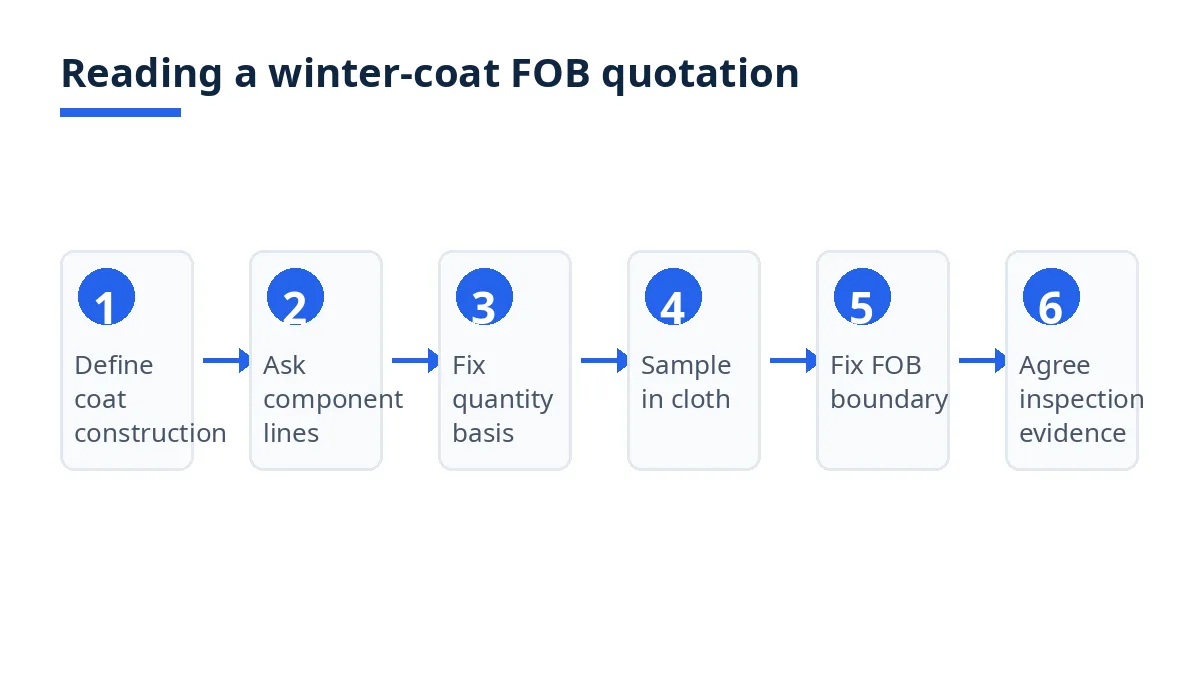
Define the coat construction first. State length, shell cloth, insulation type and weight, lining and interlining, closures, size range and packing. A photograph and a target quantity do not produce comparable lines.
Ask for component lines in construction order. Ask for each line in the table above as a separate line, each with its quantity basis.
Pin down the quantity basis per colour and size curve. Ask whether the price applies per style, per colour or to the total order, where each tier starts, and how long it stays valid.
Sample in the production cloth. Order a sample in the actual shell cloth, insulation, lining and trims that will ship. Measure it, check the fit, and approve it or list corrections in writing.
Fix the FOB boundary, port and validity in one line. State FOB, the named port of shipment, the Incoterms 2020 edition, payment terms and the expiry date.2 3
Agree inspection and evidence before production. Name the inspection standard, the sampling basis and who inspects, and list the evidence: test reports, label approvals and a sealed sample.
Costs, timelines and documents
What are the typical costs and timelines?
There is no typical FOB price or timeline for winter coats. Cloth, insulation, lining, trims, length, range, quantity, term and destination each move the figure, and sampling, lots, testing and capacity each move the timeline. Ask for a complete set of lines, a lead time by gate, and a validity date.
Ask for dates by gate: specification, sample, cloth and trims ready, production, inspection, loading. ### What sits outside the FOB price
Under FOB, the seller has fulfilled its obligation when the goods are loaded on the vessel nominated by the buyer at the named port of shipment, and the risk transfers to the buyer when the goods are on board, with the buyer bearing costs from that point forward.2 The Incoterms 2020 rules give a clear allocation of cost, risk and obligations.3 Ocean freight, marine insurance, destination charges, import clearance, duty and tax, and onward delivery sit outside the FOB unit price.
FOB should only be used for sea and inland waterway transport, and use of FOB is not recommended for container transport.2 Where coats move in containers through more than one mode, ask whether Free Carrier (FCA) fits better, and restate every quotation on the term that will be used before comparing totals.
Which documents are needed?
Three sets travel with an order: the order set (specification, itemized quotation, purchase order, sample approval), the product set (test reports, label approvals, certification evidence) and the shipment set below.
Goods shall not be loaded or stuffed in containers or ships for export unless an export declaration, the Bill of Export or Shipping Bill, is submitted to Customs and approved.4 Enclosed documents include the export contract or purchase order, the commercial invoice, the packing list, the EXP form certified by an authorized dealer, and a certificate of origin issued by the EPB or a Chamber of Commerce and Industry.4
Bangladesh-specific rules and tips
Confirm the classification by wearer and fibre. Heading 6201 covers men's or boys' overcoats, car-coats, capes, cloaks, anoraks and similar articles, other than those of heading 6203, not knitted or crocheted, split by fibre into wool or fine animal hair, cotton, man-made fibres and other textile materials.5 Heading 6202 covers the women's or girls' equivalent, other than those of heading 6204.6 A change of shell cloth after classification can change the code. Treat any heading as indicative until confirmed for the destination tariff.
Price the label work for the destination market. In the European Union, a textile product shall be labelled or marked with the name and percentage by weight of all constituent fibres in descending order, under Regulation (EU) No 1007/2011.7 The label must match the coat as made, and any change of shell cloth or lining after the label run means new labels. The same regulation addresses non-textile parts of animal origin, which matters where a coat carries a fur trim. Confirm care, origin and fibre rules for the USA, UK, EU and UAE first.
Check woven outerwear capability. A winter coat is a woven, structured garment with interlining, lining and set-in closures, and the capability to check is pattern, grading, fusing and pressing. The Bangladesh Garment Manufacturers and Exporters Association (BGMEA) states that garments with a Made in Bangladesh tag reach people in more than 150 countries, and that Bangladesh has more than 4,000 factories.8 If a supplier claims BGMEA membership, confirm it with the association. Membership signals an active garment business, not the price or capability on offer.
Allow for export clearance in the FOB handling line. The Bill of Export set takes handling time. Agree which handling lines sit inside FOB in the same quotation version as the price.4
Mistakes and red flags
Comparing a long wool-blend coat with a short polyester coat. Length, shell cloth and insulation decide most of the FOB total, so a lower total on a shorter coat in a different cloth is a different garment. Compare only replies to the same specification on the same delivery term.2 3
Accepting one total without component lines. A single unit price hides which line moved when the coat changes. Ask for itemized lines on the first quotation, and require a new version whenever the specification changes.
Ignoring the size curve and the length in the quantity basis. A price quoted for an average size does not describe a full range. Confirm the quantity basis per colour and size curve, the tier starts and the validity date in writing.
Changing the lining or interlining after the price is agreed. Lining and interlining decide structure, warmth and fusing time. Each change needs a new sample and a new quotation version.
Treating a badge or a listing as price or capacity evidence. Verification on Exportain is a document and photo review, not a factory inspection, and a badge is not a guarantee of capacity, quality or delivery.9 Price evidence is the itemized quotation, the sample and the test reports.
Cutting testing or inspection to reach a target price. Cloth and insulation tests and pre-shipment inspection catch a changed fill, a failed shell or a construction fault. ISO 2859-1:2026 defines a system of acceptance sampling plans indexed by acceptance quality limit (AQL), and AQL is the maximum average percentage of defective items considered acceptable during random sampling.10 See the quality control checklist for coat-specific checks.
Checklist
Every line should be answered in writing before you confirm.
Coat construction defined: length, shell cloth, insulation, lining, closures, size range, packing.
FOB price itemized by line, in construction order.
Quantity basis confirmed: per style, per colour or total order, with tier starts, size curve and validity dates.
Sample approved in writing in the production cloth, insulation, lining and trims.
Test evidence on file: test reports, label approvals, certification evidence where claimed.
Delivery term in full: FOB, named port of shipment, Incoterms 2020, payment terms.2 3
Costs outside FOB budgeted: freight, insurance, destination charges, import clearance, duty and tax.
Classification indicative, confirmed for the destination tariff by wearer and fibre.5 6
Destination label rules priced: fibre composition, care and origin labels.7
Export set agreed: invoice, packing list, EXP form, certificate of origin, Bill of Export.4
Inspection agreed: AQL values, level, defect classifications, inspector, rejected-lot terms.10
Changes in a new quotation version, with a new sample where the construction changed.
How Exportain helps
On Exportain, browse suppliers and post a request for quotation (RFQ) on the RFQ board with the coat construction, component lines, quantity basis per colour and delivery term. An RFQ states quantity and unit, target price, destination, Incoterm, required certifications and deadline.11 Read the badges for what they record. Exportain Verified means Exportain has checked identity, phone, email and business registration, and Export Verified means it has checked the Export Registration Certificate (ERC).9 Factory Verified means it has reviewed photos of the manufacturer factory.9 Verification is a document review by staff, free, and never granted by membership plans.9 It is not a factory inspection, so sample approval and inspection stay with the buyer. See how supplier verification works on Exportain.
FAQs
What should I know first about winter coats?
Know the coat as a set of cost lines in construction order, not as a single price. Shell cloth, insulation, lining, trims, cutting and sewing, setup, packing and handling each move the FOB price. Heading 6201 covers men's or boys' coats and heading 6202 covers women's or girls' coats, each split by fibre.5 6
What are the typical costs and timelines?
There is no typical FOB cost or timeline for winter coats. Cloth, insulation, lining, trims, length, range, quantity, term and destination each move the figure, and sampling, lots, testing and capacity each move the timeline. Example figures show structure only: an example price of 100 units rises to 108 units when the lining and trims lines rise together. Ask for a breakdown by line and a lead time by gate.
Which documents are needed?
The order documents are the specification, itemized quotation, purchase order and sample approval record. The product documents are test reports, label approvals and certification evidence where claimed. The shipment documents are the Bill of Export, invoice, packing list, EXP form and certificate of origin.4
What are the most common mistakes?
The most common mistakes are comparing coats of different length or cloth, accepting one total without component lines, ignoring the size curve, changing the lining without a new quotation version, and reading a badge as a guarantee. A badge records which document and photo checks staff have reviewed; it does not establish capacity, quality, delivery or cost lines.9
Next steps on Exportain
Browse suppliers, then post the coat construction, component lines and delivery term on the RFQ board. Before you confirm, read the MOQ guide and check each reply against the checklist above.
Sources
- Exports up over 6% to $13.1bn in Q1 of current fiscal. United News of Bangladesh (accessed )
- FOB – Free on Board (Named Place) Incoterms® 2020. Export Council of Australia, (accessed )
- Incoterms® 2020. International Chamber of Commerce (ICC) (accessed )
- Customs Clearance Procedures for Export. Bangladesh Customs, National Board of Revenue (accessed )
- Classification Detail — HS Code 6201. United Nations Statistics Division (accessed )
- Classification Detail — HS Code 6202. United Nations Statistics Division (accessed )
- Regulation (EU) No 1007/2011 on textile fibre names and related labelling and marking of the fibre composition of textile products. European Union, (accessed )
- BGMEA | Home. Bangladesh Garment Manufacturers and Exporters Association (BGMEA) (accessed )
- Trust & Safety Center. Exportain (accessed )
- ISO 2859-1:2026 - Sampling procedures for inspection by attributes — Part 1: Sampling schemes indexed by acceptance quality limit (AQL) for lot-by-lot inspection. ISO (accessed )
- How to source and buy from Bangladesh. Exportain (accessed )
- supplier verification
- quality control
- Bangladesh sourcing
- FOB pricing
- Outerwear
- Price breakdown
- Winter coats
About the author
Sourcing from Bangladesh?
Post a request for quotation and suppliers on Exportain can send you their quotes directly.
Post an RFQ


