Typical MOQ for Jute Sacks in Bangladesh (and How to Negotiate It Down)
A mill quotes 10 containers when you need 2. Learn how jute sack MOQs are counted in bales and containers, the usual minimums by grade, size and print, and six levers to negotiate a smaller first order.
Short answer
A jute sack MOQ in Bangladesh is quoted per bale or per container, not per sack, and it changes with grade, size and print. One exporter lists a 10-container minimum for standard B-Twill sacks: 300 sacks to a bale and 19,500 sacks per 20-foot container. Standard grades carry the lowest minimums; custom sizes and multi-colour prints raise them. Ask what sets the number, then trade a higher unit price, a standard grade or a repeat order for a smaller order.
On this page
Key takeaways
A jute sack MOQ is usually quoted per bale or per container, not per sack; one exporter lists 10 twenty-foot containers for standard B-Twill.
The floor comes from the loom run, the yarn batch, the bale count, the print screens and the container load.
Plain standard grades carry the lowest minimums; custom sizes, food-grade VOT batches and multi-colour prints raise them.
Take the standard grade and size, cut the print to one colour, consolidate grades into one container, commit repeat volume in writing, or pay more per sack to bring the minimum down.
A coffee roaster in Hamburg asks a Bangladeshi mill for 30,000 printed sacks. The reply comes back as a container count: ten 20-foot containers, or 195,000 sacks, nearly seven times what the roaster needs. The gap is normal, and it closes when the buyer changes the order behind the number.
This guide covers how sack minimums are counted, the usual minimums by sack type, why the mill sets them, and the levers that bring a first order down.
What a sack MOQ counts: bales, containers or pieces?
A sack minimum is rarely a round number of sacks: mills pack sacks into iron-bound bales and load bales into containers, so the minimum is usually stated in bales or containers. One Bangladeshi exporter lists its standard B-Twill sack at 300 pieces to a bale, 65 bales to a 20-foot container, and a minimum of 10 twenty-foot containers.1 At those counts, the published minimum is 195,000 sacks.
Ask the mill to state the minimum in all three units: only the bale and container counts show whether a smaller order can still fill a bale or share a container. The same exporter accepts part shipments only for orders of 5 twenty-foot containers or more.1
Bale counts differ by sack type because lighter sacks pack more to a bale: a second exporter lists B-Twill at 300 sacks per bale and 19,500 sacks per 20-foot container, light cess at 400 per bale, and rice sacking at 500 per bale and 30,000 sacks per container.2 The bale is the mill's real packing unit, so 1,000 B-Twill sacks is three and a third bales, rounded up to whole bales.
A shopping-bag order is counted piece by piece, as our jute bags MOQ guide covers. A yarn minimum is counted per count in tonnes, as our jute yarn MOQ guide sets out.
What the usual minimums look like by sack type
There is no published standard minimum for jute sacks; each mill sets its own floor per grade, size and print. The figures below are published counts, not a price list.1
Sack type | Size and sack weight | Sacks per bale | Sacks per container | What sets the minimum |
|---|---|---|---|---|
B-Twill, plain, standard stripes | 44 x 26.5 in, 1,020 g | 300 | 19,500 per 20-foot container | Loom run and bale count |
Light Cees, plain | 43 x 29 in, 1,134 g | 400 | 24,000 per 40-foot container | Heavier sack, fewer bales |
D.W.F., plain | 34.5 x 23 in, 571 g | 500 | 30,000 per 20-foot container | Small sack, high bale count |
Rice sacking, 50 kg | 94 x 57 cm, 600 g | 500 | 30,000 per 20-foot container | Light sack, more per bale |
B-Twill, one-colour print | 44 x 26.5 in, 1,020 g | 300 | 19,500 per 20-foot container | Print screens on top |
B-Twill, food-grade VOT, printed | 44 x 26.5 in, 1,020 g | 300 | 19,500 per 20-foot container | Oil batch plus print |
Bags are named by construction: B-Twill, 44 by 26.5 inches, 2.25 lb (about 1,020 grams), 6 by 8 porter and shot, for 80 to 90 kg; A-Twill, the same size at 2.62 lb with a double warp, for 100 kg; Binola at 2.0 lb; Heavy Cees, 43 by 29 inches at 2.5 lb, for 100 kg.3
Food-grade orders carry a separate floor. Under IJO Standard 98/01, sacks for coffee, cocoa or shelled nuts must use yarn prepared with food-approved vegetable oil, not mineral oil, with residue at or below 1,250 mg per kg. Those sacks are sold as vegetable-oil-treated (VOT), and a VOT order means its own oil batch.3
Print lifts the floor: each colour needs its own screen, and a screen carries a setup charge. A bulk jute supplier publishes the same ladder for jute bags: plain stock from 50 to 100 units, semi-custom with a logo print from 250 to 500, and fully custom dyed fabric from 1,000 units or more.4 A printing guide puts silkscreen at its best from 100 units up, with a one-off setup charge of SGD 30 to 60 per colour.5 Every custom step adds its own minimum.
Sacks and bags brought Bangladesh 132.3 million dollars in export earnings in the 2025-26 fiscal year, up 5.03 per cent.6
Why a mill sets the floor this high
A minimum is the quantity at which the mill stops losing money on the run: setup costs about the same for a short run as for a long one.7
The first driver is the loom run: a mill sets its sacking looms for one grade and weave, and a new grade means a new setting and a fresh cloth run.
The second driver is the batch behind the cloth. The yarn for a grade is batched and spun in lots, and a small order that needs its own batch still uses a full batch. Food-grade VOT orders add a further batch of vegetable-oil yarn.3
The third driver is packing and the container. Sacks leave in pressed, iron-bound bales of a fixed count, and a part bale is not a shippable unit, so the minimum moves in whole bales: 300 at a time for B-Twill, 500 for rice sacking.1 2 A part-filled container still pays for the container and the handling, so mills set minimums that fill them: 65 bales of B-Twill per 20-foot container.1
The fourth driver is the print: a printed sack needs a screen for each colour, made before the run starts. A one-colour print adds one screen; a three-colour print adds three.5
The fifth driver is commercial. A mill quotes the volume that makes the run pay at the quoted price, and a buyer who changes the run can move the number.7
Six levers that bring a sack MOQ down
The number falls when the run behind it changes. Work through the levers one at a time, and put each agreed point in writing.
1. Take the standard grade in the standard size
Start with the grade the mill already weaves. Standard B-Twill at 44 by 26.5 inches and 1,020 grams, with the mill's usual three blue stripes, needs no new loom setting, cutting layout or batch. A custom size or sack weight means a run of its own, and the minimum rises with it.3 7
2. Cut the print to one colour, or drop it
Print is the fastest way to raise a sack minimum, and the fastest way to lower it. One colour needs one screen; three colours need three, and each screen carries a setup charge.5 Ask for a one-colour print of your mark, or take the mill's standard stripes with no print at all.5
3. Consolidate grades into one container
If you need two grades, ask whether the mill will count them toward one container load: two grades that together fill a container give the mill the same loaded volume. Factories often accept a combined minimum across products, and the same logic applies to two sack grades.7
4. Commit the volume and split the shipment
Put a larger total in writing and take it in parts: agree the full quantity for twelve months and ship two containers now. One exporter accepts part shipments for orders of 5 twenty-foot containers or more.1 The factory counts the total committed volume, not just the first shipment.7
5. Pay more per sack, and pay earlier
Payment terms are a trade, not a concession. A mill that waits for payment carries the cost of the cloth, the print and the bales until the money arrives, and a high minimum limits that exposure. Offer a larger advance, or full payment before production, for a smaller first quantity: you rarely get both a low minimum and the lowest price, because the factory needs a minimum revenue per production run.7 A small premium per sack on a small first order costs far less than holding 195,000 sacks you do not need.
6. Ask for stock sacks or a shared run
Plain sacks the mill already holds need no loom setting and no new batch, so their minimum is far lower. Ask what the mill is weaving next: if a run of your grade is already scheduled, your sacks can join it with little extra setup.7 The trade is timing: your sacks ship when the main run ships.
The diagram below sets out the negotiation in five steps.
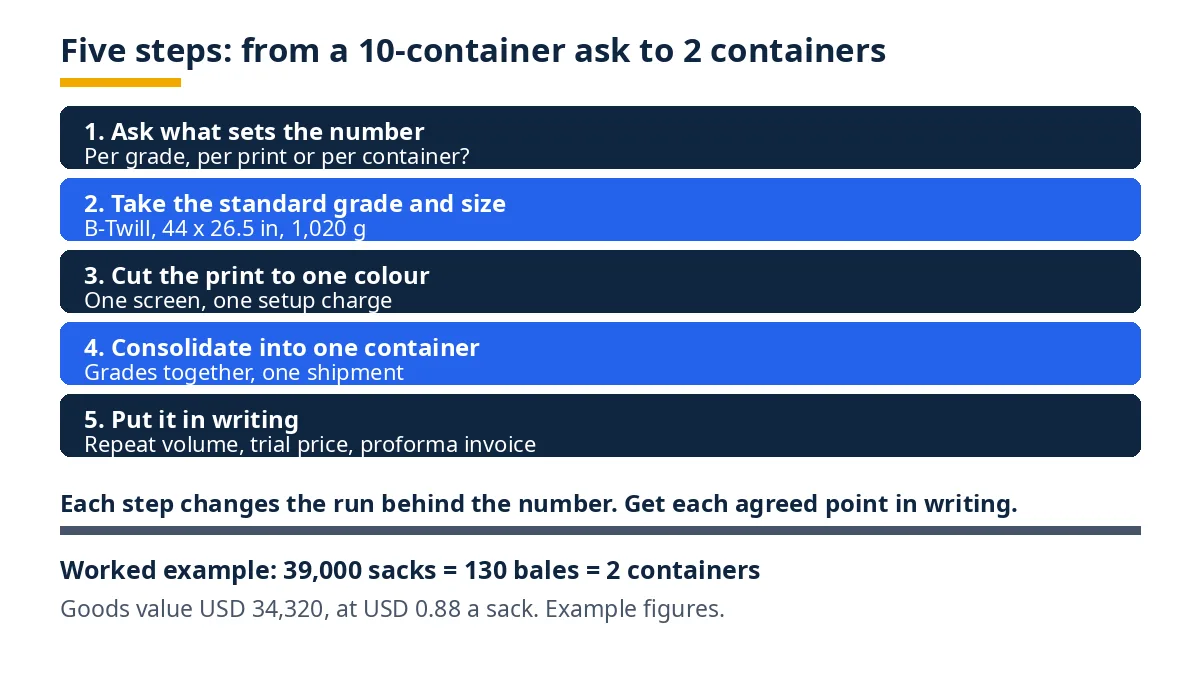
Worked example: a 10-container ask down to 2 containers
Example figures. A coffee roaster in Hamburg needs printed B-Twill sacks. The mill quotes a minimum of 10 twenty-foot containers at 0.82 dollars a sack; the roaster needs 39,000 sacks, or 2 containers, and wants the rest only if the season sells through.
The mill says the floor comes from a fresh loom run for the printed grade, with three print colours. The roaster cuts the print to one colour, takes the standard B-Twill sack, and commits in writing to 8 further containers over twelve months at the standard price. The mill agrees to ship 2 containers now at 0.88 dollars a sack.
Line | Original ask | Agreed first order |
|---|---|---|
Quantity | 195,000 sacks, 10 containers | 39,000 sacks, 2 containers |
Unit price | 0.82 dollars a sack | 0.88 dollars a sack, a one-colour trial price |
Goods value | 159,900 dollars | 34,320 dollars |
Three colours | One colour | |
Cash committed now | 159,900 dollars | 34,320 dollars |
Repeat commitment | None stated | 8 containers within 12 months at 0.82 dollars a sack |
The first order is 39,000 sacks at 0.88 dollars, which is 34,320 dollars. The premium is 0.06 dollars a sack, about 7 per cent above 0.82 dollars. The cash the roaster does not commit now is 159,900 dollars minus 34,320 dollars, which is 125,580 dollars. The repeat order is 8 containers, which is 156,000 sacks at 0.82 dollars, which is 127,920 dollars. The full 10-container program then costs 34,320 dollars plus 127,920 dollars, which is 162,240 dollars, against 159,900 dollars for the original ask: 2,340 dollars for the flexibility.
Those terms go into the proforma invoice: 2 containers now, 0.88 dollars a sack for the trial, and 8 containers at 0.82 dollars if the season sells. The roaster pays a 50 per cent advance and confirms the repeat within 30 days.
Mistakes that push the minimum back up
Asking for a sack count when the mill sells by the bale: 1,000 B-Twill sacks is three and a third bales.
Splitting one order across three print designs: each design needs its own screens.
Paying in full before the sample is approved: approve the sample sack first, then pay.
What to write into the order
Once the lower minimum is agreed, lock it in. The order should name the grade, size, sack weight and fill, the print colours and position, the bale count and sacks per bale, and the price for the first order and the repeat. Put those terms in the proforma invoice and the purchase order. For a food-grade order, name the IJO 98/01 certificate for the lot.3 State the tolerance in writing: one exporter allows plus or minus 5 per cent in quantity and weight.1 Name the test methods for fabric and seam strength, and check the results against the values you wrote into it, with our jute sacks quality control checklist as the reference. Put the HS code on the invoice and check it with your broker; sacking bags sit under heading 6305.10, as our HS code guide for jute sacks sets out.3 Hold one approved sample sack back, sealed, and judge the bulk lot against it.
Next steps on Exportain
Begin by finding the maker with our jute sacks manufacturers guide, then fix the inspection points with our jute sacks quality control checklist and confirm the heading in our HS code guide for jute sacks. Once the specification is set, search Bangladeshi suppliers and post an RFQ with the grade, bale count and print.
Sources
- STD. B-TWILL Jute Bag. Quaderi Jute (accessed )
- Jute Sacks/ Bags. BACK (accessed )
- Jute Bags & Hessian Cloth Supplier — HS 6305.10. Commbril (accessed )
- The Jute Bag Maker: Bulk Jute Bags in Hyderabad Guide. The Jute Bag Maker (accessed )
- Jute Bag Printing Singapore: Silkscreen, Heat Transfer & UV. Aquaholic (accessed )
- Jute exports rise 37 per cent as Bangladesh plans to double earnings by 2031. The Financial Express, (accessed )
- How to Lower MOQ When Sourcing from China: 10 Proven Tactics from a Sourcing Agent (2026). SinoSourceAgent (accessed )
About the author
Sourcing from Bangladesh?
Post a request for quotation and suppliers on Exportain can send you their quotes directly.
Post an RFQ