CIF vs DPU: Key Differences, Costs and Which One to Choose
CIF ends at your port with minimum insurance inside the price; DPU runs to your warehouse and unloads the goods, with no policy promised. A worked leather-handbag example from Chattogram to Hamburg prices both terms at $15,956 and shows how to choose.
Short answer
Under CIF, the seller pays sea freight and buys Clause (C) insurance to your named port, while risk moves to you on loading at Chattogram. Under DPU, the seller carries goods and risk to your named place and unloads them there, with no insurance duty. Both leave import clearance, duty and taxes with you. Choose CIF for a port delivery with a named policy, and DPU when you want goods set down at your warehouse.
On this page
Key takeaways
Under CIF the seller pays sea freight and buys minimum Clause (C) insurance to your named port, but the risk moves to you on loading at Chattogram.
Under DPU the seller carries goods and risk to your named place and unloads them there; no rule obliges either side to insure.
Import clearance, duty, taxes and onward carriage past the named place stay with you under both rules; DPU is not duty-paid.
On the same shipment the totals match: $15,956 under both terms in the worked example, because only the payer changes.
A buyer in Hamburg asks a Dhaka supplier for one container of leather handbags on two terms: "CIF Hamburg" and "DPU buyer warehouse, Hamburg". The DPU seller price comes back $710 higher, and that gap is not a freight difference: it is the terminal handling, the road leg and the unloading that one price carries and the other leaves out, plus the insurance only one rule makes the seller buy.
The short answer: a port price against a delivered-and-unloaded price
Incoterms 2020, published by the International Chamber of Commerce and in force since 1 January 2020, holds eleven rules that split delivery, cost and risk between seller and buyer.1 CIF and DPU sit at opposite ends of that set.
Under DPU, short for Delivered at Place Unloaded, the seller books and funds the carriage to the place you named, keeps the risk for the whole journey, and unloads the goods before the risk moves to you.2 Under CIF (Cost, Insurance and Freight), the seller puts the goods on board at Chattogram, pays the ocean freight to your named port, and buys a marine policy for your benefit, while the risk moves to you at loading, before the vessel reaches Hamburg.3 4 DPU is the single rule that makes the seller unload; under the other ten, unloading at destination is your job unless the contract says otherwise.2 3
Three contrasts decide most choices: CIF ends at a port and DPU at a place; CIF splits cost from risk while DPU keeps them together; and the border is yours under both rules. Only DDP shifts import clearance and duty to the seller.3 Our eleven-rule Incoterms table sets out all eleven rules in one place.
Where each rule ends: port, place, and the unloading step
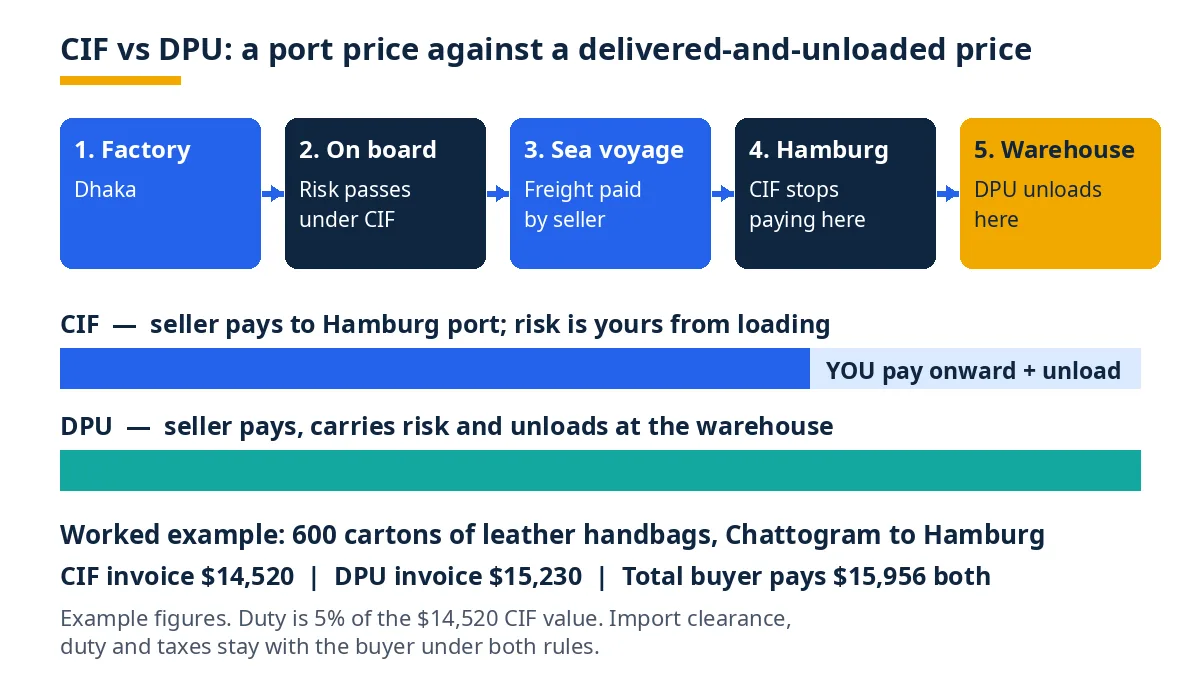
The delivery point is the hinge. Under CIF, delivery happens on board at Chattogram: the seller's duty ends the moment the handbags cross the ship's rail, though it keeps paying freight and insurance to Hamburg.3 Under DPU, delivery happens only when the goods have been taken off the arriving vehicle and set down.2
Question | CIF | DPU |
|---|---|---|
Transport modes | Sea and inland waterway | Any mode, or a mix of modes |
Delivery happens when | Goods go on board at Chattogram | Goods come off the vehicle |
Risk moves to you | At loading in Chattogram | Once unloading is done |
Seller pays carriage to | Named destination port | Named place at destination |
Cargo insurance | Seller buys Clause (C) minimum | Neither side must insure |
Unloading at destination | You | Seller |
Import clearance, duty, carriage past the named place | You | You |
DPU ends at the named place, not at your warehouse shelf: if the named place is a terminal, the final move from there is yours, so name the place with its full address, never a city alone.
CIF works only for sea and inland waterway transport, so it cannot describe an air leg, a road leg, or a sea-air combination.3 DPU works for any mode, alone or combined, so it fits a container that travels by sea to Hamburg and then by truck to your warehouse.2
The diagram below traces that split from Chattogram to Hamburg.
Before signing DPU, satisfy yourself that the seller can unload where you named it: it must arrange the labour or equipment and carry the cost and the risk of that step.2 A seller with no people, kit or contacts at a place it has never worked cannot deliver what it promised.
Insurance: the policy CIF promises and the cover DPU leaves open
Under CIF, the seller must arrange cover that meets Institute Cargo Clauses (C), the minimum level, for no less than 110 percent of the contract price, in the currency of the contract, running from the loading port to at least the named port.4 The seller takes out the policy, yet the claim sits with you.
Clause (C) names a small set of perils and pays only for those: fire, explosion, stranding, grounding, sinking, capsizing, collision, discharge at a port of distress, general average and jettison.5 It pays nothing for water entering the container, theft, packages dropped in loading or unloading, or earthquake and lightning.5 If the handbags need broader cover, agree Institute Cargo Clauses (A) in the contract and settle who pays the extra premium.4
Under DPU, the rules ask neither side to insure: the seller normally takes out cover at its own expense, since it holds the transit risk, though nothing in the rule compels it. When the cargo merits protection, put the cover in the contract in plain terms: which clause set, what sum insured, and who funds the premium.
Cover also has a time limit: it ends at the latest 60 days after discharge from the overseas vessel.5
Who pays what from Chattogram to Hamburg
A CIF quotation starts at the factory gate in Dhaka and stops at the Hamburg quay, holding the goods, the packing, the road to Chattogram, the export clearance, the sea freight and the minimum premium. Past the quay, every line is yours: terminal charges, clearance, duty and taxes, and the truck to your warehouse.4
A DPU quotation runs further: the same goods, packing, road, clearance and sea freight, then on through the Hamburg terminal, along the road to the named place, and through the unloading. The seller books and funds those legs and holds the risk while the goods are on them; clearance, duty, taxes and any carriage past the named place stay with you.2 3
Cost line | CIF Hamburg | DPU Hamburg warehouse |
|---|---|---|
Goods, packing, road, export clearance | Seller | Seller |
Ocean freight to Hamburg | Seller | Seller |
Minimum marine insurance | Seller | Seller's own cover, if any |
Terminal handling at Hamburg | Buyer | Seller |
Road carriage to the warehouse | Buyer | Seller |
Unloading at the warehouse | Buyer | Seller |
Clearance and broker fees | Buyer | Buyer |
Duty and taxes at import | Buyer | Buyer |
Under CIF, the carriage contract decides whether unloading and quay charges sit inside the seller's freight price, so settle that in writing before sailing.4 The DPU quotation reads higher for the same goods, because it carries the handling, the road leg and the unloading that the CIF price leaves out. Our CFR vs DPU guide prices the same question from the freight-only side.
Worked example: leather handbags from Dhaka to Hamburg
Example figures. A buyer in Germany orders 600 cartons of leather handbags from a supplier in Dhaka, goods worth $12,000, shipped in one 40-foot container from Chattogram to Hamburg, then by road to the buyer's warehouse, with duty at a sample 5 percent of the CIF value.
Cost line | Under CIF | Under DPU |
|---|---|---|
Goods, packing, road to Chattogram, export clearance | $12,000 | $12,000 |
Ocean freight, Chattogram to Hamburg | $2,400 (seller) | $2,400 (seller) |
Minimum marine insurance | $120 (seller) | $120 (seller) |
Terminal handling at Hamburg | $280 (buyer) | $280 (seller) |
Road carriage, Hamburg port to warehouse | $320 (buyer) | $320 (seller) |
Unloading at the warehouse | $110 (buyer) | $110 (seller) |
Import duty, 5% of the $14,520 CIF value | $726 (buyer) | $726 (buyer) |
Total the buyer pays | $15,956 | $15,956 |
Both columns land on $15,956: every leg appears once in each column, and only the payer moves. Under CIF the seller's invoice is $14,520 and you pay the other $1,436; under DPU it is $15,230 and you pay only the duty.
The CIF value is $14,520, so 5 percent duty is $726, and the minimum sum insured is 110 percent of the $12,000 contract price, or $13,200.4 5 With the totals equal, the choice turns on who carries the voyage risk and who unloads the truck.
Documents: what each term puts in your hands
Under CIF, the seller hands you three papers: the commercial invoice, the insurance policy or certificate, and the on-board bill of lading, without which you cannot take delivery, clear customs, or claim on the policy.4 Ask for the policy before loading.
Under DPU, the transport document covers the carriage to the named place, and the signed handover after unloading is your proof of delivery; the seller still issues the invoice and the packing list. If you pay by letter of credit, confirm with your bank which transport document it will accept.4
The papers from the Bangladesh side stay the same under both rules: invoice, packing list, bill of lading and certificate of origin, plus the EXP form, the export declaration the authorised dealer bank certifies, and the Bill of Export, the exporter's declaration to Customs.6 Cross-check every paper so the names, goods, quantities and amounts match.6 Our CIF vs DAP guide covers the same question with the goods still on the truck.
Choosing between CIF and DPU: five checks
Work through these checks in order, stopping at the first that settles the case.
How does the cargo move. If any leg runs by air or road, or the journey combines modes, CIF cannot describe it, so DPU is the open rule; if the cargo goes straight onto the vessel in bulk or break-bulk, CIF stays open.3
Where should the seller's job end. If you want the goods set down at your warehouse, choose DPU: it is the only rule that makes the seller unload. If a port delivery suits you and you have your own crew, CIF will do.2
Can the seller unload where you named. A DPU promise is only as good as the seller's reach at destination: with no local team, kit or contacts at your warehouse, choose DAP or CIF.2
Who should hold the insurance. If you want a named policy inside the price, choose CIF, and check the clause level before sailing; if you already hold an annual marine policy, DPU lets you use it.4
Can you act as the importer of record. Both rules leave import clearance, duty and taxes with you, so have your broker and duty budget ready before sailing; if you cannot clear import at all, ask for DDP instead.3
For a first order from a new supplier, DPU fits a buyer with no forwarder of its own: one seller price covers carriage, handling and unloading. For a regular importer with a forwarder and an insurer, CIF gives you control of the sailing and a policy to claim on.
FAQs
Is DPU always more expensive than CIF?
Not on the same shipment. The DPU seller price is higher because it runs to your warehouse and includes the unloading, but the total is the same: $15,956 under both terms; the difference is who arranges each step and who bears the risk.
Does CIF insurance cover the road leg?
No. The seller must arrange cover from the loading port to the named port at least, at Clause (C) minimum level, for no less than 110 percent of the contract price; the truck leg to your warehouse falls outside that cover unless the policy is widened in writing.4 5
Does CIF fit a container handed to a terminal?
CIF names an on-board moment, so it fits cargo loaded straight onto the vessel. For a container handed to a carrier at a terminal days before sailing, the handover does not match the delivery point CIF names, so DPU or another any-mode rule fits better.3
Next steps on Exportain
Price the same order both ways, and ask each seller to break out the handling, road and unloading lines in writing. Search Bangladeshi suppliers for a CIF quotation and a DPU quotation on identical goods to the same named place, then post an RFQ naming the rule, the place, the insurance clause and the edition. Feed the result into your landed-cost worksheet before signing.
Sources
- Incoterms® rules. International Chamber of Commerce (ICC) (accessed )
- DAP & DPU Incoterms 2020 explained: Key differences. ICC Academy, (accessed )
- Incoterms 2020 Explained: Complete Guide (2026 Update). Inecta (accessed )
- What Is CIF? Insurance and Risk. Voltim Global, (accessed )
- Cargo Insurance: Institute Cargo Clauses A, B and C Compared, 110% Cover and CIF vs CIP. TriplicateDocs, (accessed )
- The papers that move trade. Open Trade Bangladesh (accessed )
About the author
Sourcing from Bangladesh?
Post a request for quotation and suppliers on Exportain can send you their quotes directly.
Post an RFQ