CFR vs DPU: Key Differences, Costs and Which One to Choose
CFR vs DPU for buyers importing from Bangladesh: who pays the freight and the destination handling, where risk passes, who unloads, and which term fits your order, with a worked example pricing one container of home textiles to Manchester.
Short answer
CFR and DPU both make the seller pay the ocean freight, but they part after that. Under CFR the seller delivers on board at Chattogram, risk passes to you there, and you pay the destination handling, onward carriage, unloading, insurance, clearance and duty. Under DPU the seller carries the goods and the risk to your named place, unloads them, and you pay only the clearance and duty. DPU suits a first order; CFR suits a regular importer with a forwarder.
On this page
Key takeaways
Under CFR risk passes to you on board at Chattogram while the seller still pays the freight; under DPU the seller carries the risk until the goods are unloaded at your named place.
The seller pays the ocean freight under both rules, so compare the landed total to your warehouse, not the seller's invoice.
Neither rule obliges the seller to insure: under CFR you buy cover from loading, and under DPU the seller usually insures its own stretch.
Import clearance, duty and taxes stay with you under both rules; DPU is not duty-paid.
If you hold a CFR quotation and a DPU quotation for the same order from Bangladesh, the DPU figure will look much higher. It should. Under CFR the seller pays the ocean freight to your port and hands the risk to you the moment the goods go on board at Chattogram. Under DPU the seller keeps the goods, the risk and the bill to your warehouse, then unloads them.
For a first-time buyer, DPU is the safer pick: one seller price, no freight or unloading to arrange. For a regular importer with a forwarder and an insurer, CFR gives you control of the sailing.
The verdict in one table
Question | CFR (Cost and Freight) | DPU (Delivered at Place Unloaded) |
|---|---|---|
Transport modes | Sea and inland waterway only | Any mode, alone or combined |
Seller delivers when | On board at the port of shipment | Unloaded at the named place |
Risk passes to you | On board the vessel at Chattogram | After unloading at the named place |
Ocean freight | Seller | Seller |
Destination terminal handling | You | Seller |
Unloading at the destination | You | Seller, the only rule that requires it |
Cargo insurance | You insure | Seller usually insures |
Import clearance and duty | You | You |
The seller pays the freight under both rules, which is what makes the pair easy to confuse.1
What CFR means in practice
CFR stands for Cost and Freight. The seller clears the goods for export, loads them on board at the port of shipment, and pays the ocean freight to the named port of destination. Delivery happens, and risk passes to you, when the goods are on board at the origin port.1 That split defines the rule: the seller pays for a voyage it no longer carries the risk of, so any loss or damage at sea from loading on is yours, and your insurance pays for it.2
CFR belongs to the four rules written for sea and inland waterway transport only.2 It suits bulk and break-bulk cargo loaded straight onto a vessel. For a container the fit is weaker, because a box is usually handed to the carrier at a terminal days before the vessel sails.3 Our Incoterms guide for shipments from Bangladesh places CFR among the other ten rules. Write the term in full: "CFR Felixstowe, Incoterms 2020".3
What DPU means in practice
DPU stands for Delivered at Place Unloaded. The seller arranges and pays the carriage to the named place, completes export formalities, and delivers the goods unloaded from the arriving vehicle and placed at your disposal.4 Risk passes to you only after the unloading is done. Under DPU alone, the seller must unload the goods, and the rule works for any mode of transport.1
The rule is the renamed form of DAT, Delivered at Terminal, from Incoterms 2010.4 The difference from DAP is a single step: under DAP the seller delivers the goods on the arriving vehicle, ready for unloading, and you unload them; under DPU the seller unloads them.4
Before you agree DPU, check that the seller can unload at the place you name: the carrier must take the goods off the arriving vehicle and set them down safely, which can mean extra labour, a forklift and a pallet jack.4 A seller with no local agent, equipment or access at a destination it does not know cannot carry out the delivery it promised.4 Name the place with its full address: "DPU Manchester" fixes no delivery point.
Key differences: cost, risk and responsibility
The cost split
Both rules put the ocean freight on the seller. What decides the choice is everything after the vessel berths: under CFR you pay the destination handling, the onward carriage, the unloading, the clearance and the duty; under DPU the seller pays the handling, the onward carriage and the unloading, and you pay only the clearance, the duty and any carriage past the named place.1 Under CFR, whether destination handling sits inside the seller's freight price depends on the freight booked; if it is not included, the destination agent can invoice it again before releasing the bill of lading.5
The risk point
Risk is where the two rules stand furthest apart. Under CFR, risk passes to you on board the vessel at Chattogram, while the seller keeps paying freight to your port. If the container is lost or damaged at sea, the loss is yours, and you claim on your own policy.2 Under DPU, the seller bears all risks until the goods have been delivered unloaded at the named place.4 A buyer on CFR without insurance in place from loading carries the full value of the order with no policy to claim under.
Insurance: neither rule obliges the seller to insure
Only CIF and CIP oblige the seller to buy cargo insurance for the buyer. Under both CFR and DPU, no rule requires either side to insure: the party carrying the risk arranges its own cover.1 Under CFR you carry the risk from loading, so you buy cover from loading to your warehouse. Under DPU the seller carries the risk to the named place, so it usually insures the transit at its own cost, but the rule does not require a policy, so write the cover into the contract.4 Our CFR vs CIF guide shows what seller-bought minimum cover looks like, our CFR vs CIP guide compares the other rule where the seller must insure, and our CIF guide explains the Clause C minimum in full.
Customs: the same split under both rules
You keep import clearance, duty and taxes under both rules. DPU is not a duty-paid term: the seller clears the goods for export, and you complete the import formalities and pay the duty and the tax.4 The rule that moves import clearance and duty to the seller is DDP, not DPU. Name a place where your broker can clear the goods fast, and agree in writing who shows the documents and who pays storage if clearance drags. If you fail to clear the goods, you bear the risk from the agreed date for delivery, even though the goods have not yet been unloaded.4 The duty is the same under both rules; confirm the customs value basis with your broker first.
Worked example: home textiles from Chattogram to a warehouse in Manchester
Example figures. A buyer in the United Kingdom orders bed linen sets worth $11,000 from a supplier in Chattogram, shipped in one 40-foot container to Felixstowe, then by road to the buyer's warehouse in Manchester.
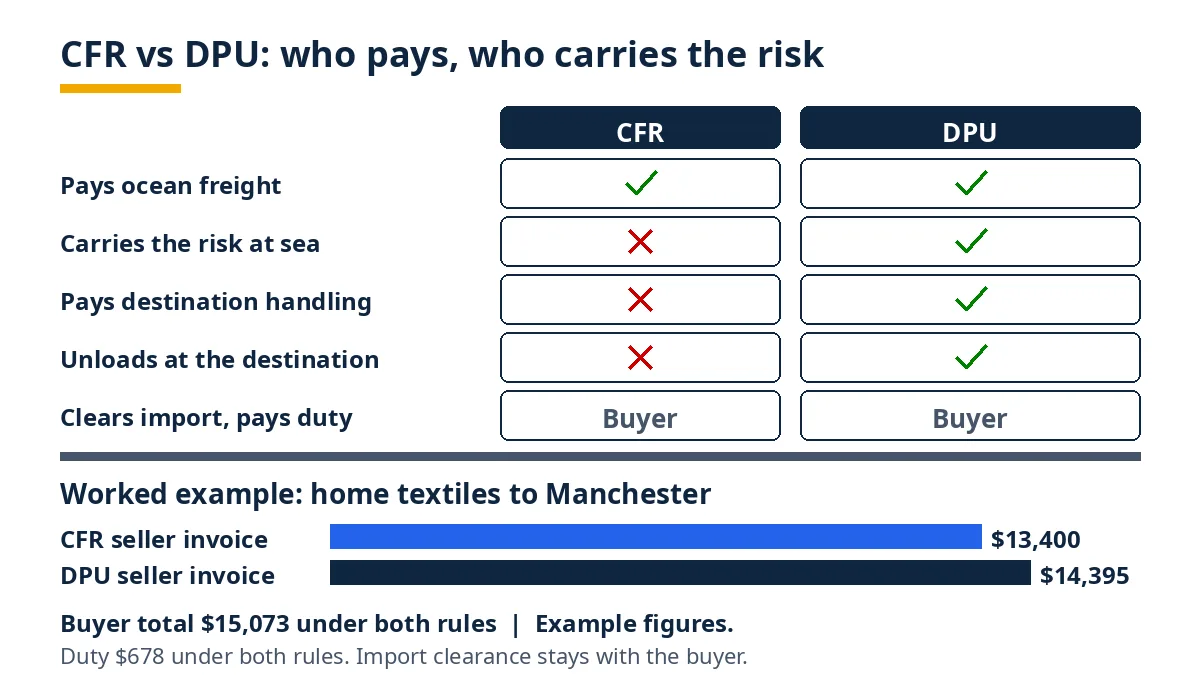
Cost line | Under CFR | Under DPU |
|---|---|---|
Goods, export clearance | $11,000, in the CFR price | $11,000, in the DPU price |
Ocean freight to Felixstowe | $2,400, paid by the seller | $2,400, paid by the seller |
Seller price | $13,400 | $14,395 |
Cargo insurance | $165, paid by the buyer | $165, paid by the seller |
Destination handling, Felixstowe | $310, paid by the buyer | $310, paid by the seller |
Road carriage to Manchester | $380, paid by the buyer | $380, paid by the seller |
Unloading at the warehouse | $140, paid by the buyer | $140, paid by the seller |
Import duty, 5% of $13,565 CIF value | $678, paid by the buyer | $678, paid by the buyer |
Total the buyer pays | $15,073 | $15,073 |
Check it. Under CFR: 11,000 plus 2,400 is 13,400, the seller price. The CIF value is 11,000 plus 2,400 plus 165, which is 13,565, and 5% of 13,565 is 678.25, shown as $678. The buyer pays 165 plus 310 plus 380 plus 140, which is 995, plus duty of 678: 13,400 plus 1,673 is 15,073. Under DPU: 11,000 plus 2,400 plus 165 plus 310 plus 380 plus 140 is 14,395, and the buyer pays only the duty: 14,395 plus 678 is 15,073.
Both columns land on $15,073. The DPU invoice reads $995 more, because the insurance, the handling, the road carriage and the unloading sit inside the seller's price. The split is in who arranges each step and who bears the risk.
When to choose CFR, and when to choose DPU
CFR fits a buyer that imports often, already works with a forwarder and an insurer, and wants to pick the carrier and the sailing. It suits bulk and break-bulk cargo, and a buyer that groups orders from several suppliers onto one freight account.3 It also suits a buyer whose payment needs an on-board bill of lading, since CFR works best with a letter of credit.2 Our FOB vs DPU guide covers the neighbouring choice.
DPU fits a buyer with no forwarder, no unloading crew and no freight set-up at the destination. It suits a first order or a small importer that wants one seller price to a named place, with the goods set down on arrival. Import clearance and duty are still yours, so DPU is not hands-free, but the voyage, the handling and the unloading move to the seller. Three checks settle most cases: can the seller unload where you named; can you clear import there without delay; and does the DPU quotation split out each element.
Bangladesh-specific considerations
The Bangladesh side is the same under both rules, and it needs the same papers: invoice, packing list, bill of lading and certificate of origin.6 Bangladesh adds its own: the EXP form is the export declaration, certified by the authorised dealer bank, and the Bill of Export is the exporter's declaration to Customs, after which the goods can be shipped out.6 Check that the names, goods, quantities and amounts agree across every paper.6
Two points bite harder under one rule than the other. First, containers are usually handed to the carrier at a yard or terminal in Bangladesh well before loading, so the on-board moment CFR names does not match the handover that actually happened; ask your forwarder whether an any-mode rule such as CPT fits it better.2 Second, a Bangladeshi seller agreeing DPU needs a workable route to your destination: a forwarder with an agent at your port, a carrier for the onward leg, and labour or equipment to unload at the named place. Test the route before you sign.
FAQs
Which is cheaper, CFR or DPU?
Neither. The worked example lands on the same $15,073 total under both rules, because every cost appears in each column and only the payer changes.
Which is safer for first-time importers?
DPU is the safer pick for a first order: the seller carries the risk and arranges the carriage, the handling and the unloading, and you deal only with import clearance and duty. CFR is safe only with cargo insurance from loading and a forwarder at the destination port.
Can the terms switch after the purchase order?
Yes, but only by agreement in writing before the goods ship, and the price must change with the term: a switch from CFR to DPU means the seller takes on the insurance, the handling, the onward carriage and the unloading, so the seller's price rises by those lines. A switch after loading is harder, because risk has already passed to you under CFR. Record the new term, place and price in an amendment, and tell your insurer and broker the same day.
Which do Bangladeshi suppliers prefer?
Most Bangladeshi suppliers prefer CFR, because it ends their responsibility on board at Chattogram while letting them use their own freight relationships.3 DPU asks the seller to manage carriage, handling and unloading in a country it may not know.
Next steps on Exportain
Price your own order both ways, then search Bangladeshi suppliers and compare a CFR quotation against a DPU quotation for the same goods and the same named place. Post an RFQ that states the rule, the place, the point and the edition, and see how to buy for the steps once you have ordered.
Sources
- Incoterms® 2020 explained: who pays and where risk passes. Globalisation (accessed )
- Incoterms 2026: Meaning, Chart & List Of Incoterms. Freightos, (accessed )
- CFR Incoterms Guide: Understanding Costs and Freight Risks. FreightAmigo, (accessed )
- DPU Delivered at Place Unloaded [Updated 2025] | Incoterms. Trade Finance Global (accessed )
- Incoterms 2020: Complete Guide for Importers and Exporters. InstantFreight (accessed )
- The papers that move trade. Open Trade Bangladesh (accessed )
About the author
Sourcing from Bangladesh?
Post a request for quotation and suppliers on Exportain can send you their quotes directly.
Post an RFQ