Private Label Jute Yarn Manufacturing in Bangladesh: A Brand Owner's Guide
A brand owner's route to private-label jute yarn from Bangladesh: write the specification, approve a sample cone, lock the labels, and inspect the first lot — with a worked 5,000 kg example, costs, documents and Bangladesh export rules.
Short answer
To source private-label jute yarn from Bangladesh, write a specification with the count, ply, colour, put-up and quality values, shortlist spinning mills from the BJMA member list, approve a sample cone in writing, lock the specification and labels, and inspect the first lot against the sealed cone. Agree the HS code, Incoterm, payment term and validity date in the order, and confirm the supplier's ERC before you pay.
On this page
Key takeaways
Write the specification with numbers — count, ply, twist, colour, put-up and packing — before you ask any mill for a price.
Approve a sample cone in writing and keep it sealed as the reference the bulk yarn is judged against.
Lock the specification, label artwork and carton marks before production starts; label errors after winding are rework on every cone.
Confirm the supplier's ERC is current, agree the HS code, Incoterm, payment term and validity date in the order, and inspect the first lot.
A private-label jute yarn order puts your brand on a product another company spins: you write the specification, approve the sample cone, and the mill spins, winds, labels and packs the yarn to it.
This guide is for buyers in the USA, the UK, the EU and the UAE. In 2025-26 Bangladesh exported 428,000 tonnes of jute yarn worth $545.8 million, up 18.18 per cent.1
Why private label changes what you are buying
With stock yarn you accept the mill's count and put-up. With private label you define the product, so the mill quotes against your specification instead of its catalogue.
You get a yarn your competitors cannot buy off the same shelf. But the risk moves to you: a vague specification gets filled with the mill's defaults.
How a private-label order works, step by step
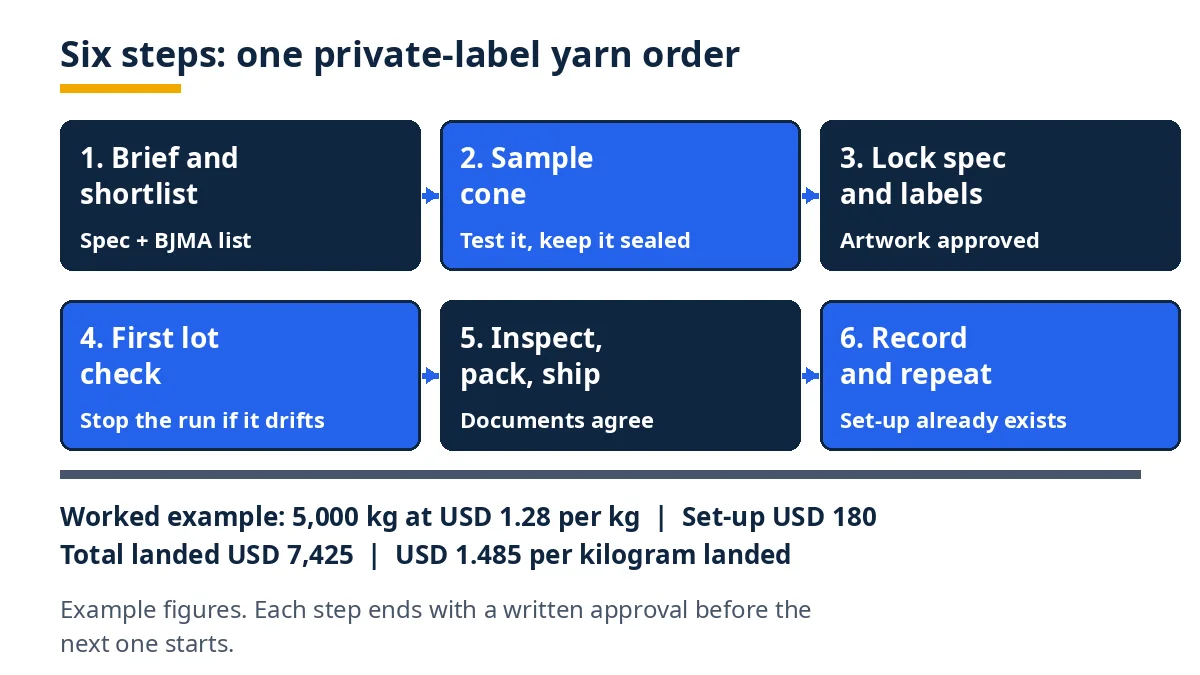
A private-label yarn order runs in six steps, each ending with a written approval before the next one starts.
Step 1: Write the brief and shortlist the mills
Write the brief before you ask for prices: count, ply, end use, colour, put-up, quantity, delivery term and destination. Send the same brief to every mill, and start the shortlist with the BJMA member list, which gives mill locations and spindle counts.2 The list is partly dated, so confirm each mill is still running.2
Step 2: Get a sample cone and test it
Ask each shortlisted mill for a sample cone spun to your count, ply and put-up, with the twist and lot number on the label. Test it for count, twist, strength and evenness, with the method named for each test, and keep the approved cone sealed as the reference.
Step 3: Lock the specification, the labels and the packing
Once the sample cone passes, write the locked specification: count, ply, twist per metre, colour, cone weight, cones per carton, pallet or bale, and the label and carton wording for each destination. Approve the label artwork and carton mark in writing, with the version and date.
Step 4: Approve the production run and watch the first lot
Agree the production window, lot size and inspection points before spinning starts, and ask the mill to hold the first lot for your check. Compare bulk cones against the sealed sample cone, and stop the run if the first lot drifts.
Step 5: Inspect, pack and ship
Agree the final inspection before the yarn is packed: count and twist checks, cone weight, colour across cones, winding faults and carton counts.
Step 6: Record the order and plan the repeat
File the locked specification, the sample cone record, the lab reports, the inspection notes and the shipment papers together. A repeat order reuses the label artwork and set-up work, so it costs less to start.
The specification, the labels and the classification
Count, ply and twist
Jute yarn is quoted by weight per length, in lb per spyndle. State whether the yarn is single or plied: a single yarn is one strand, a plied yarn twists two or more singles together, and the two take different six-digit HS subheadings.3 State the twist per metre and the quality values, with the test method named for each one. State the colour or finish with the count: natural, bleached or dyed.
HS classification
Jute yarn sits under heading 5307, yarn of jute or of other textile bast fibres. Single yarn takes subheading 5307.10 and multiple (folded) or cabled yarn takes 5307.20, and the first six digits follow the WCO international standard and stay the same in every country.3 The final digits are the national subdivision, so confirm the code against your destination country's tariff schedule and use the agreed code on every document.3
Destination labelling rules
For consumers in the EU, Regulation (EU) No 1007/2011 sets the labelling rules. Fibre composition must use only the fibre names in the regulation's Annex I, and products of several fibres must be labelled with the name and percentage by weight of all constituent fibres in descending order.4 The terms "100%", "pure" or "all" are limited to single-fibre products, and the label must be durable, legible, visible and accessible, in the official language of the country where the product is sold.4
Costs, timelines and documents
A private-label quotation has more lines than a stock one: ask each mill to break out the yarn price, set-up, testing, packing, freight and insurance, and to state the validity date.
Cost line | What to ask for |
|---|---|
Yarn price | Per kilogram, at your count and quantity |
Set-up | Dyed lot, labels, cartons, one line |
Testing | Lab tests, method named |
Freight and insurance | Named port, carrier, cover |
Delivery terms
Write the delivery rule in full, with the named place and the edition, for example "FCA Chattogram, Incoterms 2020". Incoterms 2020 are the ICC's 11 rules that set who pays carriage, who insures, and where risk passes from seller to buyer.5
Under FOB the buyer takes the risk once the goods are on board and pays the freight and insurance; under CIF the seller pays freight and minimum insurance to the destination port, but risk still passes on board at origin.5 For containers, use FCA, CPT or CIP instead of the sea-only terms.5
Payment terms and timelines
Agree the payment term in the order, with the bank and the documents named. A letter of credit pays against the documents it asks for; advance payment means you pay before shipment; open account means the seller ships first.
Allow two to four weeks for the brief and sample cone, one to two weeks for testing and the locked specification, and three to six weeks for bulk production, plus sea freight.
Worked example: 5,000 kg of branded yarn for carpet backing
Example figures. A brand owner orders 5,000 kg of single jute yarn at 8 lb per spyndle, natural colour, on cones, for carpet backing, with its own cone labels and printed cartons. All figures below are illustrative, not market prices.
Line | Calculation | Amount |
|---|---|---|
Yarn | 5,000 kg × USD 1.28 per kg | USD 6,400 |
Set-up | Labels and cartons, one-off | USD 180 |
Lab testing | Count, twist, strength | USD 120 |
Freight | Chattogram to Felixstowe | USD 640 |
Insurance | Cargo cover | USD 85 |
Total landed | 6,400 + 180 + 120 + 640 + 85 | USD 7,425 |
The total is USD 7,425, or USD 1.485 per kilogram landed. Yarn is about 86 per cent of the landed cost, so a USD 0.05 per kilogram move shifts the total by USD 250.
Bangladesh rules and tips
The export file in Bangladesh
Every export from Bangladesh needs an Export Registration Certificate (ERC) from the Chief Controller of Imports and Exports, an EXP form declared through an authorised dealer bank, and a customs Bill of Export.6 The exporter files the EXP form electronically in Bangladesh Bank's Online Export Monitoring System (OEMS), and gives the bank a signed hard copy with the certified Bill of Export within 14 days of shipment.6
Full export proceeds must normally be repatriated within four months of shipment.6 Confirm the supplier's ERC is current and its company name matches the quotation and the invoice.
A rule that helps jute buyers
Raw jute and jute goods may be exported on terms of up to 360 days against irrevocable confirmed letters of credit or under the open account rules, longer than the standard four months.6 Confirm the term with the mill and its bank, and write it into the purchase order.
The market behind your order
The Export Promotion Bureau has proposed a 2026-27 export target of $1.017 billion for jute and jute goods, with jute yarn and twine projected to contribute $620 million.7
Mistakes and red flags
The first mistake is approving a photo instead of a physical sample cone.
The second mistake is ordering by price per tonne without naming the count.
The third mistake is leaving the labels until the end.
The fourth mistake is taking a mill's full count list at face value. Ask for the production record of the last three runs of your count.
Red flags: a mill that cannot name its frames or spindle count, a quotation with no validity date, a lab report with no test methods, a supplier that will not say whether it spins the yarn or buys it in, and a price that bundles freight without naming the carrier or port.
Your private-label checklist
The brief states the count, ply, end use, colour, put-up, quantity, delivery term and destination.
The shortlist comes from the BJMA member list.
A sample cone to your count, ply and put-up has been tested, with methods named, and kept sealed as the reference.
The specification, label artwork, carton marks and packing are locked in writing, with versions and dates.
The HS code is agreed and matches on every document.
The Incoterm, payment term and validity date are in the order.
The mill's ERC is current and its name matches the quotation and invoice.
Final inspection is agreed before packing.
How Exportain helps
Exportain is a marketplace where you can find Bangladeshi suppliers and send them an RFQ with your brief attached. Read our guide to how supplier verification works on Exportain before you shortlist: badges record which documents and photos staff reviewed, and verification is a document review, not a factory inspection or a guarantee.
Exportain is not a party to your trade, does not inspect goods, book freight or clear customs, and holds money only when both parties agree to a funds hold. Also read our MOQ guide and our guide to jute yarn manufacturers in Bangladesh.
Frequently asked questions
What should I know first about private-label jute yarn?
Private label means the mill spins, winds, labels and packs yarn to your specification alone, and your brand is on the cone label and the carton. Write the specification with numbers: count, ply, twist, colour, cone weight and packing. Approve a sample cone in writing before the bulk run starts.
What do private-label jute yarn orders typically cost, and how long do they take?
No guide can set a price for your yarn, because each mill prices your exact count, ply, colour, quantity and delivery term. Ask each mill to break out the yarn price, set-up, testing, packing, freight and insurance, and to state the validity date. A first order typically takes two to four weeks for the brief and sample, one to two for testing and the locked specification, and three to six for bulk production, plus freight.
What documents do I need for a private-label jute yarn order?
On your side, the brief, the locked specification, the sample cone record and the purchase order. On the Bangladesh side, the supplier's ERC, the EXP form, the Bill of Export, the commercial invoice, packing list, bill of lading, certificate of origin and the lab reports with test methods named.
What are the most common mistakes in private-label jute yarn?
Approving a photo instead of a physical sample cone, ordering by price without naming the count, leaving the labels until the yarn is already wound, and taking a mill's full count list at face value. Avoid them by writing the specification first, testing the sample cone, and locking the labels before production.
Next steps on Exportain
Write the brief: count, ply, end use, colour, put-up, quantity, delivery term and destination. Then browse suppliers on Exportain or send an RFQ with it, and ask whether the mill spins the yarn itself, which counts it spun last month, and its set-up charge and validity date.
Sources
- Jute exports rise 37 per cent as Bangladesh plans to double earnings by 2031. The Financial Express, (accessed )
- List of BJMA Member Mills. Bangladesh Jute Mills Association (accessed )
- HS Code 5307.20.00: Jute Yarn & Twine Tariff & Duty. Zenivic (accessed )
- Textile products: textile fibre names and labelling. EUR-Lex, (accessed )
- Incoterms 2020 Explained: All 11 Rules, Chart & Meaning. Xflowpay (accessed )
- Export Law Bangladesh 2026: Critical Rules for Exporters. TRW (accessed )
- EPB charts $66b export roadmap for FY27. The Financial Express (accessed )
About the author
Sourcing from Bangladesh?
Post a request for quotation and suppliers on Exportain can send you their quotes directly.
Post an RFQ