CFR vs DDP: Key Differences, Costs and Which One to Choose
CFR stops at your port and leaves import clearance, duty and insurance with you; DDP carries the shipment to your door with duty paid. A worked cotton T-shirt example from Chattogram to New Jersey prices both terms at $23,352 and shows how to choose.
Short answer
CFR leaves you as the importer of record: the seller pays ocean freight to your named port, risk passes on board at Chattogram, and you arrange insurance, import clearance, duty and delivery to your warehouse. DDP moves all of that to the seller, who delivers the goods to your named place cleared for import with duty paid. Choose CFR if you import with a broker; DDP if you want one door price and the seller can prove its import route.
On this page
Key takeaways
Under CFR the seller pays ocean freight to your named port, risk passes on board at Chattogram, and you clear import, pay duty and arrange insurance.
Under DDP the seller clears import and pays duty, and it is the only rule that makes the seller the importer of record — check its import route before you accept it.
On the same shipment the totals match: $23,352 under both terms in the worked example, because only the payer changes.
Neither rule obliges anyone to buy cargo insurance; under CFR insure from loading, under DDP write the seller's cover into the contract.
A "CFR New York" quotation and a "DDP New Jersey" one can cover the same cartons of cotton T-shirts from Bangladesh, and leave you with two very different jobs. Under CFR the seller pays the ocean freight to your port, and you take over: insurance, import clearance, duty and the road leg home. Under DDP the seller carries the shipment to your door, cleared for import with the duty paid. The cheaper headline price usually leaves more work with you.1 2
The short answer: port price or door price
CFR and DDP sit at opposite ends of the seller's obligation. CFR is a sea-only rule: the seller delivers the goods on board at Chattogram and pays the freight to your named port, and the risk passes to you at loading. DDP is an any-mode rule: the seller delivers the goods to your named place, cleared for import with duty and taxes paid, carrying the risk until that point. Of the eleven rules, DDP alone makes the seller clear the goods for import and pay the duty.1 3
Question | CFR | DDP |
|---|---|---|
Seller pays freight to | Named port | Named place |
Delivery | Goods loaded on board at Chattogram | Goods arrive at your warehouse |
Risk passes to you | On board at Chattogram | At your warehouse |
Cargo insurance | You arrange cover | Seller |
Import clearance and duty | You | Seller |
Importer of record | You | Seller |
What CFR means in practice
Under CFR the seller prepares and packs the goods, clears them for export, carries them to Chattogram, loads them on board, and pays the ocean freight to the port you named. The seller also gives you the bill of lading, which proves the goods are on board and lets you claim them.4
Your job starts the moment the cartons are on board, even though the vessel is still in Bangladesh and the freight is already paid. From that point the risk is yours, so settle your own cargo insurance first, running from loading at Chattogram to your warehouse. CFR obliges neither party to insure, but an uninsured buyer carries the full value of the goods plus the freight already spent.4 At your port, you pay for unloading, handling, import clearance, duty and taxes, and onward carriage to your warehouse. You are the importer of record: your name sits on the declaration and you answer for the classification, the declared value and the duty due. In a VAT country a registered buyer can reclaim the import VAT.3 CFR only works by sea: it fits bulk cargo loaded directly onto a vessel at Chattogram, not air freight.2 4
What DDP means in practice
Under DDP the seller takes the shipment the whole way: export clearance, carriage to your named place, import clearance, duty and taxes, and delivery to your warehouse on the arriving vehicle, ready for unloading. Unloading stays with you unless the contract says otherwise. DDP places the maximum obligation on the seller of any Incoterms rule, and it is the only rule that names the seller as the importer of record.2 5
Check that obligation first. In the United States, forwarders may not complete customs clearance on the seller's behalf, so the supplier must be registered as an importer. In the European Union, the declarant must generally be established in the customs territory, so a Bangladeshi seller with no EU establishment usually needs a representative there.5 3 Tax adds a second check: a seller that pays import VAT in your country usually cannot reclaim it, because it holds no VAT registration there, so the tax becomes a cost inside the DDP price. Ask for the DDP price broken into its parts, because a lump sum hides whether the duty was calculated on the right value and whether a margin was added for the seller's risk.5
The cost split, line by line
Under CFR you pay everything from the destination port onward. Under DDP the seller pays everything to your door.
Cost line | CFR | DDP |
|---|---|---|
Goods, packing, export clearance | Seller | Seller |
Ocean freight to destination port | Seller | Seller |
Cargo insurance | Buyer | Seller |
Unloading and handling | Buyer | Buyer, unless included in freight |
Import clearance and broker fees | Buyer | Seller |
Import duty, VAT or sales tax | Buyer | Seller, where it can pay it |
Onward carriage | Buyer | Seller |
Two lines deserve a second look. First, insurance: neither rule obliges anyone to buy a cargo policy — only CIF and CIP require the seller to insure. Under CFR insure from loading; under DDP the seller usually insures at its own cost, but write the cover into the contract.2 Second, duty: in many countries it is charged on a customs value built from goods, freight and insurance — the CIF value — while the United States generally uses transaction value. Ask your broker to confirm the basis, and check the HS code first, because the code fixes the duty rate.3
Where the risk sits
Under CFR the risk passes early and the cost runs late. You bear the risk from the moment the cartons are on board at Chattogram, while the seller keeps paying the freight to your port. If the vessel is delayed or the container is damaged, the loss is yours to claim — against your own insurer if you bought cover, or against the carrier's capped liability if you did not.2 4
Under DDP the risk sits with the seller until the truck reaches your warehouse, and if the goods are damaged in transit, the seller bears the loss. But DDP moves a different risk onto the seller: the border. If the declaration is wrong or the seller cannot act as importer of record, the goods can sit at the border while demurrage and storage build up. The importer of record owns the classification and the declared value, and a wrong declaration can produce a demand long after delivery. Under DDP that demand comes to the seller — which is why a seller quoting DDP without a working import route is a warning sign, not a bargain.5 3
Worked example: cotton T-shirts from Chattogram to New Jersey
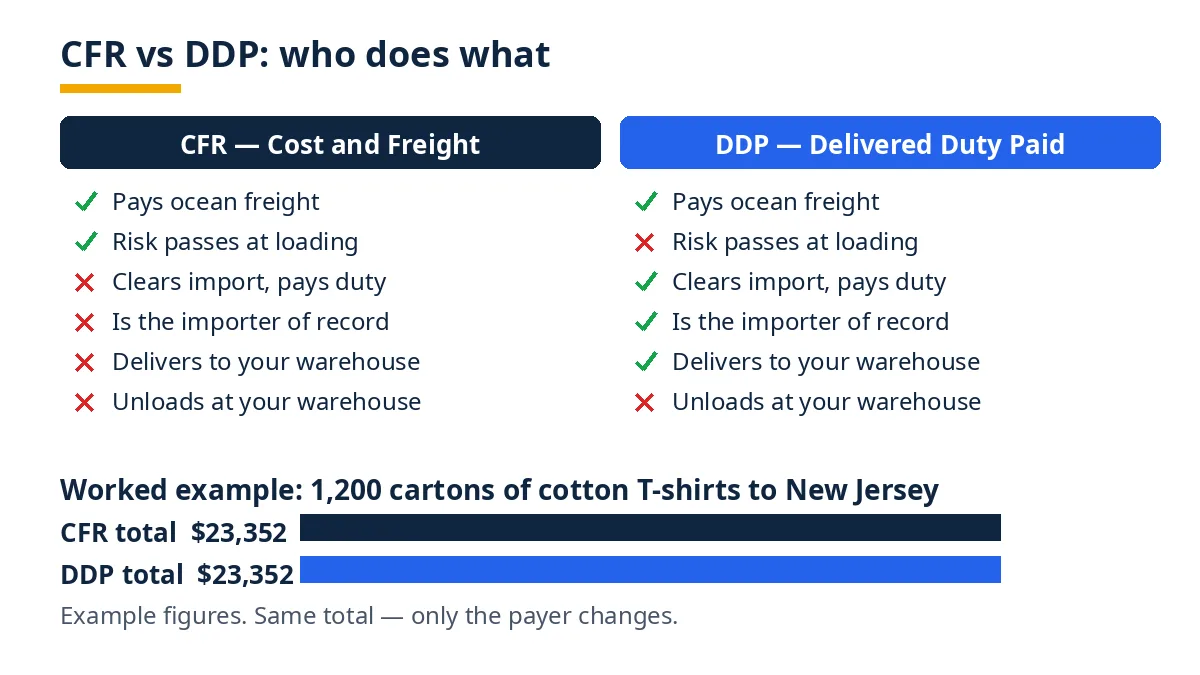
Example figures. A buyer in the United States orders 1,200 cartons of cotton T-shirts from a supplier in Chattogram, goods worth $18,000: CFR New York, or DDP at the buyer's warehouse in New Jersey, at an illustrative 10% duty rate on the CIF value.
The diagram below shows the same split as a two-column chart.
Cost line | Under CFR | Under DDP |
|---|---|---|
Goods, packing, export clearance | $18,000 | $18,000 |
Ocean freight to New York | $2,600 | $2,600 |
Cargo insurance | $220, buyer | $220, seller |
Duty, 10% of $20,820 CIF value | $2,082, buyer | $2,082, seller |
Broker fees and delivery | $450, buyer | $450, seller |
Total the buyer pays | $23,352 | $23,352 |
Both columns land on $23,352: every cost appears in each; only the payer changes. Under CFR the seller's invoice is $20,600 — goods plus freight — and you pay the other $2,752: 20,600 + 220 + 2,082 + 450 = 23,352. Under DDP the seller's invoice is the full $23,352.
The duty line uses a CIF value of $20,820 at 10%, giving $2,082. Both rates are example rates only. The totals match, so the decision is not about arithmetic: it is about who can act as importer of record, whether the DDP price adds a margin for the seller's risk, and how much your own time is worth.
Which term fits which buyer
Choose CFR when you import regularly, hold a forwarder and a customs broker, and want the freight rate visible and the sailing under your control. It fits a buyer that consolidates orders from several suppliers onto one freight account, a buyer that holds an open cargo policy, and a buyer whose payment method needs an on-board bill of lading.2 4
Choose DDP when you buy now and then, have no import registration or broker, and want one price that carries the goods to your door. It suits a first order from a new supplier, a small order where arranging freight yourself costs more time than it saves, and a buyer whose supplier already runs a working import route.5 Never choose DDP from a seller that cannot show you its import route. Ask for the broker's name, the registration the seller will file under, and a copy of a recent entry. If the seller has none of those, take DAP instead: the seller still carries the goods to your door, but you clear import and pay the duty.5 3
Bangladesh notes: checking a Chattogram supplier
Most Bangladeshi suppliers quote CFR and FOB far more often than DDP, because DDP asks them to work in a customs system they do not operate. Test the offer: ask whether the supplier has shipped DDP into your country before, who its broker is there, and how the duty was calculated on the last shipment. A supplier that answers with names and figures is a different proposition from one that answers with a lump-sum price.
On the Bangladesh side, the export file is the same under both terms: the seller clears the goods for export, and the invoice, packing list, bill of lading and certificate of origin it produces feed your import declaration at destination. Bangladesh customs practice shows why those papers matter: an import declaration there must be supported by those four documents and filed within 15 days of the transport documents being lodged. Ask for them before the goods leave Chattogram.6
Write the term in full — "CFR New York, Incoterms 2020" — and agree in writing who insures the voyage and who unloads, because neither rule settles those points on its own.1 2
FAQs
Which is cheaper, CFR or DDP?
Neither. On the same shipment the total is the same: the same goods, freight, insurance, duty and delivery have to be paid by someone. CFR shows the lower seller price because it stops at your port; DDP shows the higher one because it runs to your door with the duty inside it. Price each to your warehouse.
Which is safer for a first-time importer?
DDP is safer for the goods, because the seller carries the risk and the border work to your door — but only where the seller can actually perform the import. If it cannot show a working import route into your country, CFR with a broker you appoint is safer, because you control the entry.5 3
Can the terms switch after the purchase order?
Yes, if both sides agree in writing before the goods ship. CFR to DDP means the seller takes on the import work and reprices the order; DDP to CFR means you take it back and arrange your own broker, insurance and duty payment. Agree the new price, named place and insurance position in the same amendment, and tell your bank if the sale is paid by letter of credit.
Which term do Bangladeshi suppliers prefer?
Most suppliers prefer CFR, because it ends their obligation at the load port and leaves the import work with you. DDP asks a supplier to file an import declaration and pay duty where it may have no registration, broker or tax number, and many will decline or price that risk into the quotation. A supplier that offers DDP readily, with a broker and a broken-out price, usually ships into your market often.5 3
Next steps on Exportain
Read the Incoterms guide for shipments from Bangladesh, then CIF (Cost, Insurance and Freight) for the insured version of CFR, or FOB vs DDP for the same duty question from the load port. When you are ready, browse Bangladeshi suppliers and send an RFQ naming the rule, the place and the edition.
Sources
- Incoterms 2020 app | ICC Knowledge 2 Go. International Chamber of Commerce (accessed )
- Incoterms 2026: Meaning, Chart & List Of Incoterms. Freightos, (accessed )
- Incoterms and tax: who pays import VAT under each rule. Quaderno (accessed )
- CFR Incoterms 2026: Cost & Freight Explained. Drip Capital, (accessed )
- DDP Shipping, Incoterms & Calculator. Freightos, (accessed )
- Commercial Import Process. Bangladesh Trade Portal (accessed )
About the author
Sourcing from Bangladesh?
Post a request for quotation and suppliers on Exportain can send you their quotes directly.
Post an RFQ