Custom Jute Yarn Manufacturer in Bangladesh: OEM Process From Tech Pack to Bulk
A custom jute yarn order runs from tech pack to bulk in six steps: write the count, ply, twist and put-up; shortlist mills that spin your count; compare quotes; approve a sample cone; run the bulk lot; then inspect, pack and ship.
Short answer
A custom jute yarn order runs from a written tech pack to bulk production in six steps: write the count, ply, twist and put-up; shortlist mills that spin your count; compare quotes; approve a sample cone in writing; run the bulk lot; then inspect, pack and ship against the approved cone.
On this page
Key takeaways
Write the tech pack first: count in lb per spyndle and tex, ply, twist, colour and put-up, with test methods and tolerances named.
Shortlist mills from the BJMA list and ask each one the same four questions about frame, twist, last runs and lab reports.
Approve a sample cone in writing before bulk production starts, and keep it sealed as the reference for the lot.
Agree the ISO 2859-1 inspection level and AQL values before production, and check the EXP form, Bill of Export and shipping documents before the container is sealed.
A custom jute yarn order starts with a specification, not a catalogue. You send a mill the count, ply, twist, colour and put-up you need, the mill sets its batch and spinning line for that count, spins a sample cone for your approval, and then runs the bulk lot against the approved cone.
The Export Promotion Bureau has proposed a 2026-27 target of 1.017 billion dollars for jute and jute goods, with jute yarn and twine at 620 million dollars.1
Why an OEM yarn order is different from buying stock yarn
Stock yarn is yarn the mill already spins. An OEM order is yarn spun to your order, with the batch and frames set for your count. The sequence runs batching, carding, drawing, spinning and winding, and the batch is chosen for the count: a hessian warp batch at 8.25 lb per spyndle blends Tossa-C 60 per cent, White-X 30 per cent and Places-C 10 per cent, while a sacking warp batch at 10.25 lb blends hard jute 60 per cent with soft jute 40 per cent.2
A mill cannot quote a firm price or date from a one-line enquiry: until it knows those five values, it does not know which batch to mix.
The six steps from tech pack to bulk
The process runs in order, and each step closes before the next starts.
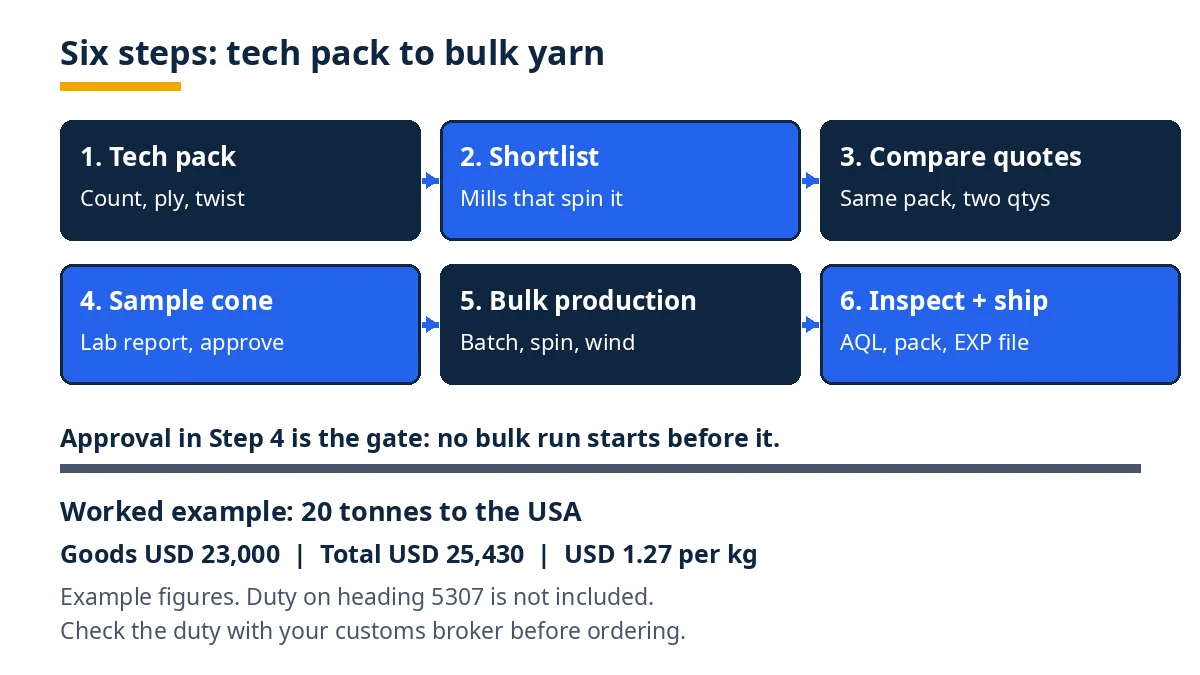
Step 1: Write the tech pack — count, ply, twist and put-up
The tech pack is one document carrying every value the mill needs.
State the count in both units: lb per spyndle (pounds per 14,400 yards) and tex (grams per 1,000 metres). Tex equals the lb per spyndle count multiplied by 34.45.3 7 lb per spyndle is 241 tex (7 x 34.45 = 241.15); 5 lb per spyndle is 173 tex (5 x 34.45 = 172.25).
State whether the yarn is single or plied: one strand, or two or more strands twisted together. The two sit under different six-digit HS subheadings: single yarn under 5307.10 and multiple or folded yarn under 5307.20.4 The split is set out in our HS code guide for jute yarn.
Then add twist per metre, fibre grade, colour, put-up, cone weight, end use, test values with methods named, and the count tolerance.
Step 2: Shortlist mills that spin your count
Start with the membership lists: the Bangladesh Jute Mills Association publishes a list of member mills with mill locations and spindle counts.5 The list is partly dated, so use it as a directory to check against.
Ask each mill the same four questions: which frame spins your count, what twist per metre it sets, what the last three runs achieved, and what the lab reports show. A mill that runs spindles can name the frame type and spindle count; a trader will skip the line. Check the mill's trade licence and export registration, with the same name, address and bank account on each, and read our guide to how supplier checks work on Exportain before you enquire. Keep three mills shortlisted until the sample cones come back, and ask how many tonnes of your count each mill spins in a normal month.
Step 3: Compare quotes and settle the price drivers
Ask every shortlisted mill for a written quote on the same pack, quantity and delivery term, priced at two quantities. Read our guide to minimum order quantities before you set the quantity: the minimum for a custom count is set by the batch size and the frame change.
Price driver | What to ask for |
|---|---|
Fibre grade and blend | Grades and percentages in the batch |
Count and ply | Price at your count, single and plied |
Put-up and packing | Cone weight, cones per carton |
No guide can set a price for custom jute yarn: each mill prices your exact order against its own fibre stock and frame bookings.
Step 4: Sample cone, lab report and written approval
The sample cone is the reference for the whole order, spun to your count, ply and put-up. Ask for two cones from each shortlisted mill, labelled with count, ply, twist, lot number and date; test one, keep one sealed.
Check the count first, weighing a fixed length and converting it with the 34.45 factor from Step 1, then check twist, evenness, thick and thin places, neps, colour and winding faults. Ask for the lab report with the method, lab and date named: numbers without methods cannot be compared.
Approve the cone in writing, naming the tech pack version and the count, ply, twist and put-up, and keep it sealed and separate from the lot. Do not release bulk production until that approval is sent.
Step 5: Bulk production and in-line checks
Bulk production follows the same sequence as the sample: batching and softening, carding, drawing, spinning and winding.2 The batch is mixed once for the lot, so a change of fibre grade halfway through is a change of yarn.
Ask the mill for cones from the start, middle and end of the run. Count drift is the fault to watch: a mill that starts at 7 lb per spyndle and drifts to 7.4 lb is spinning a heavier yarn. The cone-level checks are covered in our quality control checklist for jute yarn.
Step 6: Final inspection, packing and the export file
Final inspection confirms the lot matches the approved specification. For a bulk lot, that check is done on a sample drawn from the whole lot, using the AQL method: the acceptable quality limit defined in ISO 2859-1, which sets how many units to inspect and how many defective units are allowed before rejection.6 General Inspection Level II is the default.6
Lot size in cones | Code letter, Level II | Cones inspected | Major defects, AQL 2.5 |
|---|---|---|---|
3,201 to 10,000 | L | 200 | Accept 10, reject 11 |
A 4,000-cone lot at Level II takes code L: 200 cones inspected, and at AQL 2.5 the lot is accepted with 10 or fewer major defects and rejected at 11.7
The export is declared on the EXP form, an 11-digit number: branch code, Export Register serial number, and year.8 The exporter files the EXP electronically in the Online Export Monitoring System (OEMS) before customs formalities; Customs issues the Bill of Export; and within 14 days of shipment the exporter gives the bank a signed hard copy of the EXP form with the certified Bill of Export and shipping documents.8 The quantities on the invoice, packing list and bill of lading must agree, and the signed EXP form is kept for five years.8
Costs, timelines and documents
Figures in the worked example are labelled as example figures.
Worked example: 20 tonnes to the USA
Example figures. A buyer orders 20 tonnes of single jute yarn at 7 lb per spyndle (241 tex) on cones, shipped to the USA: goods USD 1.15 per kilo, sampling USD 180, inspection USD 350, sea freight USD 1,900. These numbers are illustrative, not a market price.
Line | Calculation | Amount |
|---|---|---|
Goods | 20,000 kg x USD 1.15 | USD 23,000 |
Sampling | Sample cones and lab report | USD 180 |
Inspection | Pre-shipment visit | USD 350 |
Sea freight | Example freight | USD 1,900 |
Total before duty | USD 23,000 + 180 + 350 + 1,900 | USD 25,430 |
Per kilo | USD 25,430 / 20,000 kg | USD 1.27 |
Agree timeline dates in writing. An illustrative schedule, labelled as example figures: one week for the tech pack, two to three weeks for samples and lab reports, one week for approval and the frame booking, then the bulk run and packing in the last week before the vessel sails.
Bangladesh-specific rules and tips
In 2025-26, jute yarn exports earned 545.8 million dollars, up 18.18 per cent, on 428,000 tonnes against 438,000 tonnes the year before.9 Bangladesh exports jute yarn to Turkey, China, India, Egypt and the United Arab Emirates, and the government plans to raise jute export earnings to 2 billion dollars by 2031.9
First, raw jute supply moves with the crop: exporters say floods damaged jute production last year, pushing up the price of raw jute, so a quote agreed in one season may not hold in the next.9 Second, mills cluster around Narayanganj, Narsingdi, Khulna, Chattogram and Rajshahi, where visits and local inspectors are easier to arrange. Third, the export file runs through the bank: ask for copies of the EXP form and Bill of Export before the container is sealed, and check your invoice, packing list and certificate of origin against them.
Mistakes and red flags
The five mistakes: ordering by price per kilo without naming the count; accepting a mill that lists every count, which usually means it buys in the counts it does not spin; approving a photo of a cone instead of a physical sample, which hides the count, the twist and the winding; letting bulk start before approval, when the batch is mixed and the frames are set; and agreeing the inspection standard after production, when the goods are already packed.
Red flags: a mill that will not name its batch, frame or last three runs of your count; a quote in hours with no questions about your end use; a lab report with no method, lab or date. Any one is a reason to pause; two together are a reason to move on.
Your pre-order checklist
Tech pack written, dated and versioned: count in both units, ply, twist, colour, put-up, end use, tolerances, test methods.
Three mills shortlisted from the BJMA list, each asked the same four questions.
Quotes compared on the same pack, quantity and delivery term, with prices at two quantities.
Sample cones received, tested and approved in writing.
Inspection level, AQL values and inspector agreed in writing.
Delivery term, payment shares and packing agreed in writing.
Export file checked before sealing: invoice, packing list, bill of lading, certificate of origin and EXP form agree.
How Exportain helps
Exportain lists Bangladeshi suppliers and lets you post the requirement as an RFQ, so mills reply against your tech pack. Search Bangladeshi suppliers for spinning mills, or post an RFQ with the count in both units, the ply, the twist, the put-up and the quantity.
Exportain is a marketplace, not a party to your goods contract: it does not inspect goods, book freight or clear customs, and profile badges record a document and photo review, not an inspection. The tech pack, sample cone, lab report and final inspection are the evidence that protects the order; no profile badge replaces them.
FAQs
What should I know first about custom jute yarn?
Know the count in both units, the ply, the twist and the put-up before you contact a mill: those five values decide the batch, the frame, the price and the date.
What do custom jute yarn orders typically cost, and how long do they take?
No standard price exists: each mill prices your exact order against its own fibre stock and frame bookings. The worked example above shows the lines for 20 tonnes.
Which documents do I need for a custom jute yarn order?
The tech pack and written sample approval, the commercial invoice with the Export Registration Certificate number and HS code, the packing list, the bill of lading, the certificate of origin, and the EXP form.
What are the most common mistakes?
Ordering by price without naming the count, accepting a mill that lists every count, approving a photo instead of a cone, letting bulk start before approval, and agreeing the inspection standard after production.
Next steps on Exportain
Write the tech pack with the count in both units, the ply, the twist and the put-up, then search Bangladeshi suppliers or post an RFQ with it attached. Read our guide to jute yarn manufacturers in Bangladesh first if you still need to shortlist.
Sources
- EPB charts $66b export roadmap for FY27. The Financial Express (accessed )
- Jute Spinning Process - An Overview. Textile Learner (accessed )
- IS 3689: Conversion factors and conversion tables for yarn counts. Bureau of Indian Standards, (accessed )
- SCG 2000 - 5307 - Yarn of jute or of other textile bast fibres of heading No. 53.03. Statistics Canada (accessed )
- List of BJMA Member Mills. Bangladesh Jute Mills Association (accessed )
- How The AQL Inspection Levels In ISO 2859-1 Affect Sampling Size. QualityInspection.org, (accessed )
- AQL Sampling Calculator (ANSI/ASQ Z1.4 · ISO 2859-1). Leeter (accessed )
- The EXP form, from number to filing cabinet. Open Trade Bangladesh (accessed )
- Jute exports rise 37 per cent as Bangladesh plans to double earnings by 2031. The Financial Express, (accessed )
About the author
Sourcing from Bangladesh?
Post a request for quotation and suppliers on Exportain can send you their quotes directly.
Post an RFQ