FOB vs DDP: Key Differences, Costs and Which One to Choose
FOB leaves duty and VAT with the buyer; DDP moves them to the seller. The VAT the seller pays is usually unrecoverable, so a VAT-registered buyer often pays more in net terms under DDP. Worked example included.
Short answer
Under FOB, the seller loads the goods on board at Chattogram and the buyer pays the freight, clears import, and pays the duty and import VAT, usually reclaiming the VAT if registered. Under DDP, the seller carries the goods to the named place, clears import, and pays the duty and import VAT, becoming the importer of record. DDP suits buyers with no import registration; FOB usually costs a VAT-registered buyer less in net terms.
On this page
Key takeaways
DDP is the only Incoterms 2020 rule under which the seller clears import and pays duty and VAT.
Under FOB the buyer is the importer of record and can usually reclaim the import VAT it pays.
Import VAT paid by a seller under DDP is usually unrecoverable without local VAT registration.
In the worked example, a VAT-registered buyer paid $3,091 more in net terms under DDP for the same shipment.
Check the seller's importer-of-record route, VAT recovery, and the broken-out DDP price before you sign.
A quotation that reads "FOB Chattogram" and one that reads "DDP Felixstowe" can describe the same jute bags and still differ by thousands of dollars. The gap is the border: who files the import declaration, who pays the duty, and who pays the import VAT.
This comparison is for a buyer importing from Bangladesh who is weighing a hands-off delivered price against a price that stops at the load port. FOB is a sea-only rule under which the seller delivers the goods on board the vessel, while DDP is an any-mode rule under which the seller delivers the goods cleared for import.1
The duty and VAT question that decides FOB vs DDP
Under FOB (Free On Board), your work begins the moment the goods are on board at Chattogram. You book the ocean freight, clear the goods for import, and pay the duty and the import VAT.
Under DDP (Delivered Duty Paid), the seller takes the shipment the rest of the way: carriage to your named place, import clearance, and payment of the duty and the import VAT. DDP is the only Incoterms 2020 rule under which the seller must do that import work and pay those charges.1 DAP carries the goods to the same door but leaves import clearance, duty and VAT with you.2
Duty and VAT behave differently once paid. Duty is a cost: you pay it, and it is gone. Import VAT is a tax, and whether it comes back to the party that paid it decides whether DDP is a convenience or a margin problem.2 A VAT-registered buyer can usually reclaim the import VAT it pays under FOB. A seller in Bangladesh that pays the same VAT under DDP usually cannot.
Ask the seller to break the DDP price into its parts before you compare it with an FOB price: goods, freight, insurance, duty, import VAT, broker fees and delivery.
Who is the importer of record, and why it matters
The importer of record is the party the customs authority holds responsible for the import. It is a legal status, not a way of splitting a bill. Whoever holds it answers for the accuracy of the declaration, the classification of the goods, and the duty and import VAT due.2
Under FOB, you are the importer of record. Your broker files the entry in your name, and the customs authority deals with you. Under DDP, the seller becomes the importer of record in your country, with no presence and no registration there.2
In the European Union, the declarant must be established in the customs territory of the Union, with only narrow exceptions.2 A Bangladeshi seller with no EU establishment generally cannot file the import declaration in its own name, so DDP into the EU usually runs through a customs representative established in the Union.
In the United States, a foreign seller acting as a non-resident importer typically needs a licensed customs broker to file entries on its behalf, under a power of attorney.3 Commercial imports worth more than $2,500 require a customs bond, with a $50,000 minimum liability amount for a continuous bond.3
DDP cannot be used where the import customs authorities legally require the local buyer to handle clearance, and in that case the ICC position is that DAP is the appropriate rule.2 The failure only appears when the goods reach the border and the declaration cannot be filed in the seller's name.
Why import VAT can turn into a dead cost under DDP
Import VAT is charged at the border, in the destination country, at that country's rate, and it is calculated on the customs value of the goods, not on your sale price.2 Under FOB, you pay it and, if your business is registered for VAT, you reclaim it on your return.
Under DDP, the seller pays the import VAT at the border and often cannot reclaim it, because it lacks a VAT registration in your country. A seller shipping to Germany pays German VAT at import but has no German VAT number to use for a refund claim, so it absorbs that tax as a hard cost.3
In the United Kingdom, import VAT recovery generally follows the person who owns the goods at import and meets the relevant VAT conditions, not simply the party named on the customs declaration.4 Paying the VAT and holding the evidence does not by itself create a right to deduct it.4
The full cost and risk split
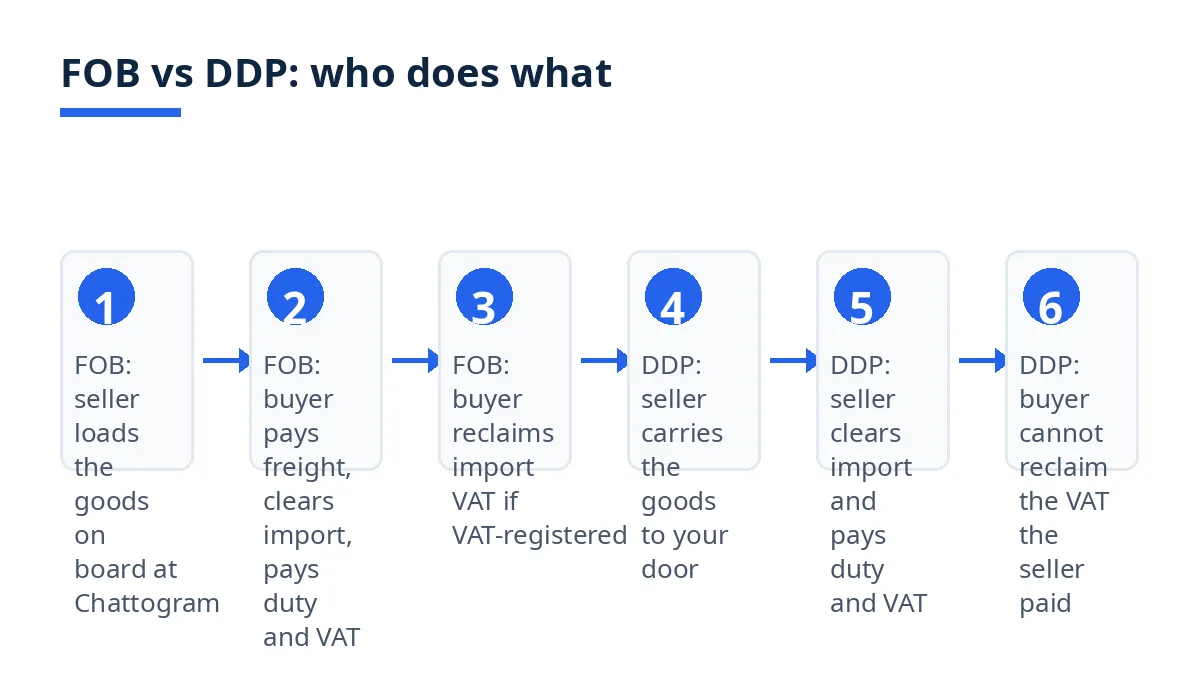
The table below sets out who does what under each rule. Read the import row first: it moves the most money and the most responsibility.
The diagram after this paragraph shows the same split as a journey.
Step | FOB | DDP |
|---|---|---|
Transport mode | Sea and inland waterway only | Any mode, single or combined |
Delivery happens when | Goods are loaded on the vessel | Goods arrive at the named place, cleared for import |
Risk passes to the buyer | On board the vessel | At the named place of destination |
Export clearance | Seller | Seller |
Main carriage | Buyer | Seller |
Cargo insurance | Buyer arranges its own cover | Seller bears the transit risk; neither rule requires a policy |
Import clearance | Buyer | Seller |
Import duty | Buyer | Seller |
Import VAT | Buyer, usually reclaimable | Seller, usually not reclaimable |
Importer of record | Buyer | Seller |
Unloading at destination | Buyer | Buyer, unless the contract adds it |
Onward delivery | Buyer | Seller, to the named place |
Three lines in that table deserve a second look. First, neither rule obliges the seller to buy cargo insurance. Only CIF and CIP require the seller to insure.1
Second, unloading stays with you under DDP. Delivery is complete when the goods arrive at the named destination on the arriving vehicle, cleared for import and ready for unloading, and the seller does not have to unload.3 Only DPU makes the seller unload.
Third, FOB is written for cargo that loads straight onto a vessel. In practice a box reaches the yard well ahead of the sailing, so the handover FOB describes happens later than the handover that actually took place.1
Worked example: jute bags from Chattogram to Felixstowe
Example figures. A buyer in the United Kingdom orders 800 cartons of jute shopping bags from a supplier in Chattogram, goods worth $12,000. The DDP named place is the buyer's warehouse in Felixstowe. The figures below are illustrative, using a 6% duty rate and a 20% import VAT rate. Check the HS code for your product first, because the code fixes the duty.3
Cost line | Under FOB | Under DDP |
|---|---|---|
Goods, packing, export clearance | $12,000, in the FOB price | $12,000, in the DDP price |
Ocean freight, Chattogram to Felixstowe | $2,400, paid by the buyer | $2,400, paid by the seller |
Cargo insurance | $180, paid by the buyer | $180, paid by the seller |
Import duty, 6% of the $14,580 CIF value | $875, paid by the buyer | $875, paid by the seller |
Import VAT, 20% of the $15,455 CIF-plus-duty value | $3,091, paid by the buyer | $3,091, paid by the seller |
Broker fees and delivery to the warehouse | $380, paid by the buyer | $380, paid by the seller |
Total the buyer pays | $18,926 | $18,926 |
Import VAT reclaimed by the buyer | $3,091 reclaimed on the VAT return | $0, buyer was not the importer of record |
Net cost after VAT reclaim | $15,835 | $18,926 |
Both columns land on the same gross total, $18,926, because every cost appears in each column and only the payer changes.
A VAT-registered buyer under FOB reclaims the $3,091 of import VAT, so the net cost is $15,835. Under DDP, the buyer was not the importer of record and cannot reclaim the VAT the seller paid, so the net cost stays at $18,926. A buyer that is not VAT-registered sees no difference in net cost.
The duty line is charged on a CIF value of $14,580: goods plus freight plus insurance. The VAT line is charged on the CIF value plus the duty, $15,455, at 20%. Both rates are example rates only.
When DDP is worth its premium
DDP earns its premium when the buyer cannot act as the importer of record, or when the cost of acting as one is higher than the VAT the buyer gives up. A buyer entering a new market for the first time, with no local entity and no broker relationship, may find DDP the only way to receive the goods at all.
DDP also suits a buyer whose supplier already runs a compliant import route into that destination, with a VAT registration or a representative that can recover the tax. Sellers with significant DDP volume into one country should seriously consider registering for VAT there.3 DDP is not worth its premium when you are VAT-registered and you import regularly.5
Before you sign a DDP quotation: five checks
Can the seller act as importer of record in your country? Ask for the broker's name and the registration the seller will file under.
Can anyone reclaim the import VAT? Ask whether the seller is VAT-registered in your country, or uses a representative that can recover the tax.
Is the DDP price broken out? Ask for goods, freight, insurance, duty, import VAT, broker fees and delivery as separate lines.
Is the HS code right, and is the duty basis confirmed? A wrong code can mean paying the wrong duty or a delayed shipment.
Does the contract name the place, the unloading and the insurance? Write the full warehouse address, because the named place is where risk passes.3 Say who unloads and who insures the voyage.
A DDP price that passes all five checks is worth paying for.
Which term fits your order?
Choose FOB when you import often, you already hold a forwarder and a broker in the destination country, and you are VAT-registered and want the VAT back.
Choose DDP when you buy now and then, you have no import registration or broker in the destination country, and you are not VAT-registered so there is no reclaim to lose. If the seller offers DDP where it has no registration and no broker, take DAP instead.
Incoterms do not cover transfer of title or ownership, the price of the goods, payment terms, breach of contract remedies, or intellectual property rights, so none of those points is settled by choosing FOB or DDP.5 Write them into the sales contract separately, alongside the rule, the named place and the edition.
Next steps on Exportain
For the step below DDP, read FOB vs DAP, where you still clear import and pay the duty, and read FOB vs CIF for the version where the seller pays the freight and buys minimum cover. When you are ready to compare prices, browse Bangladeshi suppliers and post an RFQ.
Sources
- Incoterms 2020: the complete guide for exporters. Reevol Academy (accessed )
- DDP vs DAP explained: who pays import VAT and duty. Quaderno (accessed )
- DDP Incoterms Explained: Who Pays, Risk Transfer & VAT. LegalClarity (accessed )
- Import VAT and the Importer of Record: Who Can Reclaim It?. CarraGlobe (accessed )
- Incoterms 2020: The 11 Rules Explained. GCE Logistics (accessed )
About the author
Sourcing from Bangladesh?
Post a request for quotation and suppliers on Exportain can send you their quotes directly.
Post an RFQ