Top Puffer Jackets Manufacturers in Bangladesh: How to Find and Verify Them
Puffer jacket sourcing in Bangladesh, sorted by capability: fill type, shell and quilting construction, and the evidence checks, fill reports, washed samples and inspection terms, to run before ordering.
Short answer
Puffer jackets manufacturers in Bangladesh should be chosen by capability, not by ranking: down-fill specialists, synthetic-fill lines, shell and quilting specialists, woven outerwear composites, private-label OEM and ODM makers, and exporters. State fill, shell and quilting in one specification, check fill test reports and any Responsible Down Standard certificate for the lot, approve a washed sample, and agree the inspection standard before paying.
On this page
Key takeaways
A puffer jacket is decided by fill, shell and quilting together: state all three in one written specification before asking for a price.
Woven garment exports from Bangladesh reached US$4.61 billion in the first quarter of fiscal 2026-27, up 5.11 percent year on year, per Export Promotion Bureau data reported in October 2026.
Down claims need lot evidence: a fill power report and, where claimed, a Responsible Down Standard transaction certificate covering that lot.
Approve a washed pre-production sample and agree the AQL inspection standard and defect categories in writing before production.
Exportain badges record document and photo checks reviewed by the Exportain team; they are not factory inspections or quality guarantees.
Buyers looking for puffer jackets manufacturers in Bangladesh are buying a performance garment, not a simple sewn shell. A puffer jacket has to hold its fill in place, keep cold air out at the seams, and still look the same after washing and packing.
Woven garments sit behind this search. In the first quarter of fiscal 2026-27, woven garment exports from Bangladesh reached US$4.61 billion, up 5.11 percent year on year, within ready-made garment exports of US$10.58 billion, according to Export Promotion Bureau data reported in October 2026.1 The Bangladesh Garment Manufacturers and Exporters Association (BGMEA) describes a base of more than 4,000 factories serving buyers in more than 150 countries, with factories assessed against frameworks including BSCI, WRAP, SMETA, ZDHC, GOTS and OEKO-TEX.2 A pool that size cannot be ranked usefully. It can be sorted by capability, starting with fill, shell and quilting.
Start with fill, shell and quilting, not with price
A puffer jacket is three decisions made together. The fill decides warmth for weight. The shell fabric decides wind and water resistance, and whether fill escapes through the cloth. The quilting method decides whether fill stays evenly spread or drifts into clumps and leaves cold spots along the seams.
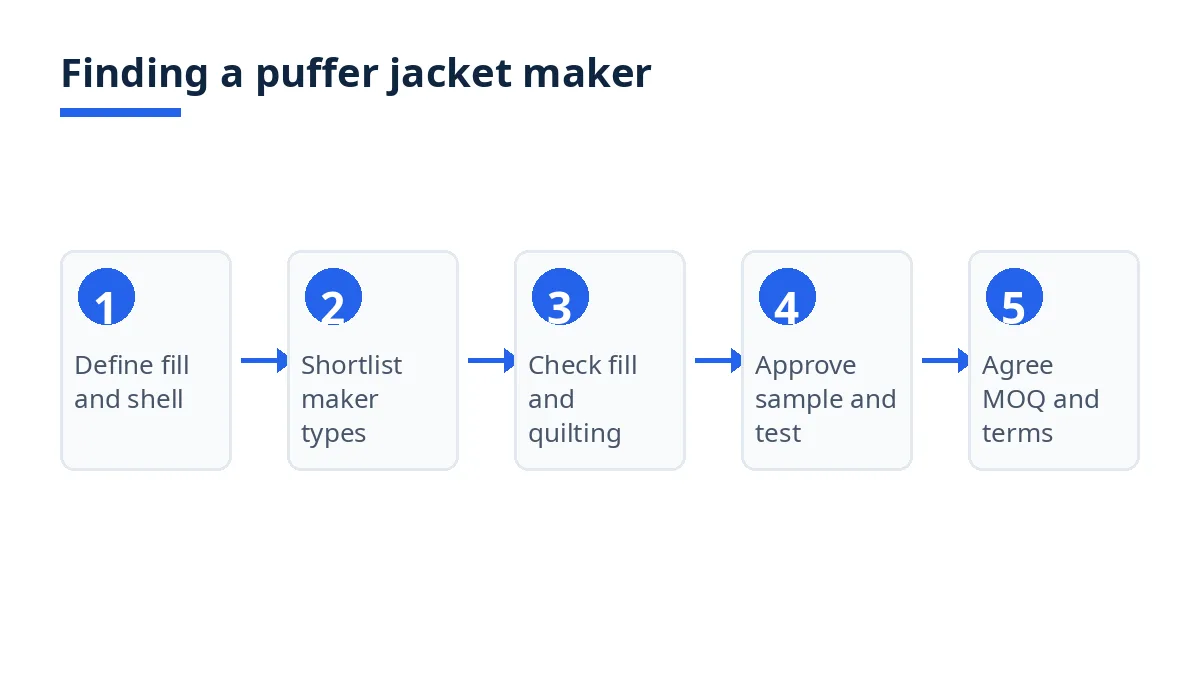
State the fill type and fill weight per size, the shell fiber and any coating, and the quilting construction with its channel width.
Classification follows the same logic. Woven puffer jackets fall under HS headings 6201 for men's or boys' garments and 6202 for women's or girls' garments, with subheadings split by fiber and by overcoat versus anorak type.3 4 Treat those headings as indicative only and verify the full code for your exact jacket, wearer and fiber with your customs broker before filing, because the national code, duty and labeling rules sit beyond the shared six digits.
The list: puffer jackets manufacturers in Bangladesh by capability
The six maker types below are capability profiles, not a ranking and not named companies. A single company can cover more than one profile, and a maker strong in one profile can be weak in another. For each type, the check that matters is the one that tests the capability the type claims.
1. Down-fill specialists
What they do. These makers fill jackets with duck or goose down and feather blends, working from bulk down that is washed, sorted and blown into quilted chambers.
Why it matters. Down is sold on loft and composition, not on appearance. Two jackets can carry the same fill weight and perform differently if one uses a lower-loft blend or a higher feather share. A down specialist should state the down-to-feather ratio, the fill power and the conditioning method behind that number, with a lab report for the lot in use.
How to check it. Ask for the fill power test method and the lab report, not only the number on a sales sheet. Fill power is a volumetric measure of the insulation value of down and feather fillings, reported in cubic inches per ounce or cubic centimeters per gram, with common values from 300 to 900 cubic inches per 30 grams in the IDFL test summary.5 Ask whether the down is certified under the Responsible Down Standard (RDS), a third-party certification covering animal welfare and chain of custody that prohibits force-feeding and live-plucking of waterfowl.6 Check that any RDS claim names the certified scope and certification body, and that the transaction certificate covers the lot you are buying.
2. Synthetic-fill and recycled-fill lines
What they do. These lines fill jackets with man-made fiber insulation, including recycled fiber fills, formed as sheets, loose fiber or molded pads.
Why it matters. Synthetic fill removes the animal-welfare and down-traceability questions, and it suits buyers who need machine-washable jackets at a set price point.
How to check it. Ask for the fiber composition, the fill weight per size, and the wash and compression test the maker runs on the finished jacket. Approve the sample after at least one wash cycle, and check chamber by chamber for thin spots and migration.
3. Shell and quilting specialists
What they do. These makers are built around the outer fabric and the quilting line: coated or laminated shells, stitch-through quilting, baffle-wall construction, and bonded or welded seams.
Why it matters. The shell is where most puffer jacket failures start. Fill escapes through open weaves and needle holes, water enters through unsealed seams, and cold enters where stitch-through quilting presses the fill flat.
How to check it. Ask which quilting constructions the line runs every week, and see a sample of each: stitch-through, baffle wall and bonded. Check the shell for down-proofing evidence, such as a fabric test report, and rub and flex the sample to look for fill working through the cloth.
4. Woven outerwear composites
What they do. These are full-package woven factories that cut, fill, quilt, sew and pack jackets within one organization, often with in-house fabric inspection and washing. They take a tech pack and return a finished jacket, controlling the handoff between fabric, filling and sewing instead of passing it between companies. A puffer jackets factory in Bangladesh of this type is judged on the whole jacket, not on one stage.
Why it matters. Fewer handoffs mean fewer places for a specification to change without notice. When the same organization inspects the shell fabric, fills the chambers and sews the jacket, a fault found at final inspection can be traced to the stage that caused it.
How to check it. Ask which stages are in-house and which are subcontracted, and get the answer in writing for your style. A factory that sews but sends filling or quilting out is not a composite for your order, however it describes itself.
5. Private-label OEM and ODM outerwear makers
What they do. These suppliers make jackets under the buyer's label. Original equipment manufacturers (OEM) produce to the buyer's tech pack and patterns. Original design manufacturers (ODM) offer their own jacket styles, fits and quilting patterns for the buyer to label and sell.
Why it matters. Puffer jackets need a fit that works over layers, with sleeve, body and hood measurements that change together across sizes.
How to check it. For OEM work, send a complete tech pack covering fill, shell, quilting, measurements, trims and labels, and judge the counter-sample against it line by line. For ODM work, try the styles on over a mid-layer and confirm who owns the patterns.
6. Outerwear exporters and trading companies
What they do. These are export-licensed companies that sell puffer jackets made in partner factories rather than on their own sewing lines. They aggregate capacity across several factories, handle export documentation, and offer one contract for a mixed outerwear range.
Why it matters. A trading company can be the right route for a mixed order or a small first order, but its export record does not tell you which filling line made your jackets.
How to check it. Ask which factory will fill and sew each style, and get the factory named in the order terms before you pay a deposit. Ask who holds the fill test reports and the RDS transaction certificates, and get copies that name the producing factory and the lot.
Summary table
Maker type | Suited to | Main check before ordering |
|---|---|---|
Down-fill specialist | Warmth-led jackets, high-loft programs | Fill power report, RDS scope and lot certificate |
Synthetic-fill and recycled-fill line | Washable jackets, set price points | Washed sample, chamber-by-chamber fill check |
Shell and quilting specialist | Bonded, baffled and water-resistant jackets | Quilting samples, shell test report, seam check |
Woven outerwear composite | Repeat programs, full-package orders | Which stages are truly in-house |
Private-label OEM / ODM | Own-label brands and retailers | Tech pack match or tried-on ODM fit |
Exporter / trading company | Mixed orders, one contract | Producing factory named, fill evidence held |
What sets price and MOQ for a puffer jacket order
A puffer jacket quote is built from fill, shell, quilting, trims and packing, so compare quotes part by part. Fill is usually the swing factor: a higher fill weight or higher fill power raises the material cost, and a certified down lot costs more than an uncertified lot of the same weight. Shell fabric follows, with coated or laminated cloth and bonded seams adding process cost over a plain stitch-through shell.
Minimum order quantity (MOQ) is set per style, per color and often per fill lot, not per factory. Dye lots, fill lots and quilting setups each have a smallest run that makes sense, so splitting one order across many colors or fills raises the effective MOQ even when the total quantity looks large. Example figures: a style quoted at 1,000 pieces in two colors with one fill may carry a higher unit price at 500 pieces in four colors, because each color and fill change adds setup and lot cost. Treat any number in a sales sheet as an example until the maker quotes your exact specification, quantity, Incoterm and packing. For how MOQ works across a range, read the guide to MOQ in the supply chain.
Check the evidence before you pay
Check association membership. Bangladesh exporters of woven garments should appear in BGMEA member records; the BGMEA site runs a member search, and membership is the trade registration signal for woven factories.2
Review the documents. Trade licence, Export Registration Certificate (ERC) and factory or office photos are the standard set. On Exportain, supplier profiles carry badges only for the document and photo checks the Exportain team has reviewed and approved.7
Get the fill evidence in writing. For down, that means the fill power report, the down-to-feather ratio and any RDS transaction certificate for the lot. For synthetic or recycled fill, it means the fiber composition and the chain-of-custody document for the claimed content. A claim without a lot document is a sales statement, not evidence.
Approve a washed sample. Approve a pre-production sample made from bulk shell, bulk fill and bulk trims, wash it, and measure it against your size chart. Keep one sealed sample as the reference for the shipment inspection.
Agree the inspection standard in the order. Set the acceptance quality limit (AQL) and inspection level before production. ISO 2859-1:2026 specifies sampling schemes indexed by AQL for inspection by attributes, so an inspector can accept or reject a shipment against a published rule instead of an opinion.8
Put payment protection in writing. Agree inspection and shipment conditions before settling. Exportain is a marketplace and is not a party to your goods contract; where a supplier asks for a funds hold, the buyer can pay it or decline it, and Exportain keeps a paid hold until the supplier files an export clearance document and the buyer confirms the trade is complete.9
The Exportain guide to how supplier verification works sets out what each badge does and does not cover, and the puffer jackets quality control checklist turns the fill, quilting and shell checks above into garment-level inspection points.
How Exportain helps
When you search for puffer jackets suppliers in Bangladesh on Exportain, you can find suppliers by keyword and category, filter to suppliers holding the Exportain Verified badge, sample availability and OEM or ODM capability, and sort by MOQ or lead time.9 Each supplier profile shows its verification level, location, main products and the certifications the supplier has declared.9 Buyers then post a request for quotation (RFQ) stating quantity, target price, destination, Incoterm, required certifications and deadline, and suppliers in that category quote against it.9
Use the badges as a starting filter, not a conclusion. Verification on Exportain is a document and photo review by the Exportain team, not a factory inspection, and membership never grants a badge.7 Run the evidence checks above on your shortlist.
FAQs
What is the biggest mistake?
Ordering a puffer jacket by the quoted price before checking fill, shell and quilting. A down specialist, a synthetic-fill line and a trading company quoting another factory's capacity are three different offers at three different prices, even when the photographs look the same.
How can I avoid it?
Write one specification covering fill type and weight, shell fiber and coating, quilting construction and channel width, size range, trims and packing, and send the identical document to every maker you quote. Name the producing factory and set the inspection level in writing before production starts.
Who is responsible?
Both sides, at different points. The maker is responsible for filling and sewing jackets to the agreed specification and the approved sample, including the fill lot named in the order. The buyer is responsible for making that specification complete and checkable, and for inspecting against it before shipment.
Where can I get help?
Start with the records that exist: BGMEA member listings for registration, the fill lab and the RDS certification body for fill and welfare claims, and an inspection provider for the pre-shipment check.2 On Exportain, read what each profile badge covers before relying on it, and message the supplier through its profile so your questions and the answers stay in one thread.7
Next steps on Exportain
Browse suppliers on Exportain to find suppliers in Bangladesh and filter the outerwear listings by badge, MOQ and OEM or ODM capability. Before you order, read how supplier verification works on Exportain so you know what each badge covers. Then post a free RFQ with your puffer jacket specification, including fill, shell, quilting, quantity, destination and Incoterm, and compare the versioned quotations that come back. The HS code guide covers headings 6201 and 6202.
Sources
- Bangladesh's merchandise exports grow 6.34pc in Q1. Daily New Nation (accessed )
- BGMEA | Home. Bangladesh Garment Manufacturers and Exporters Association (BGMEA) (accessed )
- HS, 2012 - Code 6201. United Nations Statistics Division (accessed )
- HS, 2012 - Code 6202. United Nations Statistics Division (accessed )
- FILL POWER. International Down and Feather Testing Laboratory (IDFL) (accessed )
- Responsible Down Standard (RDS). Textile Exchange (accessed )
- Supplier verification: Earn trust badges buyers can see. Exportain (accessed )
- ISO 2859-1:2026 — Sampling for Inspection by AQL. American National Standards Institute (ANSI) (accessed )
- How to source and buy from Bangladesh. Exportain (accessed )
- MOQ
- supplier verification
- quality control
- importing from Bangladesh
- Bangladesh sourcing
- Outerwear
- Puffer jackets
About the author
Sourcing from Bangladesh?
Post a request for quotation and suppliers on Exportain can send you their quotes directly.
Post an RFQ