

Puffer Jacket MOQ in Bangladesh: Minimums and Negotiation
No single puffer jacket MOQ applies in Bangladesh. This guide explains how fill, shell, quilting, size runs and color splits set the minimum, and how consolidation, fewer variants and phased orders can bring it down, with the terms to confirm in writing.
Short answer
There is no single puffer jacket MOQ in Bangladesh. Suppliers set minimums per style, color, size, fill lot and shell fabric lot, and the largest binds the order. Fill, shell, quilting, size runs and color splits decide the floor. Buyers bring the binding minimum down by cutting colors and sizes, using stock shell and fill, sharing inputs across styles, and agreeing phased orders in writing, rather than pressing for a lower number on the same order.
On this page
Key takeaways
A puffer jacket MOQ is a set of minimums, not one number: per style, color, size, fill lot and shell lot, with the largest binding the order.
Fill lots, shell fabric lots and quilting setups set the floor; changing any one restarts part of production and can raise the binding minimum.
Example figures show the trap: a 1,200-piece total can still fail a 500-piece per-color and 100-piece per-size minimum.
Negotiation works by changing the order: fewer colors and sizes, stock inputs, shared lots and phased commitments, with AQL, inspection and all terms confirmed in writing.
A puffer jacket order rarely fails on the total quantity. It fails on the split: the total meets the minimum, but one color or one size does not, or the fill lot changes halfway through the order. The puffer jackets MOQ Bangladesh factories quote is therefore not one number to beat down. It is a set of minimums, one for each input and each variant, and the binding one is the largest of them. This guide explains how those minimums are set, how to read them, and how to bring the binding minimum down by changing the order.
In the first quarter of fiscal 2026-27, woven garment exports from Bangladesh reached US$4,614.80 million, within ready-made garment exports of US$10,578.56 million, on Export Promotion Bureau (EPB) data reported by The Financial Express.1 Puffer jacket minimums follow that pattern: fabric and fill are bought in lots, and each combination is cut as its own run.
What a puffer jacket MOQ counts, and what it does not count
A minimum order quantity (MOQ) is the smallest quantity a supplier will accept for a product on its normal terms. For puffer jackets, the count almost never stops at the order total. Ask what the number counts. The usual bases are per style, per color, per size, per fill lot, per shell fabric lot, or a combination of those. A quotation that says "MOQ 1,000 pieces" without a basis has not yet told you the minimum that will bind your order.
Each variant restarts part of the work: a second color needs its own shell lot and shade approval, and a second fill weight needs its own fill allocation. Two colors at half the quantity each, against a per-color MOQ, are two orders that each fall short.
How to read the basis line on a quotation
Read the quantity line with the specification line: style, shell, fill type and weight, quilting, size range, colors, trims and packing, with the minimum stated against each. If the minimum is only a total, ask for it per color and per size before comparing suppliers. For the general meaning of MOQ, see the guide to MOQ meaning. A minimum alone promises nothing about quality, delivery or price.
Why fill, shell and quilting set the floor
The fill, shell fabric and quilting decide most of a puffer jacket's minimum. Change any one and part of the setup starts again.
Fill: the lot behind the warmth
Fill is down and feather, synthetic, or a blend, bought, tested and allocated in lots. Down fill is described by composition and fill power, which measures loft; IDFL explains that each standard has its own conditioning, cylinder, piston weight and units, and that under the United States standard, extremely high quality down has a fill power of 700+ cubic inches.2 A specific fill power or test report means fill from a tested lot, and the minimum follows the lot.
Certified fill adds a second floor. The Responsible Down Standard (RDS) is a third-party certification covering animal welfare and chain of custody for down and feathers, prohibiting force-feeding and live-plucking.3 An RDS claim must be checked against the issuing body's records: certificate scope, supplier and product category.
Shell: fabric lots, shade and downproofing
The shell is a woven fabric, produced and dyed in lots. One color is one dye lot, and shade must match across the body, sleeves, hood and pocket fabric. A supplier holding a shell fabric in stock can sometimes take a smaller order in that fabric and color. A supplier that must buy or dye the shell for your order faces the fabric lot as the floor, set by the mill, not by the sewing line.
Downproofing is part of the shell decision: IDFL describes it as the ability of a fabric to retain its plumage, tested by tumbling a filled pillow made from the fabric and counting what escapes.2 A shell passing for one fill may fail for a finer fill, so changing the fill can force a change of shell and restart the fabric lot.
Quilting: chambers, stitching and leakage
Quilting holds the fill in place: chamber shape and size, stitch density and fill placement decide insulation and leakage. A different pattern is a different setup, sample and inspection point. Leakage and cold spots show in the sample inspection, not on a photograph, so quilting construction belongs in the written specification, with the sample approved in the production shell and fill.
Driver | What changes the minimum | What to ask |
|---|---|---|
Fill type and weight | Tested fill lot | Which lots are tested and held |
Shell fabric and color | Fabric and dye lot, shade match | Whether the shell and color are in stock |
Quilting construction | Setup, sample, inspection | Which chamber patterns run on the line |
Sizes and colors | One minimum per variant | The minimum per color and per size, in writing |
Trims and packing | Trim and label runs | Whether standard trims are used |
How size and color splits raise the real minimum
Size and color splits are where most surprises happen: the minimum applies to each part of the division. Example figures below show the arithmetic.
Example figures: a buyer plans 1,200 jackets in three colors and four sizes. The supplier's minimum is 500 pieces per color and 100 pieces per size within each color. The plan puts 400 jackets in each color, which fails the per-color minimum even though the 1,200 total clears a 1,000-piece total minimum. Inside one color, the smallest size takes 60 jackets, which fails the 100-piece per-size floor. Restructure the order: fewer colors, a narrower range, or more in the sizes and colors that stay.
Split | Example figures | Against the stated minimum |
|---|---|---|
Total order | 1,200 pieces | Passes a 1,000-piece total minimum |
Per color | 400 pieces in each of 3 colors | Fails a 500-piece per-color minimum |
Per size in one color | 60 pieces in the smallest size | Fails a 100-piece per-size floor |
Restructured order | 2 colors, 600 pieces each | Meets the per-color and per-size floors |
Outer sizes usually take fewer pieces than middle sizes, so an even split across a full range is the hardest pattern to meet. If the curve cannot clear the per-size floor, drop the outer sizes or raise their quantity, and agree the curve in writing, size by size. Decide colors before finalizing the quotation: a late color restarts shade approval.
Reading a quotation: the MOQ lines to compare
Compare quotations on the same specification, delivery term and packing. A quotation is versioned on Exportain, stating unit price, MOQ, lead time, Incoterm, payment terms and validity for each version.4 Rewrite each offer into the same fields before judging it, wherever it arrives.
If one quotation uses a heavier fill, a different shell or different quilting, it describes a different jacket. Next, read the delivery term. Incoterms® 2020 allocates cost, risk and obligations between seller and buyer, and the ICC notes the rules have been used globally since 1936, updated in 2020.5 Quotations on different Incoterms are not comparable on price alone, because freight, insurance and clearance sit on different sides of the line.
Then read the price tiers and omissions. A lower price at a higher quantity reflects fixed setup costs spread over more pieces: check where each tier starts, whether it applies per color or to the total, and how long it stays valid. Samples, inspection, testing, labels, packing and freight are each a line, and omitting inspection or testing moves the cost to a later invoice or a risk you carry. Have each omitted line priced or explicitly excluded, in writing, before accepting the MOQ.
Seven ways to bring the minimum down
Negotiation works best as a change to the order, not a request for an exception.
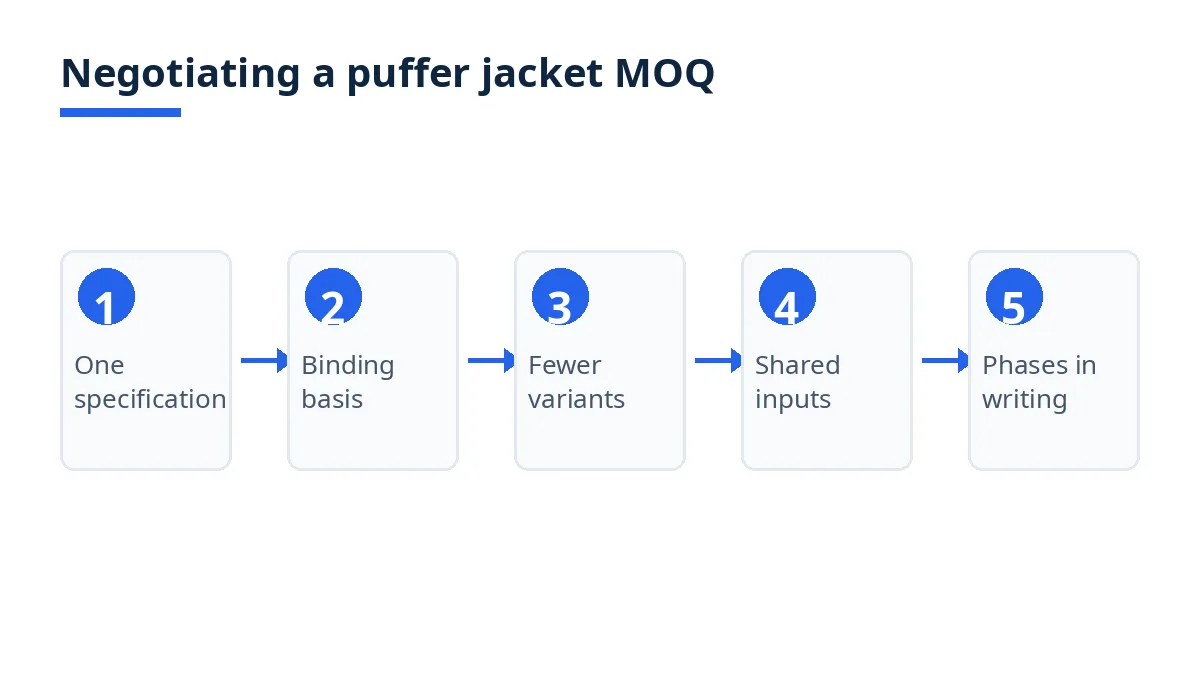
Cut the colors first. Dropping from four colors to two is usually the largest single reduction: it removes whole fabric and shade lots.
Narrow the size range. A core range clearing every floor beats a full range with sizes below it.
Use the supplier's stock shell and fill. A combination already in production removes the lot floor.
Share inputs across styles. Two styles using the same shell, fill and quilting can sometimes share a lot, if the supplier confirms it for those styles.
Accept standard trims and packing. Custom zips, trims and retail packing each carry their own lot.
Offer a phased commitment. A smaller first order with a written repeat commitment and agreed dates can succeed where a one-off small order fails.
Consolidate with a compatible order. A second style or delivery sharing shell, fill and line can lift the combined quantity over the lot floors.
The diagram below sets out the same five steps.
Do not trade away the sample or inspection to win a lower minimum: a washed sample in the production shell and fill, and an agreed inspection standard, protect a small order most. Agree the acceptance quality limit (AQL) and inspection level before production. ISO 2859-1:2026 provides sampling schemes indexed by AQL for lot-by-lot inspection by attributes.6 Name the AQL, inspection level and defect classifications in the order terms, and keep a sealed sample as the shipment reference.
Phased orders and consolidation: when a smaller first order works
A phased order works when phases share specification and inputs. Between phases, a fill lot or dye lot can change and a price validity can expire, so state in writing whether the repeat uses the same lots, what happens if a lot changes, and how long the price and MOQ terms stay valid. Agree the trial terms as one package.
Consolidation follows the same test: do the orders share shell lot, fill lot, quilting setup and production window? Two styles or deliveries from one buyer sometimes can. Two buyers normally cannot, because specification, labels and destination differ. If any input differs, the orders are separate for MOQ purposes.
What to confirm in writing before you agree a quantity
Put the quantity agreement in the same document as the specification, and state each item below in numbers and names. A quantity agreed by message and a specification agreed by email will drift apart.
The counting basis. Per style, per color, per size, per fill lot and per shell lot, with the figure against each; state the size curve, size by size, and the color list.
The fill and shell specification. Fill type, fill weight, fill test evidence required, shell fabric, color standards and shade approval step; check any certification claim against the issuing body.2 3
The quilting construction. Chamber pattern, stitching, fill distribution check and the sample proving it, approved in the production shell and fill.
The inspection standard. AQL, inspection level, defect classifications, who inspects, and what happens to a rejected lot; keep the sealed sample with the order record.6
Labels and fiber composition. Fiber composition, care and origin labeling for the destination market. In the European Union, Regulation (EU) No 1007/2011 makes labeling or marking of fiber composition compulsory.7
Classification, indicative only. The Harmonized System identifies each product by a six-digit code used by more than 200 countries and economies as the basis for customs tariffs and trade statistics.8 Heading 6201 covers men's or boys' overcoats, anoraks, wind-cheaters and similar articles, not knitted or crocheted, split by fiber.9 Treat any heading as indicative – verify, and confirm the full code with the destination tariff or a binding ruling before filing. See the guide to HS code for puffer jackets.
Delivery term, payment and validity. The Incoterm, payment terms, price validity dates and repeat-order terms, each stated in the quotation version you accept.5 4
The puffer jackets manufacturers guide sorts suppliers by capability, fill type, shell and quilting construction, rather than by ranking. Shortlist by capability, then check records, documents, a washed sample and inspection terms before payment. On Exportain, profile badges record document and photo checks the Exportain team has reviewed and approved; verification is a document and photo review, not a factory inspection.10 The puffer jackets quality control checklist turns the inspection standard into garment-level checks.
What should I know first about puffer jackets?
Know the jacket as three decisions: fill, shell and quilting. Fill decides warmth and test evidence, shell decides weather performance, shade and downproofing, and quilting decides whether fill stays where it insulates. Stating those three decisions, with size range and colors, yields comparable quotations; a style photograph and a target quantity do not.
What are the typical costs and timelines?
There is no typical cost or timeline for puffer jackets as a category: fill weight, shell, quilting, trims, quantity, delivery term and destination each move the figure. Ask for a cost breakdown by line, a lead time by approval gate, and a validity date, and compare suppliers on the same breakdown. One total price and one total lead time, without the gates, cannot be compared or held to account when a gate slips.
Which documents are needed?
The documents fall into three sets: the order set (specification or tech pack, accepted quotation version, purchase order stating basis and size curve, sample approval record); the product set (fill test reports, certification evidence, label approvals); and the shipment set (commercial invoice, packing list, transport document, any origin or customs document required), prepared under the agreed Incoterm.5 Keep all three sets in one order record.
What are the most common mistakes?
The most common mistake is agreeing a total without the split, then discovering at cutting that one color or size falls short. The second is changing fill or shell after the quotation without a new minimum, sample and price. The third is treating a badge, catalogue claim or sample photograph as verification. The fourth is agreeing a phased order verbally, with no written quantity, dates or price validity. Avoid all four by writing specification, split and terms in one document, and agreeing changes in a new version of it.
Next steps on Exportain
Search Bangladeshi suppliers and filter outerwear listings by badge, MOQ and OEM or ODM capability, then shortlist by fill, shell and quilting capability using the puffer jackets manufacturers guide. Read the puffer jackets quality control checklist before ordering, so the inspection standard is agreed before production. Then post an RFQ stating fill, shell, quilting, size curve, colors and destination, and compare versioned quotations on the same fields.
Sources
- RMG exports rise 6.10pc to US$10.58b in July-Sept of FY27. The Financial Express, (accessed )
- Explanation of Down and Feather Tests. IDFL (accessed )
- Responsible Down Standard (RDS). Textile Exchange (accessed )
- How to source and buy from Bangladesh. Exportain (accessed )
- Incoterms® 2020. International Chamber of Commerce (ICC) (accessed )
- ISO 2859-1:2026 — Sampling for Inspection by AQL. American National Standards Institute (ANSI) (accessed )
- Regulation (EU) No 1007/2011 on textile fibre names and related labelling and marking of the fibre composition of textile products. European Union, (accessed )
- What is the Harmonized System (HS)?. World Customs Organization (accessed )
- HS, 2012 - Code 6201. United Nations Statistics Division (accessed )
- Supplier verification: Earn trust badges buyers can see. Exportain (accessed )
About the author
Sourcing from Bangladesh?
Post a request for quotation and suppliers on Exportain can send you their quotes directly.
Post an RFQ


