Who Handles Customs Clearance Under DDP? Export vs Import Explained
DDP gives the seller both customs filings: export clearance in Bangladesh and import clearance abroad, with duty paid. This guide follows each filing, the importer route in the USA, UK, EU and UAE, and the checks that stop goods waiting at the border.
Short answer
Under DDP, the seller clears the goods for export in Bangladesh and for import in the destination country, pays the duty and taxes, arranges carriage, and delivers the goods at the named place ready for unloading. The buyer unloads the goods and assists the seller with documents the import authorities require. Before agreeing DDP, confirm the seller can complete import clearance in your country, name the destination broker, and get the duty basis in writing.
On this page
Key takeaways
Under DDP the seller files export clearance in Bangladesh and import clearance at destination, pays duty and taxes, and delivers at the named place ready for unloading; the buyer unloads.
The two filings are separate jobs with separate papers: approval of the export declaration comes before loading, and the import declaration, payment and release come before onward movement.
A seller that cannot act as importer in the destination country cannot perform DDP; the named place stays the same under DAP, and only the import filing moves to the buyer.
No duty rate, broker fee or transit time is stated in this guide; every figure must come from the destination broker against the live schedule for the goods.
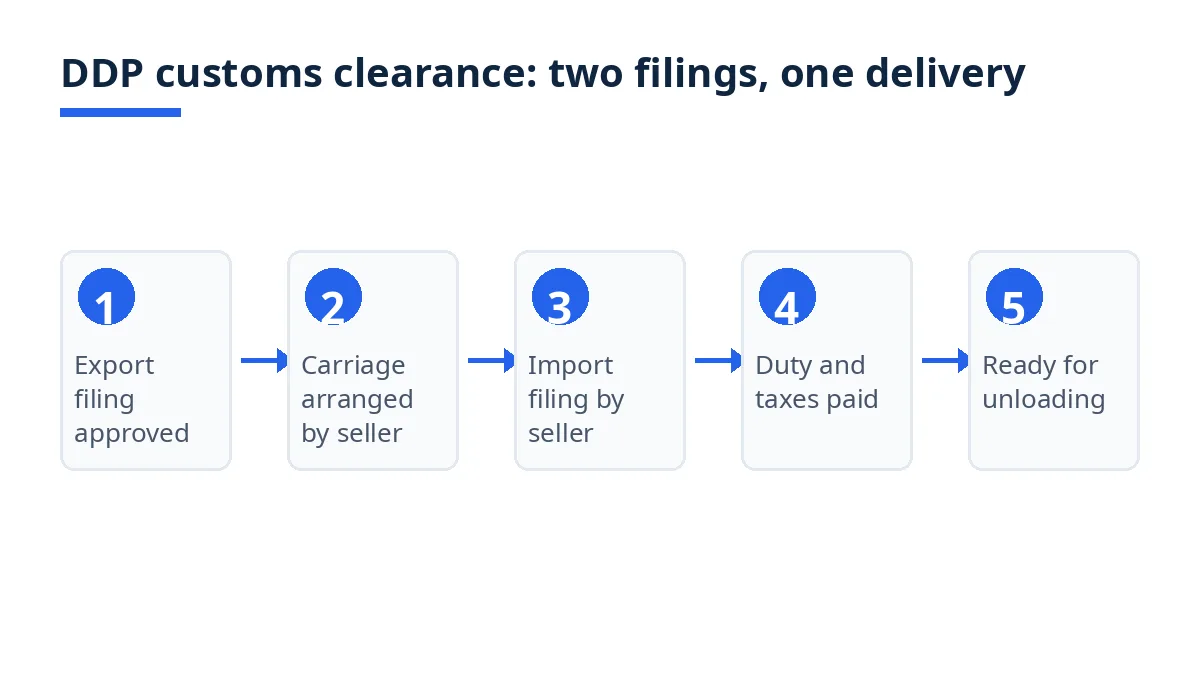
DDP customs clearance puts two filings on one seller, at two borders, under one price: export clearance in Bangladesh, approved before loading, and import clearance abroad, complete before onward movement. When either filing sits with the wrong party, the shipment waits.
Two customs files, one delivery point
DDP stands for Delivered Duty Paid, one of eleven rules in Incoterms® 2020, published by the International Chamber of Commerce (ICC). The 2020 edition entered into force on 1 January 2020, and the ICC describes the rules as the standard for interpreting the most common terms in contracts for the sale of goods.1 Only four rules are limited to sea and inland waterway transport: FAS, FOB, CFR and CIF. CPT, DPU and DDP work for any mode of transport. DDP is set apart because the seller clears the goods for import and pays the duty, and the buyer unloads at the named place.2
Under DDP, the seller delivers the goods when they stand at the named place, ready for unloading and at the buyer's disposal, with import clearance complete and duty and taxes paid.3 Delivery and destination are the same place under the D rules, and risk passes there.2 The seller arranges and pays for carriage, handles export, transit and import formalities, and carries the risk during the journey.3 The buyer unloads, bearing the risk and, usually, the cost. Where unloading charges sit inside the seller's transport contract, the buyer does not pay them twice; the unloading risk still sits with the buyer.4 The buyer must supply, when the seller asks, the papers and details the destination authority asks for.3 Supplying papers is not filing: the seller remains responsible for the clearance, and a late answer can hold goods the seller is otherwise ready to deliver.
Export, transit and import filings sit with the seller; unloading sits with the buyer.
The seller's export file in Bangladesh
Export clearance under DDP is the seller's work, at the seller's risk and cost, and it must be finished before the goods move.3 Bangladesh law ties loading to an approved export declaration: section 131 of the Customs Act, 1969 requires clearance for export, and a consignment must not be loaded or container-stuffed until customs has approved the Bill of Export (shipping bill) filed in the prescribed form.5 The declaration identifies the goods and value, the exporter, the overseas buyer or importer, and the carrier.5
Seven papers accompany the Bill of Export. The payment evidence comes first in the file: the export letter of credit, or, failing that, a contract, purchase order or guarantee approved by the negotiating bank. The goods evidence follows: a signed commercial invoice describing the goods in detail and a packing list giving quantity, weight and packing details. The identity and origin evidence closes the set: the exporter's Taxpayer Identification Number, its VAT registration certificate, origin evidence certified by the Export Promotion Bureau or a Chamber of Commerce and Industry, and the EXP form certified by Authorized Dealers.5 Some goods need more: jute, jute goods and tea need an Export Registration Certificate, and tea needs a consignment-wise export permit from the Bangladesh Tea Board.5
Once the declaration is approved, the goods are loaded, and export is complete when the ship, truck or aircraft leaves the port, with the customs officer signing the second copy of the shipping bill as shipped on board.5 Ask the seller, before booking, which papers apply to your goods, who holds each one, and the filing date. The seller must also complete customs formalities in any country the goods pass through before delivery, at the seller's cost.3
The seller's import file at destination
Import clearance is where DDP differs most. Under DAP and DPU the seller completes export and transit formalities and the buyer completes import formalities.2 Under DDP the seller completes all three.2 The seller must handle import clearance and settle duty and taxes, and the buyer must supply the papers the destination authority asks for.3 Where the seller cannot complete import clearance, or local rules prevent a foreign seller from doing so, DAP fits better than DDP.3
In the United States, the liability for duties is a personal debt of the importer, and paying a broker does not remove that liability if the broker does not pay.6 The name on the import record therefore matters even when the seller funds the payment. Ask, before shipment, whose name will stand on the entry, which broker will file it, and what authority that broker holds to act for the seller. A broker appointed by the buyer for the buyer's own entries holds no authority to file in the seller's name unless the seller has appointed that broker.
Destination | Settle first | Filing route |
|---|---|---|
United States | Name on the entry, broker authority, payment route | Entry through the Automated Commercial Environment, with entry summary and duties; importer remains liable even where a broker files6 |
United Kingdom | EORI number starting with GB7 | Import declaration filed, or an agent appointed to declare; VAT and duty paid before release7 |
European Union | Registration in the member state of first declaration, where the seller acts as declarant; EORI quoted on declarations8 | Declaration by the seller or its representative; confirm the route and payment with the broker |
United Arab Emirates | Importer registration, declaration route, licence position | Confirm the route, the party named on the declaration, and the payment and release steps with the broker |
German Customs explains that registration for a third-country operator comes from the member state where it first lodges a declaration.8 Use a single paper set that matches on both sides of the journey, and ask the broker to reconcile it before departure.
When the seller cannot stand as importer
DDP should be used only where the seller can, directly or through a representative, obtain import clearance in the destination country.3 The ICC Academy states that some authorities impose legal restrictions requiring the local importer to clear the goods itself; in those cases DAP, not DDP, is the rule that fits.3
Three situations call for a different rule: the destination country bars a foreign seller from acting as importer; the seller has no registration, representative or broker there and no dated plan to put one in place; or the goods need a licence only the buyer holds. Agreeing DDP then creates a delivery duty the seller cannot perform. Switching to DAP keeps the named place and the seller-arranged carriage, and moves only the import filing, duty and taxes to the buyer.3 Put the switch in writing before shipment, with the named place in full and the price restated without the duty and tax lines.
Before agreeing DDP, ask four questions and require written answers: can you clear the goods here, in your own name or through a named representative? Which broker will file, and what authority does it hold? Which registration, licence or permit is needed, and is it in place? If clearance is delayed, who pays storage? Names, dates and documents can perform DDP; a general assurance cannot.
Who pays, and what a DDP customs clearance price leaves out
A DDP customs clearance price is a single figure built from lines that belong to different stages. Separate the lines before comparing it with any other quotation: a bundled figure hides the duty basis, the broker position and the unloading position. No rule fixes the amount of any line. This guide states no duty rate, no broker fee and no transit time; confirm every figure with the broker and the forwarder for your order.
Line | Seller pays | Buyer pays |
|---|---|---|
Goods and export packaging | Yes | No |
Export clearance, transit formalities, carriage | Yes | No |
Import clearance, duty and taxes | Yes | No |
Broker acting for the seller | Yes | No, unless the contract says otherwise |
Unloading | Only where the carriage contract includes it | Yes, where it does not; risk always sits with the buyer4 |
Onward transport, insurance for the buyer | No; no duty to insure for the buyer3 | Yes |
A DDP order worked in example figures
The example below uses one order of cotton bath towels shipped from Chattogram to a named warehouse in New York, on DDP terms. Every figure is an example figure. No figure is a market rate, and the duty figure is an illustrative amount, not a rate from any tariff schedule.
Line | Example figure (USD) | Who pays |
|---|---|---|
Goods, 800 cartons of cotton bath towels | 18,000 | Seller |
Ocean freight, Chattogram to New York | 2,400 | Seller |
Cargo insurance for the seller's own risk | 180 | Seller |
Import duty, illustrative amount | 1,900 | Seller |
Destination handling and broker charges | 650 | Seller |
Unloading at the named warehouse | 220 | Buyer, where the carriage contract does not include it |
Total on the stated lines | 23,350 | Buyer pays the DDP price plus unloading |
The arithmetic is: 18,000 + 2,400 + 180 + 1,900 + 650 + 220 = 23,350. If the broker's duty calculation rises by 500, the total becomes 23,850, and the seller bears that rise inside a fixed DDP price unless the contract allows a stated adjustment. Import VAT and other destination tax are excluded: tax treatment follows the name on the import record and the destination country's rules. Ask the broker and your tax adviser how tax is handled on an entry filed in the seller's name. Replace every line with a written figure for a real order.
Errors that stall goods at the border
Agreeing DDP with a seller that has no import route. The seller may be able to make and ship the goods, and still be unable to file the import declaration in your country. The ICC Academy warns that DDP cannot be used where local rules require the local importer to file.3
Treating the buyer's broker as the seller's broker. A broker works under authority from a named party. Your broker holds no authority to file in the seller's name unless the seller has appointed that broker.
Writing only a town name where the exact point belongs. A contract that gives DDP with a town name leaves the delivery point open, and the seller may choose the point that suits its own purpose.4 Name the full address, dock, gate or terminal.
Accepting a duty figure with no basis shown. Ask for the classification, value basis, schedule consulted and calculation date, in writing from the destination broker. This guide gives no duty rate, because a rate without an opened schedule for your country and goods would mislead.
Letting the two paper sets disagree. The export declaration, invoice, packing list, transport document and import declaration must agree on parties, description, quantity and value. Freeze the set before departure, and have the broker reconcile it in transit.
Clearance readiness check
Work through this check before the goods are booked. Each item needs a written answer, not an assurance.
The contract reads DDP, followed by the named place in full, with dock, gate or terminal stated, and the edition cited as Incoterms® 2020.
Written confirmation from the seller that it can clear the goods for import in your country, naming the broker and representative that will file.
The registration, licence or permit the filing needs is in place, or a dated plan to put it in place before arrival is agreed.
The Bill of Export route is confirmed, with the enclosures for your goods listed and a filing date set before loading.5
The destination broker holds, or has a dated plan to receive, the invoice, packing list, transport document and certificate of origin, and has reconciled the set.
The duty and tax basis is shown in writing by the destination broker, with classification, value basis and schedule date.
Unloading charges, insurance cover and storage during a slow clearance are stated in writing, with the payer named for each.
The buyer has supplied every document the seller asked for, and the seller has confirmed receipt.3
What must be settled before a seller agrees to DDP clearance?
Settle the named place in full, the seller's import route, the broker and its authority, the duty basis, and the unloading and insurance positions, all in writing.3 DDP places the widest share of the work on the seller: carriage, export and import formalities, and duty and taxes, with delivery at the named place ready for unloading.3
How much time does import clearance add under DDP?
No standard time exists, because clearance time follows the goods, the destination, the completeness of the papers and any inspection required. The gates are fixed in order: export approval before loading, broker authority and papers before arrival, declaration and payment before onward movement.5 7 Ask the forwarder for the sailing schedule and the destination broker for the clearance sequence, and judge the order on the two together.
Which papers must the buyer hand over for the seller's import filing?
Hand over the papers the seller asks for, promptly and in the form the import authorities require.3 Expect requests for the commercial invoice, packing list, transport document and certificate of origin, plus any destination-specific licence, certificate or inspection result, and identification details the declaration needs. The seller remains responsible for the filing, and the buyer supplies papers and details when the seller asks.3 Answer each request in writing and keep a copy.
What is the most common clearance error under DDP?
The most common error is agreeing DDP with a seller that cannot finish import clearance abroad, and discovering the gap only when the goods reach the border.3 4 The next most common errors are writing only a town name where the exact delivery point belongs, taking a duty total no broker has worked out, and assuming unloading and insurance are included.
Next steps on Exportain
Ask each supplier quoting DDP to state the full delivery address, name the broker filing at destination, and show how the duty total was worked out, then check that basis with a broker in the destination country. Read how the eleven delivery rules divide the journey before you choose between DDP and DAP, and why a sea-freight quotation stops at the destination port before you compare a DDP figure with a CIF figure. Follow the eight buying steps on Exportain from enquiry through quotation to order.
Post a free RFQ on Exportain and get quotes from verified Bangladeshi suppliers
Sources
- Incoterms® rules. International Chamber of Commerce (ICC) (accessed )
- Incoterms® 2020 C rules vs D rules: Risk transfer explained. ICC Academy (accessed )
- DAP & DDP Incoterms 2020 explained: Key differences. ICC Academy (accessed )
- DDP & EXW Incoterms® 2020 explained: Key differences. ICC Academy (accessed )
- Customs Clearance Procedures for Export. Bangladesh Customs, National Board of Revenue (accessed )
- Part 141 — Entry of Merchandise. Electronic Code of Federal Regulations (accessed )
- Get UK customs clearance when importing goods into the UK: step by step. GOV.UK (accessed )
- Using the EORI number. German Customs (Zoll) (accessed )
About the author
Sourcing from Bangladesh?
Post a request for quotation and suppliers on Exportain can send you their quotes directly.
Post an RFQ