How to Import Leather Bags From Bangladesh in 2026: Complete Buyer Guide
Step-by-step buyer guide to importing leather bags from Bangladesh: leather grades, chrome and vegetable tannage, LWG checks, EU duty at 3% and a worked 2,400-tote example to Hamburg.
Short answer
To import leather bags from Bangladesh, settle the material first: name the grade, full-grain, top-grain or corrected grain, and the tannage, chrome or vegetable, in the specification. Leather handbags enter the EU under HS subheading 4202.21 at 3 percent duty, with import VAT on the value plus duty. Ask for the tannery's LWG certificate and a chrome VI test report below 3 mg/kg, approve samples in rounds, and set the AQL plan in the order before production starts.
On this page
Key takeaways
Leather handbags enter the EU under HS subheading 4202.21 at 3 percent duty, with import VAT charged on the value plus duty, 19 percent in Germany.
Grades are not regulated: full-grain keeps the grain surface intact, top-grain is sanded and finished, and genuine leather is usually a finished split.
Vegetable tanning takes 30 to 60 days against 1 to 2 days for chrome tanning, so the tannage sets the lead time.
Example figures put 2,400 full-grain tote bags CIF Hamburg at 89,500.40 euros all in, or 31.42 euros per piece ex-VAT, with duty at 3 percent and German VAT at 19 percent.
A leather bag is judged by hand before it is judged by eye. A buyer picks it up, feels the weight of the shell, works the zip, bends a handle and looks at the edge paint. This guide works through a leather bag import from Bangladesh to the European Union, with the grades, the tannage, the EU duty and a worked example for 2,400 totes to Hamburg.
Why the hide decides the bag
Bangladesh earned 1.23 billion dollars from leather and leather goods in the 2025-26 financial year, up 7.07 percent on the previous year.1 Leather goods contributed 400.4 million dollars of that total.1
Tanners moved from Hazaribagh to the Savar estate nearly a decade ago, and the estate is still not fully ready, so international bodies are withholding certification from factories there.1 Ask where your leather was tanned before you discuss price.
Which grade belongs in your bag
Leather grades describe where a hide sits in the hierarchy of the original skin, not a certified quality score.2 Full-grain keeps the entire grain surface, top-grain has the surface lightly corrected, genuine leather is usually a finished split taken from below the grain, and bonded leather is a reconstituted sheet made from shredded offcuts held together with adhesive.2 No international standard governs these labels.2
Grade | What it is | Where it fits in a bag |
|---|---|---|
Full-grain | Whole grain surface intact, minimal correction | Heritage totes and briefcases |
Top-grain | Grain lightly sanded or corrected, then finished | Structured handbags |
Corrected grain | Heavily buffed and embossed, pigment-coated | High-volume uniform lines |
Genuine leather or split | Lower split finished to imitate grain | Linings and dust bags only |
Full-grain retains the complete grain layer with only the hair removed, so the pore structure stays intact and the leather breathes, flexes without cracking and develops patina rather than wearing through.2
Put the grade in the specification as a named cut, not a marketing word, and ask in writing: which cut of the hide is this, is the surface the natural grain or an embossed pattern, and what percentage of the finished sheet is leather fibre.2
Chrome or vegetable: pick the tannage before the colour
Tanning converts raw hide into a stable material that resists rotting and water damage.3 The two methods in common use are vegetable tanning, which takes roughly 30 to 60 days, and chrome tanning, which can be completed in as little as one day.3
Factor | Vegetable tanning | Chrome tanning |
|---|---|---|
Tanning agent | Natural tannins from tree bark | Chromium sulfate and chromium salts |
Time required | 30 to 60 days | 1 to 2 days |
Feel and appearance | Firm at first, develops patina | Soft at once, consistent colour |
Water resistance | Moderate, absorbs water more readily | Higher, resists water and shrinking |
Chrome tanning accounts for roughly 80 to 90 percent of leather produced globally today because of its speed and lower production cost.3
The tannage choice also sets your lead time: a vegetable tanned tote needs five to nine weeks of tanning before cutting can start. Name the tannage and the article code in the specification.
What a tote pays at the EU border
A leather handbag is classified by its outer surface: handbags with an outer surface of leather or composition leather sit under subheading 4202.21, and the usual ten-digit EU code is 4202 21 00 90.4 The outer surface rules, not the lining, so a leather shell with a textile lining stays in 4202.21 while a plastic or textile outer surface moves to 4202.22.4
The third-country duty for a leather handbag entering the EU is 3 percent of the customs value.4 The duty does not change between member states; the VAT does, because each country applies its own rate on the value plus duty.4 Germany charges import VAT at 19 percent, France at 20 percent and Italy at 22 percent.4
Hardware, lining and stitching: where bags actually fail
The shell gets the attention and the hardware gets the returns: a zip that separates, a snap that will not hold or a handle that stretches will send a bag back faster than any shade difference. Specify the hardware by material and finish: solid brass or zinc alloy, the plating, the zip brand and gauge, and the snap pull strength. Ask for a hardware board with every metal part on the bag, labelled, and keep it with the sealed sample.
Name the lining fibre, weight and colour, and state whether pockets are bound or raw-edged. For stitching, ask for the stitch density and the seam construction on handles and stress points. Handles should be stitched and riveted, not glued alone, and edge paint should be flex-tested.
LWG, REACH and the chemical file
The Leather Working Group is a global not-for-profit organisation whose audit standard, first established in 2005, is now used to assess more than a third of the world's finished leather production.5 Certification is awarded at Bronze, Silver and Gold levels, with Gold the top tier.5 The certificate belongs to a site and a scope, so ask for the certificate number and check that the tannery named on it is the one supplying your leather.
Chemical compliance is a separate file. Chromium VI is restricted under the European REACH Regulation (EC) No 1907/2006, Annex XVII, entry 47, to under 3 mg/kg in leather that touches the skin.6 Ask for a chrome VI test report on the bulk leather, from the production tannage, before bulk is released.
The order in seven moves
Write the bag on paper, in numbers: grade, tannage, hardware, lining, stitching, sizes, colours, labels, packing, tests and delivery term. Send one document to every candidate.
Shortlist makers and weigh quotations on one term. Fix the delivery term before you compare prices: Incoterms 2020 gives eleven rules that split costs, risk and customs duties between buyer and seller.7 Under FOB Chattogram the sea leg and insurance are yours; under CIF Hamburg the seller arranges carriage and insurance; under DAP Hamburg the seller brings the bags to your warehouse.7 Our Incoterms guide covers each rule in turn.
Approve the sample in rounds: a leather swatch in the production article and colour, with the chrome VI report; a proto sample to settle the pattern, handles and hardware; then a pre-production sample in the bulk leather, bulk hardware and bulk lining. Keep one sealed pre-production sample as the bulk and inspection reference.
Fix the inspection plan in the order before production starts, with the inspector, the timing and the defect classes named in writing.
Produce, pack and file the export papers. Check the leather lots on arrival against the retained swatch and the finished bags before packing. No carton leaves Bangladesh until Customs has approved the Shipping Bill, the document that clears the goods for loading.8 The exporter applies for it with the signed commercial invoice and the packing list, the certificate of origin, the EXP form, the taxpayer identification number, the VAT registration certificate and the Export Registration Certificate, plus the export letter of credit or purchase order.8
Ship, insure and follow the sailing. Under FOB, book the freight and insurance yourself; under CIF, read the insurance certificate before the vessel sails. The carrier issues the bill of lading as its receipt for the goods and the contract to carry them.8
Clear EU customs and receive the goods. Hand your broker the code, the invoice, the packing list, the origin certificate and the bill of lading, plus your EORI number, before the vessel berths.4
Worked example: 2,400 tote bags to Hamburg
Example figures: 2,400 full-grain leather tote bags for an EU retailer, CIF Hamburg, duty at 3 percent and German import VAT at 19 percent.4
Cost element | Amount (EUR) |
|---|---|
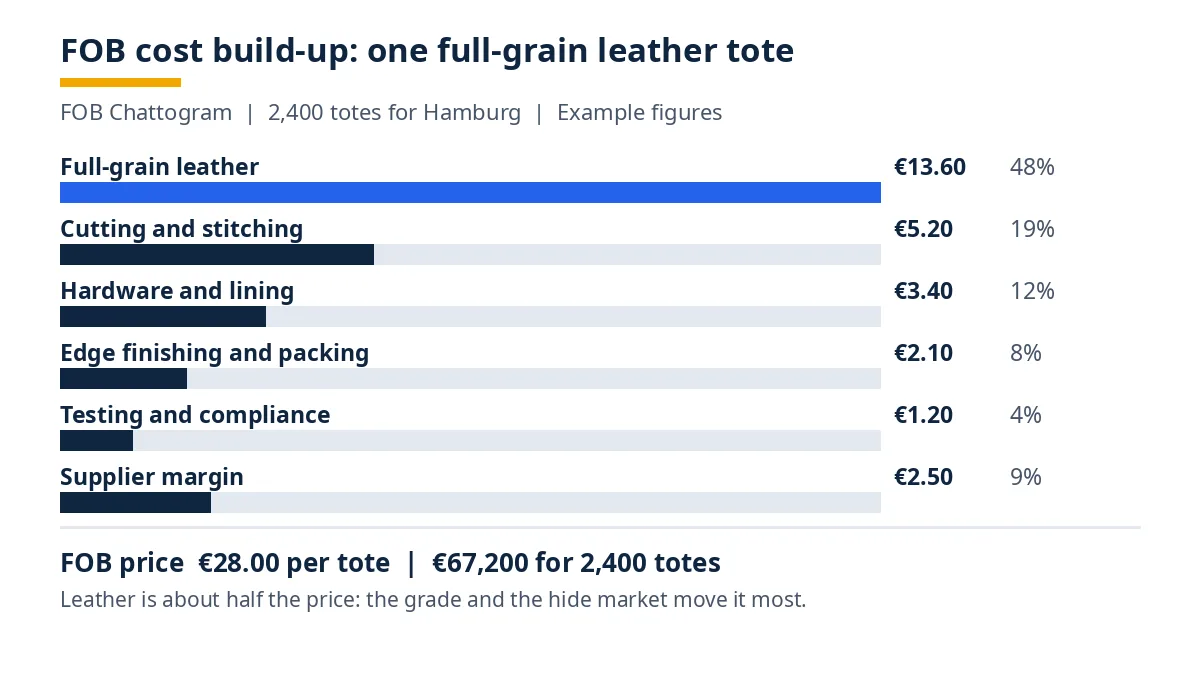
Product price, FOB Chattogram (2,400 x 28.00) | 67,200 |
Freight and insurance to Hamburg | 4,800 |
Customs value (CIF) | 72,000 |
Duty at 3% of 72,000 | 2,160 |
Value for VAT (72,000 + 2,160) | 74,160 |
VAT at 19% of 74,160 | 14,090.40 |
Customs broker fee | 350 |
Port handling | 420 |
Delivery to warehouse | 480 |
Total cash outlay | 89,500.40 |
Net cost ex-VAT | 75,410 |
Cost per piece ex-VAT | 31.42 |
Check it: 2,400 at 28.00 euros is 67,200 euros; plus 4,800 euros freight and insurance, the CIF value is 72,000 euros; 3 percent of that is 2,160 euros; 19 percent of 74,160 euros is 14,090.40 euros; the lines add to 89,500.40 euros, or 31.42 euros per piece ex-VAT.
Bag inspection points
Run the sampling to ISO 2859-1, at General Inspection Level II, and set the acceptance quality limit (AQL) for each defect class, with zero tolerance for critical defects.9 For a 2,400-piece lot at Level II the sample is 125 pieces, drawn at random across colours and cartons.9
Name the defect classes in the order. Critical defects include a chrome VI report above the limit, a wrong leather grade, or hardware that breaks under a pull test. Major defects include a zip that sticks or separates, a handle that pulls away, edge paint that cracks when flexed, or measurements outside tolerance. Our leather bags quality control checklist gives your inspector the same points as a checklist.
Six mistakes that cost leather-bag importers money
Paying a full-grain price for corrected grain. The grades are not regulated.2
Ordering vegetable tanned leather on a chrome tanning timetable. Vegetable tanning takes 30 to 60 days against 1 to 2 days for chrome tanning.3
Filing the entry on the six-digit code. The EU uses a ten-digit code, and the usual line for a leather handbag is 4202 21 00 90.4
Accepting a chrome VI report from another article. The limit for leather articles that touch the skin is less than 3 mg/kg.6 Test the bulk leather from the production tannage.
Letting a paper hold the container. Nothing loads without the Shipping Bill, which needs the EXP form plus the origin certificate.8
Paying the balance before the inspection report is read. Keep the final payment behind the inspection report.
Import checklist
Bag defined as numbers: grade, tannage, hardware, lining, stitching, sizes, packing.
EU line settled: heading 4202, ten-digit code, 3% duty, import VAT, EORI number in hand.
Makers shortlisted; quotations compared on one Incoterms rule.
Samples signed off in writing at each round, with the chrome VI report.
Inspection plan in the order: ISO 2859-1, level II, AQL values, defect classes.
Order confirmed: quantities, price, payment terms, packing and sailing date.
Export file complete: Shipping Bill, EXP form, origin certificate.
Freight and insurance arranged, bill of lading received.
Broker holds the code and entry papers before the vessel berths.
Goods received and checked against the sealed sample; order file closed.
FAQs
What duty do leather bags from Bangladesh pay in the EU?
A leather handbag under subheading 4202.21 pays 3 percent duty on the customs value, and import VAT applies on the value plus duty, 19 percent in Germany.4
How do I know the leather is really full-grain?
Ask for the cut, the surface and the tannage in writing, and check the swatch under magnification: full-grain keeps the natural grain surface with its pores intact, while top-grain has that surface sanded or buffed.2
Is LWG certification required to sell leather bags in the EU?
No law requires it, but many EU buyers ask for it, and only seven companies in Bangladesh hold it.1 Check the certificate number and the expiry date.5
Next steps on Exportain
Start with our importing from Bangladesh guide, which covers the wider process, then read the leather goods industry guide for the sector behind your order, and post an RFQ with your grade, tannage, hardware list and delivery term.
Sources
- Leather sector spots 'hope' despite old troubles. bdnews24, (accessed )
- Leather Grades Explained: From Full-Grain to Bonded. Bespoke Bags (accessed )
- Leather Tanning: The Tanning Process Explained (2026 Guide). Steel Horse Leather (accessed )
- Importing leather handbag into the EU: duty and VAT. Tarific (accessed )
- Leather Worth Learning About: Why LWG Certification Matters. DELSEY, (accessed )
- Chromium VI in leather. SATRA (accessed )
- Incoterms® 2020. International Chamber of Commerce (ICC) (accessed )
- Bangladesh Trade Portal FAQ: Export Registration Certificate (ERC). Bangladesh Trade Portal (accessed )
- AQL Sampling Explained for Importers. Importivity, (accessed )
About the author
Sourcing from Bangladesh?
Post a request for quotation and suppliers on Exportain can send you their quotes directly.
Post an RFQ