

Quality Control Checklist for Leather Bags From Bangladesh
Leather bags quality control checklist for Bangladesh orders: grain and surface defects, shape and measurements, stitching and edge paint, hardware and strap anchors, lining and interior, lab evidence, and packing, with a numbered checklist, failure fixes, and a summary table.
Short answer
This leather bags quality control checklist covers leather type and grain, surface defects graded by position and size, shape and measurements, stitching and edge paint, zipper and closure function, hardware finish, handle and strap attachment, lining and interior, odor and labels, lab evidence by named method, shape-holding packing, and the sampling decision. Use it before production, during production, and at the final inspection on finished, packed bags.
On this page
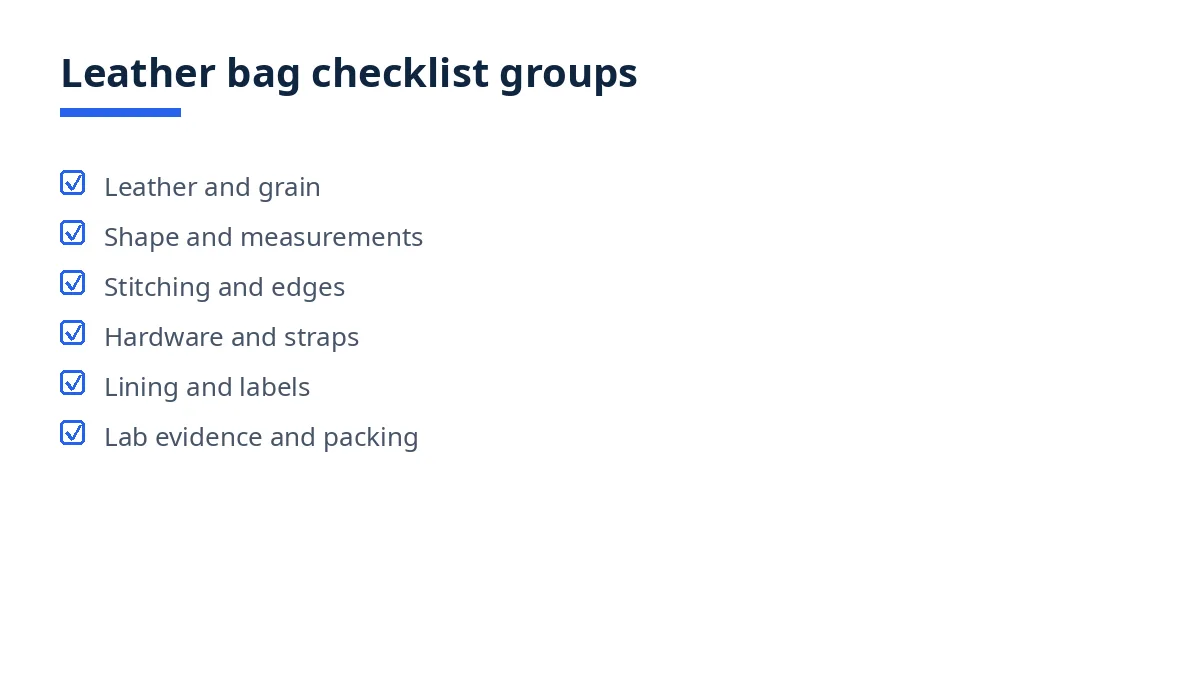
A leather bag that looks right in a photograph can still fail in the hand, at the clasp, or at the strap anchor. Leather is a natural material, so panels from one order can differ in grain, shade, and surface marks, and a bag is a working object: it opens, closes, carries weight, and holds its shape. This checklist follows that order, from leather through shape, stitching, edges, hardware, lining, labels, lab evidence, and packing.
Why this checklist matters
Leather problems are often grading problems. Genuine leather comes from animal hides, so natural marks such as scars, insect holes, blood veins, and growth wrinkles are inherent, and the inspection goal is grading rather than zero defects.1 Grading turns on position and size: damage in a corner area may mean only a grade drop, while damage in the main material area may scrap the whole hide.1
Hardware is the second reason a bag checklist differs from a garment checklist. An importer guide notes that inferior hardware is one of the most common reasons for customer complaints, even when the leather quality is excellent.2 A leather goods inspection account lists the same pattern: broken zippers or clasps, weak or detached handles and straps, and defective hardware.3 The same importer guide notes that quality control begins with raw material verification, continues during production, and concludes with a final product inspection.2
Before you start
Agree the reference set in writing before bulk production.
Approved sample and tech pack. The sealed, approved bag with its tech pack: leather type and grain, thickness, panel layout, edge finish, hardware, strap and handle construction, lining, interior layout, and dimensions.2
Measurement method. Each point, whether the bag is measured empty or filled, open or closed, and how a soft bag is supported. Use the same condition for every bag.
Defect list with classes. Which faults count as critical, major, or minor for this bag, with photos for borderline cases, plus a rule for natural marks by position and size.1
Sampling plan. The standard, inspection level, and AQL values the buyer has specified per defect class, plus the action on a fail. AQL figures here are buyer-specified values only, never a universal rule for leather bags.
Light, function, and test details. The light source for color, how each closure and strap is operated, and the lab method for each test. A leather goods inspection account lists ISO 17075 for colorfastness to rubbing among its laboratory tests.3
The full checklist (numbered, printable)
Work through the list in order. Mark each item pass, fail, or not applicable, and photograph every fail.
Leather type and grain. Against the tech pack and sample: full-grain, top-grain, suede, nubuck, or the other type the order specifies.2
Grain consistency across panels. Grain consistent across panels of one bag and across bags in the lot.3
Surface defects, graded by position and size. Scars, insect holes, blood veins, loose grain, cracking, wrinkles, holes, scratches, and dents, judged by position and size.1
Thickness consistency. Thickness even across panels and across bags.2
Panel shade under the agreed light. Shade of each panel against the approved standard under the agreed light.1
Shade across pieces and batches. Shade between bags, between panels of one bag, and between the bag and its strap and trim pieces.2
Shape and silhouette. Against the sample: the bag holds its shape when set down, carried, and opened.
Base and standing. Base flat and even, so the bag stands as designed without rocking.
Length, width, and depth. Each against the size chart and buyer-specified tolerance.2
Handle and strap length and drop. Handle length, strap length, and drop against the chart, left and right matching each other.
Pocket size and position. Pocket dimensions and positions against the tech pack, exterior and interior.2
Stitching lines and density. Stitch lines straight and stitch density even, against the approved sample.2
Stitching at stress points. Stitching at handle bases, strap anchors, corners, flap joins, and pocket mouths, reinforced where specified.2
Loose threads, skipped stitches, and open seams. None, inside or outside.3
Edge paint and coating, smooth and even. Edges smooth, evenly painted or burnished, free from cracks and peeling.2
Edge cracks, peeling, and rough edges. No cracked, peeling, rough, or unfinished edges, especially on handles, flaps, and corners.
Zipper operation. Each zipper run through its full length several times: smooth travel, no catching, and no tooth separation.3
Clasp, buckle, snap, and magnetic closure function. Each closure operated through its full range: clasps closing, buckles adjusting and holding, snaps engaging, and magnetic closures closing.3
Rivet, D-ring, and hook attachment and finish. Rivets, D-rings, hooks, and studs firmly attached, correctly placed, and finished without burrs.3
Hardware finish consistency. Finish consistent across the bag and across the lot: no rust or mismatched plating.2
Handle and strap attachment strength, as a buyer-specification test. Anchors checked by the attachment test type the buyer specification names, with method and recorded result, and no force figure stated here.3
Lining material and attachment. Lining matching the tech pack, correctly placed, and lying flat.
Interior pockets, dividers, and interior finish. Interior pockets and dividers in the specified positions, with no visible glue marks inside the bag.3
Odor, as a buyer-specification check. Odor checked against the buyer specification and recorded, with any strong chemical odor noted as a finding for the buyer to judge.3
Labels, branding, and logo position. Main label, care label, size label where specified, and logo or branding: correct content, spelling, and position.3
Lab evidence, by named method and recorded result. Where the buyer specification requires laboratory tests, the report names the method and records the result against the buyer specification, with no universal grade or pass mark stated here, including colorfastness to rubbing under ISO 17075 where specified3 and abrasion testing by the method the buyer specification names.
Packing that holds the shape, then the sampling decision. Dust bag, tissue, stuffing, polybag, and carton as specified, packed so the bag keeps its shape in transit and no hardware presses into the leather.2 The agreed sampling plan is then applied to the finished, packed lot. As a published standard-table example only, a lot of 3,201 to 10,000 bags at General Inspection Level II gives code letter L and a sample size of 200, with acceptance and rejection numbers of 10 and 11 for major defects at AQL 2.5 and 14 and 15 for minor defects at AQL 4.0.4 Those numbers are buyer-agreed values, not values the standard mandates for leather bags.
Common failures and how to fix them
Edge paint that cracks or peels. This points to the edge finish, not to the leather panel. Re-check edge preparation and paint layers against the sample, then re-run the edge check after correction.
Zipper that catches halfway. This usually has a tape, tooth, or alignment fault at that point. Run the zipper slowly to locate the catch, and replace the section or the zipper rather than forcing it.
Strap anchor that loosens under use. This is an anchor fault. Check the anchor stitching, rivets, and reinforcement against the tech pack, and re-run the attachment check after correction.
Shade split across panels. Panels matching under one light and differing under another are a light and lot problem. Re-check under a second light, and hold unmatched lots.
Lining that twists or bunches. This is a placement or attachment fault. Check the lining cut, attachment points, and ease against the sample.
Bag that slumps after packing. This is a packing fault. Check the stuffing, tissue, and carton fit against the specification, and re-check a packed carton.
Downloadable template / summary table
No file download is offered with this article. Use the table below as the printable summary: copy it into your inspection sheet, add one row per sampled bag.
Check group | What to check | Record |
|---|---|---|
Leather and grain | Type, grain, surface defects, thickness | Mark position |
Shape and measurements | Silhouette, base, dimensions, strap drop, pockets | Against chart |
Stitching and edges | Lines, density, stress points, edge paint | Photographed |
Hardware and straps | Zippers, closures, rivets, finish, anchor test | Method and result |
Lining and interior | Lining, pockets, dividers, glue, odor | Buyer finding |
Labels and lab evidence | Labels, branding, named lab methods | Method and result |
Packing and sampling | Shape-holding packing, lot, sample, Ac and Re | Counts and decision |
How Exportain helps
Exportain connects buyers with Bangladeshi sellers and service providers, and it does not itself inspect goods. The inspection contract is always between the buyer and the inspection provider, and the provider works to the buyer's checklist and pass criteria. For the inspection step, see the inspection services category on Exportain, with the exact caveat that applies there: No services published in this category yet. Use this checklist as the product-specific layer the provider checks against, alongside the approved sample and tech pack.
FAQs
When should this checklist be used?
At three stages: before production, when leather, hardware, and edge finish are approved; during production, when early finished bags show whether faults are repeating; and at the final inspection, on finished, packed bags.
Who should complete it?
The buyer, the buyer's inspection provider, or the supplier's own quality team can each complete it, but the roles must be kept separate: a supplier checking its own work is factory quality control, not an independent inspection. The final check must follow the buyer's sample, tech pack, and defect list.
What are the most common failures?
In leather goods inspection, the recurring failures are broken zippers or clasps, weak or detached handles and straps, defective hardware, uneven dyeing or color variation, misaligned stitching or loose threads, visible glue marks, weak seams or poor edge finishing, and inconsistent grain.3 The leather accessories list adds uneven stitching, weak edge paint, and color variation beyond the approved tolerance.2
Can a third party do it?
Yes. A third-party provider can carry out the sample check, the during-production check, and the pre-shipment check against this checklist and the buyer's sampling plan, and can arrange laboratory testing where the buyer specification requires it. Book the provider against the agreed checklist, and require a report recording the lot, sample size, defects with photographs, measurements, and packing findings.
Next steps on Exportain
Write the bag specification, defect list, and sampling plan into one requirement, then read the AQL guide and the pre-shipment inspection guide before you set values for a leather bag order.
Sources
- Genuine Leather Inspection | Grading and Defects. NITR (accessed )
- Leather Accessories Quality Checklist for Importers. Walletsplus (accessed )
- Leather Goods Inspection and Quality Control in Asia & China. V-Trust (accessed )
- AQL Calculator | Sample Size and ISO 2859-1 Tool. AQMBD (accessed )
About the author
Sourcing from Bangladesh?
Post a request for quotation and suppliers on Exportain can send you their quotes directly.
Post an RFQ


