Jute Rugs and Carpets Exporters: A Buyer Verification Guide
Five stage gates for checking a jute rug exporter in Bangladesh before you order: the registration pack, the export record, the factory floor, the sample protocol and the inspection terms.
Short answer
Check a jute rug exporter in Bangladesh in five gates, in order: read the registration pack, including the ERC, trade licence, e-TIN, BIN and bank account; test the export record with shipping papers and buyer references; audit the factory floor on a live call or visit; test a sample rug for size, GSM, pile and colourfastness; and fix the sampling plan and payment terms in the order. A fail at any gate stops the order.
On this page
Key takeaways
Run five gates in order: papers, export record, factory floor, sample, inspection terms.
The ERC must be in the exporter's own name, in date, and match every other paper.
Test the sample for size, GSM, pile height and colourfastness before approving bulk.
Write the ISO 2859-1 sampling plan and the payment terms into the order.
Any single red flag, from a mismatched ERC to a refused factory call, ends the negotiation.
A jute rug exporter in Bangladesh is worth ordering from only after five checks pass in order: the registration papers, the export record, the factory floor, the sample, and the inspection terms. A fail at any gate stops the order until the exporter fixes it.
This article is for a first-time buyer of braided, flatweave or tufted rugs from Bangladesh, with no existing relationship with the exporter.
How the five verification gates work
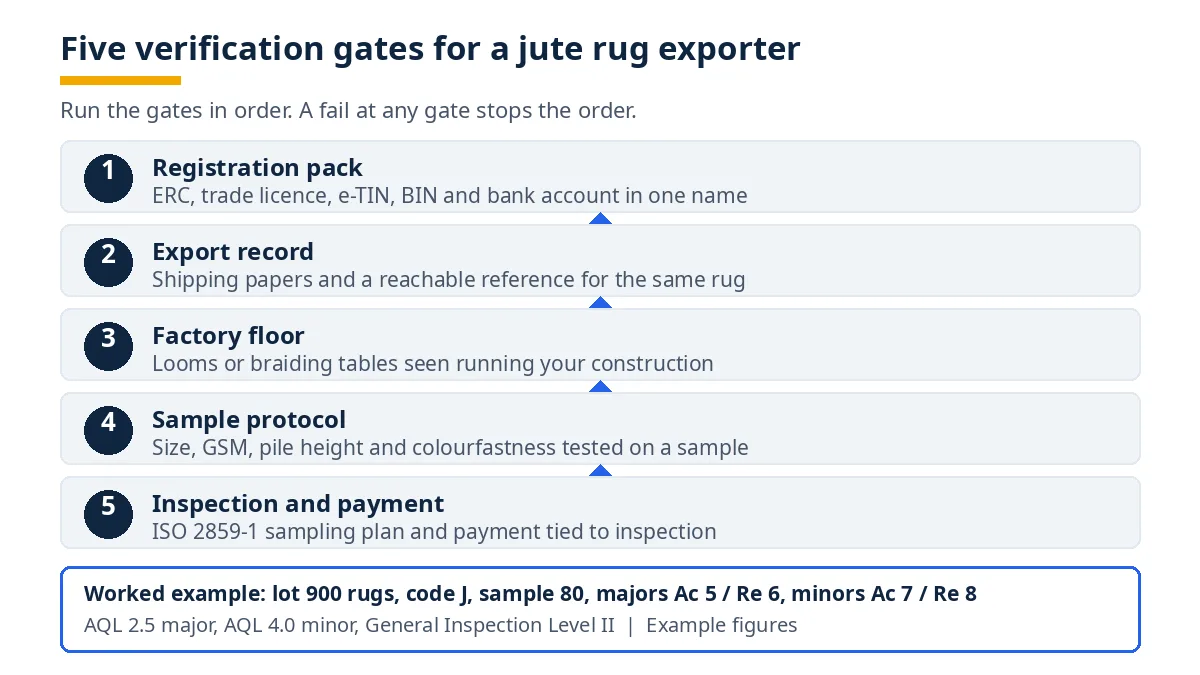
Run the gates in order and pay nothing beyond a sample fee until Gate 4 passes.
Gate | Question it answers | Pass rule |
|---|---|---|
1. Registration pack | Can this firm sign export papers in its own name | Every document in the same name and in date |
2. Export record | Has it shipped rugs abroad before | Shipping papers and a reachable reference |
3. Factory floor | Does it make the rugs, or buy them in | Looms or braiding tables seen running |
4. Sample protocol | Does the rug meet your specification | A sample rug passes your tests |
5. Inspection and payment | Who decides the lot passes, and when do you pay | A sampling plan and payment tied to inspection |
Keep one file per exporter with the replies, the document copies and the sample results.
Gate 1: Read the registration pack before the price
Ask for the registration pack in the first reply, before you discuss price. A firm that sends the pack without being asked twice is already behaving like an exporter.
The pack has five items: a trade licence for the business address; an Export Registration Certificate, the ERC, in the exporter's own name; an e-TIN for income tax; a Business Identification Number, the BIN, for VAT; and an account with an authorised dealer bank.1
Read the ERC first. The Chief Controller of Imports and Exports issues it under the Importers, Exporters and Indentors (Registration) Order 2023, in force from 1 April 2024.2 Check the copy for four things: the name agrees with the quotation and the bank account, the certificate covers export, the expiry date has not passed, and the ERC number is the number on the firm's invoices. A renewal can cover one to five years; apply at least 60 days before the old certificate runs out.1
Ask if the ERC was ever suspended or cancelled. The 2023 Order permits either, and a cancelled certificate blocks the bank from handling new export papers.2 Match the names across every paper, since banks pay against documents and a name that differs can delay or stop payment.3 An Exportain badge shows documents and photographs were reviewed, not a factory visit. Our manufacturers guide explains the difference between a mill exporter, a trading exporter and a buying house.
Gate 2: Test the export record, not the sales pitch
A registration pack proves a firm may export, not that it has shipped rugs. Ask for the shipping papers of a recent rug order, with prices and buyer names blanked out, and two buyer references for the same construction. A reference that stays silent, or papers that show only domestic sales, leave the export history unproven.
Read the papers for three details: the construction, which should match what you asked for; the destination, which should be a market with rules like yours; and the dates, which should be recent.
Rugs are a small slice of Bangladesh's jute trade, made mostly by smaller workshops. Per Export Promotion Bureau figures, jute and jute goods earned 820.16 million dollars in 2024-25, after 855.23 million dollars in 2023-24.4 A thin record is normal; what matters is whether it is real, recent and for rugs. Ask who made the rugs on those past orders.
Gate 3: Audit the floor: looms, dyeing, backing and finishing
Run Gate 3 on a visit, or on a live video call. A recorded video is not enough: ask for a live call and ask the camera to move.
For braided rugs, look for braiding tables and stitching lines. For flatweave, look for looms running in the width you ordered. For tufted rugs, look for the tufting frame and the station where the second backing is glued on. For hand-knotted rugs, look for knotting looms with work in progress. If the floor shows none of this, you are dealing with a trader.
Jute takes dye unevenly, and the natural shade varies from pale beige to rich caramel. Ask how the exporter keeps one dye lot consistent and whether the dye house is on site or a separate unit.
Chemical risk concentrates in the backing of tufted rugs. Ask what the second backing is made of and what adhesive holds it: a certificate for the face yarn alone leaves the rest of the rug untested. OEKO-TEX Standard 100 tests every thread, button and accessory of a certified article against a list of more than 1,000 harmful substances, and rugs fall in product class 4, home textiles and decoration materials.5
Look for the trimming table, the edge binding, the measuring table and the packing area, and ask where rejected rugs go. If the exporter refuses a live call or a visit, treat that as a fail at this gate.
Gate 4: Run the sample protocol: GSM, pile and colourfastness
Never approve bulk production from a catalogue photograph. Ask for one sample rug in your largest size and your darkest shade. It should arrive with a tag stating the construction, blend, yarn count, backing and dye lot. Keep one approved sample sealed as the reference.
Test the sample in four steps. Measure it unrolled and flat: length and width at three points each, against a tolerance of plus or minus 2 per cent. Weigh a 10 by 10 cm piece to work out the grams per square metre, the GSM: a rug far lighter than quoted uses less yarn than you paid for. Measure pile height on tufted rugs at five points. Check the edges and backing for curling corners, stitch gaps, loose selvedges and peeling.
Then run the rub test under ISO 105-X12, dry and wet: a white cotton cloth is pressed against the rug with a force of 9 newtons, moved back and forth for 10 cycles, and the colour transfer is graded on a grey scale from 1, severe staining, to 5, no staining.6 For pile fabrics the test uses a rectangular crock block, 19 by 25.4 mm.6 If the sample fails, ask for a second sample; two failed samples in a row is a fail at this gate.
Gate 5: Fix inspection and payment in the order
Put the inspection plan and the payment terms in writing before production starts.
Write the sampling plan into the purchase order. The final random inspection runs under ISO 2859-1, once production is finished and at least 80 per cent of the order is packed.7 General Inspection Level II is the level most buyer programmes use: AQL 0 critical, 2.5 major and 4.0 minor defects.7 Name the inspection firm and who pays for a re-inspection if the lot fails.
For a first order, use an irrevocable confirmed letter of credit, or pay a smaller advance and hold the balance until the documents arrive. Our letter of credit guide explains how the bank pays against matching documents. Full advance payment before the sample is approved is a fail at this gate.
Export proceeds must normally be repatriated within four months of shipment, and the EXP form is declared at full invoice value through an authorised dealer bank.2 For raw jute and jute goods, payment terms can stretch to 360 days when the buyer opens an irrevocable confirmed letter of credit.2 Within 14 days of shipment the exporter must give its bank the signed EXP copy and the certified Bill of Export.2 The EXP form declares the export to the bank and the Bill of Export declares the goods to Customs.3 The quality control checklist sets out the checks for the sample rug and the packed cartons.
Six red flags that end the conversation
Any one of these ends the negotiation. Do not try to price around them.
There is no ERC, or the ERC names a different firm.
The exporter will not name the workshop that makes the rugs, or refuses a live video call from the floor.
The sample arrives in a different construction, blend or shade from the one you specified, with no explanation.
The dye transfers heavily in the wet rub test, or there is no lab report for the rug.
The exporter asks for the full amount before the sample is approved, or refuses an inspection clause in the order.
The papers disagree: the company name on the invoice is not the name on the ERC, or the quantity on the packing list is not the quantity on the invoice. A small mismatch under a letter of credit can delay payment.3
When you walk away, say so in one short message and keep the file.
Worked example: 900 tufted rugs for a Toronto buyer
Example figures. A homeware buyer in Toronto orders 900 tufted jute rugs: 160 by 230 cm, two shades, 450 rugs of each shade, FOB Chattogram.
The buyer asks four exporters for the registration pack. Two send the full pack in the same company name; one sends an ERC in a different name; one sends a price and a photograph. Of the two with clean packs, one shows shipping papers for tufted rugs to the United States and a reference who answers, the other shows papers for jute sacks.
The sample rug measures within tolerance, weighs in at the quoted GSM, and passes the dry and wet rub tests with grey scale grades of 4 and 4. The buyer seals it as the reference and approves bulk.
Cost line | Example figure |
|---|---|
Goods: 900 rugs at 21.00 dollars | 18,900 dollars |
Third-party inspection | 600 dollars |
Sea freight to Toronto | 2,700 dollars |
Total landed | 22,200 dollars |
Landed cost per rug | 24.67 dollars |
Under ISO 2859-1, a lot of 900 rugs sits in the 501 to 1,200 band, giving code letter J and a sample of 80 rugs at General Inspection Level II.7 At AQL 2.5 the lot passes with five or fewer major defects and fails at six; at AQL 4.0 it passes with seven or fewer minor defects and fails at eight.7 One critical defect fails the lot.
The buyer writes the plan into the order and pays by irrevocable confirmed letter of credit, releasing the balance only after the inspection report arrives.
Questions buyers ask about rug exporter checks
How long does the five-gate check take?
About three to five weeks: a few days for the papers and the export record, a week for the factory call and the sample, a week for the sample to arrive and be tested, and a few days to agree the inspection plan and payment terms. A faster timetable usually means a gate was skipped.
Can I skip the factory audit if the exporter sends a certificate?
No. A certificate covers a named article, at a named site, for a limited time. It does not show that the workshop making your rugs is the workshop on the certificate. The live call or visit is what ties the papers to the floor.
What should the quotation state before I compare prices?
The construction, blend, yarn count, GSM, backing, size, shade, quantity per carton, Incoterm, port and what the price covers. Our price guide takes a rug quotation apart line by line.
Next steps on Exportain
Run Gate 1 today: ask each exporter for the five registration papers, then search Bangladeshi suppliers and raise an RFQ listing the construction, blend, size, shade and quantity, and ask for the ERC number and the mill behind the rugs in every reply. For classification and duty, read the classification guide before the container is booked.
Sources
- Start an Export Business in Bangladesh (2026 Guide). Entrepreneurs.bd (accessed )
- Export Law Bangladesh 2026: Critical Rules for Exporters. TRW (accessed )
- The papers that move trade. Open Trade Bangladesh (accessed )
- Exports of jute and jute goods keep falling. The Financial Express, (accessed )
- OEKO-TEX Standard 100. OEKO-TEX (accessed )
- ISO 105-X12 Textiles Tests for colour fastness to rubbing. UnitedTest (accessed )
- Textile Quality Control: AQL Sampling And Inspection Guide. TextileTuts (accessed )
About the author
Sourcing from Bangladesh?
Post a request for quotation and suppliers on Exportain can send you their quotes directly.
Post an RFQ