Jute Rugs and Carpets Price in Bangladesh: FOB Cost Breakdown for Buyers
A 120 by 180 cm flatweave jute rug at 14.20 dollars FOB works out at 6.57 dollars per square metre. This guide breaks that price into nine cost lines, shows how fibre, weight and dyeing move it, and builds the landed cost to Felixstowe.
Short answer
Under FOB Chattogram, a jute rug price covers fibre, spinning, weaving, dyeing, backing, labour, packing, inland freight and export handling up to loading on board, and nothing after it. Compare quotations per square metre on the same construction, weight, shade and quantity. Example figures put a 120 by 180 cm flatweave rug at 14.20 dollars FOB, or 6.57 dollars per square metre, with fibre and weaving taking 54.6 per cent of the price.

On this page
Key takeaways
FOB covers everything up to loading on board at Chattogram; freight, insurance, duty and tax sit with the buyer.
Compare rug quotations per square metre on the same construction, weight, shade and quantity, not per piece.
Fibre and weaving take 54.6 per cent of the example FOB price of 6.57 dollars per square metre.
Example figures price 1,800 flatweave rugs at 37,682 dollars landed in the UK, or 20.93 dollars a rug.
A homeware buyer in Manchester is comparing two quotations for the same flatweave jute rug, 120 by 180 cm, in a dyed sage shade. One maker quotes 14.20 dollars a rug, free on board Chattogram. The other quotes 11.80 dollars a rug, with no port named and no list of what the price covers. The gap may be a saving, or a price that stops at the factory gate, leaves out packing, or uses a thinner yarn. This guide takes the price apart line by line.
What does FOB mean for a jute rug order?
FOB stands for Free On Board. Under Incoterms 2020, it covers shipments by sea or inland waterway, and the seller's job ends once the rugs are loaded onto the ship the buyer chose at the port both sides named in the contract.1 From that loading moment, the risk of loss or damage sits with the buyer.1
That definition draws a clear line through the price. Everything up to loading at Chattogram sits with the seller: fibre, yarn, weaving, dyeing, backing, packing, the truck to the port, and export clearance. Everything after loading sits with you: ocean freight, insurance, discharge, import clearance, duty, and delivery to your warehouse.1 Insurance is not part of the bargain for either side under this term.1 Name the port, because FOB Chattogram is a price and FOB on its own is not, and handing the container to a forwarder warehouse does not finish the seller's delivery; the rugs must be loaded onto the ship.1
How much do jute rugs cost per square metre?
There is no published FOB price list for jute rugs from Bangladesh, and any figure quoted without a construction, a size, a shade, and a quantity is a starting point, not a price. Marketplace listings show the spread: hand-braided round jute rugs from Bangladeshi sellers are listed at 0.60 to 1.50 dollars per square foot, a flat-pile handmade jute rug at 17 to 20 dollars a piece for 1,000 pieces, and small braided pieces from 0.39 dollars a piece.2 Those are asking prices, not FOB quotations, and they mix pieces of very different sizes.
Compare on the square metre: divide the price per rug by its area. A 120 by 180 cm rug covers 2.16 square metres, so 14.20 dollars a rug is 6.57 dollars per square metre, while 11.80 dollars is 5.46 dollars. A 200 by 290 cm rug covers 5.80 square metres, so the same 14.20 dollars a rug would be only 2.45 dollars per square metre. Always ask for the price per square metre, and whether the figure is FOB, ex-works, or something else.
What makes up the FOB price of one square metre?
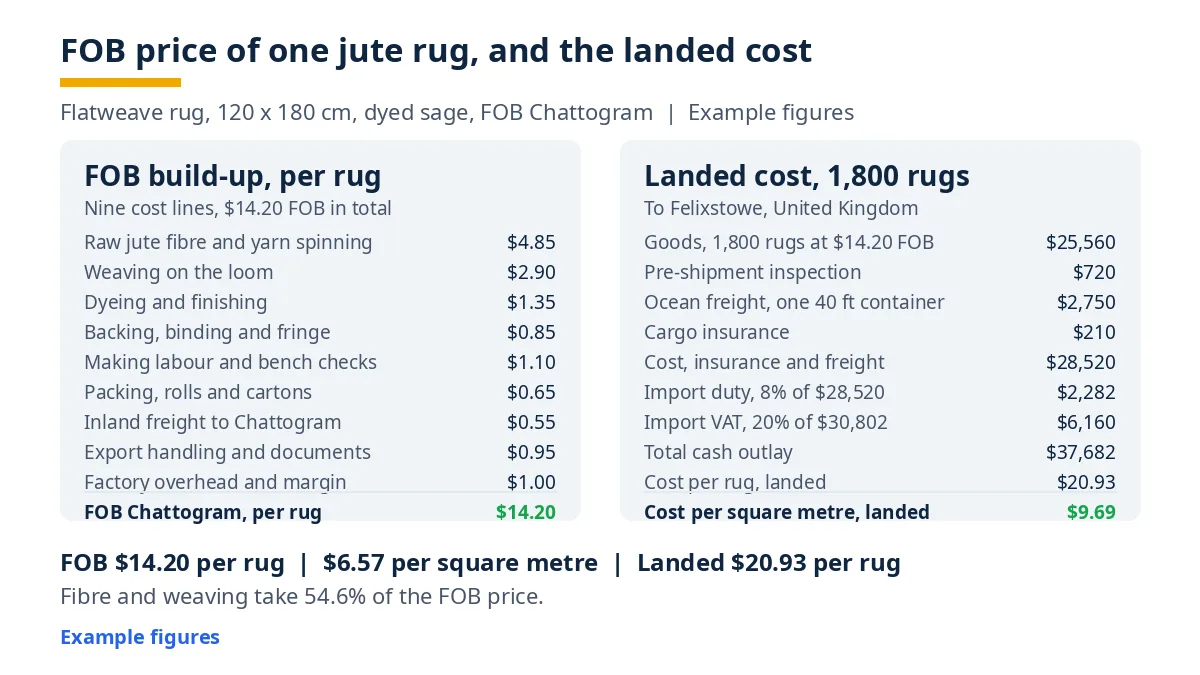
Nine cost lines sit inside a normal FOB rug price, set out below for one flatweave rug, 120 by 180 cm, dyed, with a bound edge, at an order of 1,800 rugs. All figures are example figures.
Cost line in the FOB price | Example, per rug | Example, per square metre | Share of the FOB price |
|---|---|---|---|
Raw jute fibre and yarn spinning | 4.85 dollars | 2.25 dollars | 34.2 per cent |
Weaving on the loom | 2.90 dollars | 1.34 dollars | 20.4 per cent |
Dyeing and finishing | 1.35 dollars | 0.63 dollars | 9.5 per cent |
Backing, binding and fringe | 0.85 dollars | 0.39 dollars | 6.0 per cent |
Making labour, cutting and bench checks | 1.10 dollars | 0.51 dollars | 7.7 per cent |
Packing, rolls and cartons | 0.65 dollars | 0.30 dollars | 4.6 per cent |
Inland freight to Chattogram | 0.55 dollars | 0.25 dollars | 3.9 per cent |
Export handling, documents and terminal charges | 0.95 dollars | 0.44 dollars | 6.7 per cent |
Factory overhead and seller margin | 1.00 dollars | 0.46 dollars | 7.0 per cent |
FOB Chattogram, total | 14.20 dollars | 6.57 dollars | 100 per cent |
Fibre and weaving together take 54.6 per cent of the price, so those two lines decide most of the difference between quotations. Dyeing, backing, and packing are smaller, but they are where a quotation most often goes quiet.
Why does the same rug cost more from one maker than another?
Raw fibre is the first mover. In September 2026, market reports put raw jute in Bangladesh at around 4,000 to 4,500 taka per maund, about 810 to 915 dollars per tonne, with better-quality fibre fetching up to 4,800 taka per maund.3 The same report put jute yarn and twine export prices up by about 70 to 90 dollars per tonne in the month.3 A quotation written before a fibre rise and one written after it come from different fibre markets, so ask when it was priced and how long it holds.
Weight is the second mover: a flatweave rug at 240 grams per square metre uses far less yarn than a heavy braided rug of the same size, so ask for the weight and measure the sample against it. Construction is the third: braiding is hand work, flatweave runs on a loom, and tufting adds a glued backing, each with a different labour cost.
Dyeing and order size are the last two movers. A natural shade needs no dye lot, while a dyed shade needs yarn dyed in one batch and approved before production, and a Pantone-matched shade costs more than one from the maker's own card. Fixed costs also spread across the order, so a larger order carries a lower fixed cost per rug.2
How should you read a rug quotation line by line?
Ask for the quotation on one page, with each of the nine lines from the table above shown separately. A quotation that shows only a total gives you nothing to check.
Work through the page in this order: the specification, with construction, size, weight, blend, shade, backing, and quantity in numbers; the price basis, with the port named and the Incoterms edition stated; the inclusions, each marked as included or separate; and the validity, because fibre prices move.3 Then ask what happens if the quantity changes by a quarter, if the shade changes after the sample is approved, and what is charged separately. Write the answers into the purchase order.
What does the FOB price leave out?
The FOB price stops at the ship. For fiscal 2024-25, EPB figures put exports of jute and jute goods at 820.16 million dollars, against 855.23 million dollars in the prior year, and jute yarn and twine accounted for 461.83 million dollars of the total.4 That trade is priced mostly on FOB terms, so the freight, duty, and tax that follow are the buyer's arithmetic, not the seller's.
Ocean freight is the largest line after the goods themselves, priced by the container, not by the rug. A standard 40-foot dry container holds about 67.7 cubic metres and carries a maximum payload of 28,800 kilograms.5 Rugs are light for their volume, so the container fills on space long before it fills on weight. Import duty follows the classification: most jute rugs fall under heading 5705, and the United Kingdom tariff sets third-country duty at 8 per cent, with value added tax at 20 per cent.6 Duty is calculated on the cost, insurance, and freight value, and tax on the value after duty is added. Bangladesh supplies 282 types of jute goods to 118 countries, through an industry body with 240 member mills.7
Testing and certification sit outside the FOB price unless the quotation says otherwise: OEKO-TEX Standard 100 places rugs in Class IV, and a certificate is valid for 12 months, renewed each year by re-submitting samples.8
Worked example: 1,800 flatweave rugs to Felixstowe
Example figures. A homeware buyer in Manchester orders 1,800 flatweave jute rugs, 120 by 180 cm, dyed sage, 240 grams per square metre, shipped in one 40-foot container from Chattogram to Felixstowe, FOB Chattogram, with the buyer booking freight and insurance.
Cost line | Example figure | How it is worked out |
|---|---|---|
Goods, 1,800 rugs at 14.20 dollars FOB | 25,560 dollars | 1,800 times 14.20 |
Pre-shipment inspection | 720 dollars | Agreed fee, paid before shipment |
Ocean freight, Chattogram to Felixstowe | 2,750 dollars | One 40-foot container |
Cargo insurance | 210 dollars | Arranged by the buyer |
Cost, insurance and freight value | 28,520 dollars | Goods plus freight plus insurance |
Import duty, 8 per cent of 28,520 dollars | 2,282 dollars | United Kingdom duty under heading 57056 |
Import VAT, 20 per cent of 30,802 dollars | 6,160 dollars | 20 per cent of duty-paid value |
Total cash outlay | 37,682 dollars | All lines above added |
Cost per rug, landed | 20.93 dollars | 37,682 divided by 1,800 |
Cost per square metre, landed | 9.69 dollars | 37,682 divided by 3,888 |
The goods are 67.8 per cent of the cash outlay, so a 1 dollar move in the FOB price per rug moves the order by 1,800 dollars. Each vacuum-sealed roll takes about 0.018 cubic metres, so 1,800 rolls take about 32.4 cubic metres against the 67.7 cubic metres a 40-foot dry container holds.5 Each packed rug weighs about 0.65 kilograms, so the lot weighs about 1,170 kilograms against the 28,800 kilogram limit.5
Common mistakes when buyers compare rug prices
Comparing a per-piece price with a per-square-metre price, so the cheaper number turns out to be the smaller rug. Comparing an ex-works price with an FOB price, so the cheaper number is the price before packing, inland freight, and export handling. Accepting a quotation with no weight per square metre, then receiving a rug that uses less yarn than the sample. Treating a marketplace listing as a quotation: listings run from 0.39 dollars a piece to 17 to 20 dollars a piece.2 Forgetting the charges after the ship: freight, insurance, duty at 8 per cent, and tax at 20 per cent in the example above add 11,402 dollars to a 25,560 dollar goods value.6
Questions buyers ask about jute rug prices
What is a normal FOB price for a jute rug from Bangladesh?
There is no normal price: the price follows the construction, the weight, the size, the shade, and the quantity. Marketplace listings run from under 1 dollar a piece for small braided pieces to 17 to 20 dollars a piece for a flat-pile rug.2 Use those listings as a range to test against, then ask each maker for a build-up on your own specification.
Does the FOB price include freight and insurance?
No. The buyer books and pays the ocean leg from the named departure port, and insurance is optional for both sides under this term.1 The seller pays for packing, inland transport to the port, export clearance, and loading on board.1 If a quotation described as FOB includes freight, it is priced on different terms, and the terms should be corrected in writing.
Why did the rug price rise between my first order and my repeat order?
Fibre is the usual reason. Market reports put raw jute at 4,000 to 4,500 taka per maund in September 2026, while jute yarn export prices rose by 70 to 90 dollars per tonne in a month.3 A repeat order priced from a later fibre market will cost more, even when nothing else has changed.
Next steps on Exportain
Work out the FOB build-up for your own rug size and shade from the nine lines in the table above, then check the classification in our guide to classifying jute rugs for customs and the inspection points in our inspection checklist for jute rugs. For the fibre behind the price, read our jute yarn price guide, and for the same build-up on another jute product, read our jute sacks price guide. Once the specification is fixed, look for Bangladeshi suppliers and post an RFQ with the construction, weight, size, shade, quantity, and FOB port named.
Sources
- FOB delivery terms — Incoterms 2020. SimpleDuty (accessed )
- Rug Price in Bangladesh: Best Deals 2025. Accio (accessed )
- Jute Market Report for September 2026. Wilhelm G. Clasen GmbH & Co. KG, (accessed )
- Exports of jute and jute goods keep falling. The Financial Express, (accessed )
- 40 ft Container Dimensions. ContSize (accessed )
- Other carpets and other textile floor coverings, whether or not made up. GOV.UK (UK Integrated Online Tariff) (accessed )
- BYETS and Bangladesh Jute Mills Association Collaborates to Advance Skills in Jute Diversification. Swisscontact, (accessed )
- OEKO-TEX Standard 100: Complete Guide. TextileTuts (accessed )
About the author
Sourcing from Bangladesh?
Post a request for quotation and suppliers on Exportain can send you their quotes directly.
Post an RFQ