Jute Yarn Price in Bangladesh: FOB Cost Breakdown for Buyers
A jute yarn FOB price hides seven cost lines, from raw fibre to export papers. This guide takes the figure apart line by line, with a worked 26-tonne example, the timeline from quotation to loading, and the documents that travel with the yarn.
Short answer
An FOB price for jute yarn from Bangladesh is built from seven lines: raw jute fibre, about 70 per cent of the price, spinning, packing, testing, inland freight to Chattogram, export documents and the supplier margin. Ask every supplier to price FOB Chattogram with the count in both lb per spyndle and tex, compare the lines rather than the totals, and confirm validity, payment terms and the HS code before you accept.
On this page
Key takeaways
Ask for FOB Chattogram with the count in both lb per spyndle and tex, and ask every supplier to price the seven cost lines separately.
Raw jute fibre is about 70 per cent of the FOB price, so the raw jute market moves the quotation more than any other line.
A letter of credit pays against documents, not goods, and an estimated 60 to 75 per cent of presentations are refused the first time.
Single yarn is classified under HS 5307.10 and multiple (folded) or cabled yarn under HS 5307.20, so check the code on the invoice with your broker.
Two quotations arrive for the same yarn: single jute yarn, 7 lb per spyndle, natural, on cones, FOB Chattogram. One reads $1,180 per tonne and the other reads $1,320. This guide takes the FOB figure apart line by line.
What FOB means for a jute yarn order
FOB stands for Free On Board, one of the eleven Incoterms 2020 rules published by the International Chamber of Commerce.1 Under FOB, the seller delivers the goods loaded on board the vessel the buyer nominates at the named port, and risk passes to the buyer at that point.1
The seller loads the goods and clears them for export; the buyer names the carrier and pays freight. FOB applies only to sea and inland waterway transport.1
Ask for the quotation as FOB Chattogram. A price quoted as FOB factory gate is not comparable: the truck to the port, the port charges and the export papers are missing from it or priced another way. Ocean freight, marine insurance, import duty and delivery at destination sit outside the FOB figure. Where the yarn travels in a container handed to a carrier at a terminal, the ICC guidance points to FCA instead.1
The seven lines inside a yarn FOB price
Ask for the seven lines separately.
Cost line | What it pays for | What moves it |
|---|---|---|
Raw jute fibre | Graded fibre, allowing for waste | Raw jute market, grade, count |
Batching, carding, drawing and spinning | Emulsion to winding | Count, batch size, frame time |
Cone packing and cases | Cones, cases, strapping, marks | Put-up, cones per case |
Quality testing | Count, twist, strength tests | Tests named, samples per lot |
Inland freight to Chattogram | Mill to port by truck | Distance, load size, fuel cost |
Export documents and port handling | Papers, port and agent fees | Document set, inspection |
Supplier margin | Supplier's profit | Supplier type, order size, terms |
Raw jute fibre is the heaviest line, about 70 per cent of the FOB price. Floods damaged jute production last year and pushed up the price of raw jute, while yarn and sack makers earn very low margins.2
Spinning turns that fibre into yarn through a fixed sequence. Raw jute is selected and sorted by end use, then softened with a jute batching oil emulsion so the stiff fibre can be handled.3 The emulsion is commonly 20 to 30 per cent water and 2 to 5 per cent jute batching oil, and the fibre is piled for 24 to 48 hours before carding.3 Carding runs through a breaker card and then a finisher card, and drawing and spinning follow before winding.3
Packing protects everything above it: yarn travels wound on cones, packed in cases or bales, strapped and marked, so ask how many cones go in each case. Quality testing is a small line: name the test method for each value in the order and keep one sealed approved cone per count as the reference. Our jute yarn manufacturers guide sets out the lab checks. Inland freight is the truck to the port, and export documents and port handling cover the papers and fees.
The last line is the supplier margin: a mill controls the first two lines directly, while a trading company adds its own margin, so ask each supplier to state in writing whether it makes the yarn or buys it in.
How count, grade and quantity move the price
Fix the count first: two mills can quote the same tonne at different prices for different yarns. A count in lb per spyndle states how many pounds one spyndle weighs, and one spyndle is 14,400 yards of yarn; the tex count states the same yarn in grams per kilometre.3 The conversion follows from the research: 138 tex is 4 lb per spyndle, a factor of about 34.5, so a 7 lb per spyndle yarn is about 241 tex.3 State the count in both units and the ply.
Grade and end use matter as much as the count. Jute yarns are classified by the use they are put to: fine yarns, hessian yarns, carpet yarns and sacking yarns, each split into warp and weft.3 Warp yarns are normally superior to weft yarns, which act more as filler.3 A fine carpet-backing yarn and a coarse sacking yarn are priced differently.
Quantity is the lever a buyer controls most directly: a bigger order lets the mill spread its batching and setting time across more yarn, so the per-tonne price falls. Our wholesale jute yarn guide sets out the listed price bands by count and grade, and our jute yarn MOQ guide works through the levers that bring a small order down. In 2025-26, Bangladesh exported 428,000 tonnes of jute yarn, earning $545.8 million.2
Worked example: 26 tonnes of 7 lb yarn, FOB Chattogram
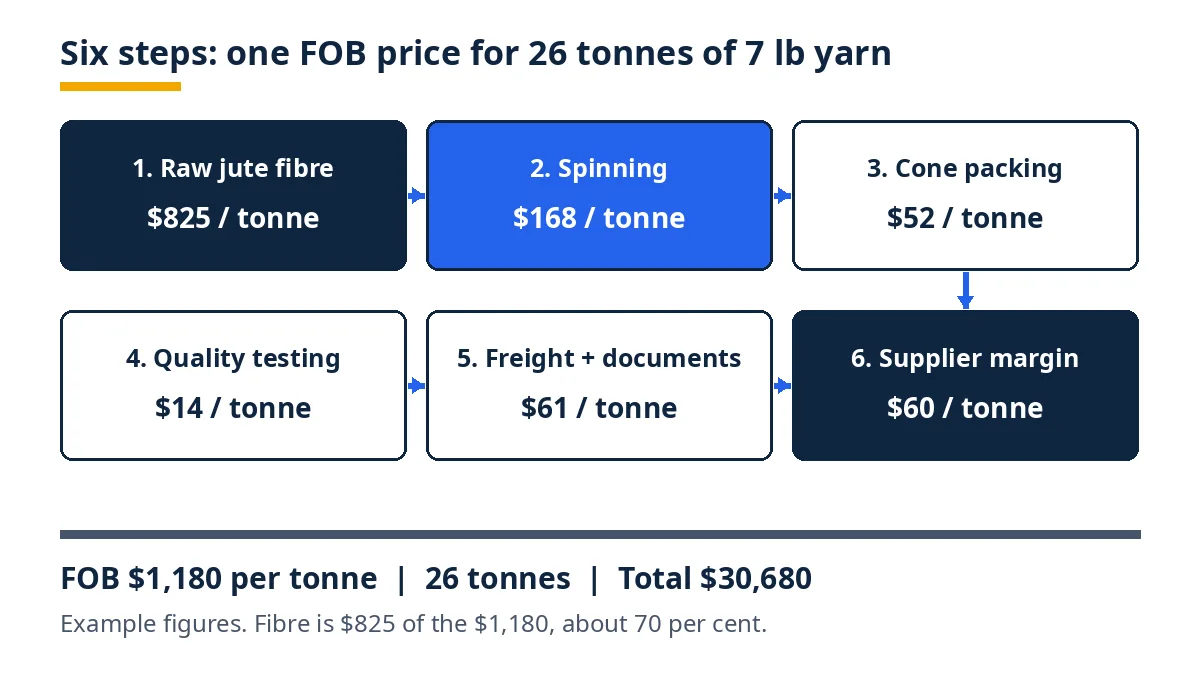
Example figures. A buyer needs 26 tonnes of single 7 lb per spyndle yarn, natural, on cones, for hessian weaving, FOB Chattogram. The diagram below builds the FOB price line by line.
Cost line | Per tonne | Order total (26 MT) |
|---|---|---|
Raw jute fibre | $825 | $21,450 |
Batching, carding, drawing and spinning | $168 | $4,368 |
Cone packing and cases | $52 | $1,352 |
Quality testing | $14 | $364 |
Inland freight to Chattogram | $38 | $988 |
Export documents and port handling | $23 | $598 |
Supplier margin | $60 | $1,560 |
FOB price | $1,180 | $30,680 |
The seven lines add to $1,180 per tonne; times 26 tonnes that is $30,680, or $1.18 per kilogram. Fibre is $825 of the $1,180, about 70 per cent of the price. A $50 per tonne movement in the fibre price moves this order by $1,300.
From quotation to loading: the timeline in order
A yarn order runs in six steps; confirm each timing with the supplier in writing.
Step | Indicative timing | What closes it |
|---|---|---|
1. Specification and RFQ | Days 1 to 3 | Count, ply, grade, put-up, quantity, FOB Chattogram |
2. Sample cone approved | Weeks 1 to 2 | Cone approved in writing, kept sealed |
3. Proforma invoice and payment | Weeks 2 to 3 | Price, validity, payment term, shipment window |
4. Production | Weeks 3 to 6 | Spinning and winding complete |
5. Packing, testing and export file | Week 6 | Packed, tested, declaration filed |
6. Loading and documents | Weeks 6 to 7 | On board, bill of lading issued |
Payment is settled at step 3. A letter of credit is an irrevocable undertaking by the buyer's bank to pay the exporter once the exporter presents documents that comply exactly with the credit's terms, and under UCP 600 the banks deal in documents and not in goods.4 Each bank has a maximum of five banking days to examine the documents, and the exporter must present them within 21 calendar days of shipment.4
On the Bangladesh side, the exporter files the EXP form electronically through its authorised dealer bank before customs formalities, Customs then issues the Bill of Export, and within 14 days of shipment the exporter gives the bank a signed EXP copy with the certified Bill of Export and the shipping documents.5
Documents that travel with the yarn
The papers travel with the shipment, not with the quotation, and they should agree on quantity, count, ply and put-up: commercial invoice, packing list, bill of lading, certificate of origin, EXP form certified by the authorised dealer bank, and Bill of Export.5 The general export documents also include the Export Registration Certificate and the Business Identification Number.5 Classification sits on the invoice: jute yarn falls under heading 5307, with single yarn under 5307.10 and multiple (folded) or cabled yarn under 5307.20.6
Mistakes and red flags
The first mistake is comparing a FOB factory gate price with a FOB Chattogram price: the inland leg, the port charges and the export papers sit between the two, so the cheaper figure may be the dearer order.
The second mistake is accepting a single unit price with no lines. A single total can hide the one line that is wrong: a thin fibre grade, a missing test, or a margin that doubles the mill's price. Ask for all seven lines from the table above.
The third mistake is naming the count in one unit only: a quotation that reads "7 lb" without the tex equivalent leaves room for a different yarn to be supplied at the same price. State both units, the ply and the put-up in every enquiry.
The fourth mistake is paying in full upfront to a supplier you have not checked. Advance payment suits the seller and carries the most risk for the buyer, and the Bangladesh Trade Portal notes that an exporter receiving advance payment must ship within one year of receiving it.5 Use a letter of credit for a first order with a new supplier, and get the validity date in writing: without one, the price can move before the order is placed.2
Checklist before you accept a quotation
Same term and same port: every quotation should read FOB Chattogram.
Count in both units, plus ply, grade and end use.
Seven itemised lines: fibre, spinning, packing, testing, freight, documents, margin.
Validity and exclusions: price validity, and freight, insurance and duty outside the FOB figure.
Sample cone approved in writing and kept sealed as the reference.
Test methods named, judged against your order value only.
Payment term and documents named: term, bank, presentation period, document list.
Classification confirmed with your broker: single yarn 5307.10, plied yarn 5307.20.6
How Exportain helps
Browse Bangladeshi suppliers and read each trust checklist before you shortlist. The badges record which documents and photos Exportain staff have reviewed; our guide to how supplier verification works on Exportain sets out what each badge does and does not mean. Verification is a review of documents and photos, not a factory visit, so samples, inspection and safe payment terms are still your job. Then post an RFQ with the count in both units, ply, grade, put-up, quantity and FOB Chattogram, asking every reply to price the seven lines separately. Exportain is not a party to your trade: it does not inspect goods, book freight or clear customs.
Frequently asked questions
What should I know first about jute yarn prices in Bangladesh?
Ask for FOB Chattogram, with the count in both lb per spyndle and tex, the ply, the grade and the put-up, then ask for the seven cost lines. Fibre is about 70 per cent of the FOB price.
What does a jute yarn order typically cost, and how long does it take?
There is no published market price for jute yarn: compare itemised quotations on the same basis. The worked example prices 26 tonnes of single 7 lb per spyndle yarn at $1,180 per tonne FOB Chattogram, or $30,680 for the order, using example figures. Allow six to seven weeks.
Which documents does a jute yarn shipment need?
The commercial invoice, packing list, bill of lading, certificate of origin, EXP form certified by the authorised dealer bank, and Bill of Export.5 Single yarn is classified under HS 5307.10 and multiple (folded) or cabled yarn under HS 5307.20.6
What mistakes cost buyers the most?
Comparing prices quoted on different terms, accepting a single total with no cost lines, naming the count in one unit only, paying in full upfront to an unchecked supplier, and letting the quotation expire while the fibre market moves. Under a letter of credit the most expensive mistake is paperwork: an estimated 60 to 75 per cent of presentations are refused the first time.4
Next steps on Exportain
Write the specification first, then search Bangladeshi suppliers and post an RFQ, asking every reply to price the seven lines separately.
Sources
- FOB & FAS Incoterms® 2020 explained: Key differences. ICC Academy (accessed )
- Jute exports rise 37% as Bangladesh plans to double earnings by 2031. bdnews24.com, (accessed )
- Manufacturing of jute yarns: An overview. Scribd (accessed )
- Letter of Credit Explained: Exporter's LC Guide 2026. ShipScout, (accessed )
- Bangladesh Trade Portal FAQ: Export Registration Certificate (ERC). Bangladesh Trade Portal (accessed )
- Chapter 53 - Other vegetable fibre yarns and woven fabrics. Government of Canada (accessed )
About the author
Sourcing from Bangladesh?
Post a request for quotation and suppliers on Exportain can send you their quotes directly.
Post an RFQ