Jute Sacks Price in Bangladesh: FOB Cost Breakdown for Buyers
What a jute sack FOB price from Bangladesh is made of: the fabric, stitching, print, food-grade treatment, packing, inland freight, export papers and margin, the market forces moving each line, and a worked example of 48,000 Heavy Cees sacks at $0.96 a sack.
Short answer
A jute sack FOB price from Bangladesh covers the fibre, cloth, stitching, print, food-grade treatment, bale packing, inland transport to Chattogram, export papers and the supplier margin, with the fabric the largest line. In October 2026 sacking export prices rose 8 to 9 per cent as raw jute traded at Tk 5,000 to 5,800 a maund. Compare quotations only on the same grade, sack weight, quantity and FOB Chattogram term, and ask for the price broken into lines.
On this page
Key takeaways
FOB Chattogram stops at the vessel: the seller pays for the sacks, packing, inland transport and export papers, while you pay ocean freight, insurance and import duty.
Raw jute traded at Tk 5,000 to 5,800 a maund in October 2026, and sacking export prices rose 8 to 9 per cent in the same month.
Sack weight drives the fabric line: a 1,188-gram A-Twill sack carries about 16 per cent more fibre than a 1,020-gram B-Twill sack of the same size.
Example figures put 48,000 Heavy Cees sacks for sugar at $0.96 a sack FOB Chattogram, or $46,080 for the order, with fabric the largest line at $0.58.
Food-grade sacks for cocoa and coffee must meet IJO 98/01, and a February 2026 industry specification now caps MOSH at 250 mg/kg and MOAH at 25 mg/kg.
A sugar refiner in Liverpool asks three Bangladeshi mills for the same sack: Heavy Cees, 43 by 29 inches, 1,134 grams, for 100 kg of sugar. The replies come back at $0.98, $1.06 and $1.14 a sack. None of the three is wrong. Each prices a different cloth weight, print, container count and validity date. This guide takes the FOB price apart line by line, then works through a 48,000-sack order.
What the raw jute market is doing to sack prices
A sack price starts in the field, not at the loom. Bangladesh grew 9.5 million bales of jute in fiscal year 2024, then 8.9 million in fiscal year 2025 and 8.7 million in fiscal year 2026, a fall that has left mills short of fibre.1 In the two weeks before the October 2026 market report, raw jute prices rose to Tk 5,000 to 5,800 per maund, and several small and medium mills had already suspended operations.1 Sacking export prices rose by about 8 to 9 per cent during October 2026, and jute yarn prices rose by about USD 130 to 150 per tonne.1
The export figures tell the same story. In 2025-26, jute sacks and bags brought in $132.3 million, 5.03 per cent more than the year before, within $883.7 million for jute and jute goods as a whole.2 Sacks and bags earnings dropped 13 per cent across July and August of 2026-27: floods damaged the crop and pushed raw jute prices up, so the money rose while the tonnage did not.2 Makers of yarn and sacks earn very low margins, so a rise in the market lands in the next quotation.2 Treat the validity date as part of the price, and ask for it in writing.
How the grade, the size and the order change the figure
The table below gives the standard grades as one Bangladeshi exporter lists them, with the bale and container counts that decide how an order ships.3
Grade | Size | Sack weight | Fill | Sacks per bale | Sacks per container |
|---|---|---|---|---|---|
Binola | 44 x 26.5 in | 907 g | 80 to 90 kg | 300 | 21,000 per 20-foot container |
B-Twill | 44 x 26.5 in | 1,020 g | 100 kg | 300 | 19,500 per 20-foot container |
A-Twill | 44 x 26.5 in | 1,188 g | 100 kg | 300 | 15,600 per 20-foot container |
Heavy Cees | 43 x 29 in | 1,134 g | 100 kg | 400 | 24,000 per 40-foot container |
An A-Twill sack at 1,188 grams carries about 16 per cent more fibre than a B-Twill sack at 1,020 grams in the same size, so it costs more for the fibre alone.3 Have the grade, size and sack weight written on the quotation and checked against the sample sack.
Quantity moves the price through the container. One 20-foot container takes 19,500 B-Twill sacks, packed as 65 bales of 300; an order of 20,000 sacks spills 500 sacks into a second container.3 Heavy Cees packs 400 to a bale and 24,000 to a 40-foot container, so the natural order sizes are multiples of 24,000.3 Our wholesale jute sacks guide works through order sizing in full.
Small orders pay more per sack because the setup is done once per order. The loom is warped, the cutting table is set, the print screens are made and the sample is approved once per order, whatever the quantity. One exporter allows plus or minus 5 per cent on quantity and weight as standard, so an order for 48,000 sacks may arrive as 45,600 or as 50,400, and the invoice follows the shipped count.3
What FOB Chattogram covers, and what it leaves out
FOB stands for Free On Board. The seller's duty ends when the sacks are loaded on the vessel at Chattogram: from that moment, the freight, the insurance and the risk are yours. The Incoterms 2020 rules run to 11 terms, and FOB is one of the terms for sea transport.4 Ask every supplier to quote FOB Chattogram, so all of them price to one point. A factory-gate price, or a price with no port named, cannot sit beside an FOB Chattogram price.
Under FOB Chattogram | Paid by |
|---|---|
Sacks, packing in bales, marking | Seller |
Inland transport from the mill to Chattogram | Seller |
Export clearance and loading charges | Seller |
Ocean freight from Chattogram | Buyer |
Marine insurance | Buyer |
Import duty and handling at destination | Buyer |
Buyers most often set CIF beside FOB. CIF is reserved for sea trade, and its default insurance is Institute Cargo Clauses (C).4 With CIF the seller pays the sea freight and buys the insurance, so those two costs sit inside the seller's figure; with FOB they sit outside it. Put every quotation on one rule and one place before you compare, and judge them by the landed cost per sack, not the unit price.
Print, food-grade treatment and the 2026 cocoa and coffee rules
Each print colour needs its own screen, made before the run starts, so a design with three colours needs three screens and three press passes, while a single colour needs one of each. Spread over 48,000 sacks, a screen set adds almost nothing to each sack; spread over 1,000 sacks, it adds far more. One colour on one face keeps the setup charge down.
Food-grade treatment is a separate batch, not a label. Under IJO Standard 98/01, the yarn for sacks that hold coffee, cocoa or shelled nuts must be prepared with food-approved vegetable oil rather than mineral oil, keeping unsaponifiable matter below 1,250 mg per kg.5 The standard entered into force on 1 October 1998, and such sacks are sold as vegetable-oil-treated, known as VOT.5 A VOT order means its own oil batch and certificate, so it carries a line of its own in the price.
The old standard is being overtaken for European cocoa and coffee buyers. A February 2026 industry specification from the European Coffee Federation and the European Cocoa Association sets direct limits of 250 mg per kg for MOSH and 25 mg per kg for MOAH, and states that the IJO 98/01 proxy, based on unsaponifiable matter, does not control MOAH well enough.6 Every substance used in production must be food-grade, and if any sample from a lot fails, the whole lot is rejected.6 Ask which standard your buyer requires before the price is fixed.
How to read a quotation line by line
A single unit price hides the one line that may be wrong. Ask the supplier to fill in each line below, with setup charges shown separately.
Cost line | Ask the supplier |
|---|---|
Jute fabric | Grade, sack weight and porter and shot, in writing |
Weaving, cutting and stitching | Whether the mill weaves its own cloth |
Printing | Number of colours, sides printed, screen charge per colour |
Food-grade treatment | VOT or mineral oil, test method, certificate for the lot |
Packing | Sacks per bale, bale count, container count |
Inland freight | Mill location, full or part truckload |
Export documents and handling | Which papers are included and which are charged separately |
Supplier margin | Whether the price is mill-direct or through a trader |
Before you accept, run five checks: one term and one port on every quotation; grade, size, sack weight and food-grade treatment on the quotation itself, not only in an email; bale count, sacks per bale and container count, so a part-filled container shows; a validity date, since raw jute moved to Tk 5,000 to 5,800 per maund within two weeks;1 and sample and inspection terms: one exporter charges $250 including international shipping, delivered in 3 to 7 working days, with SGS, Intertek or Bureau Veritas reports at the buyer's expense.3
Payment terms are part of the price too. The same exporter wants the full amount by wire transfer before production starts, and quotes a lead time of 7 to 30 working days from payment.3 For a first order from a new supplier, advance payment or a letter of credit is the usual term. Our jute sacks manufacturers guide and jute sacks MOQ guide cover the shortlist and minimums behind the quotation.
Worked example: 48,000 Heavy Cees sacks for sugar to Liverpool
Example figures: a sugar refiner in Liverpool orders 48,000 Heavy Cees sacks, 43 by 29 inches, 1,134 grams, food-grade VOT, one-colour print, FOB Chattogram. The numbers are illustrative, not a market price.
Cost line | Per sack | Order total |
|---|---|---|
Jute fabric, Heavy Cees | $0.58 | $27,840 |
Weaving, cutting and stitching | $0.14 | $6,720 |
Printing, one colour | $0.04 | $1,920 |
Food-grade VOT treatment and testing | $0.05 | $2,400 |
Packing in bales | $0.03 | $1,440 |
Inland freight to Chattogram | $0.03 | $1,440 |
Export documents and handling | $0.02 | $960 |
Supplier margin | $0.07 | $3,360 |
FOB price | $0.96 | $46,080 |
The eight lines add to $0.96 per sack, and $0.96 times 48,000 sacks is $46,080. Fabric is $0.58 of the $0.96, about three-fifths of the price, which is why the sack weight and the raw jute market matter most. At 1,134 grams a sack, the empty sacks weigh about 54.4 tonnes, and the order fills 120 bales, or two 40-foot containers exactly.3
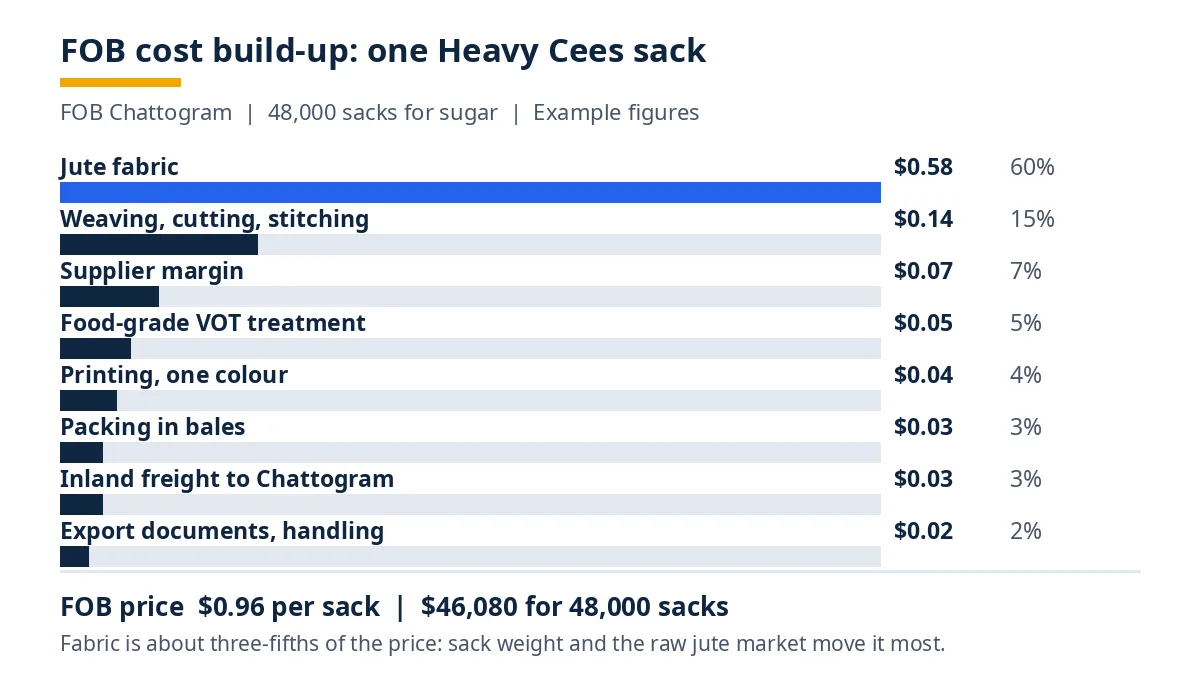
Question first the line that sits far above its bar in the diagram. Beyond the FOB figure, the buyer still pays the sea leg, the insurance and the duty: new jute sacks entering the United Kingdom under 6305 1090 00 carry a 4.00 per cent third-country duty in the UK tariff, charged on the customs value.7 See our classification guide for jute sacks for the full heading.
Four mistakes that push the price up
Comparing FOB with CIF. A CIF price already contains the sea freight and the insurance, so put every quotation on one rule and one place before you compare.4
Ordering less than a container load. A part-container order is charged freight on the whole container, not on the sacks inside it, so the freight per sack can double even when the unit price does not move.
Adding food-grade treatment after the price is fixed. A VOT batch is its own run with its own test and certificate, so a late change means a second batch and a new price.5
Paying before the sample passes. Get the sample sack approved in writing first, then send money: one exporter wants the full amount by wire before production starts, so the sample is your only check before the money moves.3 Test the sample with your own goods before you sign off the bulk run.
FAQs
What is the FOB price of a jute sack from Bangladesh?
There is no single published price: it depends on the grade, sack weight, print, treatment and quantity. Our jute bags price guide breaks down the FOB price for lighter bags on the same basis. Example figures put a 48,000-sack order of Heavy Cees at $0.96 a sack FOB Chattogram, with fabric the largest line at $0.58. Sacking export prices rose by about 8 to 9 per cent in October 2026.1
What does FOB Chattogram include?
It includes the sacks, bale packing, inland transport to Chattogram, export clearance and loading on board the vessel. It leaves out ocean freight, marine insurance and import duty, which the buyer pays.4
Next steps on Exportain
Start by writing the specification: grade, size, sack weight, food-grade treatment, print and quantity, priced FOB Chattogram, with the bale and container counts beside it. Then find Bangladeshi suppliers or raise an RFQ and ask every reply to break its price into the eight lines above.
Sources
- Jute Market Report for October 2026. Wilhelm G. Clasen GmbH & Co. KG, (accessed )
- 90 Kg Jute Bag. BACKBD (accessed )
- Jute exports rise 37 per cent as Bangladesh plans to double earnings by 2031. The Financial Express, (accessed )
- Incoterms® 2020. International Chamber of Commerce (ICC) (accessed )
- IJO Standard 98/01: Special Criteria for the Manufacture of Jute Bags used in the Packing of Selected Food Materials. International Jute Study Group (accessed )
- Industry Specification: Jute Bags - Jute Yarns for Use in Cocoa Supply Chains. European Cocoa Association, (accessed )
- Sacks and bags, of a kind used for the packing of goods - UK Integrated Online Tariff. GOV.UK (accessed )
About the author
Sourcing from Bangladesh?
Post a request for quotation and suppliers on Exportain can send you their quotes directly.
Post an RFQ