Jute Bags Price in Bangladesh: FOB Cost Breakdown for Buyers
An FOB price for jute bags hides eight cost lines, from fabric to export papers. Here is what each line pays for, and how to read a quotation before you accept it.
Short answer
An FOB price for jute bags from Bangladesh covers the goods, export packing, inland transport to Chattogram, export clearance and loading on board the vessel, and leaves ocean freight, insurance and import duty to the buyer. Fabric is the heaviest single line, followed by stitching, print, handles or treatment, packing, freight, documents and margin. Ask for the price broken into its eight lines on the same specification and port, and compare quotations only on that basis.
On this page
Key takeaways
FOB covers costs up to loading on board at Chattogram; freight, insurance and duty after that are yours.
Fabric is the heaviest line, about three-fifths of the FOB price in the worked example.
Ask for an itemised quotation; a single unit price hides fabric weight, print and margin.
Listing ranges for sacking run about $0.20 to $1.20 per bag, depending on specification and quantity.
Fixed setup costs spread over more bags, so the unit price falls as the run grows.
A quotation that reads FOB Chattogram $0.86 per bag looks like a finished answer. It is not. That one figure hides the fabric, the stitching, the print, the packing, the truck to the port, the export papers and the supplier margin. This guide opens the quotation up line by line, so you can compare two suppliers on the same basis and spot the line that pushes a price up.
What does an FOB price cover, and what does it leave out?
FOB stands for Free On Board. Under the Incoterms 2020 rules, the seller delivers the goods on board the vessel at the named port of shipment, and cost and risk pass to the buyer at that point. The rules are 11 terms that allocate cost, risk and obligations between buyer and seller.1
Ask for the quotation as FOB Chattogram, so every supplier prices to the same point. A price quoted FOB factory gate or with the port unnamed is not comparable, because the inland leg is priced differently or left out altogether. Under FOB, the seller pays for the goods, the export packing, the inland transport, export clearance and the loading charges, while the buyer pays for the ocean freight, the marine insurance, the import duty and the handling at destination.
CIF is the term buyers most often set beside FOB. It is reserved for maritime trade, and its default insurance cover is Institute Cargo Clauses (C), with the option of a higher level.1 A CIF price bundles freight and insurance into the seller's figure, while an FOB price leaves both out, so the comparison only works when you know which lines each price contains.
The eight lines inside an FOB quotation
Every FOB quotation is built from the same eight lines, even when the supplier shows you only the total. Ask for them separately.
Cost line | What it pays for | What moves it |
|---|---|---|
Jute fabric | Raw jute fibre, spun yarn, woven cloth | GSM, grade, raw jute price |
Weaving, cutting, stitching | Loom time, cutting, seams | Bag size, stitch density |
Printing | Screens or plates, ink, press passes | Colours, printed sides, artwork |
Handles, lining, treatment | Handles and lining, sack treatment | Material, food-grade needs |
Packing | Bales or cartons, strapping, marking | Packing type, bags per bale |
Inland freight | Truck from the mill to Chattogram | Distance, load size, fuel cost |
Export documents, handling | Papers, port charges, agent fees | Document set, inspection |
Supplier margin | The supplier's profit on the order | Supplier type, order size, terms |
A mill that weaves its own fabric controls the first two lines directly, while a trading company buys the bags in and adds its own margin on top of the maker's price. Ask each supplier to state in writing whether it makes the bags or buys them in; the guide to finding and checking jute bag makers shows what to look for before you enquire.
When a quotation arrives as a single unit price, ask the supplier to fill in each line of this table. A supplier that can break the price down is showing its real cost structure; one that will not is asking you to trust a total, and a total hides the one line that may be wrong.
How does fabric grade and GSM move the price?
Fabric is the heaviest cost line in almost every jute-bag quotation, and the line most often hidden inside a cheap-looking unit price. GSM means grams per square metre, the weight of the cloth. A heavier cloth uses more fibre per bag, so it costs more and makes a stronger bag. A quotation that looks cheap may simply quote a lighter cloth, so have the GSM written on the quotation and checked against the sample.
Raw jute prices move, and that movement lands straight in the fabric line. Flood damage pushed up the price of raw jute last year, and exporters say the higher prices lift export earnings in value without lifting volume shipped.2 Makers of yarn and sacks earn very low margins and struggle to absorb higher fibre prices, so a rise in the market shows up in the next quotation.2 Fix the price basis in the order, and ask how long the quotation stays valid.
Sacks and bags brought in $132.3 million in export earnings in 2025-26, a rise of 5.03 per cent, while jute and jute goods as a whole earned $883.7 million, though July and August then saw a 13 per cent fall in sacks and bags earnings.2
Listing ranges show how wide the spread is once specification and quantity change: food-grade B-Twill sacks are listed at $0.86 to $0.94 per bag with a 1,000-piece minimum, while a heavier 685-gram sack built for 60 kg is listed at $1.12 to $1.14 per bag.3 Plain sacks are listed from $0.20 per bag at very large quantities.4 These are listing ranges, not market prices, and the spread comes from the same factors as the table above: raw jute quality and market swings, production scale and quantity, the sack specification in GSM, size and weave type, custom work such as printing and treatment, compliance certificates, and shipping costs.4
Printing, stitching, handles and lining: where small choices add up
Print is the next line to watch after fabric. A design with four colours needs four screens and four press passes, while a single colour needs one of each, so the cost per bag rises with every colour you add, and the gap is widest on small orders. Printing on both sides doubles the work, so if the artwork is simple, a single colour on one face keeps the setup charge at its lowest.
Stitching is a smaller line, but it decides whether a bag holds its rated load or splits at the handle. Double stitching at the handles and the base costs more in thread and machine time than a single seam, so ask how the handles are attached and check the sample at those exact points.
Handles and lining change the price more than buyers expect. Cotton, webbing and woven jute handles each carry a different material cost, and a long handle uses more material than a short one. A lining adds a second material and a second making step, and on sacks the equivalent line is treatment: food-grade sacks need treatment and testing, a fixed cost per batch rather than per bag.4 Ask for handles, lining and treatment as separate lines: they are the lines a supplier can quietly thin out when the unit price is squeezed.
Packing, inland freight and export documents
Packing is the line buyers most often forget, and it is the line that protects everything above it. Sacks are usually packed in bales, which is cheap and suits a commodity that will be filled and used. Printed totes are often packed in cartons, which costs more but keeps the print clean. Ask how many bags go in each bale or carton, since that count decides how many bags fit in a container.
Inland freight is the truck from the mill to the port at Chattogram. It depends on the distance from the mill, the size of the load, and the fuel cost at the time of shipping. A full truckload costs less per bag than a part load.
Export documents and handling cover the commercial invoice, the packing list, the certificate of origin, the bill of lading and any inspection certificate the order needs. The Incoterms 2020 rules set out detailed security-related obligations on export and import clearance.1 Ask which documents are included in the FOB price and which are charged separately, because a certificate the buyer needs but the seller has not priced is a cost that appears later.
Why does the same bag cost more at 1,000 pieces than at 25,000?
The answer is setup. Warping the loom, setting the cutting table, making the screens and approving the sample are all done once per run, and their cost does not shrink when the order shrinks. On a run of 25,000 bags, a $250 screen set costs $0.01 per bag; on a run of 1,000 bags, the same screens cost $0.25 per bag. The bag is the same and the setup is the same. Only the spread is different.
Production scale and quantity sit among the main factors that set a jute sack price, alongside the raw material, the specification and the custom work, which is why a supplier asks about quantity before it quotes a price.4 If the quantity is fixed and the price still looks high, change the specification instead: one colour instead of three, a standard size instead of a custom one, or a fabric the supplier already runs. The jute bags MOQ guide works through those levers, and the wholesale jute bags guide sets out how MOQ bands and supplier types shape the price.
Worked example: 25,000 B-Twill sacks, FOB Chattogram
Example figures. A buyer orders 25,000 food-grade B-Twill sacks, one-colour print, FOB Chattogram. The numbers below are illustrative, not a market price.
Cost line | Per bag | Order total |
|---|---|---|
Jute fabric, B-Twill | $0.52 | $13,000 |
Weaving, cutting and stitching | $0.12 | $3,000 |
Printing, one colour | $0.05 | $1,250 |
Treatment for food-grade use | $0.04 | $1,000 |
Packing in bales | $0.03 | $750 |
Inland freight to Chattogram | $0.02 | $500 |
Export documents and handling | $0.02 | $500 |
Supplier margin | $0.06 | $1,500 |
FOB price | $0.86 | $21,500 |
Fabric is $0.52 of the $0.86, about three-fifths of the price, which is why the GSM and the raw jute market matter most. The eight lines add to $0.86 per bag, and $0.86 times 25,000 bags is $21,500 for the order. On a repeat order in the same design the screens already exist, so the printing line falls.
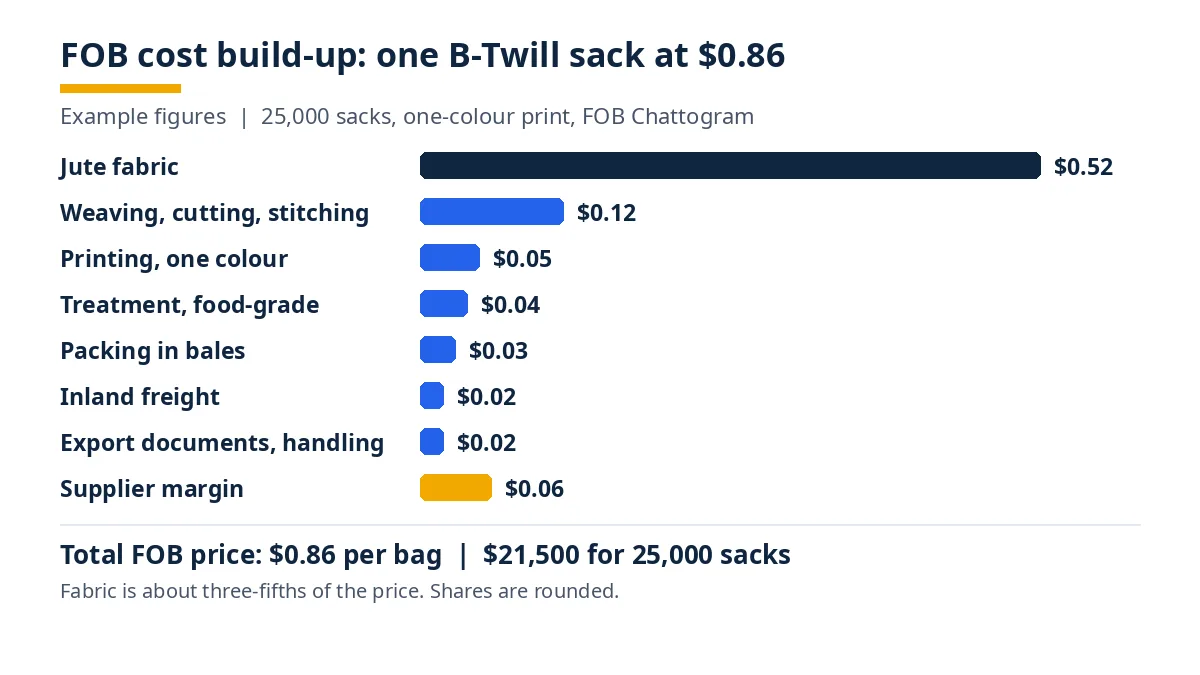
The diagram shows the same build-up as bars. Put your own supplier's lines beside it, and question first the line that sits far above its bar here.
Reading a quotation: five checks before you accept
Run these five checks before you accept any FOB price.
Same term and same port. Every quotation should read FOB Chattogram, so the inland leg is priced on the same basis.
Fabric weight in writing. The GSM, the grade and the tolerance should be on the quotation, not only in an email, and the sample should be checked against them.
Itemised lines. Ask for all eight lines from the table above, with setup charges shown separately, so a cheap unit price cannot hide a thin fabric or a missing treatment.
Validity and exclusions. Ask how long the price holds, and confirm in writing that ocean freight, insurance and import duty sit outside the FOB figure.
Sample and inspection. Approve the sample in writing against the specification, and agree who inspects the bulk run and what happens to rejected bales. Use the quality control checklist for jute bags for the inspection points, and check the classification in the HS code guide for jute bags with your customs broker before the order ships.
A quotation that passes all five checks can still be expensive, but it is expensive for a reason you can see.
Next steps on Exportain
Write the specification first: bag type, fabric GSM and grade, size, print and quantity, with FOB Chattogram as the term. Then search Bangladeshi suppliers or post an RFQ and ask every reply to price the eight lines in this guide separately. Read how to buy before you place the order.
Sources
- Incoterms® 2020. International Chamber of Commerce (ICC) (accessed )
- Jute exports rise 37 per cent as Bangladesh plans to double earnings by 2031. The Financial Express, (accessed )
- FOB CIF Sugar Jute Bags from Bangladesh. Accio, (accessed )
- Jute Sack Price in Bangladesh 2025. Accio, (accessed )
About the author
Sourcing from Bangladesh?
Post a request for quotation and suppliers on Exportain can send you their quotes directly.
Post an RFQ