Wholesale Jute Sacks From Bangladesh: Prices, MOQ and Reliable Suppliers
Wholesale jute sacks from Bangladesh are priced by the container load: about 19,500 standard B-Twill sacks fill one 20-foot container. This guide gives the price bands by sack type, shows how quantity moves the unit price, and works through sizing, payment and a landed-cost example to Hamburg.
Short answer
Wholesale jute sacks from Bangladesh are bought by the container, not by the sack: one 20-foot container holds about 19,500 standard B-Twill sacks at 1,020 grams, packed 300 to a bale. Listing prices run from $0.84 to $1.22 a sack depending on grade, weight and quantity. Compare quotations on the same grade, quantity and FOB Chattogram term, approve a sample, and pay by letter of credit on a first order.
On this page
Key takeaways
One 20-foot container holds about 19,500 standard B-Twill sacks at 300 sacks a bale, and that container load is the natural unit for a wholesale price.
Listing prices run from $0.84 to $1.22 a sack across grades and quantities, with the 1,190-gram B-Twill costing about 40 per cent more than the 1,020-gram grade.
Compare quotations only on the same grade, quantity and FOB Chattogram term, and judge them on the landed cost per sack, not the unit price alone.
Pay by letter of credit on a first order, approve a sample first, and write the plus or minus 5 per cent quantity tolerance into the order.
A wholesale jute sack order is bought by the container, not by the sack. The smallest sensible lot is a 20-foot container, about 19,500 standard B-Twill sacks, and the price per sack follows from the size of that lot, the weight of the cloth and the delivery term on the quotation.1 This guide covers the price, the order size and the payment.
Bangladesh is the natural place to start that search. Bangladesh earned $132.3 million from jute sacks and bags in 2025-26, up 5.03 per cent year on year, while jute and jute goods as a whole brought in $883.7 million.2
What counts as a wholesale order for jute sacks
A wholesale order is a production lot, not a shelf purchase. The sack is made to order in a stated grade and size, packed in bales and shipped in containers, so the choice is between a part container, one container and several containers.
A Bangladeshi exporter lists the standard B-Twill sack at 44 by 26.5 inches and 1,020 grams, packed 300 sacks to a bale, with 65 bales filling one 20-foot container, or 19,500 sacks in all.1 A lighter rice sacking bag at 600 grams packs 500 to a bale, so 60 bales fill the same container with 30,000 sacks.1 The bale count and the container count are therefore part of the price: a quotation for 10,000 sacks leaves half a container empty, and you pay freight on the space as well as on the sacks.
Before you ask for prices, fix the specification in one document: sack type, size, sack weight, porter and shot, fill weight, food-grade treatment if the fill is food, print or stripes, and the number of sacks. Our guide to jute sack makers in Bangladesh explains how to tell a mill that weaves its own sacking cloth from a stitching unit or a trader.
Which sack types do buyers order wholesale, and what do they cost
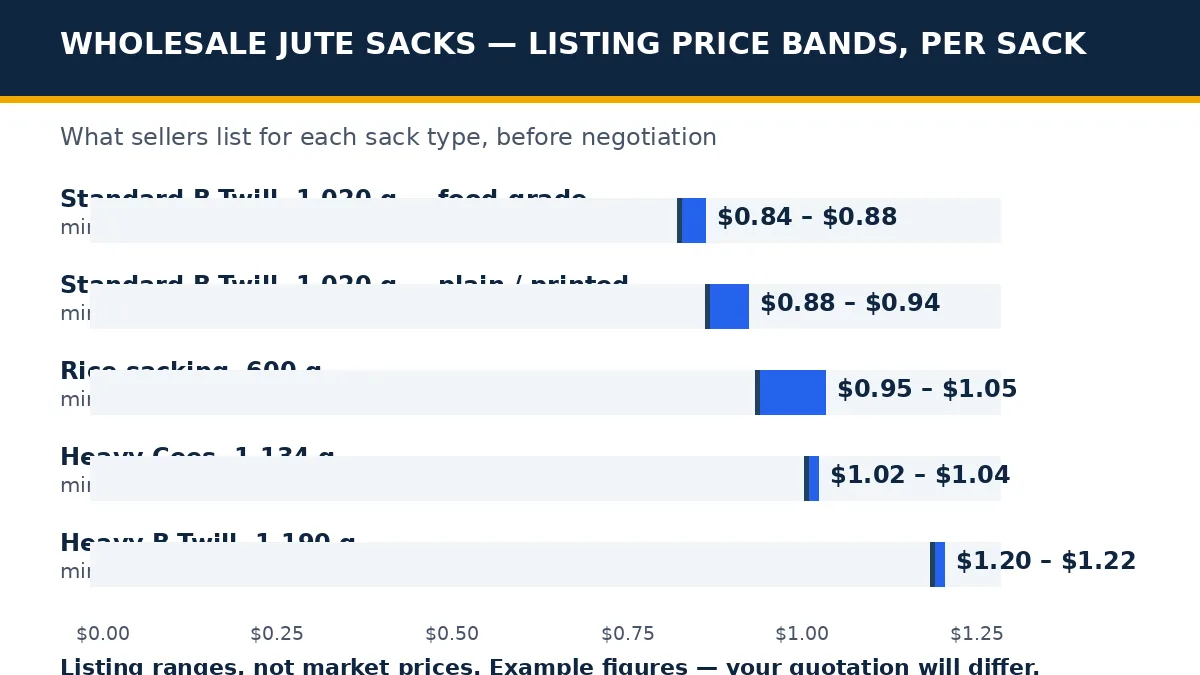
The table below gives the specification and listing price band for the four sack types that cover most wholesale orders. These are listing ranges, not market prices: a listing shows what one seller asks for one specification at one quantity, and your quotation will differ.
Sack type | Size and weight | Listing price per sack | Listed minimum |
|---|---|---|---|
Standard B-Twill, food-grade | 44 x 26.5 in, 1,020 g | $0.84 to $0.88 | 19,500 sacks |
Standard B-Twill, plain or printed | 44 x 26.5 in, 1,020 g | $0.88 to $0.94 | 1,000 sacks |
Heavy B-Twill, 1,190 g | 44 x 26.5 in, 1,190 g | $1.20 to $1.22 | 14,000 sacks |
Heavy Cees, 1,134 g | 43 x 29 in, 1,134 g | $1.02 to $1.04 | 16,000 sacks |
Rice sacking, 600 g | 37 x 22.5 in, 600 g | $0.95 to $1.05 | 20,000 sacks |
The spread comes from the same factors every time: sack weight, weave, food-grade treatment, print and quantity.3 A heavier sack uses more fibre, so it costs more and carries a heavier fill: the 1,190-gram B-Twill costs about 40 per cent more per sack than the 1,020-gram grade at the listed minimums, and that gap is the fibre, not the seller.1 3
How quantity moves the unit price
Quantity moves a wholesale sack price through three channels. First, the set-up is spread across the run. Warping the loom, setting the cutting table, making the print screens and approving the sample are done once per order, whatever the quantity. On a run of 39,000 sacks a $300 screen set costs under a cent per sack; on a run of 1,000 sacks the same screens cost $0.30 per sack.
Second, the bale and the container set natural breaks. A standard B-Twill order of 19,500 sacks fills one 20-foot container exactly, at 300 sacks a bale and 65 bales.1 An order of 20,000 sacks needs a second container for the last 500 sacks, so the freight per sack jumps.
Third, the fibre market feeds straight into the fabric line. Flood damage pushed raw jute prices up, and exporters say the higher prices lift export earnings in value while the volume shipped stays flat.2 Our jute bags price guide covers the same quantity effect for lighter bags, and the wholesale jute bags guide explains order size and price for shopping bags.
How to size a wholesale order
Size the order from the fill, not from the sack. Start with the tonnes you need to pack in a season, divide by the fill per sack, and round to the nearest container load. A coffee importer who needs to pack 3,500 tonnes of beans at 85 kg a sack needs about 41,000 sacks; rounding down to two containers of standard B-Twill gives 39,000 sacks, and the shortfall can be covered from stock or from the next order.
Then check the tolerance. A Bangladeshi exporter states a quantity and weight tolerance of plus or minus 5 per cent as standard and acceptable.1 An order for 39,000 sacks may arrive as 37,050 or as 40,950, and the invoice follows the shipped count.
Three routes to a wholesale lot
A wholesale sack order can reach you by three routes, and each one prices and delivers differently.
Buying direct from a mill puts you closest to the cloth. A composite mill spins, weaves and stitches under its own roof, so it controls the fabric weight and the weave, and it can run a repeat order in the same grade without re-setting the loom.
Buying through a trading company suits a mixed order. A trader buys finished sacks from one or more makers and resells them, sometimes adding inspection or repacking. The cost is a margin over the mill price.
Buying through a sourcing agent suits a first order. An agent sources, negotiates and follows up on your behalf, usually for a fee. Agree in writing how the agent is paid: a fee that comes from the maker is built into the unit price.
How to read a wholesale quotation
A wholesale quotation is only comparable when every supplier prices the same sack, the same quantity and the same delivery term. Our CIF vs DAP comparison works through the same point for a jute-bag shipment: a price that bundles freight cannot be set beside one that leaves it out.
The Incoterms 2020 rules are the shared language for that comparison. Published by the International Chamber of Commerce, the current edition entered into force on 1 January 2020 and sets out eleven three-letter terms that spell out who does what, who pays and where risk passes when goods move from seller to buyer.4 Under FOB, the seller puts the goods on board the vessel at Chattogram, and you arrange and pay the ocean freight and insurance from there. Under CIF, the seller pays the freight and buys minimum insurance to your named port, but the risk still passes to you when the goods are loaded on board at Chattogram. Compare them on the landed cost per sack, not on the unit price alone.
Before you accept a quotation, check five things: the same term and port on every quotation; the grade, size, sack weight, porter and shot and food-grade treatment written on the quotation itself; the bale count, sacks per bale and container count; the validity date; and the sample and inspection terms. One exporter quotes a sample fee of $250 including international shipping, delivered in 3 to 7 working days, and third-party inspection reports from SGS, Intertek or Bureau Veritas are available at the buyer's request and expense.1 Our jute sacks QC checklist lists the inspection points in full, and the HS classification for jute sacks sets out the heading: sacks and bags of jute for packing goods fall under 6305.10, the subheading for jute sacking inside heading 6305.5 Confirm the code with your customs broker before the order ships.
How payment works on a wholesale sack order
Payment terms are part of the price, and they change with the size of the order and the history between buyer and seller. A first order from a new supplier is normally paid in advance or by letter of credit (LC). One Bangladeshi exporter asks for 100 per cent advance by wire transfer, with production starting only when the advance arrives, and a lead time of 7 to 30 working days from that payment.1
A letter of credit is the usual middle ground for a first container load. Documentary LCs remain an important and widely accepted instrument for international trade, and Bangladesh Bank's 2026 trade finance circular keeps them alongside newer options rather than replacing them.6
The circular also opens three alternatives that an authorised dealer bank may facilitate, subject to its own credit policies and the foreign exchange rules: advance payment, open account trade and documentary collection on documents against payment or documents against acceptance terms.6 Open account means the seller ships first and the buyer pays on an agreed later date, and it is offered only where the buyer has a satisfactory track record and defined credit terms. For a wholesale sack order, the practical ladder is advance or LC for the first order, documentary collection for a repeat order with a supplier who has performed, and open account only after a long run of on-time payments. Whatever the method, write the payment split, the documents that must be presented, the bank charges on each side and what happens if the inspection fails into the order.
Worked example: 39,000 B-Twill sacks for cocoa to Hamburg
Example figures. A chocolate maker in Hamburg needs sacks for cocoa beans. The buyer orders 39,000 standard B-Twill sacks, food-grade, one-colour print, FOB Chattogram, in two 20-foot containers.
Cost line | Amount |
|---|---|
Goods, 39,000 sacks at $0.90 each | $35,100 |
Sample, including shipping | $250 |
Third-party inspection | $700 |
Inland transport to Chattogram | $600 |
Ocean freight to Hamburg | $3,400 |
Marine insurance | $180 |
Total landed cost | $40,230 |
Landed cost per sack | $1.03 |
The order fills two containers at 19,500 sacks each, or 130 bales at 300 sacks a bale.1 At 1,020 grams a sack, the empty sacks weigh about 39.8 tonnes. Goods plus sample plus inspection plus inland transport comes to $36,650; adding freight and insurance gives $40,230; and $40,230 divided by 39,000 sacks is $1.03 per sack. The unit price of $0.90 is only part of the story: the sample, inspection, transport, freight and insurance add $0.13 a sack.
Mistakes that cost wholesale sack buyers
Ordering below a container load without pricing the empty space is the first mistake. A part-container order pays freight on the container, not on the sacks, so the freight per sack can double while the unit price stays the same.
Comparing listing prices as if they were quotations is the second. A listing shows one seller's price for one specification at one quantity, and the range for the same sack can run from $0.84 to $1.22 a sack across grades and quantities.3
Paying 100 per cent in advance to a supplier you have not yet tested is the third. Advance payment is a normal term in this market, but it belongs after the sample is approved and the supplier's export record is checked, not before.
Skipping the fill test is the fourth. An empty sack can look sound and still split at the bottom seam once it is filled. Fill the sample with your goods before you approve the bulk run.
Next steps on Exportain
Write the specification first: sack type, size, sack weight, porter and shot, food-grade treatment, print and quantity, with FOB Chattogram as the term and the bale and container counts on the page. Then search Bangladeshi suppliers or post an RFQ, giving the full specification and asking each reply to state whether it weaves the cloth, what its smallest lot is, and its price broken into lines.
Sources
- Jute Sacks/ Bags. BACK (accessed )
- Jute exports rise 37 per cent as Bangladesh plans to double earnings by 2031. The Financial Express, (accessed )
- Bulk Agricultural Jute Sacks Exporter: Reliable & Eco-Friendly. Accio (accessed )
- Incoterms® rules. International Chamber of Commerce (ICC) (accessed )
- Bag HS Codes Guide: 6305 Breakdown for Importers. FreightAmigo, (accessed )
- New ways to finance exports. Open Trade Bangladesh (accessed )
About the author
Sourcing from Bangladesh?
Post a request for quotation and suppliers on Exportain can send you their quotes directly.
Post an RFQ