Leather Bags Price in Bangladesh: FOB Cost Breakdown for Buyers
An FOB leather bag price is six cost lines up to loading: leather, making, hardware, testing, set-up and port handling. This guide shows how to read each line, compare quotations on the same specification, and spot what a single total hides.
Short answer
There is no single typical FOB price for leather bags from Bangladesh. The price is the sum of six lines up to loading on board at the named port of shipment: leather, cutting and stitching, hardware and lining, testing and labels, set-up and samples, and inland, port and export handling. Ask every supplier for the same itemized lines on the same specification and delivery term, then compare lines, not totals, before confirming an order.
On this page
Key takeaways
There is no single typical FOB price for leather bags from Bangladesh: the price is the sum of six cost lines up to loading on board at the named port of shipment.
Example figures show the structure: in a 100-unit example, leather is 38 units and cutting and stitching is 24 units, and raising the leather line alone to 46 units raises the total to 108 units.
Under FOB the buyer carries freight, insurance and import costs beyond loading, and FCA may fit containerized movement better than FOB.
Leather bags sit under indicative heading 4202, export clearance in Bangladesh requires an approved Bill of Export, the EU chromium VI limit is 3 mg/kg for skin-contact leather, and LWG medals run from 85 percent for Gold to 50 percent for Audited over 24 months.
An Exportain badge is a document and photo review, not a factory inspection or a guarantee: price evidence is the itemized quotation, the sample and the test report.
A leather bag quotation usually arrives as one unit price. The work for the buyer is to unfold it into the lines that produced it, in production order: leather, cutting and stitching, hardware and lining, testing and labels, set-up and samples, and inland transport and port handling up to loading. Every illustrative number here is labeled Example figures, showing structure only.
The six lines below run in production order, from the hide to the port.
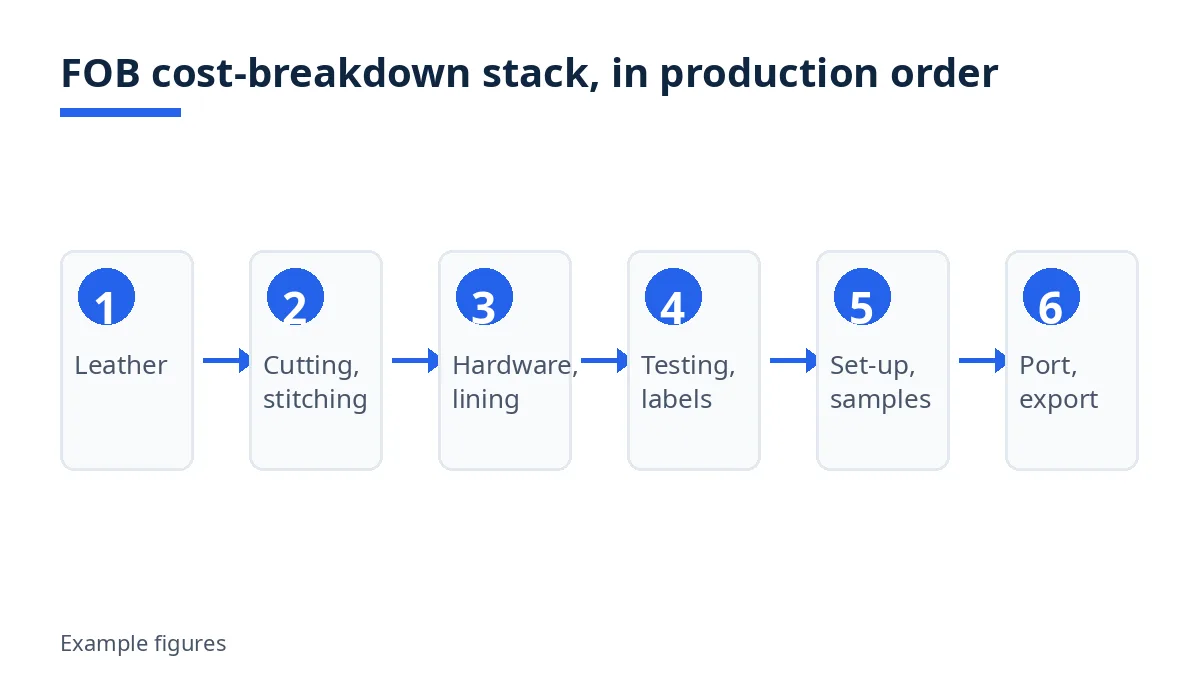
Read the quote in production order: what each FOB line pays for
Ask every supplier for the same six lines; a missing line sits inside another line or appears later as an extra charge.
FOB line | What it pays for | What to ask |
|---|---|---|
Leather | Tanned and finished hides or skins | Type, thickness, grade, tannery |
Cutting and stitching | Cutting, grading, stitching, reinforcement | Yield basis, stitch, reinforcement |
Hardware, lining and edges | Zips, clasps, rivets, lining, edge finish | Type, finish, size, attachment |
Testing, labels and packing | Lab tests, labels, cartons | Tests, label proofs, cartons |
Set-up and samples | Pattern, sample rounds, tooling, print set-up | Separate set-up lines |
Inland, port and export handling | Transport, port handling, export documents | Named port, handling |
Example figures: an example FOB unit price of 100 units divides as leather 38, cutting and stitching 24, hardware, lining and edges 14, testing, labels and packing 9, set-up and samples 6, and inland and port handling 9. When one line moves, the total moves by the same amount. Example figures: if the leather line rises from 38 to 46, the example total rises from 100 to 108.
The FOB boundary: what the price stops paying for
FOB is one of 11 Incoterms 2020 rules, which allocate cost, risk and obligations.1 Under FOB, the seller delivers the goods on board the vessel at the named port of shipment, cleared for export, and risk transfers once the goods are on board.2 FOB covers sea and inland waterway transport only.2 The seller pays to loading on board; the buyer pays ocean freight, destination charges, import clearance and onward transport.2
Freight, insurance, destination charges, import clearance, duty and onward delivery sit outside the FOB price; budget them separately. A cost, insurance and freight (CIF) total and an FOB total describe different boundaries, so they cannot be ranked by price alone.2 FOB is not recommended for containerized cargo: containers sit at the terminal days before loading, and damage there leaves responsibility unclear.2 Under Free Carrier (FCA), risk transfers on handover to the carrier at a named place, fitting container movement better.2 Restate on FCA with the named place if it fits better.
The leather line: the line that moves the total most
Leather is usually the largest line in a leather bag quotation, and the line where two quotations most often describe different bags. State the leather in the same terms for every supplier: type, thickness, grade, color and finish, and tannery. A thinner leather or lower grade at a lower price is a different bag, not a cheaper version of the same bag.
Hides are natural material, so panels differ in grain, shade and surface marks, and grading decides which panels go where in the bag. Ask which marks are accepted, where they may sit, and how shade is judged, under which light. The quality control checklist for leather bags covers grain, shade, stitching, edge and hardware checks. A made-to-order color carries the lot minimum; a running leather may carry a lower minimum. Ask whether the leather is stocked, running, or made to order. For the general meaning of minimum order quantity, see the MOQ meaning guide. Record the tannery and workshop sites separately; if a supplier will not name the tannery, close that gap before discussing price.
The making line: cutting, stitching and reinforcement
The making line pays for cutting, grading, stitching, and reinforcement at load points: handle bases, strap anchors, corners, flap joins and pocket mouths. Cutting yield moves both the leather line and the making line together: the number of usable panels per hide, and the grade of panel used for each part of the bag. Ask how yield is counted, per hide, per panel set, or per finished bag, and state the stitch specification for each style: stitch density, thread type, and the reinforcement method at each stress point.
Check reinforcement on the pre-production sample as a customer will: set it down loaded, carry it by each handle, and work every closure repeatedly. Approve in writing, and keep one sealed counter-sample per style. Ask for lead time by gate, not a single week: specification, leather lot, sample, hardware, production, inspection, loading.
Hardware, lining and edge work as priced lines
Hardware is bought in lots, each with its own minimum and finish, and it is the line most likely to be substituted without a price change. State the hardware for each style: the type, the metal and finish, the size, and the attachment method at handles, straps and corners. Ask which hardware is standard and which is custom, and whether a custom finish carries a lot minimum or a set-up line of its own.
State the lining material, reinforcement, and interior layout, and separate lining from hardware for comparison. State whether edges are painted, burnished or folded, and check the finished edges on handles, flaps and corners on the sample. Treat a later hardware, lining or edge change as a new bag for costing: a new sample and a new quotation version.
Quantity, tiers and validity: fixed lines spread differently
Quantity changes an FOB price in two ways. The first is the tier: the unit price falls in steps, each with a starting quantity, counting basis and validity date. The second is the spread of fixed lines: set-up, pattern and sample work cost the same whether the run is short or long, so spreading them over more bags lowers the unit price even where no tier changes.
Example figures: 600 units of set-up spread over 300 bags adds 2 units each; over 1,200 bags, 0.50 units each. Example figures: at 100 units below 800 pieces and 96 from 800 pieces, 780 pieces cost 78,000 units and 800 cost 76,800 units. Confirm whether the tier counts per style, color, leather, or the whole order. The wholesale leather bags guide covers the same tiers from the wholesale buying angle.
Classification and export documents inside the handling line
Heading 4202 covers trunks, suitcases, briefcases, handbags, travel bags, wallets and similar containers, split by container kind and outer surface.3 Handbags, briefcases, pocket articles and other bags with a leather outer surface sit at 4202.21, 4202.11, 4202.31 and 4202.91.3 Treat every heading as indicative until your broker confirms the full national code, and keep each style on its own invoice line. The HS code guide for leather bags covers boundary cases, including leather-look bags.
Goods shall not be loaded for export unless the Bill of Export is submitted to Customs and approved.4 Enclosed documents include the export contract or purchase order, commercial invoice, packing list, EXP form certified by an authorized dealer, and certificate of origin from the EPB or a Chamber of Commerce and Industry.4 Agree which documents sit inside the handling line before the price is fixed.
Evidence lines: testing, chemical limits and tannery audits
Testing, chemical evidence and tannery audits are cost lines. Agree the inspection plan before production: standard, level, AQL values per defect class, and action on a failed lot. AQL is the maximum average percentage of defective items considered acceptable during random sampling, and ISO 2859-1:2026 defines AQL-indexed acceptance sampling plans for lot-by-lot inspection.5 AQL values are buyer-agreed, never a universal rule.
For skin-contact leather sold in the European Union, leather articles and leather parts coming into contact with the skin shall not be placed on the EU market at or above 3 mg/kg chromium VI, 0.0003 percent by weight of dry leather.6 Ask for a test report naming the method and the leather in your order.
The Leather Working Group (LWG) audit is an international certification standard for leather manufacturing covering 17 sections, including water and energy use, chemical management, waste and effluent treatment, and traceability.7 Medals run Gold 85 percent, Silver 75 percent, Bronze 65 percent and Audited 50 percent, earned across all scored sections.7 Certification lasts 24 months; for Gold and Silver, chromium VI above 3 mg/kg is an automatic failure.7 Chrome-free means below 1,000 mg/kg total chromium, dry weight, under BS EN 15987.7 LWG states certification does not guarantee no restricted-substance failures.7 Check the certificate names your tannery. The Leathergoods and Footwear Manufacturers and Exporters Association of Bangladesh (LFMEAB) describes itself as the official trade body registered under the Ministry of Commerce for the export-oriented leather footwear and leather goods industry, with over 300 members.8 Confirm any membership claim with the association.
Compare two quotes on the same lines
Example figures: both quotations total 100 units, but the lines differ.
FOB line | Quote A, Example figures | Quote B, Example figures | Question to ask |
|---|---|---|---|
Leather | 42 | 34 | Which leather and tannery |
Cutting and stitching | 20 | 26 | Which stitch and reinforcement |
Hardware, lining and edges | 14 | 14 | Same figure, same hardware |
Testing, labels and packing | 9 | 9 | Same tests and carton |
Set-up and samples | 6 | 6 | Same sample rounds |
Inland, port and export handling | 9 | 11 | Same port and documents |
Total | 100 | 100 | Which lines are included |
Quote A spends more on leather, Quote B more on making and handling. The totals match; the bags do not. Work through the worksheet with each supplier, and require a new version whenever a line changes.
Supplier verification on Exportain is a document review, not a factory inspection or a government-database check.9 Exportain Verified covers identity, phone, email and business registration; Export Verified covers the Export Registration Certificate (ERC); Factory Verified covers factory photos; Trading Company Verified covers office or warehouse photos.9 A badge is not a guarantee of capacity, quality or delivery.9 See how supplier verification works on Exportain; price evidence is the itemized quotation, sample and test report.
Mistakes that hide inside a single total
Ranking totals on different delivery boundaries. An FOB total, a CIF total and an ex works total describe different boundaries.1 2 Restate every quotation on one term and named port before comparing prices.
Accepting one total without lines. Ask for itemized lines first, and a new version whenever a line changes.
Comparing leather lines that name different leather. A lower price in thinner leather or a different finish is a different offer. Compare only replies stating the same leather and delivery term.
Treating the tier as the quantity. A per-color or per-style price is a different commitment from an order-total price. Confirm the counting basis, the tier starts and the validity date in writing.
Reading a tannery certificate as a bag certificate. A tannery report covers the tannery and its leather, not the workshop, hardware or finished bag. Check the scope line by line.6 7
Cutting the evidence lines to reach a target price. Tests and inspection catch a changed leather or failed closure before shipment.5
Accepting a verbal price, validity or tier. Keep specification, quantity basis, tiers, delivery term, payment terms and validity in one quotation version, and agree changes in a new version of it.
Red flags: a far-below quotation, refusal to sample in your leather, pressure to pay to a personal account, reluctance to name the tannery, and certificates naming a different company. One is a reason to ask a direct question. Two or more are a reason to move on.
What should I know first about leather bag prices from Bangladesh?
Know the price as a set of cost lines, not a single figure. Leather, cutting and stitching, hardware and lining, testing and labels, set-up and samples, and inland and port handling each move the FOB price, and the delivery term decides where the seller's cost stops. Heading 4202 covers the classification, split by container kind and outer surface.3 State the leather, construction and hardware for each style before asking for a price.
What are the typical costs and timelines for an FOB leather bag order?
There are no typical costs or timelines a guide can state. Each supplier prices your leather, construction, hardware, testing, labels and packing on your delivery term, and the Incoterms 2020 rules allocate cost, risk and obligations across 11 rules.1 Under FOB, risk transfers once the goods are loaded on board at the named port of shipment, and the buyer pays freight, insurance and import costs beyond loading.2 Example figures: an example FOB unit price of 100 units, with leather 38 units, rises to 108 units when the leather line alone rises to 46 units. Ask for a breakdown by line, a lead time by gate, and a validity date.
Which documents are needed, and which sit inside the FOB price?
The order set is the specification, the itemized quotation, the purchase order and the sample approval record. The product set is the grading and shade rules, the hardware specification, the label proofs and the test evidence checked with the issuer. The shipment set is the Bill of Export, with the export contract or purchase order, commercial invoice, packing list, EXP form certified by an authorized dealer, and certificate of origin.4 The handling line must state which of these documents it includes.
What are the most common mistakes when reading a leather bag quote?
The most common mistakes are ranking totals on different delivery boundaries,1 2 accepting one total without lines, comparing leather lines that name different leather, treating a tier as the order quantity, reading a tannery certificate as proof about the finished bag,6 7 and cutting testing or inspection to reach a target price.5 Fix each one the same way: put the specification, lines, evidence and approval in writing before production starts.
Next steps on Exportain
Browse suppliers, then post your specification with the six FOB lines on the RFQ board. An RFQ states quantity and unit, target price, destination, Incoterm, required certifications and deadline.10 Before you confirm, work through the quality control checklist for leather bags with your inspector, and read how supplier verification works on Exportain so each badge is read for what it records.
Post a free RFQ on Exportain and ask suppliers to quote each FOB line separately: https://exportain.com/rfqs
Sources
- Incoterms® 2020. International Chamber of Commerce (ICC) (accessed )
- FOB Incoterm (Free on Board). iContainers (accessed )
- HS, 2017 - Code 4202 Classification Detail. United Nations Statistics Division (accessed )
- Customs Clearance Procedures for Export. Bangladesh Customs, National Board of Revenue (accessed )
- ISO 2859-1:2026 - Sampling procedures for inspection by attributes — Part 1: Sampling schemes indexed by acceptance quality limit (AQL) for lot-by-lot inspection. ISO (accessed )
- Commission Regulation (EU) No 301/2014 amending Annex XVII to REACH as regards chromium VI compounds. European Commission, EUR-Lex, (accessed )
- Certification - Leather Working Group. Leather Working Group (accessed )
- Terms of Reference (TOR) for Factory Assessment on BSCI, SEDEX and OHSMS ISO 45001:2018. Leathergoods and Footwear Manufacturers and Exporters Association of Bangladesh (LFMEAB) (accessed )
- Trust & Safety Center. Exportain (accessed )
- How to source and buy from Bangladesh. Exportain (accessed )
About the author
Sourcing from Bangladesh?
Post a request for quotation and suppliers on Exportain can send you their quotes directly.
Post an RFQ