FOB vs CIP: Key Differences, Costs and Which One to Choose
FOB leaves insurance to the buyer; CIP makes the seller buy Clause A cover. Here is how the two terms differ on cost, risk and mode.
Short answer
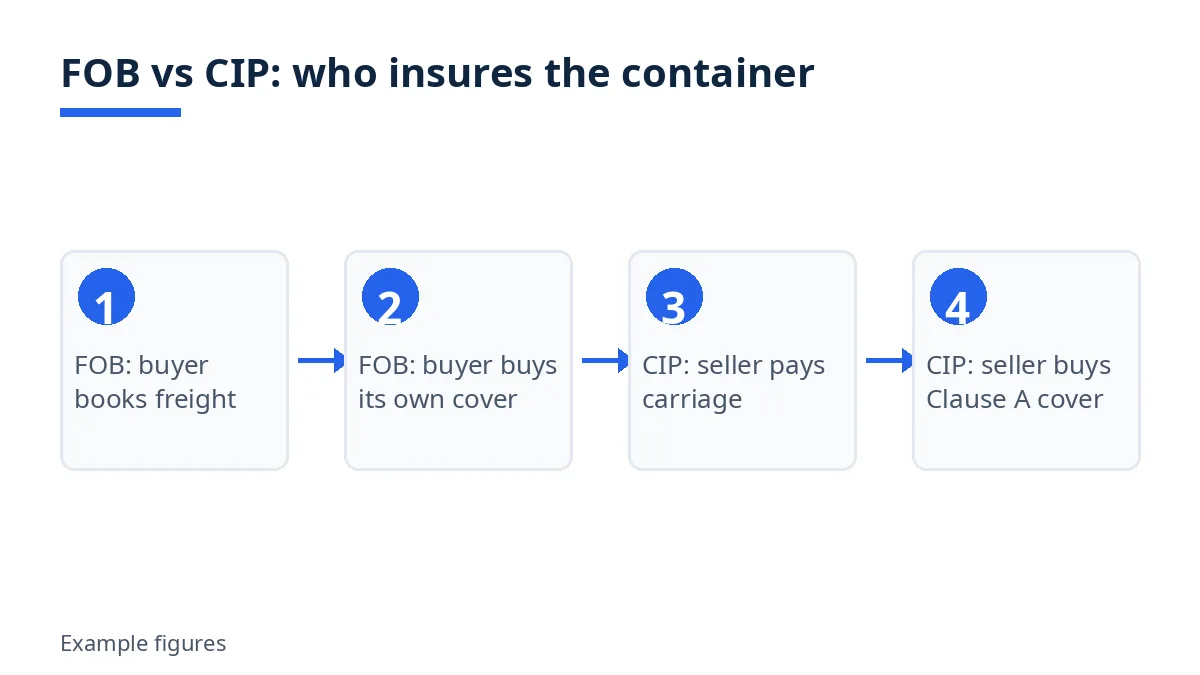
FOB leaves freight and insurance to the buyer, with risk passing on board the vessel at Chattogram. CIP makes the seller pay carriage to the named destination and buy Institute Cargo Clauses (A) cover, the widest standard wording, for at least 110 percent of the contract price. CIP also works for any transport mode, while FOB is sea-only, so CIP fits containerised cargo and FOB suits bulk cargo loaded directly onto a vessel.
On this page
Key takeaways
Under FOB the buyer arranges freight and insurance; under CIP the seller pays both.
CIP requires Institute Cargo Clauses (A), the widest cover, for at least 110 percent of the contract price.
Clause A covers theft, water entry and handling damage that Clause C does not.
FOB is sea-only; CIP works for any mode, including combined transport.
Risk passes to the buyer at origin under both rules, so the buyer needs cover from that point.
A buyer comparing two quotations for a container of electronics from Bangladesh will see prices hard to rank. One quotation stops at the vessel in Chattogram, leaving freight and cover to the buyer. The other runs to a named place in Europe with carriage and a cargo policy inside the price. The gap between them is not only freight. It is the insurance clause, and the clause decides what the buyer can claim when a container arrives wet, short or crushed.
Why does the insurance sit at the centre of FOB vs CIP?
Under FOB (Free On Board), the seller loads the goods on board the vessel the buyer has nominated at the named port of shipment, with export clearance completed. The buyer then books the vessel, pays the freight and arranges whatever insurance it wants, or none at all. Nothing in the FOB rule obliges either party to insure the goods.1 2
Under CIP (Carriage and Insurance Paid To), the seller hands the goods to the first carrier, contracts and pays for carriage to the named destination, and must buy cargo insurance for the buyer's benefit. Incoterms 2020 sets that cover at Institute Cargo Clauses (A), the widest of the three standard clause sets, for at least 110 percent of the contract price, unless the parties agree a different level in writing.2 3
With FOB, the buyer chooses the insurer, the clause, the sum insured and the deductible, and claims on a policy it holds. With CIP, the buyer claims on a policy the seller bought, so the certificate matters as much as the price.
How do Clause A, Clause B and Clause C actually differ?
The three Institute Cargo Clause sets are published by the Lloyd's Market Association and the International Underwriting Association, and the current editions took effect on 1 January 2009.4 Clause A is written on an all-risks basis: it covers loss or damage from any accidental cause except the causes the wording expressly excludes. Clauses B and C are named-perils wordings: they pay only when the loss was caused by a peril on their list.4 3
Cause of loss | Clause A | Clause B | Clause C |
|---|---|---|---|
Fire or explosion | Covered | Covered | Covered |
Vessel stranding, grounding, sinking or capsizing | Covered | Covered | Covered |
Collision, jettison, general average | Covered | Covered | Covered |
Earthquake, volcanic eruption, lightning | Covered | Covered | Not covered |
Entry of sea, lake or river water | Covered | Covered | Not covered |
Package lost overboard or dropped in loading | Covered | Covered | Not covered |
Theft, pilferage, non-delivery | Covered | Not covered | Not covered |
Deliberate damage by a third party | Covered | Not covered | Not covered |
Rough handling or crushing in transit | Covered | Not covered | Not covered |
Any other accidental cause, not excluded | Covered | Not covered | Not covered |
The lower rows carry the losses electronics buyers actually face: water inside a sealed container, a carton crushed by handling, or a unit missing after pilferage. None of those is a Clause C event, and only Clause A answers all of them, subject to its exclusions.4
Clause A is wide, not unlimited. The exclusions shared by all three sets include misconduct by the assured, ordinary wear, packing that is insufficient for the journey, inherent vice, delay, and war or strikes unless added by separate wordings.4 3 For electronics, goods shipped without moisture protection or with loose bracing can fall outside the cover even under Clause A.
Where does risk pass, and why does the container make it worse under FOB?
Risk and cost do not move together under either rule. Under FOB, risk passes to the buyer when the goods are on board the vessel at the port of shipment.1 Under CIP, risk passes when the goods are handed to the first carrier, while the seller keeps paying carriage and insurance to the named destination.1
The container sharpens the problem under FOB. A box is usually delivered to a terminal well ahead of sailing and may sit in the stack while the seller still bears the risk until loading.1 If it is damaged there, the seller is on risk for goods it no longer controls, and the buyer has no policy yet. The ICC guidance points containerised cargo toward the any-mode rules instead, and CIP is the any-mode rule that adds seller-bought insurance to seller-paid carriage.1 2 FOB is sea-only, while CIP works for any mode, including combined transport.1 2
How does CIP compare with CIF on cover?
CIF is the sea-only rule that looks closest to CIP, because the seller also buys insurance under both. The difference is the clause the seller must buy. Under Incoterms 2020, CIF requires only Clause C, the narrowest set, while CIP requires Clause A, the widest.1 2 Both require a sum insured of at least 110 percent of the contract price, but that figure does not fix a narrow clause: it only raises the amount a narrow policy would pay when one of its listed perils actually causes the loss.3
A buyer that accepts a CIF quotation for containerised electronics therefore gets seller-paid freight and a policy that does not cover theft, water entry or handling damage. The same buyer on CIP gets seller-paid freight and Clause A cover for those losses, so ask for CIP instead when a seller offers CIF for a container.
Worked example: one container of electronics, Chattogram to Rotterdam
Example figures. Take one 40-foot container of electronics, Chattogram to Rotterdam, goods worth $24,000, with onward road carriage to a warehouse in the Netherlands. These illustrative numbers hold goods, freight and destination charges the same under both rules, changing only the insurance route.
Cost line | Under FOB | Under CIP |
|---|---|---|
Goods, packed for export | $24,000, in the FOB price | $24,000, in the CIP price |
Freight, Chattogram to Rotterdam | $3,400, paid by the buyer | $3,400, paid by the seller |
Insurance, Clause A | $380, paid by the buyer | $310, paid by the seller |
Duty at 4% of the $27,710 CIP value | $1,108, paid by the buyer | $1,108, paid by the buyer |
Destination handling and onward road carriage | $520, paid by the buyer | $520, paid by the buyer |
Total the buyer pays | $29,408 | $29,338 |
Under FOB: 24,000 + 3,400 + 380 + 1,108 + 520 = 29,408. Under CIP the seller's price is 24,000 + 3,400 + 310 = 27,710, and 27,710 + 1,108 + 520 = 29,338. The $70 gap is the premium gap alone: $380 for a policy the buyer buys on its own, against $310 for the policy the seller buys inside the CIP price.
Two figures deserve a second look. The sum insured under CIP must reach at least 110 percent of the contract price, which is $26,400 on goods worth $24,000, so test that floor against the full amount lost if the container never arrived, including freight and destination charges already spent.3 The duty line uses the CIP value of $27,710 as its base at 4 percent; valuation rules differ by destination country, so confirm the basis with a customs broker.
What should you check on the CIP certificate before the goods move?
The certificate is the buyer's only proof that the Clause A cover in the quotation exists. Ask for it before the goods are handed to the first carrier, and read the clause set, the sum insured, the destination, and the deductible. The clause set should name Institute Cargo Clauses (A), or the CL382 wording, and not Clause C.4 3
Check also that the certificate names the buyer as the party entitled to claim, and that the cover runs from handover to the named destination rather than ending at the port of discharge. Cover under the standard wording ends at the latest 60 days after discharge from the overseas vessel, so goods left at the port beyond that period can fall outside the cover.3 If the certificate names a lower clause, a lower sum or a shorter route, fix it before handover.
Under FOB the buyer must place its own policy before loading, starting when the buyer takes the risk, and keep the certificate with the invoice and packing list.
Which term fits which buyer?
Use three questions, and the term usually picks itself.
First, how does the cargo travel? If it moves in a container, or by more than one mode, CIP fits the journey and FOB does not, because FOB is sea-only and its delivery point sits on board.1 If the cargo is bulk or break-bulk loaded directly onto the vessel, FOB remains a live option.
Second, does the buyer already hold cargo cover? A buyer with an open Clause A policy covering every shipment may prefer FOB, because a seller-bought CIP policy would duplicate cover already paid for. A buyer with no open policy usually gains more from CIP, because the Clause A policy arrives inside the seller's price without a separate placement.
For most containerised electronics orders out of Bangladesh to Europe, CIP is the working default and FOB the option for a buyer that already holds its own freight and Clause A cover.
Mistakes that leave a buyer paying for cover it does not have
The first mistake is reading a CIP quotation as if the insurance were full cover in every sense. Clause A still excludes poor packing, inherent vice, delay, war and strikes, so a buyer that packs electronics loosely or leaves goods at the port past the 60-day limit can still find a claim refused.4 3
The second mistake is accepting a CIP certificate that names Clause C. Under Incoterms 2010 both CIP and CIF required only Clause C, and some sellers still quote on that old basis, but under Incoterms 2020 the CIP minimum is Clause A.4 2
The third mistake is writing the named place loosely. "FOB Bangladesh" and "CIP Europe" do not fix a port or a destination, so name the rule, the place and the edition in full, for example "CIP Rotterdam, Incoterms 2020".1
The fourth mistake is comparing the two quotations on the seller's price alone. The FOB price stops at the vessel, while the CIP price contains freight and the Clause A premium, so add freight, insurance, duty and onward carriage on the same basis before comparing, as in the worked example above.
Next steps on Exportain
Read FOB vs CIF to see why the sea-only insured term still leaves theft and water damage uncovered, and FAS vs CIP for the same Clause A cover against a term with no insurance at all. FOB vs CPT shows the same mode-scope gap without any insurance requirement, and FOB vs CFR covers the freight-only step between them. When you are ready to buy, search Bangladeshi suppliers or post an RFQ that names the term, the place, the edition and the Clause A cover you require, then follow how to buy.
Sources
- Incoterms 2020 Explained: Costs, Risk and Which Rule to Use. FreightScanner (accessed )
- Comparison of EXW, FAS, FCA, FOB, CFR, CIF, CPT, CIP, DPU, DAP, DDP Incoterms 2020. PaperIndex (accessed )
- Cargo Insurance: Institute Cargo Clauses A, B and C Compared, 110% Cover and CIF vs CIP. TriplicateDocs, (accessed )
- Institute Cargo Clauses (A), (B), (C) Explained. VoyageCover (accessed )
About the author
Sourcing from Bangladesh?
Post a request for quotation and suppliers on Exportain can send you their quotes directly.
Post an RFQ