

Insurance Under DAP: Who Must Insure the Cargo and for How Much?
DAP requires no insurance from either side, so a buyer with no policy of its own has no insurer to claim from. This guide closes the gap: who bears each leg, how to buy cover, how much to insure, and how a claim runs.
Short answer
Under DAP, neither side must buy cargo insurance: the seller bears transit risk to the named place but need not insure it, and the buyer bears risk from arrival, including unloading. A buyer who wants protection must buy its own cover, choose a clause such as Institute Cargo Clauses (A), set the sum insured on the full journey value, and hold the certificate before shipment.
On this page
Key takeaways
DAP imposes no insurance obligation on either side: the seller bears transit risk to the named place but need not insure it, and the buyer bears risk from arrival.
Only CIF and CIP oblige the seller to buy insurance, at different clause levels; under DAP the buyer arranges its own cover or agrees seller-arranged cover in writing.
Value buyer-bought cover on the full journey basis, commonly invoice value plus freight and charges plus 10 percent, and let the policy run through unloading to the final destination.
Clause (A) covers all risks except specific exclusions, including theft, handling damage and water entry that Clauses (B) and (C) do not cover.
At arrival, inspect immediately, note damage on the delivery receipt, notify carrier and insurer promptly, and preserve the goods and packaging until inspected.
Read a DAP quotation line by line and one line is missing: insurance. The missing line is not an oversight. Under DAP, no rule requires either side to buy cargo insurance. This guide explains how to close the gap: who bears the loss on each leg, how to buy cover, how much to buy, which clause wording to choose, and how a claim runs at the named place.
The insurance gap under DAP, stated plainly
DAP is one of the 11 Incoterms 2020 rules, which allocate cost, risk and obligations between seller and buyer.1 Under DAP, the seller delivers the goods at the named place, ready for unloading, and risk passes to the buyer on arrival, before unloading.2 The seller bears the journey's cost and risk.2
The seller has no obligation to arrange insurance for the buyer.2 That is the whole gap: the seller bears the transit risk but need not insure it. A seller may buy cover for its own exposure, and freight guidance notes sellers often opt for coverage up to the named place.3 That cover protects the seller, not the buyer. Only CIF and CIP place an insurance duty on the seller.4 Under every other rule, including DAP, the buyer arranges insurance itself or agrees in the contract that the seller will add it.5 Ask before shipment who insures, which leg, which clause, what sum.
Who bears the loss on each leg of a DAP journey
Risk decides who suffers a loss; cover decides whether an insurer pays.
Leg | Risk | What insurance answers |
|---|---|---|
Factory to loading | Seller | Seller's own cover, if any |
Main carriage | Seller | Seller's own cover, if any; the buyer has no policy unless it bought full-journey cover |
Arrival, ready for unloading | Seller, then buyer | Damage here needs evidence of when it happened; the claim route depends on the answer |
Unloading | Buyer | Buyer's own cover, if it includes unloading |
Import clearance after arrival | Buyer | Buyer's own cover; the buyer bears the risks of loss or damage during import clearance under DAP2 |
Onward transport | Buyer | Buyer's own cover, if it extends to the final destination |
A buyer covered only from the named place onward leaves the main carriage to the seller's uninsured risk: damaged goods mean a claim against the seller under the sales contract, not a prompt insurance payment. Cover must also run past arrival, through unloading and any clearance delay, to the final destination. Cargo cover is often called warehouse to warehouse, but its span follows the terms of sale and the policy wording.6
How a buyer buys cover for a DAP shipment
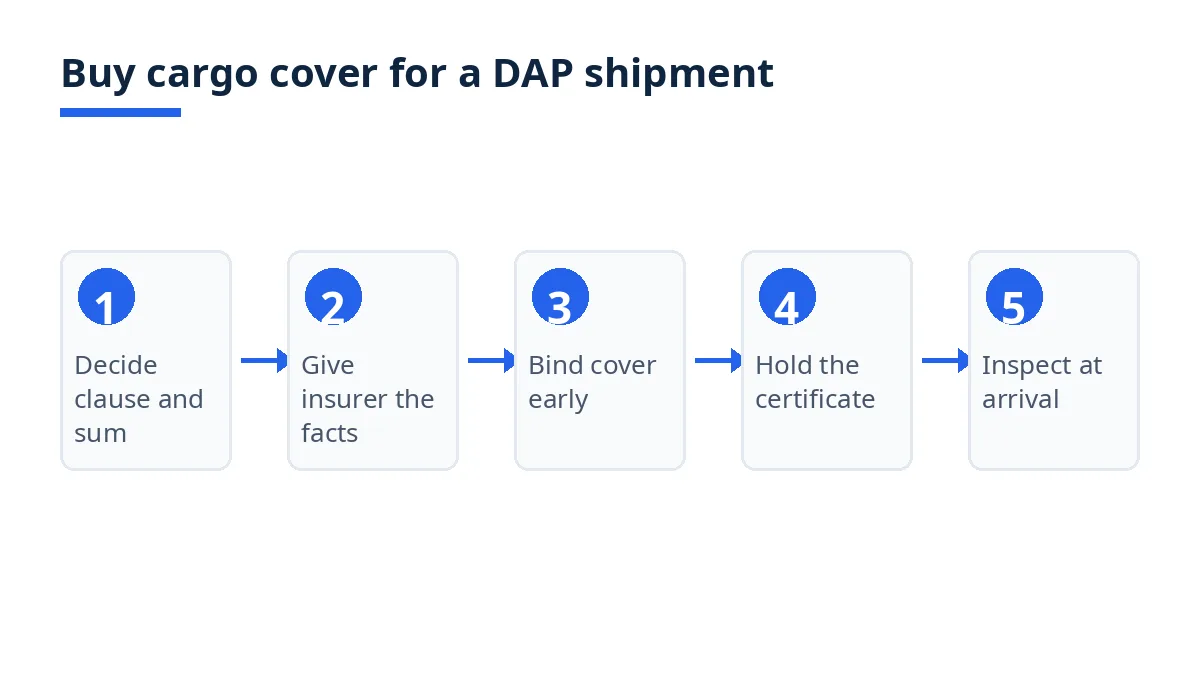
The first step is completing the insurer's application or questionnaire, so the insurer can price the risk on the facts of the shipment.6
Decide the shape: one shipment or a standing policy. A regular buyer may hold an open or annual policy and declare each shipment under it.
Give the insurer the facts: the goods, packing, invoice value, route and modes, the named place in full, and any transhipment or storage points. Packing matters, because insufficiency or unsuitability of packing is a standard exclusion under the Institute Cargo Clauses.7
State the clause, sum insured, currency, insured party and leg covered, including unloading and onward transport. Ask for the clause by name and number, for example Institute Cargo Clauses (A), CL382, and check the certificate when it arrives. Confirm war and strikes cover separately.7
Hold the certificate or policy, insurer, claim contact and notice period before shipment, and brief the receiving team on inspection and notation at arrival.
Where the seller arranges cover for the buyer's benefit, the certificate must name the buyer, or another party with an insurable interest, as entitled to claim, as a CIP policy is issued in favour of the buyer so the buyer can claim directly.4
How much cover: the sum insured, and what the 110 percent figures really mean
DAP sets no minimum sum insured: it sets no insurance duty at all. Two figures that look like DAP minimums belong to other rules. Under CIF, the seller must buy cover complying with Institute Cargo Clauses (C) for at least 110 percent of the contract price, in the contract currency, from delivery to at least the named port.8 Under CIP, the seller must buy cover complying with Institute Cargo Clauses (A) for at least 110 percent of the contract price, from delivery to at least the named destination.4 Those are CIF and CIP facts, not DAP requirements.
For a buyer's own policy, insurers commonly value goods on a CIF plus 10 percent basis: invoice value, plus the premium, plus freight and associated charges, plus 10 percent for additional charges.6 That is a valuation convention, not a DAP rule.6 Insuring only the invoice value leaves freight, clearance charges and any re-shipping margin outside the sum insured.
Example figures.
Sum insured element | Example figure (USD) |
|---|---|
Invoice value | 12,000 |
Freight and associated charges | 1,400 |
Invoice value plus freight and charges | 13,400 |
Plus 10 percent | 1,340 |
Sum insured, CIF plus 10 percent basis | 14,740 |
Insuring for 12,000 only would leave cover 2,740 below the illustrated sum, before any deductible. Check the deductible too: it is the part of a loss the buyer carries itself.9 Agree the sum insured, currency and deductible.
No premium rate is stated in this guide: no source consulted states one for a DAP shipment.
Clause (A), (B) and (C): choosing the wording
The Institute Cargo Clauses are three standard clause sets, published by the Lloyd's Market Association and the International Underwriting Association of London, in editions CL382, CL383 and CL384, effective from 1 January 2009.7
Clause | Basis | Cover |
|---|---|---|
Clause (A), CL382 | All risks | All causes of loss or damage except those specifically excluded |
Clause (B), CL383 | Named perils | Only listed perils; wider than Clause (C) |
Clause (C), CL384 | Named perils | Only listed perils; the narrowest list |
Fire, stranding, grounding, sinking, capsizing, collision, discharge at a port of distress, general average sacrifice and jettisoning are covered under all three.7 Earthquake, volcanic eruption and lightning, washing overboard, and entry of sea, lake or river water are covered under (A) and (B), not (C). Theft, pilferage and non-delivery, malicious damage, rough handling damage, and all other causes not specifically excluded are covered under (A) only.7 All three exclude wilful misconduct, ordinary leakage, insufficiency or unsuitability of packing, inherent vice, delay, and insolvency of vessel owners, managers, charterers or operators, while war and strikes need separate clauses.7
Do not rewrite CIP or CIF cover as DAP cover. A contract saying "insurance as under CIP", without the clause, sum insured, buyer and payer, agrees nothing enforceable. If CIP-level protection is wanted, write the clause, sum insured basis, payer and certificate requirement into the contract. The CIF guide applies the same discipline to seller-bought cover.8
The claim route when damage is found at the named place
A claim runs on two tracks: insurance, against the buyer's own policy where one exists, and carrier, against the carrier. They are not substitutes. A carrier does not provide first-party cargo insurance; recovery requires proving it was legally at fault, within limits set by law and strict time limits.6 A buyer's own policy pays for physical loss or damage in transit without first proving the carrier at fault.6
Inspect immediately, before signing anything clean: check damage, count items, photograph.9
Note the damage on the delivery receipt, with the date and time of delivery and inspection. A clean receipt makes a later claim harder.9
Notify the carrier as soon as possible, ideally within 24 hours, and the insurer within the policy's notice period.9
Preserve the goods and all packaging, and do not repair or dispose of damaged items until inspected.9
Review the cover, gather the documents below, and file inside the policy's time limit.9
Document | Why it is asked for |
|---|---|
Policy or certificate | Proves cover, clause, sum insured, who may claim |
Invoice and packing list | Prove value, quantity, weight, packing |
Bill of lading or air waybill | Proves the contract of carriage and receipt |
Delivery receipt noting damage | Proves damage was recorded at arrival |
Photographs and description | Prove the extent of damage |
Inspection report, where requested | Independent assessment of cause and extent |
Repair or replacement estimates | Support the claim amount |
Correspondence with the carrier | Shows notice was given |
The claim amount is the actual loss: the value of damaged or lost goods, plus costs such as inspection or disposal, less salvage value, with evidence for each figure; overclaiming causes delay or denial.9 Where damage happened during main carriage, notify the seller in writing too, since the seller still bears the contractual risk. In a general average, cargo interests share expenses pro rata, and a buyer with no policy can be asked to contribute and provide security before release.6 |
What the seller may do, and what to agree in writing
Nothing in DAP stops the seller from insuring. Three positions are possible: the buyer insures the whole journey including unloading; the seller arranges cover for the buyer's benefit at an agreed price, with the certificate naming the buyer, which works only if the contract states the clause, sum insured and payer4; or the seller insures its own risk only and the buyer insures from arrival onward.
Record who buys the cover, which clause and sum insured apply, who pays the premium, who holds the certificate and claim contact before shipment, and the leg covered. A quotation folding an insurance charge into the headline price, without naming the clause or insured party, should be treated as uninsured until the certificate proves otherwise.
Bangladesh origin notes: what changes, what does not
No Bangladesh rule changes the split.2 5 The export document set is fixed before loading: goods must not be loaded or stuffed unless a Bill of Export, also called a Shipping Bill, has been submitted and approved, under section 131 of the Customs Act, 1969.10 The enclosed documents are the export contract or letter of credit, commercial invoice, packing list, EXP form, certificate of origin, VAT certificate and TIN.10 The invoice, packing list and transport document form the core of any later claim, so copy them to the buyer's file before the goods leave Bangladesh. Packing insufficiency is excluded under all three clauses: agree the packing specification and photograph packing before departure.7 10 State the named place explicitly, with the full address and access details, so the handover point is not open to argument.3
Mistakes that leave a DAP shipment uninsured
Assuming the price includes insurance. DAP imposes no insurance obligation on either side.2 5
Reading a seller's policy as the buyer's cover. A policy in the seller's name protects the seller; the buyer needs cover in the buyer's favour to claim directly.4
Copying a CIF or CIP minimum into a DAP contract. Clause (C) at 110 percent is the CIF minimum; Clause (A) at 110 percent is the CIP minimum.1 4 Neither is a DAP requirement.
Insuring the invoice value only. Freight, charges and the re-shipping margin sit outside an invoice-only sum; value cover on the full basis, commonly CIF plus 10 percent.6
Letting cover stop at the port, or accepting Clause (C) for theft-prone goods. Unloading and onward transport are the buyer's risk2, and Clause (C) does not cover theft, handling damage or water entry.7
Signing a clean receipt, or relying on carrier liability. Damage unnoted at arrival is harder to prove, and carrier recovery needs proof of fault within legal limits and short time limits.6 9
Checklist: insure a DAP shipment before it moves
[ ] The contract states who insures, for which leg, under which clause, for what sum, in which currency, and who pays.
[ ] The clause is named by letter and number, e.g. Institute Cargo Clauses (A), CL382; war and strikes cover decided expressly.
[ ] The sum insured covers invoice value plus freight and charges plus a margin; the deductible is known.
[ ] Cover spans the full journey to the final destination.
[ ] The certificate, insurer, claim contact and notice period are held before shipment, in the buyer's name or favour.
[ ] Packing specification agreed; named place written in full, with warehouse address and dock or gate.
[ ] Receiving team briefed: inspect, note damage, photograph, preserve goods and packaging.
[ ] The export set, including the Bill of Export, invoice, packing list and certificate of origin, is copied to the buyer's file before loading.10
What should I know first about DAP insurance?
DAP requires no insurance from either side, while the seller bears transit risk to the named place and the buyer bears risk from arrival, including unloading and import clearance.2 5 A buyer with no policy has no insurer to claim from, whatever caused the damage.
What do DAP insurance costs and timelines look like?
DAP sets no premium and no timeline. The premium comes from the insurer or broker for the specific goods, route, packing and clause; no typical figure is stated here, because none of the sources consulted states one for a DAP shipment. Notify the carrier as soon as possible, ideally within 24 hours, and file inside the policy's time limit.9
Which documents does an insurer need for a DAP claim?
The policy or certificate, invoice and packing list, transport document, delivery receipt noting damage, photographs and description, an inspection report where requested, repair or replacement estimates, and correspondence with the carrier.9 The Bangladesh export set, invoice, packing list, Bill of Export and certificate of origin, supports the same file and should be copied before loading.10
What are the most common insurance mistakes under DAP?
Assuming the price includes cover, treating the seller's policy as the buyer's, copying a CIF or CIP minimum into a DAP contract, insuring the invoice value only, letting cover stop at the port, accepting Clause (C) for goods exposed to theft or handling damage, signing a clean receipt, and relying on carrier liability instead of cargo cover.
Next steps on Exportain
Read the Incoterms guide for shipments from Bangladesh and the DAP price guide to price the remainder a DAP quotation leaves to the buyer. Then post a free RFQ on Exportain stating the DAP term, the named place in full, and the insurance position agreed in writing, and check how to buy for the buying steps, including what an RFQ should state.11
Sources
- Incoterms® 2020. International Chamber of Commerce (ICC) (accessed )
- DAP & DDP Incoterms 2020 explained: Key differences. ICC Academy (accessed )
- DAP in Shipping: A Guide to Delivered at Place Incoterms. FreightAmigo, (accessed )
- CPT & CIP Incoterms 2020 explained: Key differences. ICC Academy (accessed )
- Incoterms for Shipments From Bangladesh. Exportain (accessed )
- Cargo Insurance Frequently Asked Questions. Berkley Offshore Underwriting Managers (accessed )
- Institute Cargo Clauses (A), (B), (C) Explained. VoyageCover (accessed )
- CIF Meaning (Cost, Insurance & Freight). Exportain (accessed )
- Step-by-Step Guide to Filing a Successful Cargo Claim. FreightAmigo, (accessed )
- Customs Clearance Procedures for Export. Bangladesh Customs, National Board of Revenue (accessed )
- How to source and buy from Bangladesh. Exportain (accessed )
About the author
Sourcing from Bangladesh?
Post a request for quotation and suppliers on Exportain can send you their quotes directly.
Post an RFQ


