

What Does a DAP Price Include? Cost Breakdown With a Real Example
Definition
A DAP price is the goods plus export packing and clearance and carriage to a named place of destination, where the seller delivers the goods ready for unloading. The seller bears the cost and risk of that journey. Import clearance, duty and taxes, unloading and any onward transport stay with the buyer, and DAP requires no insurance from either side. Always read the named place: it fixes where the seller price ends.
By Naim Islam
Published 10 min read
On this page
Key takeaways
A DAP price is the goods, export packing and clearance, and carriage to a named place, where the seller delivers the goods ready for unloading.
Risk passes to the buyer at arrival at the named place, ready for unloading, not at loading and not after unloading.
Import clearance, duty and taxes, unloading and onward transport sit outside the DAP price and stay with the buyer.
DAP requires no insurance from either side, so an insured and an uninsured quotation must be compared with the insurance line shown separately.
The named place, written in full with the dock or gate, fixes where the seller cost and risk end.
A truck arrives at the named warehouse with the goods still on the vehicle, waiting for the buyer to unload. That moment is the whole of DAP. The seller has paid to bring the goods that far and has carried the risk of the journey. From that moment, the remaining costs and the risk belong to the buyer.
This guide is for buyers comparing DAP quotations from Bangladeshi suppliers. It sets out what a DAP price includes, what it leaves out, and how to price the remainder before accepting a quote.
Quick answer
DAP stands for Delivered at Place. Under DAP, Incoterms 2020, the seller delivers the goods at a named place of destination, placed at the disposal of the buyer on the arriving means of transport, ready for unloading.1 The DAP price covers the goods, export packing and clearance, and carriage to that named place, and the seller bears the cost and risk of the journey to that point.2 Import clearance, duty and taxes, unloading, and any onward transport stay with the buyer, and DAP requires no insurance from either side.3 The named place fixes where the seller's price ends, so it must be written in full.
The named place decides what the price covers
DAP is one of the 11 Incoterms 2020 rules published by the International Chamber of Commerce, which allocate cost, risk and obligations between seller and buyer.4 It replaced the older terms DAF, DES and DDU, and it applies to any mode of transport, including sea, air, road and rail, and to combinations of modes.1 That flexibility suits door-to-door container shipments, where the seller manages the whole journey to the buyer's door without taking on import clearance in the buyer's country.2
The named place must be stated explicitly in the contract, with the full address, including the dock or gate where the vehicle will arrive.2 A city name alone does not fix the end of the carriage, and a vague place leaves the inland leg, the unloading point and the transfer of risk open to argument. Write the rule, the named place and the edition together in every document, in the form "DAP (named place), Incoterms 2020". Delivery happens before unloading: the former DAT rule was renamed DPU in Incoterms 2020 to mark the single difference from DAP, that under DAP the seller does not unload the goods, while under DPU the seller does.4
What a DAP price includes, line by line
Cost line | In a DAP price |
|---|---|
Goods, including export packing and marking | Yes, seller |
Export clearance and export documents | Yes, seller |
Pre-carriage and main carriage to the named place | Yes, seller |
Inland carriage to the named place beyond the port | Yes, seller |
Import clearance, duty and taxes | No, buyer |
Unloading at the named place | No, buyer |
Cargo insurance | No obligation on either side |
The seller's costs are freight, inland transport to the named place, export formalities and documentation, and any cargo cover the seller chooses to buy for its own risk.2 The seller bears all cost and risk until the goods are placed at the buyer's disposal at the named place, ready for unloading.1 If the carriage contract happens to include an unloading charge, confirm that in writing; the risk point does not move, and the buyer still bears the risk during unloading.5
What a DAP price leaves out
Import clearance comes first. The buyer handles all import procedures and pays the duties, taxes and official charges that apply at destination, including the broker's work, the import declaration and classification, and any inspection or storage charges if the goods are not released promptly.1 Get a broker's estimate for the exact goods and destination before ordering. Unloading comes second: the buyer unloads the goods and pays for the labour and equipment, so book the dock and labour before the vehicle arrives.1 Any movement beyond the named place is also outside the DAP price unless the contract states otherwise.
Insurance is the gap most often missed. Only CIF and CIP oblige the seller to buy insurance for the buyer, at different levels of cover; under every other rule, including DAP, the seller has no insurance obligation, and the buyer should arrange cover itself or agree in the contract that the seller will add it.3 DAP imposes no insurance obligation on either party, so an insured quotation and an uninsured quotation are not like for like until the insurance line is shown separately.5 If cover matters, agree who buys it, for whose benefit, for which leg, and at what price, in writing, before shipment.
How a DAP shipment runs from order to arrival
Agree the term in writing: goods, quantity, packing, the named place in full, the edition, currency and validity. State who unloads and who arranges insurance, even where no insurance is agreed.
The seller prepares and clears the goods for export: packing, marking, export clearance, and the commercial invoice, packing list and transport documents.1 For a shipment from Bangladesh, goods must not be loaded or stuffed in containers unless a Bill of Export, also called a Shipping Bill, has been submitted and approved by Customs under section 131 of the Customs Act, 1969, with the export contract or letter of credit, commercial invoice, packing list, EXP form, certificate of origin, VAT registration certificate and taxpayer identification number enclosed.6
The seller contracts carriage, gives notice of arrival, and must provide proof of delivery, such as a transport document, so the buyer can take delivery.1 Agree the arrival-notice method and contact before shipment, so unloading and broker clearance are booked before the vehicle arrives.
The buyer prepares import clearance and unloading while the goods are in transit: classification and duty estimate with the broker, advance filing where possible, and the dock and unloading labour for the arrival window.
Arrival and handover: the goods are placed at the buyer's disposal on the arriving means of transport, ready for unloading, at the named place, and risk passes at that point.1 The buyer unloads, clears import customs, pays duty and taxes, and arranges any onward transport.
Parties can agree variations in the contract, so check your own documents. A quotation that folds an import service into a DAP headline price should have that service priced separately, so the DAP price can be compared with other DAP prices on the same basis.5
Worked example with numbers: bath towels to Dallas
Example figures only. The figures below are illustrative arithmetic for one shipment of cotton bath towels from Chattogram to the buyer's distribution centre in Dallas, Texas, quoted DAP the distribution centre, Incoterms 2020. They are not a quotation or a market price.
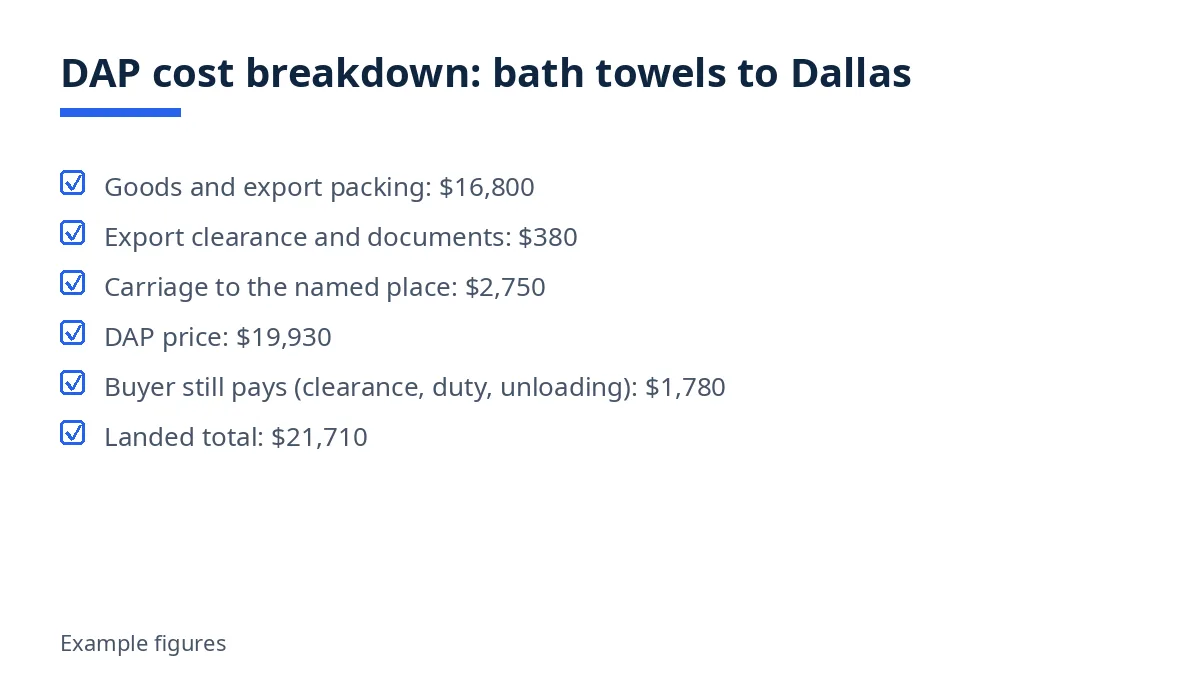
Element of the DAP price | Example figure (USD) |
|---|---|
Goods, including export packing | 16,800 |
Export clearance and documents | 380 |
Carriage to the named place | 2,750 |
DAP price to the distribution centre | 19,930 |
Buyer-side cost | Example figure (USD) |
|---|---|
Import clearance and broker | 340 |
Duty and taxes, example lump sum | 1,180 |
Unloading at the distribution centre | 260 |
Buyer-side total | 1,780 |
Landed total at the distribution centre | 21,710 |
The duty line is an example lump sum only. No duty rate is stated here, because duty depends on the classification of the exact goods and the rules of the destination country. Ask the broker for a calculation for the confirmed classification, and rework the landed total with that figure. Compare DAP price against DAP price for the same named place, specification and quantity, with the same buyer-side lines added to each.
DAP beside DDP, DPU and CPT
Two questions separate DAP from its neighbours: who unloads, and who imports. Under DPU, the seller also unloads the goods at the named place, and risk passes after unloading; DPU is the only rule that requires the seller to unload.3 Choose DPU where the receiving site has no dock or handling equipment, and DAP where the buyer can unload.
Under DDP, the seller also clears the goods for import and pays duty and taxes, the maximum obligation any rule places on the seller.3 DDP suits a seller with a compliant import route in the buyer's country. Where the seller has none, DAP keeps import clearance and duty with the buyer, who knows the local rules.1
Under CPT, the seller also pays carriage to a named destination, but delivery and risk pass much earlier, when the goods are handed to the first carrier.3 A CPT price therefore leaves the buyer carrying the transit risk from the first handover, while a DAP price keeps transit risk with the seller until arrival at the named place. Compare the two rules on the risk point, not only on the headline price.
Common mistakes to avoid
Treating a DAP price as a duty-paid price. DAP excludes import clearance, duty and taxes.1 A quotation promising duty handling inside a DAP price must have that service separated out, or the term reconsidered.5
Accepting a city as the named place. Risk and cost transfer at the named place, so it must be identified precisely, with the warehouse address and the dock or gate.2
Assuming the seller unloads. Under DAP the seller is not required to unload.1 Book labour and equipment before arrival, and confirm whether the carriage contract includes the unloading charge, while remembering that the buyer still bears the risk during unloading.5
Assuming insurance is included. DAP imposes no insurance obligation on either party.5 Agree cover in writing, with the price shown separately.
Comparing a DAP headline price with an FOB or CIF headline price. FOB ends on board at origin, CIF ends at the destination port, and DAP ends at the named place. Price every quotation to the same point, adding each cost the rule leaves to the buyer, before ranking.
Leaving the edition out. Write "DAP (named place), Incoterms 2020" in full wherever the term repeats. Without the edition, the governing rules are not fixed.
How Exportain helps
Post the specification, quantity, named place in full and Incoterm as an RFQ on Exportain, and compare supplier replies on the same basis, with the carriage, unloading and insurance lines stated in the same format. Exportain is a B2B marketplace where buyers post RFQs, receive quotations and message suppliers. It is not a party to the contract for the goods, and it does not inspect goods, book freight or clear customs.
What is DAP?
DAP stands for Delivered at Place. It is one of the 11 Incoterms 2020 rules, and it means the seller delivers the goods at a named place of destination, placed at the buyer's disposal on the arriving means of transport, ready for unloading.1 The seller bears the cost and risk of carriage to that place. The buyer unloads, clears import customs, and pays duty and taxes.1
How does DAP work in practice?
The seller prepares the goods, clears them for export, contracts carriage to the named place, and gives notice of arrival. The buyer prepares import clearance and books unloading before arrival. On arrival at the named place, ready for unloading, delivery happens and risk passes to the buyer, who unloads, clears import customs, pays duty and taxes, and arranges onward transport.1
Is DAP used for shipments from Bangladesh?
Yes. DAP is quoted by suppliers shipping from Bangladesh where the seller arranges carriage to the buyer's named place and the buyer handles import clearance at destination.5 No separate Bangladesh rule changes the DAP split: export clearance stays with the seller, including the approved Bill of Export before loading, and import clearance and duty stay with the buyer.6 Confirm the seller's export-clearance scope and the carriage end point in writing, including whether the carriage price ends at the named warehouse or at an earlier terminal.
What are common mistakes with DAP?
The common mistakes are treating a DAP price as duty-paid, accepting a city name as the named place, assuming the seller unloads, assuming insurance is included, and comparing a DAP headline price with a price written on another rule. Each mistake comes from reading the headline price as a delivered, all-in total. Read the named place first, then the cost lines, then the buyer-side remainder.
Next steps on Exportain
Read the Incoterms guide for all 11 rules side by side, and the CIF guide to see how a port-based price differs from a place-based DAP price. Then work the landed cost guide with your broker's figures, and read the DAP quotation guide before ranking quotations. When the named place and specification are fixed, post a free RFQ on Exportain, and check how to buy for the buying steps.
Sources
- DAP Incoterms 2026: Meaning, Seller vs Buyer Duties & Examples. Drip Capital, (accessed )
- DAP in Shipping: A Guide to Delivered at Place Incoterms. FreightAmigo, (accessed )
- Incoterms for Shipments From Bangladesh. Exportain (accessed )
- Incoterms® 2020. International Chamber of Commerce (ICC) (accessed )
- How to Compare DAP Quotations From Bangladeshi Suppliers. Exportain (accessed )
- Customs Clearance Procedures for Export. Bangladesh Customs, National Board of Revenue (accessed )
Reviewed by Nourin Tabassum
About the author
Sourcing from Bangladesh?
Post a request for quotation and suppliers on Exportain can send you their quotes directly.
Post an RFQ


