Sustainable Jute & Jute Products From Bangladesh: Certifications and Green Factories
Jute and jute goods exports were USD 820.16 million in FY2024-25. This guide separates the fibre's documented environmental properties from mill-level claims, and covers diversified products, certifications, EU green-claims rules, MOQ and buying steps.
Short answer
Sustainable jute products from Bangladesh are goods made from a fibre the FAO describes as 100 percent biodegradable and recyclable, in a sector that exported USD 820.16 million in fiscal year 2024-25. Sustainability is not automatic: buyers verify the fibre content, the batching oil and dyes behind each product, the mill's current operating status, and the evidence file behind every environmental claim they repeat.
On this page
Key takeaways
Jute and jute goods exports were USD 820.16 million in fiscal year 2024-25 on the EPB fiscal-year series, down from USD 1.16 billion in FY2020-21, with sacks and bags at USD 125.96 million the only category whose shipments did not fall that year.
FAO material states that jute fibre is 100 percent biodegradable and recyclable, that a hectare of jute plants consumes about 15 tonnes of carbon dioxide and releases 11 tonnes of oxygen, and that jute products require less energy and have a lower carbon footprint than plastic products.
Bangladesh has declared 282 diversified jute products under the Jute Law 2017 definition, which requires at least 50 percent jute content and excludes traditional hessian, sacking, carpet backing cloth and coarse yarn.
There is no jute-specific green-factory certification a buyer can check: mill-level claims are verified one by one, from batching oil type and fibre percentage to dyeing, lamination and test reports.
For food packing, IJO Standard 98/01 caps unsaponifiables at 1,250 mg/kg in bags for cocoa, coffee and shelled nuts, and EU Directive 2024/825 bans generic environmental claims such as eco-friendly unless they are substantiated.
Sustainable jute products from Bangladesh are bought on two kinds of evidence. The first is the fibre itself: what jute is and how it behaves at end of life. The second is the individual product and mill: fibre content, batching oil, dyes and finishes, and the paperwork behind every environmental claim. This pillar guide is for importers, brands, retailers and sourcing agents in the United States, the United Kingdom, the European Union and the United Arab Emirates. It covers market data, the fibre's documented properties, products and clusters, supplier verification, MOQ, pricing and lead times, certifications and green-claims law, shipping, Incoterms and duties, and a step-by-step buying process.
Market overview with latest data
Start with the trade record, because the sustainability story sits inside a shrinking export sector. Export earnings from jute and jute goods were USD 1.16 billion in fiscal year 2020-21, then fell in each following year of the Export Promotion Bureau (EPB) fiscal-year series: USD 1.13 billion in FY2021-22, USD 911.51 million in FY2022-23, USD 855.23 million in FY2023-24 and USD 820.16 million in FY2024-25.1 These are EPB fiscal-year figures, running July to June.
The product mix shows where demand held up. Jute yarn and twine is the largest single earner, at USD 461.83 million, down 6.22 percent from USD 492.45 million in FY2023-24.1 Raw jute shipments were USD 148.48 million, down 7.94 percent.1 Jute sacks and bags were the exception: shipments reached USD 125.96 million, the only category in the EPB breakdown whose shipments did not fall that year.1 Economists and exporters name two causes of the wider decline in the same reporting: a low rate of value addition in basic jute goods, and India's anti-dumping duties on Bangladeshi jute products, first imposed in 2017 and extended on 30 December 2022; rising raw jute prices have also lifted mill production costs.1 The reading for a buyer is direct: the commodity end of the sector is under price pressure, and the growth argument for jute rests on diversified, higher-value goods, where the sustainability claims are also concentrated.
The demand side of that argument is documented by the Food and Agriculture Organization of the United Nations (FAO). The FAO records that demand for jute and allied fibres is influenced by increasing awareness of the environmentally friendly properties of natural fibres and by a shift in consumer preferences towards more sustainable, recyclable and biodegradable products, and that the market is stimulated by demand for value-added products.2 The same FAO overview states that products made from jute require less energy and have a low carbon footprint compared to plastic products.2 Those are statements about jute products as a class, not a certificate for any single bag, rug or mill.
The fibre-level properties behind the comparison are stated in FAO material on jute: jute fibre is 100 percent bio-degradable and recyclable and thus environmentally friendly; a hectare of jute plants consumes about 15 tonnes of carbon dioxide and releases 11 tonnes of oxygen; and cultivating jute in crop rotations enriches the fertility of the soil for the next crop.3 Those figures describe the plant and the fibre. They do not substantiate a claim about a dyed, printed, laminated or blended finished product, because the finish and the blend are not jute.
Bangladesh policy pushes in the same direction, through product definition rather than marketing. The government has declared 282 jute products as diversified items, under a definition in the Jute Law 2017: a product counts as diversified where jute has been used at least 50 percent as raw material, excluding traditional hessian, sacking, carpet backing cloth and jute yarn of six counts or more.4 The declared items include gardening and office bags, bed sheets, curtains, cushion covers, shoes, fashion garments and denim, and the Jute Diversification Promotion Centre (JDPC) promotes these enterprises.4 The practical point for a buyer: a "jute" product can legally be a blend, so the fibre percentage belongs in your written specification. Domestic law adds a demand floor of its own: the Mandatory Jute Packaging Act 2010 lists 19 products, including paddy, rice, wheat, fertiliser, sugar, pulses, potato, flour, poultry feed and fish feed, that are to be packed in jute, and enforcement through mobile courts continues.5
In the European Union, carrier-bag law works against the plastic alternative. The Plastic Bags Directive (Directive (EU) 2015/720) targets lightweight plastic carrier bags below 50 microns and obliges member states to apply reduction targets, mandatory pricing or marketing restrictions, with a cap of 40 lightweight bags per person per year by 31 December 2025.6 The Commission's reasoning is that such bags are used for a few minutes yet take centuries to degrade and fragment into persistent microplastics.6 This is the regulatory gap reusable jute shopping bags are sold into: a gap about carrier bags specifically, not a general EU endorsement of jute.
Main products and production clusters
Jute products are classified across several chapters of the Harmonized System, because the system follows the stage of manufacture. Raw fibre and yarn sit in Chapter 53, floor coverings in Chapter 57, and made-up sacks and bags in Chapter 63:
HS heading | What it covers | Typical Bangladesh products |
|---|---|---|
5303 | Jute and other textile bast fibres, raw or processed but not spun; tow and waste | Raw jute in bales, cuttings and tow |
5307 | Yarn of jute or of other textile bast fibres of heading 5303 | Single and folded jute yarn and twine |
5310 | Woven fabrics of jute or of other textile bast fibres of heading 5303 | Hessian cloth, sacking cloth and carpet backing cloth |
Chapter 57 | Carpets and other textile floor coverings | Woven and braided jute rugs, mats and floor coverings |
6305 | Sacks and bags, of a kind used for the packing of goods, including 6305.10 of jute | Sacking bags for cocoa, coffee and food grains, shopping and promotional bags |
For sustainability-led buying, the offer divides into three groups. The first is the traditional volume lines, yarn and twine under 5307 and sacks and bags under 6305, where the environmental case rests on the fibre properties above and, for food packing, on the batching-oil standard in the compliance section. The second is fabric under 5310, sold to converters, where the claim file depends on what the converter does next. The third is the diversified group defined by the 282-item list: shopping and promotional bags, rugs and mats, home textiles, gardening products, footwear and fashion items.4 Diversified goods carry the highest value per kilo and the heaviest claims burden, because they are sold to consumers with words like biodegradable on the label.
Capacity is counted in mills. Bangladesh has 266 licensed jute mills, including 25 state-owned mills under the Bangladesh Jute Mills Corporation (BJMC); of the 266, 193 are operational and 73 remain closed, according to figures the Textiles and Jute Minister gave to parliament in June 2026.7 Production at all 25 BJMC mills was suspended in 2020, and the mills are returning through leases to private operators: 14 had been leased by June 2026, of which nine had resumed production, with the rest expected to restart by December 2026.7 When you assess a BJMC-named mill, ask which operator currently runs it, because the operator may differ from the name on the gate.
This is also where the phrase "green factory" needs discipline. There is no jute-specific green-factory certification in Bangladesh that a buyer can check against a public register. What exists is a set of mill-level practices you verify one by one: the batching oil used on food-grade lines, whether dyeing, printing and lamination are in-house or subcontracted, how process water and dye waste are handled, and what energy source the mill runs. A mill that answers with documents is making a checkable claim; a mill that answers with the word "green" alone is making the kind of generic claim EU law now restricts. Treat "green factory" as a list of questions, not as a label.
How to find and verify suppliers
Find suppliers through more than one channel so you can cross-check what a mill tells you. Start with the mill and exporter associations, add Bangladesh export data and Exportain trade intelligence for context, then work Bangladeshi suppliers listings by product.
Verification has a document layer and a claims layer. Ask for the following before you discuss price:
Trade licence and export registration, in the company's own name, plus the name of the current operator where the mill is a leased BJMC mill.7
Association membership, where claimed, and the mill's licensed status against the 266-mill national picture.7
Export history: anonymised bills of lading or shipment summaries for your target market.
The fibre evidence: the jute percentage against the 50 percent diversified threshold, the fibre grade, and any blend components stated by name.4
The process evidence: batching oil type for food-grade lines, dye and print chemistry by product, and whether lamination is applied.8
Test reports and certificates for the exact construction you plan to buy, checked against the registers named in the compliance section, not accepted as scans alone.
Mill profile evidence: daily spinning, weaving and finishing capacity, and whether finishing is in-house or subcontracted.
On Exportain, read badges for what they are. Supplier profiles carry document and photo review badges: the badge records that documents and photos were reviewed by Exportain staff, verification is free, and membership never grants a badge.9 A badge is not a factory inspection, a certification or a guarantee, and Exportain is not a party to the contract for goods between buyer and seller; it does not inspect goods, book freight or clear customs.9 Use the badge as a first filter, then run the checks above yourself or through an inspection firm you appoint.
Two red flags end a conversation early: a supplier that will not state its product's jute percentage in writing is asking you to carry a claim it will not document, and a supplier that cannot state whether its mill is currently operational, when 73 of the country's licensed mills remain closed, has not answered the first capacity question.7
MOQ, pricing and lead times
There is no industry-wide MOQ, standard price or standard lead time for jute products from Bangladesh, and no official body publishes one. All three are quoted per mill, per product and per order, against a written specification.
MOQ. The minimum order quantity is set by the production stage, not by the buyer's carton count. A yarn order carries the spinning mill's minimum per count and blend; a fabric order carries loom and finishing minimums per construction, width and finish; a bag order carries cutting, stitching and printing minimums per size and design. Sustainability specifications add segregated runs, for food-grade batching, certified fibre or a custom dye lot, and each segregated run carries its own minimum. State your target quantity per product, per size, per design and per claim in your enquiry.
Pricing. The FY2024-25 figures show why a single jute price does not exist: yarn and twine earned USD 461.83 million and sacks and bags USD 125.96 million in the same year, at very different values per tonne and per piece.1 Your unit price is built from raw jute grade and price at purchase, spinning or weaving cost, finishing, cutting and stitching where they apply, printing, packing, and export costs to the agreed Incoterm point. Raw jute prices move with the harvest, and exporters name rising raw jute prices as a direct cause of higher production costs.1 Certification and testing add line items of their own. Compare quotes only at the same Incoterm, specification and claim set, and ask each mill to state the raw jute grade, jute percentage and price-validity period in writing.
Example figures. For illustration only: a specification for 10,000 printed jute shopping bags, unlaminated, is quoted by two suppliers at the same Incoterm, FOB Chattogram. Supplier A quotes USD 2.10 per bag itemised as fabric and making USD 1.55, printing USD 0.25 and packing and export costs USD 0.30. Supplier B quotes USD 1.92 per bag with no itemisation. The totals are USD 21,000 and USD 19,200. The example shows the method, not a market price: the buyer asks Supplier B for the same itemisation, and for the fabric weight and jute percentage behind the quote, before treating the USD 1,800 gap as a saving, because an unitemised gap is usually a lighter fabric or a lower jute percentage. The specification states "unlaminated" deliberately: a plastic lamination would change the end-of-life claim the buyer can make.
Lead times. A lead time is a chain, not a single number: raw jute purchase and grading, spinning, weaving, finishing, cutting and stitching where they apply, inspection and booking, then transit. Certified or food-grade production adds stages: fibre segregation, batch testing and certificate paperwork sit between weaving and packing. Ask for the stages separately and agree what starts the clock, normally written order confirmation plus approved sample.
Quality, certifications and compliance
Quality and sustainability compliance in jute products are decided by three layers: the destination market's product and claims law, the product-specific standard your goods are sold against, and your own specification and testing.
Food-grade bags and batching oil. Jute is softened in manufacture with batching oil, and where mineral-oil-based batching oil is used in bags that pack food, hydrocarbon contamination of the food is the documented concern. IJO Standard 98/01, adopted by the International Jute Council in 1998 and revised in 2005, sets special criteria for jute bags used in the packing of selected food materials, namely cocoa beans, coffee beans and shelled nuts: batching oil ingredients must be non-toxic and approved for packing materials that come into contact with those foods, the bags must not contain unsaponifiables exceeding 1,250 mg/kg, and no undesirable odours or odours untypical of jute may be present.8 Food-grade production is segregated production, often described as vegetable oil treated, and it must be specified at order stage, not requested after weaving. Write the standard into the purchase specification and require a batch test report against the 1,250 mg/kg limit.8
EU fibre labelling. Regulation (EU) No 1007/2011 governs textile fibre names and the labelling and marking of fibre composition for textile products placed on the EU market.10 In that regulation, "jute" is the fibre obtained from the bast of Corchorus olitorius and Corchorus capsularis, and bast fibres from named related species are treated in the same way for fibre naming.10 A shopping bag, rug or home textile sold to EU consumers therefore needs its fibre composition stated with the regulation's fibre names, in the destination language set. Agree the label artwork at sampling stage, because a bag woven from a blend cannot be labelled as pure jute.
Organic claims and GOTS. The Global Organic Textile Standard (GOTS) is the processing standard buyers most often name for an organic claim. Only textile products that contain a minimum of 70 percent organic fibres can become GOTS certified; all chemical inputs, such as dyestuffs and auxiliaries, must meet environmental and toxicological criteria, a functional wastewater treatment plant is mandatory for any wet-processing unit in the chain, and all processors must comply with minimum social criteria.11 Two consequences follow. First, conventional jute is not "organic" on a label unless the fibre itself is certified organic and the chain behind it is certified. Second, a GOTS claim covers the spinner, weaver and maker-up, so ask for the scope certificates of every unit in your chain, not only the exporter's.
Green claims law in the EU. Directive (EU) 2024/825, the Empowering Consumers for the Green Transition Directive, amends EU consumer law to protect consumers against greenwashing, including misleading claims about a product's environmental benefits and unverified sustainability labels.12 Under the rules it introduces, generic claims such as "eco-friendly" or "carbon neutral" are banned unless they are substantiated, sustainability labels must be certified or issued by public bodies, and a trader may not suggest an environmental benefit applies to the entire product when it only relates to a specific part.12 Future-performance claims require verifiable commitments, a measurable plan, and independent verification.12 The working rules are direct: name the property, state its scope, and hold the evidence. "Bag made of 100 percent jute fibre, unlaminated" is a specific claim you can evidence. "Eco-friendly bag" is a generic claim the fibre's properties alone do not substantiate for a finished product.
Claim a buyer wants to make | Evidence to hold before using it |
|---|---|
Biodegradable | Fibre composition test showing the jute percentage, plus finish and lamination status in writing3 |
Organic | GOTS scope certificates for each processing unit and a transaction certificate for the shipment, with at least 70 percent certified organic fibres11 |
Food-grade | Batch test report against IJO Standard 98/01 showing unsaponifiables below 1,250 mg/kg8 |
Carbon neutral | Under Directive (EU) 2024/825, offsetting alone does not substantiate this claim for EU consumers; future-performance claims need verifiable commitments and independent verification12 |
Your own quality system. Write the specification so an inspector can measure it: fibre grade and jute percentage, yarn count, fabric construction and weight per unit area, bag dimensions and tare weight, stitch type, print colours and placement, finish and lamination status, and packing. Approve a pre-production sample and a counter-sample, set the inspection point before bales are closed, and test production-representative goods, not showroom samples, through a laboratory accredited for those methods.
Shipping, Incoterms and duties
Jute goods from Bangladesh normally leave by sea from Chattogram. Packing drives the freight economics: finished bags are bulky relative to weight, so confirm bale or carton dimensions and pieces per bale or carton in the specification, because those numbers set your freight cost per unit.
Incoterms® 2020 is the current edition of the ICC rules, in force since 1 January 2020. The rules are eleven three-letter trade terms that clarify the tasks, costs and risks involved in the delivery of goods from sellers to buyers, and they are recognised as the global standard for interpreting the most common terms in foreign trade.13 The four rules you will meet most often on jute orders are EXW, where the buyer collects at the seller's premises and carries the export clearance workload; FOB, where the buyer arranges main freight and risk passes when the goods are on board at the named loading port; CIF, where the seller pays freight and minimum insurance but risk still passes at loading, not at arrival; and DAP, where the seller delivers to a named destination place and the buyer still clears import and pays duty unless the contract says otherwise.13 Always write the rule with its named place and edition, for example "FOB Chattogram, Incoterms® 2020". Exportain does not book freight or clear customs; name your forwarder and broker in the order paperwork.9
Duties are decided by the heading from the products table, the origin of the goods and the destination's preference scheme, in that order. As a least developed country, Bangladesh benefits from the Everything But Arms (EBA) arrangement under the EU's Generalised Scheme of Preferences, which grants duty-free, quota-free access to the EU for all products except arms and ammunition, and 91 percent of Bangladesh's exports to the EU enter duty- and quota-free.14 Bangladesh is the largest beneficiary under the EBA arrangements, with EUR 19 billion in exports benefitting from these preferences in 2024 at a 96 percent utilisation rate.14 Jute goods that meet the EBA rules of origin and ship with the required proof of origin therefore enter the EU without customs duty. Two cautions apply. First, preference is a property of the consignment, not the country: if the origin evidence fails, the standard third-country duty applies. Second, India's anti-dumping duties on Bangladeshi jute products, in place since 2017 and extended in December 2022, are a material cost for any programme selling into India.1 For the United States, the United Kingdom and the UAE, read the duty beside your confirmed six-digit code in the destination tariff; this guide states no rate for them, because jute rates vary by heading.
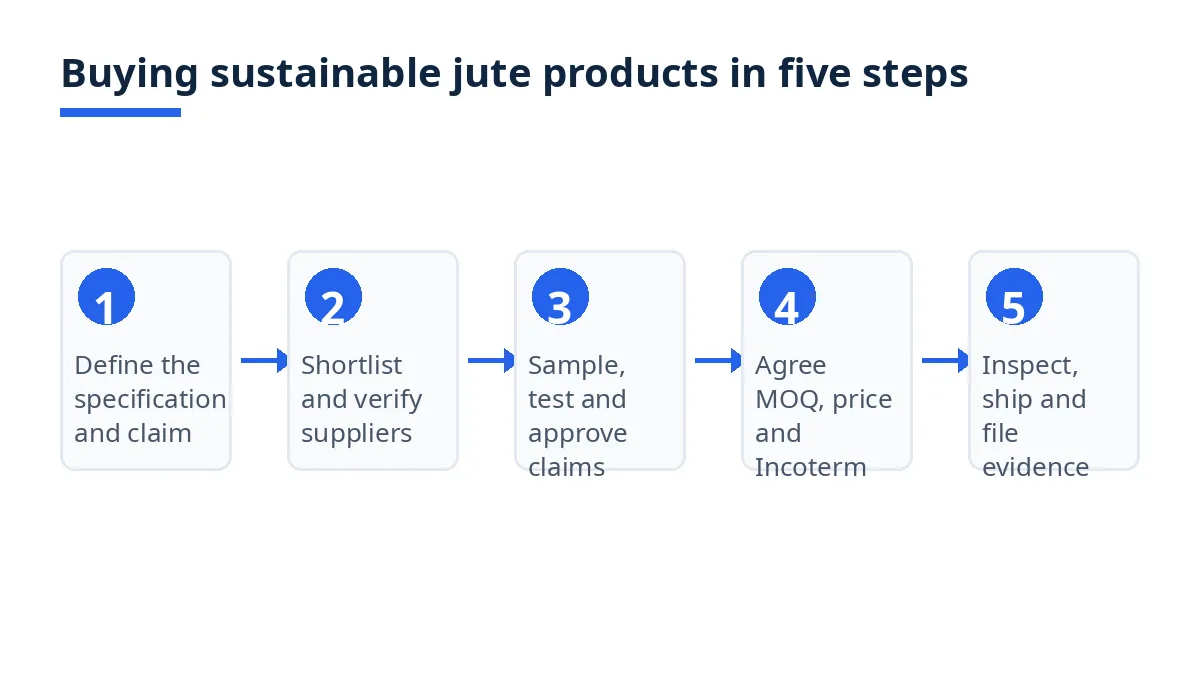
Step-by-step buying process
Define the specification and the claim together. HS heading, fibre grade and jute percentage, construction, dimensions, finish, lamination status and print, packing, target quantity, destination market, and the exact environmental claims you intend to make.
Shortlist and verify suppliers. Confirm the mill is operational and who operates it, then run the document and claims checks in the verification section.7 9
Sample, test and approve the claim file. Test production-representative goods for the food-grade limit where it applies and for fibre composition, verify any certificate against its register, and approve a counter-sample in writing.8 11
Agree commercial terms in writing. Fix MOQ per product, design and claim set, itemised unit price, the Incoterm with its named place, the staged lead time, payment terms and the inspection point, all in the purchase order.13
Produce, inspect and ship with the evidence file. Inspect finished goods against the approved counter-sample, then ship with the origin evidence your duty position depends on and the test file your claims depend on.14
Related guides
Read the jute products industry in Bangladesh pillar for mill capacity and the general category picture, how to import from Bangladesh for the general import sequence, and Bangladesh export data for category scale. Incoterms for shipments from Bangladesh covers the delivery terms in more detail.
FAQs
Is Bangladesh a good place to source jute & jute products?
Bangladesh is a credible sourcing option for jute yarn, sacks and bags and diversified jute goods where the specification, fibre percentage and claims file are managed actively. The country holds 266 licensed jute mills of which 193 are operational, exported USD 820.16 million in FY2024-25 on the EPB series, and has declared 282 diversified jute products under a definition requiring at least 50 percent jute content.7 1 4 The constraints to price in are the fall from USD 1.16 billion in FY2020-21, low value addition in basic goods, and India's anti-dumping duties.1 Source mill by mill and claim by claim.
What is the typical MOQ?
There is no published typical MOQ for jute products from Bangladesh, and no official body sets one. Each mill quotes its MOQ from its production stage: a spinning minimum per yarn count, a loom and finishing minimum per fabric construction, or a cutting, stitching and printing minimum per bag size and design. Sustainability specifications add segregated runs, each with its own minimum. State your target quantity on the same basis in your enquiry.
How long is the lead time?
There is no standard lead time: yours is the sum of its stages, raw jute purchase and grading, spinning, weaving, finishing, making-up where it applies, batch testing and certificate paperwork where a claim requires them, inspection and booking, and transit. Ask for the stages separately.
Which certifications matter?
The requirements that matter are the ones your destination market and your buyers require for the exact product and claim. For food packing, the operative standard is IJO Standard 98/01: non-toxic batching oil ingredients and unsaponifiables not exceeding 1,250 mg/kg in bags for cocoa beans, coffee beans and shelled nuts.8 For the EU, fibre composition labelling under Regulation (EU) No 1007/2011 is a legal requirement for textile products.10 For an organic claim, GOTS certification requires at least 70 percent certified organic fibres and a certified chain.11 For any environmental claim sold to EU consumers, Directive (EU) 2024/825 requires the claim to be substantiated and specific, and restricts sustainability labels to certified schemes or labels issued by public bodies.12 Buyer-named audits sit on top of this legal file and do not replace it.
Next steps on Exportain
Browse Bangladeshi suppliers by jute product, use Exportain trade intelligence to check the market picture behind this guide, and post a free RFQ at Exportain RFQs with your specification, jute percentage, target quantity and destination market.
Sources
- Exports of jute and jute goods keep falling. The Financial Express (accessed )
- Jute and hard fibres. Food and Agriculture Organization of the United Nations (accessed )
- Food and Agriculture Organization of UN report on Jute. Food and Agriculture Organization of the United Nations (accessed )
- 282 jute products added to list of diversified items. The Financial Express (accessed )
- DCs asked to mobilise mobile courts to ensure jute bag use. The Financial Express (accessed )
- Plastic bags. European Commission (accessed )
- 9 state-owned jute mills back in production, rest to reopen by Dec: Minister. The Daily Star, (accessed )
- IJO Standard 98/01: Special Criteria for the Manufacture of Jute Bags used in the Packing of Selected Food Materials. International Jute Study Group (accessed )
- Supplier verification: Earn trust badges buyers can see. Exportain (accessed )
- Regulation (EU) No 1007/2011 on textile fibre names and related labelling and marking of the fibre composition of textile products. European Union, (accessed )
- Global Organic Textile Standard (GOTS). Organic Trade Association (accessed )
- Directive (EU) 2024/825 – Empowering Consumers for the Green Transition. Department of Enterprise, Trade and Employment, Ireland (accessed )
- Incoterms® rules. International Chamber of Commerce (ICC) (accessed )
- EU trade relations with Bangladesh. European Commission, (accessed )
- Incoterms
- quality control
- Bangladesh Export Data
- Category Pillars
- Supplier Sourcing
- Jute Bangladesh
- Jute products
About the author
Sourcing from Bangladesh?
Post a request for quotation and suppliers on Exportain can send you their quotes directly.
Post an RFQ