

Power Transformers Price in Bangladesh: FOB Cost Breakdown for Buyers
Power transformer FOB price in Bangladesh, line by line: what sits inside the factory-to-on-board price, what stays outside it, and how to compare quotes on the same rating, test scope and port.
Short answer
Under FOB Chattogram, Bangladesh, Incoterms 2020, a power transformer price should cover the built and tested unit, export packing, inland transport to the port, export clearance and loading on board the vessel you nominate. Sea freight, marine insurance and destination clearance sit outside that price. Compare quotes only when every supplier prices the same rating, test scope and FOB inclusions, with each line in writing.
On this page
Key takeaways
An FOB price is a stack, not a single figure: factory price, export packing, inland transport, port handling and loading, and export clearance and documents.
FOB cost and risk pass to the buyer only when the goods are on board the vessel nominated by the buyer at the named port of shipment.
Sea freight, marine insurance, destination clearance, duty and tax, and destination inland transport sit outside the FOB price.
Compare quotations only on the same rating, cooling method, test scope, FOB port and inclusions, with the exclusions list attached.
A badge is a document and photo review, not a factory inspection, so test reports and your own checks stay with you.
A power transformer quotation that says only "FOB price" tells you almost nothing on its own. The figure only becomes useful when you can see the lines inside it: the built and tested unit, the export packing, the inland haul, the port handling and loading, and the clearance papers. This guide reads a power transformers price in Bangladesh that way, line by line, so you can compare quotations on the same FOB port and rating without mistaking a thinner scope for a lower price.
Under FOB, the seller bears cost and risk up to delivery on board the vessel nominated by the buyer at the named port of shipment.1 From that moment the buyer bears the costs and the transport risk.1 FOB applies only to water transport.1 The Incoterms® 2020 rules allocate cost, risk and obligations across 11 rules.2 State the rule, for example "FOB Chattogram, Bangladesh, Incoterms® 2020". See the FOB definition guide and the Incoterms guide for shipments from Bangladesh.
Why this matters for buyers and sellers
For the buyer, FOB keeps control of the sea leg. You choose the vessel, routing and marine insurance, and you can compare factory prices without each seller burying a different freight rate inside the total. That control only pays off if the FOB lines match. A quotation that leaves out heavy-lift handling, or that prices light packing when your unit needs a braced skid and bushing protection, is not cheaper. It is incomplete, and the missing lines surface later as extra charges or damage risk. For the seller, the same openness defends the total: folding those lines into one lump sum invites comparison with an ex-works price, a different bargain.
The build drives most of the factory price, and the rating drives the build. Transformer cost scales with power capacity and voltage class, because a larger rating uses more core steel and winding conductor, and a higher voltage class needs thicker insulation, larger clearances and more demanding tests.3 Core and winding materials account for a major share of manufacturing cost, so a change in conductor, core grade or agreed loss figures changes the price at the same kVA.3 Two FOB prices for the same headline rating can therefore differ widely.
Step-by-step: how it works
Read an FOB quotation in the order the money is spent.
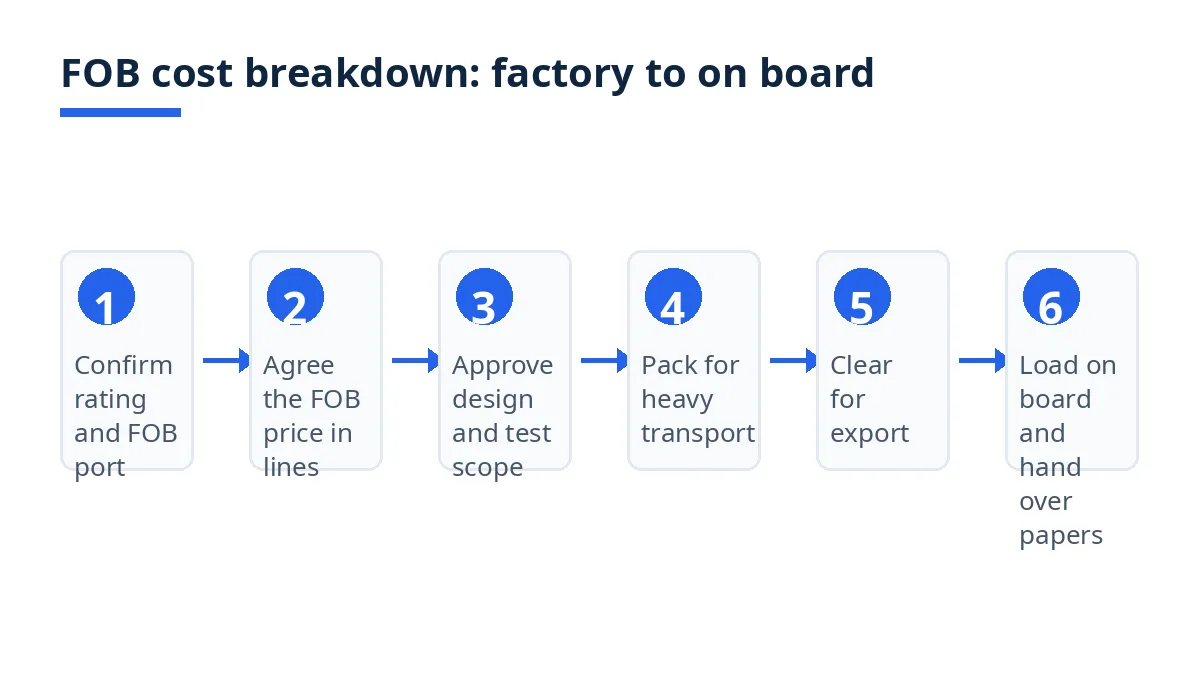
Name the rating and the FOB port first. Send one specification to every candidate: kVA, voltages, frequency, vector group, impedance, tap range and changer type, cooling method, insulation levels and the standard edition for build and test. Treat each as a per-model verification point: rating plate data, routine test report per serial number, type test evidence for the design family. State the named port in the same message.
Ask for the FOB price in lines, not as one sum. Ask for the factory price, export packing, inland transport, port handling and loading, and export clearance and documents as separate lines, plus a written exclusions list. A line you cannot see cannot be compared or challenged.
Agree the test scope before production. Ask what routine tests will be run on each unit, and what type test evidence covers the design family, Hold shipment until the reports for your serial numbers are checked against the agreed figures. A report for a different rating or construction does not cover your unit. For accessory and documentation checks, ISO 2859-1 AQL-indexed schemes set lot-by-lot sample sizes.4
Approve the design in writing. Approve the outline drawings, the rating plate draft and the agreed loss and impedance figures before bulk work starts. Changes after winding and assembly cost far more than changes on paper.
Fix the packing and transport plan for a heavy load. Confirm whether the unit ships oil-filled or dry, whether first-filling oil is inside the price, how bushings are protected, whether it moves as break-bulk or on a flat rack, and what lifting gear the port and vessel need.
Nominate the vessel in time and close the papers. Give the nomination early enough for clearance and port booking, confirm who pays waiting or storage charges if the vessel is late, and collect the on-board evidence, invoice, packing list and test reports at loading. Under FOB the seller does not arrange sea freight or marine insurance, so book both before loading.
Costs, timelines and documents
What sits inside an FOB price?
An FOB price has five layers.
FOB layer | What it covers | Ask for it as |
|---|---|---|
Factory price | Core, windings, insulation, tank, oil, bushings, tap changer, cooling, testing, margin | One line, with rating and test scope |
Export packing | Seaworthy packing, bracing, bushing protection, marking | One line, oil-filled or dry |
Inland transport | Factory-to-port haul, heavy-load permits or escort | One line, naming the port |
Port handling and loading | Terminal handling, lifting, special gear | One line, who pays for special gear |
Export clearance and documents | Export declaration, clearance handling, document set | One line, with document list |
Example figures: for one oil-filled unit, a seller might quote a factory price of USD 82,000, export packing of USD 1,800, inland transport of USD 1,200, port handling and loading of USD 900, and export clearance and documents of USD 600, giving an FOB total of USD 86,500. A second quotation at USD 85,000 excluding packing and port handling is not USD 1,500 cheaper. It is USD 2,700 short, and the gap appears once the unit reaches the port.
What stays outside an FOB price?
Sea freight, marine insurance, unloading at destination, import clearance, destination duty and tax, and destination inland transport all sit outside the FOB price. The buyer bears the costs and the transport risk from the moment the goods are on board.1 Each party may insure the part it is liable for; that insurance is not mandatory under the rule itself.1 Arrange your marine cover to start at loading, and read the landed cost guide for imports from Bangladesh for the full picture beyond the FOB line.
What are the typical costs and timelines?
There is no typical FOB price, lead time or transit time that holds across ratings, because the rating, voltage class, cooling method, tap changer, test scope and route change every layer.3 Ask for separate dates instead of one delivery week: design approval, production complete, tests complete, packing complete, nomination deadline, loading window and documents handed over. If the buyer nominates late, agree in writing before production who pays storage, waiting charges or a missed sailing.
Which documents are needed?
For export clearance in Bangladesh, goods shall not be loaded or shipped for export unless an export declaration, known as the Bill of Export or Shipping Bill, is submitted to Customs in the prescribed format and approved by the Customs authority.5 The documents enclosed with it include the export letter of credit or, where there is none, the export contract, purchase order or export guarantee approved by the negotiating bank, the commercial invoice, the packing list, the authorized-dealer-certified EXP form, the certificate of origin (Export Promotion Bureau or Chamber), the VAT certificate and the taxpayer identification number.5 Once approved after documentary check and physical verification, the goods are loaded, and export is complete once the ship leaves and the officer signs the shipping bill as shipped on board.5
Your commercial set adds the purchase order with the FOB port and line-by-line price, the approved drawings and rating plate draft, the routine test reports per serial number, the packing list with weights and dimensions, and the on-board evidence. Keep the exporter, buyer and bank account names identical across the quotation, invoice, declaration and payment papers.5
Bangladesh-specific rules and tips
Name the port, not just the country. "FOB Bangladesh" prices nothing, because the haul, terminal and lifting gear differ by port. Name the port in the quotation, purchase order and letter of credit or contract, and check every inland and port line is priced to that port.
Clearance comes before loading, not after it. Goods shall not be loaded unless the Bill of Export is submitted and approved.5 Build clearance into the loading plan, with the EXP form and certificate of origin in hand before the vessel window opens. A unit that arrives without an approved declaration waits, and waiting charges follow the unit.
Price the heavy load, not the average load. Confirm the gross weight, dimensions and lifting points on the packing list, and whether the terminal and vessel can lift the unit as packed. Where a crane, flat rack or special spreader is needed, name who hires it and who pays for it.
Check test evidence by serial number and design family. Treat the routine test report for each unit and the type test evidence for the design family as separate verification items. A report for another rating, cooling method or construction answers a different question from the one your order asks. Read the power transformers quality control checklist and the import guide before you confirm.
Keep payment papers aligned with the FOB point. FOB does not sit easily with a letter of credit demanding an on-board bill of lading from the seller, because the seller does not arrange sea transport under FOB.1 If you pay by letter of credit or documentary collection, agree in advance which document the seller can tender, and write it into the contract.
Mistakes and red flags
What are the most common mistakes?
Comparing prices on different bases. An ex-works, FOB and CIF price are three different totals. The Incoterms® 2020 rules allocate cost, risk and obligations differently under each rule,2 so a comparison only works when every quotation names the same rule, port and inclusions. Convert every reply to the same stack before you rank them.
Accepting a lump sum. A single FOB figure with no lines hides packing, handling and clearance inside the factory price. When a line is missing, you cannot tell whether the seller absorbed it or left it for you. Ask for the five layers in writing, plus the exclusions list.
Using FOB for a container sealed at the factory. FOB suits general cargo checked as it is loaded on board. A container is already loaded and closed earlier, so its condition cannot be checked at loading, and the Free Carrier (FCA) rule is more suitable.1 If your unit ships sealed, ask whether FCA at the terminal fits better.
Nominating the vessel late. The seller can clear and present the unit, but it cannot load a vessel that has not been nominated. A late nomination can mean storage, a missed sailing and a new freight booking at a different rate. Put the deadline and the cost of delay in the order.
Approving the price before approving the test scope. A lower FOB price built on a shorter test list, a simpler tap changer or higher agreed losses is a different unit, not a saving. The rating, cooling method and test scope decide the factory price,3 so approve those before you approve the total.
Checklist
Before you confirm, every line below should be answered in writing.
Rating sent: kVA, voltages, frequency, vector group, impedance, tap range and changer type, cooling, insulation levels, standard edition.
FOB port named: "FOB [port], Bangladesh, Incoterms® 2020".
FOB price split: factory price, packing, inland transport, port handling and loading, clearance and documents.
Exclusions attached: sea freight, marine insurance, destination charges, duty and tax, destination inland transport.
Test scope agreed: routine test report per serial number, type test evidence for the design family.
Drawings, rating plate draft and agreed loss and impedance figures approved.
Packing confirmed: oil-filled or dry, first-filling oil in or out of the price, bushing protection, break-bulk or flat rack, lifting gear and payer.
Nomination deadline and cost of delay agreed in writing.
Export set agreed: Bill of Export, invoice, packing list, EXP form, certificate of origin.5
Marine insurance booked from loading; tenderable payment document agreed.
How Exportain helps
On Exportain, browse suppliers and post a request for quotation (RFQ) on the RFQ board with your full rating, your named FOB port and a request for the five FOB lines plus the exclusions list, so every reply prices the same stack. Ask each reply for the test scope as verification items, and compare line by line, not total by total.
Read the badges for what they record. Exportain Verified means Exportain has checked identity, phone, email and business registration, and Export Verified means it has checked the Export Registration Certificate (ERC).6 Verification is a document review, not a factory inspection.6 7 Test checks stay with you, and Exportain is not a party to the goods contract. See how supplier verification works on Exportain.
FAQs
What should I know first about power transformers?
Know the FOB boundary before you compare prices. Under FOB, the seller bears cost and risk up to delivery on board the vessel you nominate at the named port, and you bear cost and risk from that point.1 FOB applies only to sea and inland waterway transport.1 There is no single FOB price, because the rating, voltage class, cooling, fittings and test scope set the factory price,3 and the packing, haul and port lines differ by unit and port.
What are the typical costs and timelines?
There are no typical FOB costs or timelines to quote, because each layer moves with the rating, test scope, packing method and named port. Work from the five-layer stack, ask for each line in writing, and ask for the timeline as separate dates: design approval, production complete, tests complete, packing complete, nomination deadline, loading window and documents handed over.
Which documents are needed?
The export set, listed in full in the Costs section above, is the Bill of Export, the letter of credit or contract or purchase order, the invoice, the packing list, the EXP form, the certificate of origin, the VAT certificate and the taxpayer identification number.5 Your commercial set adds the purchase order with the FOB stack, approved drawings and rating plate draft, routine test reports per serial number, and on-board evidence.
What are the most common mistakes?
The most common mistakes are comparing prices on different delivery bases, accepting a lump-sum FOB figure with no lines, using FOB for a container sealed at the factory when FCA fits better,1 and nominating the vessel late. Each is avoidable with one written line: the rule, the port, the five layers, the exclusions, the deadline and the test scope.
Next steps on Exportain
Browse suppliers, then post your rating, your named FOB port and your request for the five FOB lines on the RFQ board so replies arrive on the same basis. Before you confirm, read the FOB definition guide, the import guide and the landed cost guide.
Sources
- Incoterms explained: everything you need to know. Netherlands Chamber of Commerce (KVK) (accessed )
- Incoterms® 2020. International Chamber of Commerce (ICC) (accessed )
- What Affects Transformer Pricing?. Taishan Transformer (accessed )
- ISO 2859-1:2026 — Sampling procedures for inspection by attributes — Part 1: Sampling schemes indexed by acceptance quality limit (AQL) for lot-by-lot inspection. ISO (accessed )
- Customs Clearance Procedures for Export. Bangladesh Customs, National Board of Revenue (accessed )
- Supplier verification: Earn trust badges buyers can see. Exportain (accessed )
- Trust & Safety Center. Exportain (accessed )
About the author
Sourcing from Bangladesh?
Post a request for quotation and suppliers on Exportain can send you their quotes directly.
Post an RFQ


