How to Import Power Transformers From Bangladesh to USA: Step-by-Step Guide
Ten steps for United States buyers importing power transformers from Bangladesh: rating-plate specification, DOE efficiency, HTS 8504 classification and the CBP entry file.
Short answer
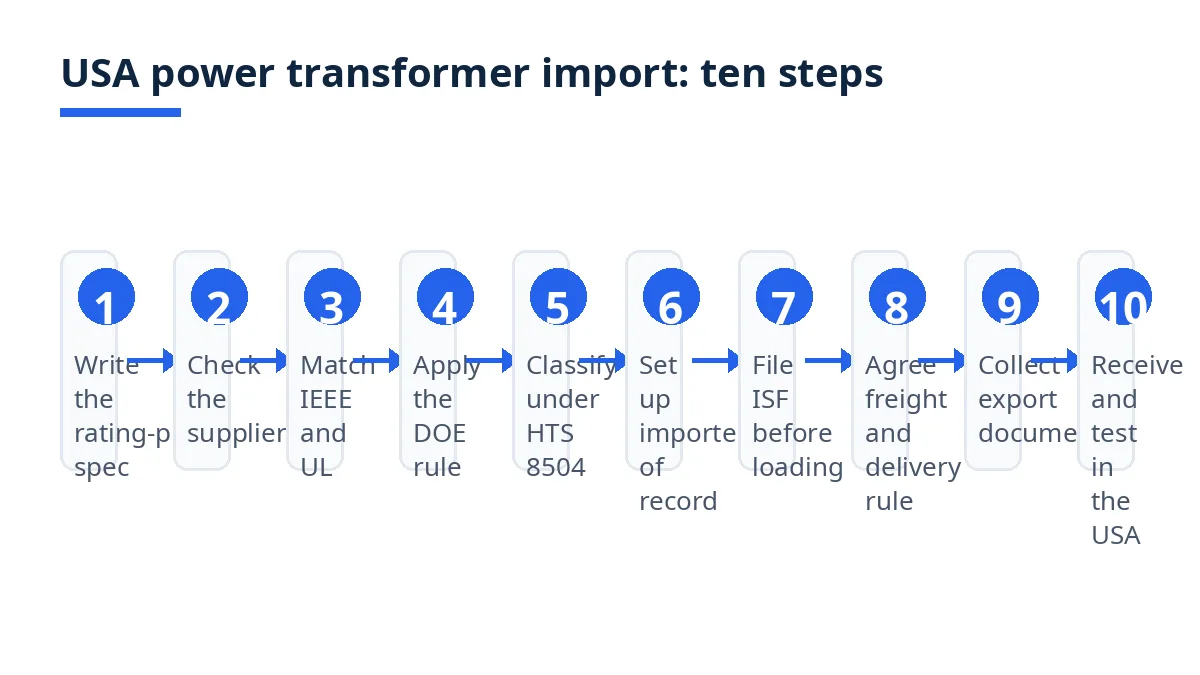
To import a power transformer from Bangladesh to the United States, write the rating-plate specification first, then check the supplier, match the unit to IEEE C57.12.00 and the UL listing, and apply the DOE efficiency rule for distribution sizes. Classify each rating under HTS 8504, set up the importer of record, file the Importer Security Filing before loading, and collect the Bangladesh export documents. Price from a landed cost with the broker-confirmed duty figure.
On this page
Key takeaways
Write the rating-plate specification before contacting a supplier: every rating needs its own kVA, voltages, vector group, impedance, tap range, cooling and guaranteed losses.
Distribution transformers must meet the DOE minimum efficiency in 10 CFR 431.196: a 2,500 kVA three-phase liquid-immersed unit needs 99.53% at 50% load before 23 April 2029.
Liquid dielectric transformers enter under HTS 8504.21 and 8504.22 at a general rate of Free, and under 8504.23 at 1.6%; the broker confirms the full duty position in writing.
The importer of record files the entry under 19 U.S.C. 1484 using reasonable care, and the Importer Security Filing is due at least 24 hours before loading.
Price from a worked landed cost, not the product price: the example 2,500 kVA unit lands at $59,470 before any additional broker-confirmed duties.
Bringing a power transformer from Bangladesh into the United States is a paperwork order as much as a purchase. Three things decide whether it clears smoothly: the rating plate fits the system it will serve, the unit meets the United States efficiency and safety rules for its size, and the entry file names the correct classification, importer and advance filing. Settle those three before the unit ships. The general guide to importing power transformers from Bangladesh covers the same product for every market; this guide covers only the United States, in ten steps.
Step 1: Write the rating-plate specification first
List every rating on its own line before you contact a supplier. Each rating needs its own core cutting, winding and test slot. For each rating, state the power in kVA, the primary and secondary voltage, the frequency, the vector group, the short-circuit impedance and its tolerance, the tap range and changer type, the cooling method, the guaranteed losses, the insulation levels, and the fittings and packing.
Ask each maker to reply in one shared format covering design, losses, inclusions, tests, validity and quantity per rating. Replies in different formats cannot be compared.
Step 2: Check the supplier against the rating
Shortlist makers whose present range already covers the size and type you need. A plant that builds only low-voltage panels or cables is a weak substitute, because core work, winding, drying, oil handling and high-voltage testing need different equipment and staff. The manufacturers guide for power transformers in Bangladesh shows how to check makers.
Run three checks. First, papers: trade licence, export registration and membership where applicable, with the same name, address and bank account on each. Second, plant: output by rating band, core cutting in-house, winding and drying equipment, test bay instruments and calibration, plus recent test reports for ratings like yours. Third, payment: use only the company account shown in the documents, and confirm any change of bank details through a separate channel.
Before production, ask for the design pack: outline drawings, promised loss and impedance values and a draft rating plate. Compare it with your single-line diagram, and sign off in writing. Then approve a fully tested first unit of each rating.
Step 3: Match the unit to IEEE C57.12.00 and the UL listing
For a liquid-immersed unit, most United States buyers name IEEE C57.12.00. The 2021 edition sets out the electrical and mechanical requirements for liquid-immersed distribution and power transformers, plus autotransformers and regulating transformers, single-phase and polyphase, where the highest-voltage winding is 601 V or above.1 Put the edition in the specification.
Ask separately whether the exact model holds a UL listing. Liquid-filled substation transformers sold for the North American market are commonly offered as UL Listed, with high efficiency to the DOE 2016 standards.2 The listing answers a different question from the standard: the standard governs how the unit is built and tested, while the listing record shows a certification body assessed representative samples against the safety standard. Get the record for the exact model. An IEC 60076 test report alone is not that record.
Step 4: Apply the DOE efficiency rule to distribution sizes
The United States Department of Energy sets minimum efficiency levels for distribution transformers, varying by type, kVA rating and date of manufacture. The rule is at 10 CFR 431.196, with one table per covered type.3
A liquid-immersed distribution transformer made from 1 January 2016 up to 23 April 2029 is measured at 50 percent of nameplate-rated load. A three-phase 500 kVA unit must reach at least 99.35 percent, and a three-phase 2,500 kVA unit at least 99.53 percent.3 From 23 April 2029 the same 2,500 kVA unit must reach 99.55 percent, and that period's table extends to 5,000 kVA.3 Low-voltage dry-type units use a different test point, 35 percent of nameplate-rated load.3
Write the efficiency figure into the specification as a number.
Step 5: Classify each rating under HTS 8504
Duty follows the classification of each rating, not the supplier's product name. Power transformers sit under heading 8504:4
HTSUS line | Description | General rate shown |
|---|---|---|
8504.21.00 | Liquid dielectric, not exceeding 650 kVA | Free |
8504.22.00 | Liquid dielectric, exceeding 650 kVA but not exceeding 10,000 kVA | Free |
8504.23.00 | Liquid dielectric, exceeding 10,000 kVA | 1.6% |
8504.32.00 | Other transformers, exceeding 1 kVA but not exceeding 16 kVA | 2.4% |
8504.33.00 | Other transformers, exceeding 16 kVA but not exceeding 500 kVA | 1.6% |
8504.34.00 | Other transformers, exceeding 500 kVA | 1.6% |
Put spare parts on their own lines, and keep each rating on its own invoice line. The rates above are the schedule's general figures, not the full duty position for an entry. Have the broker confirm in writing the full ten-digit line per rating and the measures in force on the entry date, before you price the order. The HS code guide for power transformers explains the heading structure.
Step 6: Set up the importer of record
Section 1484 of Title 19 puts the entry on the importer of record. That party, or an agent it authorizes in writing, files what Customs and Border Protection needs to release the goods, using reasonable care, and then completes the entry with the declared value, the classification and the duty rate.5 The filer is the owner or purchaser, or a licensed customs broker designated by the owner, purchaser or consignee.5
Agree four points with the broker before the shipment leaves Bangladesh: who acts as importer of record and which importer number goes on the filings; which bond covers the entry; and the duty figure the broker will put in writing for each rating. Hiring a broker leaves the reasonable-care duty with the importer of record, so read the entry file before filing, not after the goods land.
Step 7: File the Importer Security Filing before loading
Ocean cargo bound for the United States needs an advance filing sent before the unit loads. Under 19 CFR section 149.2, the Importer Security Filing for cargo arriving by vessel goes to Customs and Border Protection in English, using one of its approved electronic systems.6
Eight core items reach Customs and Border Protection a full day before the vessel loads overseas: seller and buyer, the importer of record and consignee numbers, the maker or supplier, the ship-to party, the origin, and the tariff number.6 The stuffing location and the consolidator go as early as possible, and no later than a day before arrival.6 When a submitted fact changes before the vessel reaches the United States port, the filing has to be updated.6
Step 8: Agree freight, insurance and the delivery rule
Transformers often travel on flat racks or as break-bulk, since height, mass and exposed bushings rule out a standard box. Ask the forwarder which sailings can lift the unit and whether it travels oil-filled or dry.
Name the delivery rule with its place in full. A vague port name lets the seller choose a terminal you did not plan for, and the inland leg becomes your cost. On a first United States order, many buyers use FOB at the Bangladeshi port, with their own forwarder running the sea leg, or FCA at the named terminal or factory. Under either rule, write down who bears the risk while the unit waits at the terminal, who books the vessel, who insures the cargo, and who clears the goods. The bill of lading is the sea transport document, and it works as a document of title as well as the contract with the carrier.7
Step 9: Collect the Bangladesh export documents
Build the export file on the Bangladesh side before the goods sail, not after they land. The commercial invoice is the basis for customs valuation, and in Bangladesh it must carry the Export Registration Certificate number and the HS code of the goods.7 Exporters must hold an Export Registration Certificate from the Export Promotion Bureau, and the certificate of origin comes from their local Chamber of Commerce or another authorised body.7
Check the set before shipment: commercial invoice with the Export Registration Certificate number and HS code, packing list with weights and serial numbers, bill of lading, certificate of origin, insurance certificate, and the routine test report for each serial number. An inspection certificate may also be needed for some destinations.7
Step 10: Receive and test the unit in the United States
When the unit lands, compare it with the file before you sign. Count units against the packing list and match the rating plate on each unit to the approved design pack. Record damage on the delivery note at once.
Get a routine test report for each serial number, showing measured results next to the promised values and tolerances. Compare measured losses with the guaranteed figures from Step 1 and the efficiency level from Step 4. Where the contract allows, hold the balance until the reports pass. See the quality control checklist for power transformers.
Worked example: landed cost for one 2,500 kVA unit
Example figures. One three-phase liquid-immersed transformer, 2,500 kVA, FOB Chattogram, sea freight to a United States port. The duty line uses the general rate shown for 8504.22.00.4
Cost line | Example figures (USD) |
|---|---|
Product cost, FOB Chattogram | 48,000 |
Ocean freight, Chattogram to the United States port | 6,400 |
Cargo insurance | 520 |
Duty at the general rate for 8504.22.00 (Free) | 0 |
Customs broker fee | 650 |
Destination port and terminal charges | 900 |
Inland delivery to the United States site | 1,800 |
Inspection and testing on arrival | 1,200 |
Total landed cost | 59,470 |
The arithmetic is: 48,000 + 6,400 + 520 = 54,920; 54,920 + 650 + 900 + 1,800 + 1,200 = 59,470. The duty line is zero only at the general rate shown for this line; if the broker confirms additional measures in force on the entry date, that figure replaces the zero. The unit must also meet the DOE minimum of 99.53 percent efficiency at 50 percent load.3
Mistakes that delay transformer orders
The first mistake is ordering from a product name instead of a rating plate. Without voltages, vector group, impedance, tap range and cooling, the factory cannot build the right unit. The second mistake is treating an IEC test report as a United States listing: the design standard and the listing record answer different questions.2 The third mistake is pricing from the product cost alone. Freight, insurance, broker and port charges, inland delivery and arrival testing add up before duty. The fourth mistake is filing the advance data from a different description than the invoice.6
Next steps on Exportain
Start with the specification in Step 1, then search Bangladeshi suppliers whose range covers your ratings, and post an RFQ with the rating-plate fields, the standard edition and the test scope in the requirement. Compare replies on the same delivery rule and test scope, and read how to buy for the steps after you have ordered. For the same border sequence on another electrical product, see the solar panel guide to the United States.
Sources
- IEEE C57.12.00-2021 - Standard General Requirements for Liquid-Immersed Distribution, Power, and Regulating Transformers. Institute of Electrical and Electronics Engineers (accessed )
- Substation Liquid Filled Transformers. Schneider Electric (accessed )
- 10 CFR § 431.196 - Energy conservation standards and their effective dates. Cornell Law Institute (accessed )
- HS Code 8504 - Tariff Classification of - Electrical transformers, static converters (for example, rectifiers) and inductors; parts thereof. Flexport (accessed )
- 19 U.S.C. 1484 - Entry of merchandise. U.S. Government Publishing Office (accessed )
- 19 CFR 149.2 - Importer security filing, requirement, time of transmission. Cornell Law Institute (accessed )
- Essential export documents for shipping from Bangladesh. DHL (accessed )
About the author
Sourcing from Bangladesh?
Post a request for quotation and suppliers on Exportain can send you their quotes directly.
Post an RFQ