Power Transformers From Bangladesh to Germany: A Buyer's Import Checklist
A German buyer's checklist for power transformers from Bangladesh: rating-plate specification, EU TARIC duty under heading 8504, 19% import VAT, CE marking and IEC 60076 tests.
Short answer
To import a power transformer from Bangladesh to Germany, write the rating-plate specification first, then classify each rating under EU heading 8504, where the third-country duty shown is 3.70%. Work out German import VAT at 19% on the customs value plus duty, hold the EU declaration of conformity and CE file for the exact unit, and collect IEC 60076 routine reports for your serial number plus type reports for the design. Finish the Bangladesh export file before the unit sails.
On this page
Key takeaways
Write the rating-plate specification before contacting a supplier: every rating needs its own kVA, voltages, vector group, impedance, tap range, cooling and stated losses.
Liquid dielectric transformers enter the EU under heading 8504 at a third-country duty of 3.70% shown on the tariff page; the broker confirms the live TARIC rate and any preference.
German import VAT is 19% on the customs value plus duty, so price it on the CIF value plus duty, not on the FOB price alone.
Hold the EU declaration of conformity for the exact unit before paying the balance, and check whether the Low Voltage Directive covers your voltages.
Collect IEC 60076 routine reports for your serial number and type reports for the design family, and put the loss and impedance tolerances in the contract.
Three gates decide a German power transformer import: a rating plate that fits the German system, an EU border file with the right code and charges, and test evidence that matches the unit. Tick each check before you pay the balance and before the unit sails. For the same product bound for any market, see the general import guide.
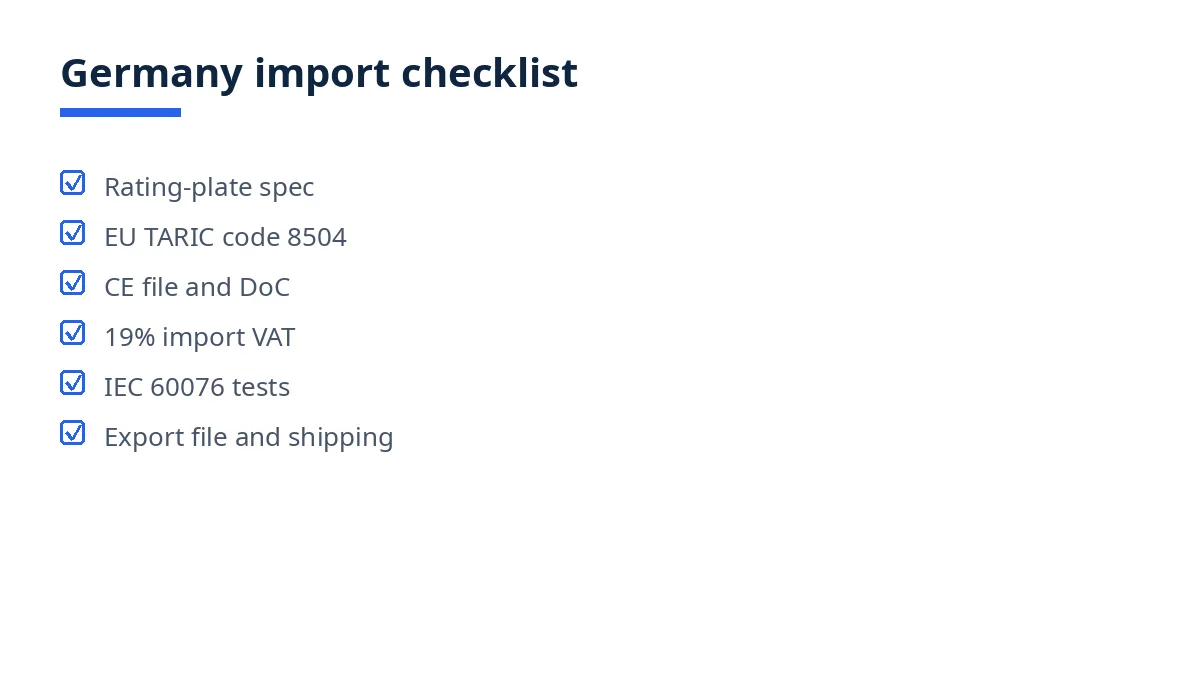
Work through the checks in order. A check counts as done only when you hold the document it names.
Check 1: Is the rating-plate specification complete for every rating?
Write the specification before you contact any supplier, one line per rating: kVA, voltages, frequency, vector group, impedance with tolerance, tap range and changer type, cooling method, stated losses, insulation levels, fittings and packing.
[ ] Each rating has its own line, with its own voltages and vector group.
[ ] Tap range, cooling method and stated losses are numbers, not descriptions.
[ ] The specification names the IEC 60076 parts that apply, not only the series name.
[ ] Spares sit on their own lines, with their own codes and values.
Ask makers to answer on one common template: design, losses, inclusions, tests, validity and quantity for each rating. Replies in different formats hide price gaps.
Check 2: Can the supplier build the rating you need?
Shortlist makers whose current range already covers the size and type in Check 1. Core cutting, winding, drying, oil handling and high-voltage testing call for plant and staff that a low-voltage panel or cable shop does not have. Our guide to makers in Bangladesh covers the wider checks.
[ ] Trade licence, export registration and membership agree on name, address and bank account.
[ ] The plant covers your rating band, with in-house core cutting, winding and drying kit, a test bay and calibration records.
[ ] Recent test reports exist for ratings like yours, and payment goes only to the company account in the documents.
Before production, ask for outline drawings, stated loss and impedance values and a draft rating plate, and sign the pack off in writing.
Check 3: Is each rating classified under the right EU code, and what duty follows?
Power transformers sit under heading 8504 of the EU tariff, "Electrical transformers, static converters and inductors". The code follows the type and the power handling capacity, and the duty follows the code; the third-country duty shown for the liquid dielectric lines is 3.70%:1
Transformer type | EU code | Duty shown |
|---|---|---|
Liquid dielectric, not exceeding 650 kVA | 8504 2100 00 | 3.70% |
Liquid dielectric, exceeding 650 kVA but not exceeding 1,600 kVA | 8504 2210 00 | 3.70% |
Liquid dielectric, exceeding 1,600 kVA but not exceeding 10,000 kVA | 8504 2290 00 | 3.70% |
Liquid dielectric, exceeding 10,000 kVA | 8504 2300 00 | 3.70% |
Other transformers, exceeding 500 kVA | 8504 3400 00 | 3.70% |
[ ] Each rating has its own ten-digit code, confirmed by your broker for the date of import, on its own invoice line.
[ ] Spares are coded on their own lines under 8504 90, at the rate shown for the exact subheading.
[ ] The broker has confirmed in writing the duty position in force on the entry date, including any preference and the proof of origin it needs.
These are the third-country duty figures shown on the tariff page read for this checklist, not the full duty position for an entry. Duty is charged on the customs value, and the broker confirms the live TARIC rate before you price the order. See the HS code guide.
Check 4: Has preferential origin been checked, not assumed?
A preference can reduce or remove duty, but only with the right proof. German Customs notes that where a preference exempts goods from customs duty, only import VAT and any applicable excise duty remain payable, and the origin must be shown by a written proof of preferential status.2
[ ] The broker has checked whether any preference applies to your goods from Bangladesh, and at what rate, and the supplier can supply the proof of origin it needs.
Do not price an order at a preferential rate until the broker confirms it and the supplier confirms it can supply the proof. A preference claimed without proof is refused at the border, and the duty becomes payable in full.
Check 5: Is German import VAT worked out on the right base at 19%?
German import VAT is charged on the customs value plus the customs duty. German Customs states that the import VAT base is the customs value plus duty, and that the rate is currently 19 percent, with a reduced rate of 7 percent for selected goods such as food products and books.2
[ ] The VAT base is the customs value plus duty, not the FOB price alone, and the rate is 19%, since a power transformer is not in the reduced-rate group.
[ ] Freight and insurance to the EU border sit inside the customs value, so they raise the VAT base.
A worked example with example figures follows Check 9.
Check 6: Does the CE file match the unit, and does the Low Voltage Directive apply?
CE marking is required only for products covered by harmonised EU rules that specifically mandate it. The manufacturer must draft and sign an EU declaration of conformity and hold the technical documentation behind it, both kept for at least 10 years after the product is placed on the market.3
Directive 2014/35/EU, the Low Voltage Directive, applies to electrical equipment designed for use with a voltage rating of between 50 and 1,000 V for alternating current and between 75 and 1,500 V for direct current, and all such equipment on sale in the EU must bear the CE marking.4
[ ] Your compliance adviser has confirmed which EU rules govern your unit, since a unit whose high-voltage winding exceeds 1,000 V AC sits outside the Low Voltage Directive range.
[ ] The EU declaration of conformity names the exact model, type, batch or serial number, the manufacturer, the rules met and the standards used, is signed by the manufacturer, and reaches you before you pay the balance.
[ ] Rating plate, declaration and packing list agree on model, rating and serial numbers.
[ ] Any notified body involved is named with its four-digit identification number next to the CE marking, where one was used.3
A CE mark on a catalogue page proves nothing about your unit. The declaration for your serial numbers is the evidence.3
Check 7: Do the IEC 60076 test reports match your order?
IEC 60076 is a series, not one document. Part 1 covers the general requirements, including the rating plate, loss and impedance tolerances and the list of tests, each classed as routine, type or special.5 Name the parts in the specification; a bare "IEC 60076" reference leaves the test list open.
Routine tests run on every unit before dispatch, and their reports should travel with your transformer.5 Type tests prove a design, so they run on one unit of a design family, and the report's design reference, rating and date must match your order.5
Test group | What to ask for | What the report must show |
|---|---|---|
Routine, every unit | Winding resistance, ratio and phase displacement, load and no-load loss, applied and induced voltage, insulation resistance, oil tests | Results for your serial number |
Type, one unit of the design family | Temperature rise, lightning impulse, partial discharge, noise | Design reference and rating matching your order |
Short-circuit withstand | IEC 60076-5, on a sample at a third-party laboratory | Design tested, laboratory name |
[ ] Routine reports exist for your unit, by serial number, and type reports exist for the design family, from a laboratory whose accreditation covers the tests named.
[ ] Short-circuit evidence, where agreed, comes from a third-party laboratory and names the design tested, since the test is destructive and runs on a sample, never on your unit.5
Under IEC 60076-1, total losses may run 15% above the stated figure and short-circuit impedance may vary by 7.5% either way, with wider limits for the first unit of a new design.5 See the transformer quality checks.
Check 8: Is the shipment packed, insured and booked for a heavy unit?
A transformer is heavy, tall and fitted with exposed bushings, so it rarely fits a standard container. It usually ships on a flat rack or as break-bulk cargo.
[ ] The forwarder has confirmed a sailing that can lift the unit at both ends, the lifting gear, and the packed weight and dimensions.
[ ] Packing protects the bushings and the tap changer, and the lifting points are marked.
[ ] Cargo insurance covers the full value for the whole route, and the certificate travels with the export file.
[ ] The delivery rule states the place in full and assigns terminal waiting risk, vessel booking, cargo cover and clearance between the parties.
[ ] The bill of lading is checked against the invoice and packing list before the vessel sails.
Check 9: Is the Bangladesh export file complete before the goods sail?
Assemble the export file in Bangladesh before loading, not after arrival. DHL's Bangladesh export guide states that the commercial invoice forms the basis for customs valuation and must show the Export Registration Certificate number and the HS code, that the Export Promotion Bureau issues the certificate, and that the certificate of origin comes from the local Chamber of Commerce or another authorised body.6
[ ] Commercial invoice, showing the Export Registration Certificate number and HS code, matching the declaration and payment papers.
[ ] Packing list with weights and serial numbers for every package, and bill of lading as the sea transport document and document of title.6
[ ] Certificate of origin, from the Chamber of Commerce or another authorised body.6
[ ] Insurance certificate, routine test report for each serial number, and inspection certificate where the destination or the contract needs one.6
[ ] Exporter, buyer and bank account names agree across the quotation, invoice, declaration and payment papers.
The FOB price breakdown shows what the build-up should include.
Worked example: duty and VAT on one 1,000 kVA unit
Example figures. One 1,000 kVA liquid-immersed transformer, FOB Chattogram, shipped to Hamburg. Duty uses the third-country rate shown for 8504 2210 00, and VAT uses the 19% German rate.1 2
Charge | Example figures (EUR) |
|---|---|
Product cost, FOB Chattogram | 28,000 |
Freight and insurance to Hamburg | 3,200 |
Customs value (CIF Hamburg) | 31,200 |
Duty at 3.70% of 31,200 | 1,154.40 |
VAT base (31,200 + 1,154.40) | 32,354.40 |
Import VAT at 19% of 32,354.40 | 6,147.34 |
Duty plus import VAT at the border | 7,301.74 |
Check it: 28,000 + 3,200 = 31,200; 3.70% of 31,200 = 1,154.40; 19% of 32,354.40 = 6,147.34; 1,154.40 + 6,147.34 = 7,301.74. Broker fees, port handling and delivery to site sit outside this table.
Next steps on Exportain
When the specification is written, search suppliers by rating band and send an RFQ that lists the rating-plate fields, the EU code, the CE file and the test scope. How to buy covers the steps after ordering. The USA guide and UK guide cover the same product for other markets, and the solar panels to Germany checklist follows the same border file for a different electrical product.
Sources
- Electrical transformers, static converters (for example, rectifiers) and inductors - Northern Ireland Online Tariff. GOV.UK (accessed )
- Assessment of taxes and duties. German Customs (Zoll) (accessed )
- CE marking – obtaining the certificate, EU requirements. European Union (accessed )
- Directive 2014/35/EU on electrical equipment designed for use within certain voltage limits — summary. EUR-Lex, European Union (accessed )
- IEC 60076 Test Requirements: Routine, Type & Special. Harbin Transformer, (accessed )
- Essential export documents for shipping from Bangladesh. DHL (accessed )
About the author
Sourcing from Bangladesh?
Post a request for quotation and suppliers on Exportain can send you their quotes directly.
Post an RFQ