Importing Power Transformers From Bangladesh to UK: Costs, Duties and Suppliers
Duty is 0.00% on the main power transformer codes, so import VAT is the charge that moves the landed cost. Here is the full build-up, with a worked example in pounds.
Short answer
A UK buyer importing a power transformer from Bangladesh pays the FOB price, freight and insurance to a UK port, UK duty on the commodity code, and import VAT at 20%. The UK Global Tariff shows 0.00% duty for power transformer codes under heading 8504, so import VAT is the larger border charge, and VAT-registered buyers can account for it on their VAT return through postponed VAT accounting. Check the rate and confirm UKCA or CE evidence first.
On this page
Key takeaways
The UK Global Tariff shows 0.00% duty on the main power transformer codes under heading 8504; confirm the live rate per line before ordering.
Import VAT is 20% of the customs value plus any duty, and VAT-registered buyers can use postponed VAT accounting.
For Great Britain, electrical equipment can carry UKCA or CE marking; large units above 1,000 V AC sit outside the 2016 safety regulations.
Ask for routine test reports for your unit and type test reports that match the design and rating ordered.
The Bangladesh export file runs on an electronic EXP form and a Bill of Export, with shipping documents to the bank within 14 days.
A power transformer is a heavy, high-value, single-unit purchase, so the quoted price is only the first line of what you will pay. The rest sits in the freight, the UK border charges and the delivery to site, and import VAT is often the heaviest charge.
What does the landed cost of a power transformer include?
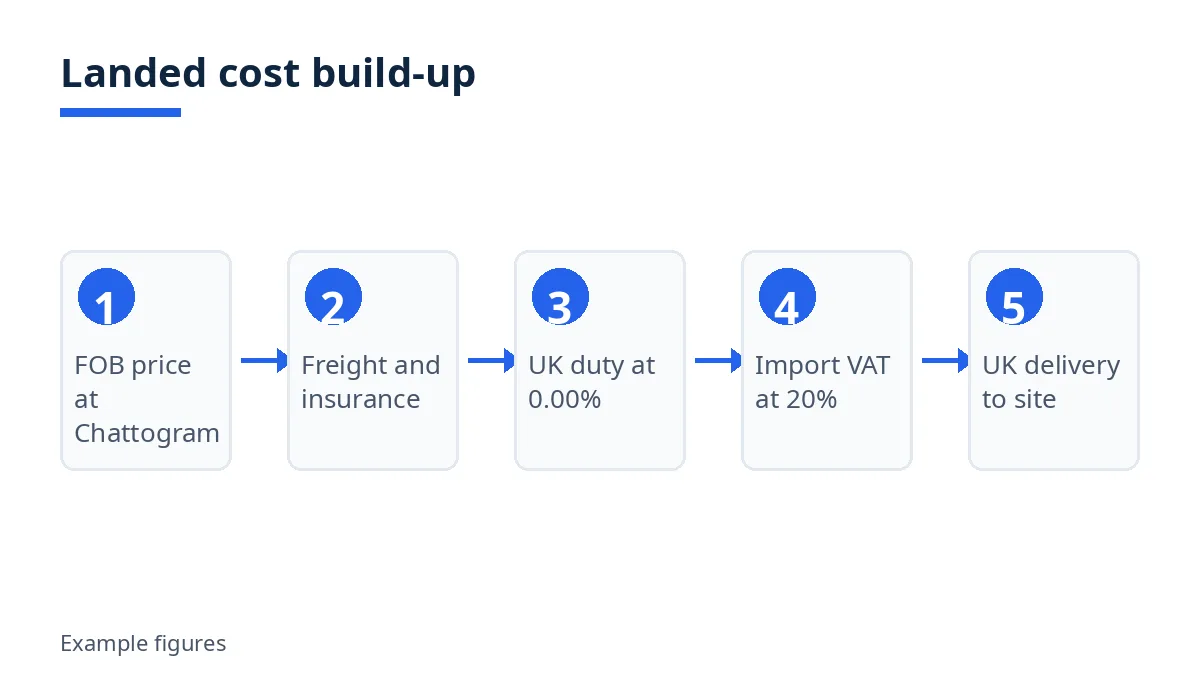
The landed cost is the FOB price plus every charge that follows it until the unit is at your site. Ask the supplier to price each line separately.
Cost line | What it covers | What decides it |
|---|---|---|
FOB price, Chattogram | Unit, packing, transport, clearance, loading | Rating, voltage, losses, tests |
Freight and insurance | Voyage plus cargo cover | Weight, dimensions, route |
UK import duty | Duty by commodity code | Code and live rate |
Import VAT | VAT on customs value plus duty | 20% on heading 8504 lines1 |
Port handling and broker | Terminal charges, declaration, fees | Port, size, broker |
UK delivery to site | Haulage, craneage, placement | Distance, access, weight |
The FOB price hides the most variation: one quotation includes routine tests, export packing and oil filling, and another does not. Ask for it broken down into the unit, the tests, the packing and the transport to port. Our power transformer price guide covers the FOB build-up in detail.
Freight is the second line that moves: a distribution transformer ships as break-bulk or on a flat rack, so the freight depends on the packed weight and dimensions and the lifting gear at each end.
What duty applies to power transformers under the UK Global Tariff?
Power transformers fall under heading 8504 of the UK Integrated Online Tariff, "Electrical transformers, static converters and inductors".1 The code depends on the type and the power handling capacity.
Transformer type | Commodity code | Duty | VAT |
|---|---|---|---|
Oil-immersed, up to 650 kVA | 8504 2100 00 | 0.00% | 20% |
Oil-immersed, 650 to 1,600 kVA | 8504 2210 00 | 0.00% | 20% |
Oil-immersed, 1,600 to 10,000 kVA | 8504 2290 00 | 0.00% | 20% |
Oil-immersed, over 10,000 kVA | 8504 2300 00 | 0.00% | 20% |
Other transformers, over 500 kVA | 8504 3400 00 | 0.00% | 20% |
The rates above are the third country duty and VAT shown on the UK tariff page for heading 8504, read on 6 November 2026.1 Duty is 0.00% on each line, which is why the VAT line matters more than the duty line. Check the live rate for your exact code before you pay. For Northern Ireland, use the Northern Ireland Online Tariff.1 Our HS code guide for power transformers explains the code build.
Classify by what the unit is, not by what it will be used for: an oil-immersed unit and a dry-type unit sit on different lines, and the kVA band decides the code. Give your broker the rating plate details and ask for the code confirmed in writing.
How does import VAT work, and what does postponed VAT accounting change?
Import VAT is 20% on the tariff lines for heading 8504, calculated on the customs value plus any duty payable.1 With duty at 0.00%, the base is effectively the CIF value — goods plus freight and insurance — so pricing only the FOB value understates the VAT. Confirm the base with your broker.
Postponed VAT accounting (PVA) changes when the VAT is paid, not whether it is paid. Introduced in January 2021, it lets a VAT-registered importer account for import VAT on their VAT return instead of paying it at the border or through a duty deferment account and reclaiming it later with the C79 form.2 Where PVA is chosen and notified on a declaration, the VAT appears on a Monthly Postponed Import VAT Statement from the Customs Declaration Service dashboard, giving the amounts for box 1 and, where appropriate, box 4 of the VAT return, subject to the normal rules.2
Three points from the same HMRC guidance: importers who are not VAT registered, or who cannot treat the import VAT as input tax because they are not the owner of the goods, may not use PVA; the decision is for the importer, not the intermediary, so tell your broker in writing before the declaration is made; and keep the monthly statement as the evidence for the VAT return.2
What UKCA or CE evidence should you ask for before the unit ships?
For electrical equipment placed on the market in Great Britain, the marking required is UKCA or CE, and legislation in force since 1 October 2024 continues recognition of CE marking, so businesses may choose either.3 The relevant legislation is the Electrical Equipment (Safety) Regulations 2016,3 but those regulations apply to equipment designed for use between 50 and 1,000 volts AC or 75 and 1,500 volts DC.4 A distribution transformer with a high-voltage winding above 1,000 volts AC sits outside that range, so ask your compliance adviser which regime governs your unit before you accept a UKCA or CE claim.
For a unit inside the regulations, the manufacturer must hold a declaration of conformity, affix the UKCA or CE mark, and keep technical information for inspection.4 The declaration should name the model, type, batch or serial number, the manufacturer, the equipment, the designated standards used, and the place and date of issue. Designated standards are approved by the Secretary of State and published by the British Standards Institution (BSI), and the file must be kept for 10 years.4
Your duty as the importer is to check, not to assume: an importer must not place electrical equipment on the market without assurances of compliance with the safety objectives and of the manufacturer's conformity assessment, documentation, marking and labelling.4 Ask for the declaration before you pay the balance, and check the model, rating and serial numbers against the packing list. The Electromagnetic Compatibility Regulations 2016 may also apply.4
How do you check a supplier can build to IEC 60076?
The standard that matters is IEC 60076. Part 1 defines service conditions, the rating plate, the tolerances on losses and impedance, and the test list, with each test classified as routine, type or special.5 A specification citing only "IEC 60076" without the parts is incomplete.
Routine tests run on every unit, and their reports should arrive with your transformer: winding resistance, voltage ratio and phase displacement, load loss and impedance voltage, no-load loss and current, applied and induced voltage, insulation resistance and oil tests.5 Type tests prove a design and run on one unit of a design family, so the design reference, rating and date must match your order.5 Temperature rise, lightning impulse, partial discharge and noise are type tests; short-circuit withstand under IEC 60076-5 is destructive, so it runs on a sample in a third-party laboratory, never on your unit.5
Before you award the order, ask in writing for the routine test reports for your unit, by serial number; the type test reports for the design family, with design reference and rating; and the accreditation certificate and scope of the testing laboratory.5 IEC 60076-1 allows plus 15% on total losses and plus or minus 7.5% on short-circuit impedance, wider for the first unit of a new design, so write the tolerance and remedy into the contract.5 A supplier without a matching type test report has a gap in evidence, not a paperwork delay. Our guide to power transformer manufacturers in Bangladesh sets out the wider supplier checks.
What does the Bangladesh export file look like?
The export side runs on the EXP form and the Bill of Export. Exports from Bangladesh must be declared on the EXP form, and authorised dealer banks may provide Online Export Monitoring System (OEMS) user IDs for electronic EXP forms.6 The EXP number has 11 digits: branch code, register serial number, and year.6
The electronic EXP goes into OEMS before customs formalities, and the data flows to the customs system.6 Customs then issues the Bill of Export, which permits the shipment. Within 14 days of shipment, the exporter must give the authorised dealer bank a signed hard copy of the EXP form with the certified Bill of Export and the shipping documents.6
Two details matter: the bank compares the invoice with the EXP form and the customs value, and the invoice value must never be below the value declared for customs purposes;6 and the exporter, buyer and bank account names must match across the quotation, invoice, declaration and payment papers. The full import sequence is in our guide to importing power transformers from Bangladesh.
Worked example: one 1,600 kVA unit, Chattogram to Felixstowe
Example figures. One 1,600 kVA oil-immersed distribution transformer, FOB Chattogram, shipped to Felixstowe. The numbers are illustrative.
Cost line | Amount |
|---|---|
FOB price, Chattogram | £18,000 |
Freight and insurance to Felixstowe | £2,400 |
CIF value | £20,400 |
UK duty at 0.00%, code 8504 2210 001 | £0 |
Import VAT at 20% of £20,4001 | £4,080 |
Port handling, broker, UK delivery | £1,150 |
Landed cost, excluding recoverable VAT | £21,550 |
Cash outlay without PVA | £25,630 |
£18,000 plus £2,400 is £20,400; 20% of that is £4,080; £20,400 plus £1,150 is £21,550 excluding VAT, or £25,630 with VAT paid at the border. With PVA, the £4,080 is declared and reclaimed on the return instead, so the border outlay is £21,550.2
Use this example as a template, not a price: replace each line with your own quotations. If a quotation looks cheaper than the rest, check which lines it leaves out — usually the tests, the packing or the insurance.
What usually goes wrong on a first UK transformer order?
First, comparing FOB prices as if they were landed costs. Price every quotation on the build-up above, with each line named.
Second, taking the duty rate from another country or product. The 0.00% rate belongs to the exact code and the date of import, so confirm both with your broker.1 The related UK guide for importing solar panels from Bangladesh to the UK follows the same border file for other electrical goods.
Third, paying import VAT at the border when PVA was available. The choice belongs to the importer, so instruct your broker in writing first.2
Fourth, accepting test evidence that does not match the order. A type test report for a different design or rating proves a different transformer, and a routine report without your serial number proves no unit at all. Check every report against the order.5
Fifth, leaving the heavy lift to the end. Confirm the weight, dimensions and lifting points, and whether the UK port and the site can lift the unit as packed, before the vessel sails.
Next steps on Exportain
Start with the numbers: run the build-up on your quotation, confirm the code and live duty rate with a broker, and instruct the broker on PVA. Then search Bangladeshi suppliers or post an RFQ with the rating, voltages and test reports in the requirement, or read how to buy.
Sources
- Electrical transformers, static converters and inductors - UK Integrated Online Tariff, Heading 8504. GOV.UK (accessed )
- IMPS02350 - Background information and policy objectives: postponed VAT accounting. UK Government, HM Revenue and Customs (accessed )
- Product regulations by sector and current approaches to product marking: UKCA and CE regimes. GOV.UK (accessed )
- Electrical equipment. Business Companion (accessed )
- IEC 60076 Test Requirements: Routine, Type & Special. Harbin Transformer, (accessed )
- The EXP form, from number to filing cabinet. Open Trade Bangladesh (accessed )
About the author
Sourcing from Bangladesh?
Post a request for quotation and suppliers on Exportain can send you their quotes directly.
Post an RFQ