

What Does an FOB Price Include? Cost Breakdown With a Real Example
An FOB price covers the goods and the seller costs up to loading on board at the named port. This guide breaks down each included and excluded line, with a labelled example, so you can compare quotes on the same basis.
Short answer
The fob price meaning is that an FOB price covers the goods, export packing, transport to the named port of shipment, export clearance, and loading on board the vessel nominated by the buyer. It does not cover ocean freight, cargo insurance, import clearance, or import duty. FOB is an Incoterms 2020 rule for sea and inland waterway transport only.
On this page
Key takeaways
An FOB price covers the goods, export packing, transport to the named port of shipment, export clearance, and loading on board the vessel nominated by the buyer.
An FOB price does not cover ocean freight, cargo insurance, import clearance, import duty, or onward transport at destination, which the buyer budgets separately.
The named port matters: inland transport and loading lines differ by port, so a quote without a named port cannot be compared with another FOB quote.
In the worked example, example figures total USD 19,500 for 5,000 bags, or USD 3.90 per bag, with each included line shown separately.
Exportain verification is a document and photo review, not a factory inspection or a guarantee, and it does not change the cost lines in an FOB quote.
An FOB quote looks like a single unit price, but it is a bundle of costs that stops at a precise point. The fob price meaning is the key to reading that bundle: it tells you which costs the seller has already paid and which costs you still have to pay after the goods are on board.
Quick answer
An FOB price covers the goods, export packing, transport from the seller premises to the named port of shipment, export clearance, and loading on board the vessel nominated by the buyer. It does not cover ocean freight, cargo insurance, import clearance, import duty, or transport after arrival. FOB is an Incoterms 2020 rule for sea and inland waterway transport only.
FOB price meaning in plain English
FOB stands for Free On Board. Under the Incoterms 2020 rules, FOB means the seller delivers the goods loaded on board the vessel nominated by the buyer at the named port of shipment, having cleared them for export.1 The price is a delivered-to-the-ship price, not a delivered-to-your-warehouse price.
The word "Free" marks the point up to which the seller bears the costs in the price. Costs before that point sit inside the FOB price, and costs after it sit outside it. Read every FOB quote with its named port: "FOB Chattogram" and "FOB Mongla" differ because inland transport and loading differ by port. A quote that says only "FOB", without a named port, currency, quantity, and validity period, is incomplete. The Incoterms rules allocate costs, risks, and customs formalities between seller and buyer, and they show what is included in the sales price.2
How it works step by step
Make and pack the goods. The seller produces the goods and packs them for export.
Move the goods to the port. The seller transports the goods to the named port of shipment.1
Clear the goods for export. The seller completes the export formalities, at a cost inside the FOB price.1
Load the goods on board. The seller loads the goods on board the vessel nominated by the buyer.1 After loading, the buyer contracts the carrier and pays the costs that follow.1
The diagram below shows that sequence.
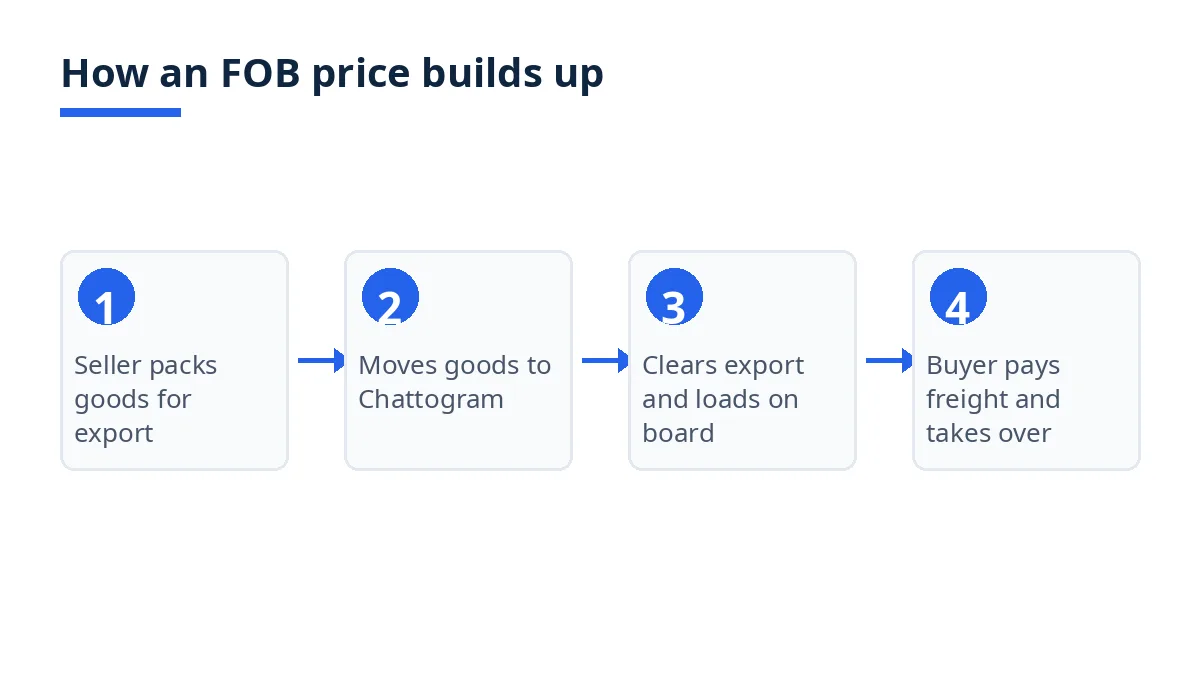
After loading, the buyer pays ocean freight, arranges cargo insurance if wanted, and handles import formalities.1 Keep those costs separate from the FOB figure.
Who is responsible for what
Cost line | Paid by | Inside the FOB price |
|---|---|---|
Goods | Seller | Yes |
Export packing and marking | Seller | Yes |
Inland transport to the port | Seller | Yes |
Export clearance | Seller | Yes |
Loading on board | Seller | Yes |
Ocean freight | Buyer | No |
Cargo insurance | Buyer, if wanted | No |
Import clearance | Buyer | No |
Import duty and taxes | Buyer | No |
Unloading and onward transport | Buyer | No |
The rule behind the table is direct: in the E, F, and D rules, costs before delivery are for the seller, and costs after delivery are for the buyer.3 FOB is an F rule, so the buyer arranges freight. In the C rules, the seller also pays the costs of getting the goods to their destination.3 In only two rules, CIP and CIF, must the seller provide the buyer with insurance.3 FOB is not one of them, so arrange cover yourself.
Worked example with numbers (Bangladesh shipment)
All figures in this section are example figures only, not market rates.
A buyer orders 5,000 cotton tote bags from Dhaka, on FOB Chattogram, Incoterms 2020.
Included line | Example figures |
|---|---|
Goods: 5,000 tote bags | USD 18,000 |
Export packing and marking | USD 600 |
Inland transport, Dhaka to Chattogram | USD 450 |
Export clearance handling | USD 180 |
Port handling and loading | USD 270 |
Total FOB price | USD 19,500 |
FOB unit price | USD 3.90 per bag |
The unit price is the total divided by the quantity: USD 19,500 divided by 5,000 equals USD 3.90. Check the arithmetic on every quote. If export packing rose by USD 500 in these example figures, the total would rise to USD 20,000 and the unit price to USD 4.00. Never reuse these example figures for another product.
The excluded lines sit below the FOB total: ocean freight, cargo insurance if wanted, import clearance, import duty and taxes, and onward transport. Price those from your own freight and insurance quotes and your destination duty calculation, then add them to the FOB total to reach a landed cost. See the landed cost guide.
FOB vs related terms
FOB is one of four Incoterms 2020 rules for sea and inland waterway transport only: FAS, FOB, CFR, and CIF.3
Term | Price covers | Buyer still pays |
|---|---|---|
FAS (Free Alongside Ship) | Goods, packing, transport, clearance, alongside vessel | Loading, freight, insurance, import clearance and duty |
FOB (Free On Board) | Goods, packing, transport, clearance, loading on board | Freight, insurance, import clearance and duty |
CFR (Cost and Freight) | FOB lines, plus ocean freight | Insurance, import clearance and duty |
CIF (Cost, Insurance and Freight) | CFR lines, plus minimum cargo insurance | Import clearance and duty |
EXW (Ex Works) | Goods only, at the named place | Loading, transport, clearance, freight, insurance, import clearance and duty |
Under FAS, the seller delivers the goods alongside the vessel, and the buyer covers loading.1 Under FOB, loading is inside the seller price, so the gap between FAS and FOB quotes for the same goods should be close to the loading cost. Under CIF, the seller pays freight and insurance to the destination port, while the on-board point stays the same as under FOB.4 A CIF quote will look higher, but the gap is freight and insurance. For the full set of rules, see the Incoterms guide.
Common mistakes to avoid
Comparing FOB with CIF as if they were the same. A CIF figure includes freight and insurance. An FOB figure does not.
Treating the FOB price as a landed cost. Ocean freight, insurance, duty, and destination transport are outside the price.
Accepting "FOB" without a named port. The port decides the inland transport and loading lines.
Using FOB for air freight. FOB applies only to sea or inland waterway transport.1 For air freight, ask for a term made for that mode.
Assuming insurance is included. Under FOB, the seller has no insurance obligation for the ocean leg.3 Arrange cover before loading.
Using FOB for containerized cargo handed over at a terminal. The seller typically delivers containers to a terminal, not on board the vessel, and they may stay there for days before loading.1 In that case, FCA is the more appropriate rule.1
Paying a loading charge twice. Loading on board is inside the FOB price.1 If a separate loading charge appears, ask the supplier to confirm in writing whether it is inside or outside the quoted figure.
How Exportain helps
Exportain is a B2B marketplace where buyers can find Bangladeshi suppliers, post requests for quotation, receive quotations, message suppliers, and place orders. Ask several suppliers for the same product, quantity, and named port, on FOB terms, with the build-up itemized. A quote with no loading line is a question to ask, not a lower price to accept.
Read supplier badges for what they record. Exportain verification is a review of documents and photos, not a factory inspection or a guarantee of quality, capacity, or delivery.5 6 A badge does not change the cost lines in an FOB quote. For background, see the FOB overview. Post a request for quotation and ask each supplier to quote FOB Chattogram, Incoterms 2020, with the lines shown separately. Start at the RFQ board.
FAQs
What is FOB?
FOB stands for Free On Board. It is an Incoterms 2020 rule for sea and inland waterway transport: the seller delivers the goods loaded on board the vessel nominated by the buyer at the named port of shipment, having cleared them for export.1
How does FOB work in practice?
The seller makes and packs the goods, moves them to the named port, clears them for export, and loads them on board.1 The buyer contracts the carrier, pays ocean freight, arranges insurance if wanted, and handles import formalities.1
Is FOB used for shipments from Bangladesh?
Yes, FOB is used for sea shipments from Bangladeshi ports, including Chattogram, where the seller loads the goods on board at the named port of shipment. The port must be named in the quote and contract. For containerized cargo handed over at a terminal, check whether FCA fits better.1
What are the common mistakes with FOB?
The common mistakes are comparing an FOB price with a CIF price as if they were the same, treating the FOB price as a landed cost, accepting "FOB" without a named port, using FOB for air freight, assuming insurance is included, and paying a loading charge twice.
Next steps on Exportain
Post your product, quantity, and named port on the RFQ board and ask suppliers to itemize the FOB lines. Read how to buy on Exportain before you accept a quotation, and use the landed cost guide to add freight, insurance, duty, and destination transport to the FOB total.
Sources
- FOB & FAS Incoterms® 2020 explained: Key differences. ICC Academy (accessed )
- What are the Incoterms® rules?. International Chamber of Commerce (accessed )
- Insider thoughts: Bob Ronai on Incoterms 2020 Rules; What are they about?. International Chamber of Commerce (accessed )
- Incoterms Comparison: FOB vs. CIF—What's the Difference?. Shipping Solutions (accessed )
- Trust & Safety Center. Exportain (accessed )
- Supplier verification: Earn trust badges buyers can see. Exportain (accessed )
About the author
Sourcing from Bangladesh?
Post a request for quotation and suppliers on Exportain can send you their quotes directly.
Post an RFQ


