When Does Risk Transfer Under FOB? A Visual Guide for Importers
When risk transfers under FOB, and when it can transfer early: the on-board moment, the factory-to-vessel timeline, cost versus risk, and three claim scenarios for importers.
Short answer
Under FOB, risk transfers from seller to buyer when the goods are placed on board the vessel nominated by the buyer at the named port of shipment, cleared for export. The seller bears the risk through inland transport, the port wait, and loading. From the on-board moment the buyer bears the risk for the voyage, and must arrange the carrier, pay freight, and handle import formalities.
On this page
Key takeaways
Risk transfers under FOB when the goods are placed on board the vessel nominated by the buyer at the named port of shipment, cleared for export.
The seller bears the risk through inland transport, the port wait, the alongside position, and loading; the buyer bears it from the on-board moment.
Risk and cost normally pass together under FOB, but buyer default can move storage costs and risk earlier, before loading.
FOB names no insurance duty for either party, so the buyer should arrange voyage cover; for containerised terminal handovers, FCA is typically the better choice.
Exportain verification is a document and photo review, not a factory inspection, and a badge is not a guarantee.
When you buy goods on FOB terms, fob risk transfer is the single moment that decides who bears the loss if the goods are damaged. That moment is when the goods are on board the vessel nominated by the buyer at the named port of shipment. Before it, the seller bears the risk; from it, the buyer does. This article walks that line, separates risk from cost, and works through three claim scenarios.
Quick answer
FOB risk transfer happens when the goods are placed on board the vessel nominated by the buyer at the named port of shipment, cleared for export. At that point delivery is complete and the risk of loss or damage passes from seller to buyer, even though the voyage has not started and the goods have not reached their destination.
FOB stands for Free On Board: an Incoterms 2020 rule for sea and inland waterway transport only.1 See the FOB (Free On Board) guide.
The transfer point in one sentence: on board the vessel
Under FOB, risk passes when the goods are on board the vessel nominated by the buyer at the named port of shipment.2 The point is not the factory gate, the port gate, or the alongside position, and not arrival at the destination: in the Incoterms rules, delivery is tied to the transfer of risk, while in ordinary conversation it tends to mean arrival.2 Two names fix the point: the named port of shipment, and the vessel name and loading place and point the buyer must give the seller in time.1
FOB risk transfer timeline: from factory gate to on board
The seller carries the risk through every step until the goods are on board. The buyer carries it from that point on.
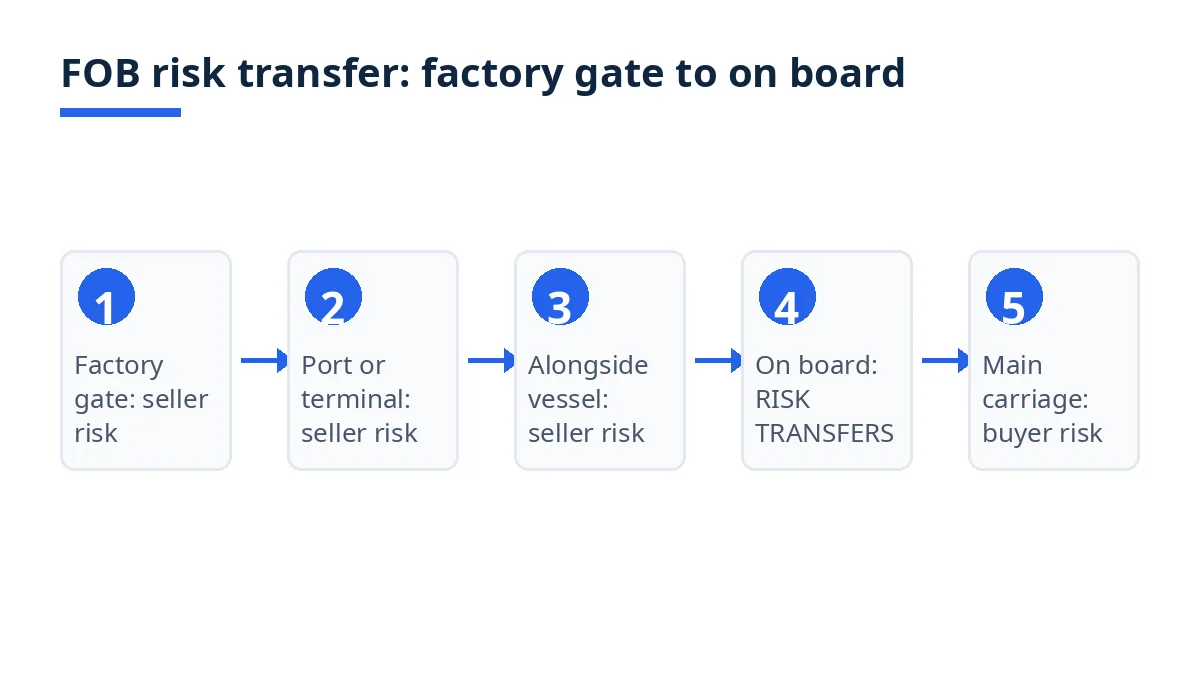
Factory gate. Goods packed and ready. Seller bears the risk.
Inland transport. The seller transports the goods to the port of shipment. Risk stays with the seller.1
Port or terminal. Goods wait at the port, still at the seller risk. Containers are typically delivered to a terminal and may stay there for several days before loading.1
Alongside the vessel. Goods placed alongside the ship. The seller still bears the risk: this is the FAS transfer point, not the FOB point.1 2
Loading. The seller loads the goods on board the buyer-nominated vessel.1 Risk stays with the seller until the goods are on board.
On board. Delivery is complete and risk transfers to the buyer, who must then take delivery on board, subject to the exceptions below.1
Main carriage. The buyer bears the risk for the voyage, having designated the carrier and agreed to pay freight.1
Risk can pass early when the buyer is at fault: if the buyer fails to name the vessel or loading point in time and loading cannot happen, if the nominated ship is delayed, or if late notice means the master closes for cargo early, the buyer bears the risk, and the storage cost, although the goods are not loaded.1
Cost vs risk: what passes when
Under FOB, risk and cost normally pass together, on board the vessel: after delivery and risk transfer, the buyer assumes all costs.1 Under the C-family rules the two diverge: the seller pays transport to the destination while the buyer bears the risk.2
Stage | Who bears the risk | Who bears the cost |
|---|---|---|
Factory gate and inland transport | Seller | Seller |
At the port, before loading | Seller | Seller |
Alongside the vessel | Seller | Seller |
Loading, until on board | Seller | Seller |
On board, and the voyage | Buyer | Buyer |
They are not the same moment for every cost: when buyer default delays loading, the buyer bears the storage cost at the port.1 The seller pays for transport to the port, loading, and export formalities; the buyer pays for main carriage and everything after loading.1 The FOB rule names no insurance duty for either party; insurance duties in the rules apply to the CIP and CIF rules, with different levels of cover.3 The buyer should arrange voyage cover. See the landed cost guide for imports from Bangladesh.
Claim scenarios: damage before, during, and after loading
These scenarios assume the contract follows the Incoterms 2020 FOB rule and no separate agreement moves the risk line. Ask who bore the risk when the damage happened.
Damage before loading
Cartons are damaged in the port warehouse while waiting for the vessel. The seller bears the loss, because risk has not transferred.1 The exception is buyer default: if loading could not happen because the buyer failed to name the vessel or loading point in time, the risk has already transferred.1
Damage during loading
A carton is dropped as it is lifted toward the vessel, before it is on board. The seller bears the loss, because the seller duty to load the goods is not complete.1 The boundary is the deck, not the quay: keep the loading record, since a loading dispute is usually a dispute about whether the goods were on board when the damage happened.
Damage after loading
Goods are damaged by seawater during the voyage. The buyer bears the loss, because risk transferred on board.1 Any claim runs against the carrier or the insurer, not the seller. The seller must still have given timely notice of delivery, or that the vessel failed to take delivery in the agreed period.1
FOB vs FAS and FCA on risk transfer
FAS is maritime-only: risk passes when the goods are placed alongside the vessel at the named port of shipment.2 FOB is also maritime-only, with its line one step later, on board.2 FCA is multimodal: risk passes when the goods are delivered to the carrier.2 For containerised goods, FCA is typically the better choice, even for maritime transport, because containers are handed to the carrier at a terminal before loading.2
Rule | Risk transfer point | Transport scope |
|---|---|---|
FAS | Alongside the vessel | Sea and inland waterway only |
FOB | On board the vessel | Sea and inland waterway only |
FCA | Handed to the carrier | Any mode, including multimodal |
A buyer who wants risk to pass at the terminal handover should not use FOB. See the Incoterms guide for shipments from Bangladesh.
Common mistakes to avoid
Treating the factory gate as the transfer point. The seller bears the risk through inland transport, the port wait, and loading.
Using FOB for containerised cargo handed over at a terminal. Containers may sit at the terminal for days, with the seller still bearing the risk under FOB.1 FCA is more appropriate in such cases.1
Naming no port, point, or vessel. A contract that says only FOB leaves the transfer point vague.2
Assuming the seller insures the voyage. The FOB rule names insurance duties for the CIF and CIP rules, not for FOB.3 The buyer should arrange cover for the voyage.
Assuming the freight payer bears the risk. Under FOB the buyer pays freight and bears the risk from on board.1 Under the C-rules the seller pays freight while the buyer bears the risk.2
Missing the buyer notice duty. The buyer must inform the seller in time of the vessel name and loading place and point.1 Late notice can move risk and storage costs to the buyer before loading.
How Exportain helps
On Exportain, post a request for quotation (RFQ) that states FOB and the named port of shipment, so suppliers quote against the same risk line. An RFQ states quantity, target price, destination, Incoterm, and deadline, and suppliers in the category can quote against it.4 Compare quotations only on the same term and port, and read the badges for what they record: Exportain verification is a document review by staff, not a factory inspection, and a badge is not a guarantee of capacity, quality, or delivery.5 Follow the how-to-buy guide, and post your requirement on the RFQ board.
FAQs
What is FOB, and where does risk transfer under it?
FOB means Free On Board. The seller delivers the goods loaded on board the vessel nominated by the buyer, and at that point the risk transfers to the buyer.1 The seller loads the goods and completes export formalities; the buyer contracts the carrier and pays freight.1
How does FOB work in practice for risk and cost?
The seller carries the risk and costs up to loading, and the buyer carries them from on board, unless buyer default moves the transfer earlier.1
Is FOB the right risk choice for container shipments from Bangladesh?
Often it is not. Containers typically sit at a terminal for days before loading, and under FOB the seller still bears the risk during that wait.1 For containerised goods, FCA is typically the better choice, because risk passes when the goods are handed to the carrier.2
What are the common mistakes with FOB risk transfer?
Treating the factory gate or the alongside point as the transfer point, using FOB for containerised handovers, naming no port or vessel point, assuming the seller insures the voyage, and missing the vessel notice duty. Name the port and point, give the notice on time, and keep the loading record.
Next steps on Exportain
Read the FOB (Free On Board) guide, the Incoterms guide for shipments from Bangladesh, and the landed cost guide for imports from Bangladesh. Post your requirement with the FOB term and named port stated.
Sources
- FOB & FAS Incoterms® 2020 explained: Key differences. ICC Academy (accessed )
- Place of delivery & risk transfer in trade contracts. ICC Academy (accessed )
- Incoterms® 2020. International Chamber of Commerce (ICC) (accessed )
- How to source and buy from Bangladesh. Exportain (accessed )
- Trust & Safety Center. Exportain (accessed )
About the author
Sourcing from Bangladesh?
Post a request for quotation and suppliers on Exportain can send you their quotes directly.
Post an RFQ