

HS Code for Jute Shopping Bags: Classification Guide for Importers
A jute shopping bag is examined under indicative heading 4202, which names shopping bags among its containers. Handles, outer surface, lining, blend shares and retail or promotional presentation decide the branch and material split, and the full national line must be confirmed for the entry date.
Short answer
Heading 4202 is the indicative heading for a jute shopping bag, since it names shopping bags among the containers it covers, worked down to subheading 4202.92 for textile outer-surface containers. Handles, construction, outer surface and fibre shares decide the branch and material split, and the full national line must be confirmed in the destination tariff for the entry date.
On this page
A jute shopping bag is bought to carry things home from a shop, and that job is the starting point for its classification. Heading 4202 names shopping bags expressly among the containers it covers, so a jute bag sold empty for retail carrying is examined under heading 4202 first.1 That is an indicative starting point, not a finished code: the heading still has to be worked down through subheading, outer-surface split, and national digits.
Verify note: every heading and line named here is indicative only. Before you declare a code, confirm the six-digit subheading and the full national code in the destination tariff for the entry date, and put a doubtful bag to a broker or the binding ruling route for that destination.
Quick answer: indicative HS heading (with verify note)
Heading 4202 covers trunks, suitcases, handbags, shopping bags, wallets, tool bags, sports bags and similar containers, of leather, composition leather, sheeting of plastics, textile materials, vulcanised fibre or paperboard, or wholly or mainly covered with such materials or with paper.1 A jute bag fits that wording when it is a listed container, made of or mainly covered with textile material, and presented as a carry article rather than packing.
The United States note to chapter 42 confirms the reading: for heading 4202, "travel, sports and similar bags" means goods designed for carrying clothing and other personal effects during travel, including backpacks and shopping bags of this heading.1
A published United Kingdom ruling shows the method on a shopping bag, though not on a jute one. A foldable, reusable polyester shopping bag with a handle, which folded into a pouch sealed by a popper, was classified under GIR 1 by the terms of heading 4202 and under GIR 6 to subheading 4202.92, with the commodity code 4202929890 for a textile "other" bag that was not hand-made.2 That code belongs to that polyester bag only.
How HS codes are structured (2-4-6 digits)
The code narrows in stages. The first two digits are the chapter: chapter 42 covers travel goods, handbags and similar containers. The next two digits make the four-digit heading, here 4202. The final two digits of the six-digit code make the subheading, here 4202.92 for other containers with an outer surface of sheeting of plastics or of textile materials.3
Only the first six digits are internationally shared. Beyond them, each destination adds its own digits, so the same shopping bag can carry a different full code in the United States, the European Union and the United Kingdom. Under subheading 4202.92, the textile "other" branch splits into hand-made and other 10-digit commodity codes.3 Always read the full national line, not only the heading.
Factors that decide the code for jute shopping bags
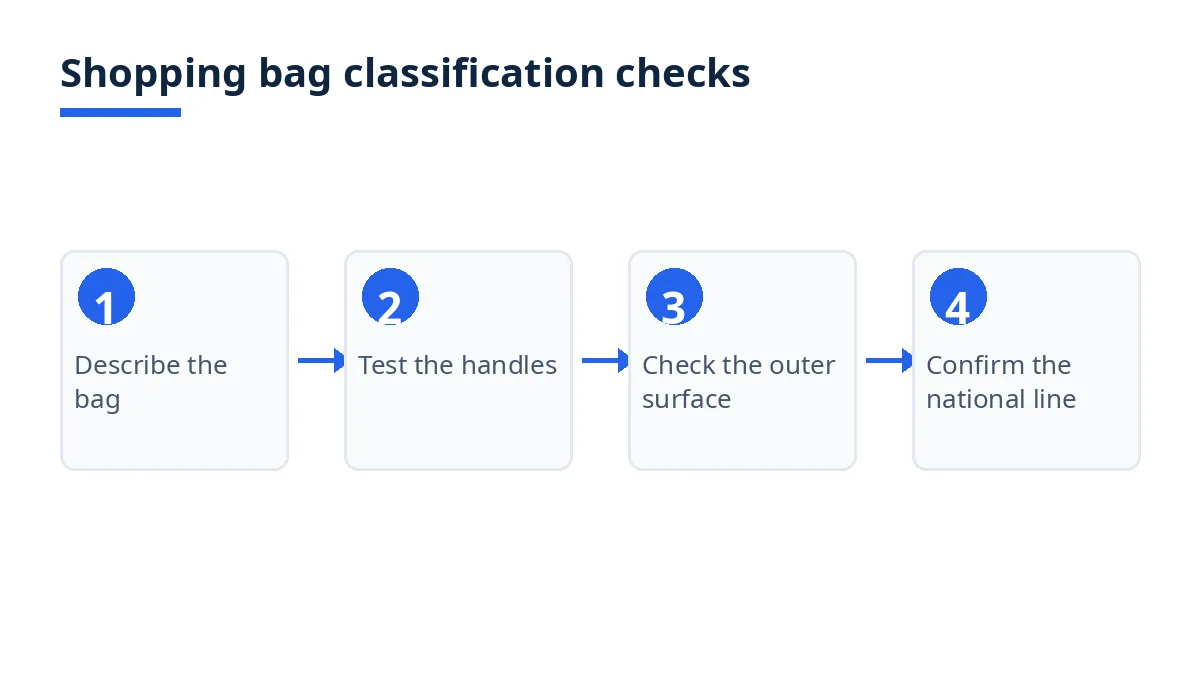
First, apply the carry test: handles and straps. Check whether the bag has handles, shoulder straps or a similar fitting, how they are attached, and whether the bag is built to be carried by hand or over the shoulder. Stitched, load-bearing handles make a stronger candidate than no fitting or one too weak to carry a load. But handles alone do not settle the heading: chapter 42 excludes bags made of sheeting of plastics, whether or not printed, with handles, not designed for prolonged use, sending those to heading 3923.1 3 That proves the principle: a handle on a throwaway bag does not create a heading 4202 container.
Second, test lined against unlined construction. A lining does not change the heading by itself, because the question is the outer surface, not the inside. The tariff note for heading 4202 subheadings states that "outer surface" refers to the material visible to the naked eye, even where that material is the outer layer of a combination.3 A plastic-coated outside raises a different question: for textile fabric coated or laminated with plastics, the outer surface is textile material or plastic sheeting depending on whether and to what extent the textile or the plastic constituent makes up the exterior.1
Third, test retail against promotional use. A bag sold empty at retail for carrying purchases, and a bag given away printed with a brand at an event, can be the same physical article, and the declared use and presentation for sale are part of the facts file. A promotional bag handed out free is still a container if built to carry. Promotional intent is context, not a heading.
Fourth, test jute-blend predominance by weight. Many shopping bags mix jute with cotton or another fibre. The mixture rule in the Section XI notes states that goods of a mixture of two or more textile materials are classified as if consisting wholly of the one textile material which predominates by weight over any other single textile material, with a last-in-numerical-order tie-break where no material predominates.4 That note covers chapters 50 to 55 goods, so it governs the fabric side rather than the finished bag. For the bag, the practical step is the same: weigh the fibre shares and record them for the material split inside subheading 4202.92.
Fifth, treat print as a non-heading factor: a logo, shop name or slogan on the outside does not move the bag to a different heading.
The neighbouring bag types stay open questions.
Bag type | What the opened sources settle | What stays open |
|---|---|---|
Jute shopping bag, handled, sold empty for retail carrying | Heading 4202 names shopping bags; 4202.92 covers textile outer-surface containers | The national line for your bag and entry date |
Jute tote, handled, sold empty, marketed for everyday carrying | Same heading wording, since the heading covers similar containers | Whether the tariff treats a tote as a shopping bag or another 4202 container |
Jute beach bag, handled, sold empty, marketed for beach use | Heading 4202 covers similar containers with a textile outer surface | Whether beach use changes the container description |
Jute packing sack, sold to hold bulk goods for transport or sale | A different kind of article from a retail carry bag | No code is assigned here; see the companion jute-bags guide |
National codes: US HTS, EU CN/TARIC, UK commodity code
In the United States, the Harmonized Tariff Schedule extends the six-digit subheading to a 10-digit statistical number. Within subheading 4202.92, the schedule separates insulated food and beverage bags, travel, sports and similar bags, and other bags, with outer-surface material splits including textile materials of vegetable fibres.1 A jute shopping bag is therefore examined branch by branch rather than being read off a single line. Confirm the current United States line before shipping.
In the European Union, the Combined Nomenclature code builds on the six-digit subheading, and TARIC adds further digits for the import declaration. The Northern Ireland (EU) tariff page opened for this article shows the 4202.92 structure directly: under "of textile materials", travelling-bags, toilet bags, rucksacks and sports bags sit in one branch, and "other" textile bags sit in another, with hand-made and other 10-digit commodity codes beneath each.3 Re-check the entry-date line for a specific EU destination in the destination tariff.
In the United Kingdom, the commodity code is also built on the shared six-digit foundation with national extensions. The published advance ruling shows the structure in action: a shopping bag classified to subheading 4202.92 received the 10-digit code 4202929890, the "other than hand-made" line within the textile "other" branch.2 That code is that ruling's outcome only. For Great Britain, work the same branch structure in the UK Integrated Online Tariff and confirm the hand-made split for your bag.3
How to confirm the code officially
Start with the destination tariff text, not a supplier invoice or listing. Open the current chapter 42 text, read the heading wording and the section and chapter notes, and work down from the heading to the subheading and then to the national line. The tariff's General Rules state the order: heading terms and notes first, then subheading terms and notes.3
Next, build a short classification file for each bag style: description, fibre shares by weight, outer-surface material and any coating, handles and fittings, lining, dimensions, whether sold empty or filled, and retail or promotional presentation.
Where the answer is still doubtful, seek a binding decision. For Great Britain, an Advance Tariff Ruling must be applied for before all customs procedures have been completed, and a separate application is needed for each type of goods; HMRC replies within 30 to 120 days.5 For Northern Ireland and the European Union, the equivalent route is a Binding Tariff Information decision, which the same guidance points to for imports into or exports from Northern Ireland or the EU.5
Common classification mistakes
The first mistake is quoting the fibre heading for the bag. Jute fibre and jute yarn have their own headings, and neither is the code for a finished shopping bag. The second mistake is treating handles as proof of heading 4202: a handle on a bag that is not a container for carrying, or on a thin plastic sheeting bag not designed for prolonged use, does not create a heading 4202 article.1
The third mistake is treating a lining or a coating as the outer surface. The test is the material visible on the outside, even where it is the outer layer of a combination.3 A cotton lining does not make the outer surface cotton. The fourth mistake is copying a code from a different bag: the published shopping-bag ruling code belongs to a foldable polyester bag with a popper pouch.2 The fifth mistake is stopping at the heading or subheading, or using a code from the wrong destination or trade date: writing 4202, or even 4202.92, leaves the national extension undecided.
Related duties and documents
The HS code does not by itself state what an importer will pay. No rate is stated in this article. Ask your broker for the treatment for your code, origin and entry date.
Documents that normally travel with the shipment are the commercial invoice, packing list, bill of lading or airwaybill, and certificate of origin where a preference or buyer requirement calls for one. The invoice description should match the classification file: bag type, handles, outer-surface material, fibre shares and whether the bag is sold empty or filled. A mismatch between the invoice description and the entry is a common source of delay at clearance.
FAQs
What is the HS code for jute shopping bags?
The indicative heading is 4202, which names shopping bags among the containers it covers, worked down to subheading 4202.92.1 3 There is no single finished code here: the full national line depends on the bag's branch, material split, hand-made status, destination and entry date, and must be confirmed in the destination tariff.
Is the HS code the same in every country?
Only the first six digits are shared. Each destination adds its own digits after the sixth digit, as the 10-digit lines under subheading 4202.92 show.3 The line must therefore be checked for the destination of the actual shipment.
How do I confirm the correct code?
Read the destination tariff text for chapter 42 and test the bag's carry fitting, construction, outer surface and fibre shares.1 3 Then get a broker confirmation in writing, or seek a binding decision: an Advance Tariff Ruling for Great Britain, a Binding Tariff Information decision for Northern Ireland and the European Union, or the binding ruling route for the United States.5
What happens if I use the wrong code?
A wrong code can delay clearance while customs re-examines the goods, and it can change the treatment that applies to the entry.
Next steps on Exportain
For background on how the system works, read HS Code: Harmonized System Explained and HS Codes: How to Classify Your Product. browse suppliers on Exportain and compare handle construction, lining and outer surface before you ask for a quotation.
Sources
- Harmonized Tariff Schedule of the United States, Chapter 42 (2026 Revision 18). U.S. International Trade Commission (accessed )
- Information for ruling 600006622 - Search for Advance Tariff Rulings (folding polyester shopping bag, 4202929890). GOV.UK (accessed )
- With outer surface of sheeting of plastics or of textile materials - Northern Ireland Online Tariff, subheading 4202.92. GOV.UK (accessed )
- Section XI: Textiles and Textile Articles, Notes (HS 2022). World Customs Organization (accessed )
- Apply for an Advance Tariff Ruling. HM Revenue & Customs (GOV.UK), (accessed )
About the author
Sourcing from Bangladesh?
Post a request for quotation and suppliers on Exportain can send you their quotes directly.
Post an RFQ


