Quality Control Checklist for Jute Shopping Bags From Bangladesh
Product-specific QC checklist for jute shopping bags: retail face, size and gusset, fabric, print and lamination, handles, seams, inside finishing, buyer-specified tests, labels, and folding and retail packing, with a numbered checklist, failure fixes, and a summary table.
Short answer
This jute shopping bags quality control checklist covers the retail face, dimensions, gusset depth and standing, fabric weight, print and lamination, handle type and attachment, seam strength, inside finishing, labels, and folding and retail packing, with a numbered checklist, a published-table sampling example, failure fixes and a summary table for buyers ordering from Bangladesh.

On this page
A jute shopping bag is judged where it will be used, not where it was sewn. A bag that looks tidy folded can lean when set down, twist when carried, or show print that cracks along the fold line when first opened. It carries a brand and must hold its shape.
This guide checks the bag in retail order: customer view, size and gusset, fabric, print and lamination, handles, seams and inside finish, buyer-specified tests, labels, then folding and retail packing. Every test item names its method; record the result against the order value. No item carries a universal pass mark.
Why this checklist matters
A shopping bag fails in public: a handle that parts, a gusset that collapses, or a base that sags changes how the brand looks when the customer leaves the shop.
Retail packing hides the risk. Bags are folded, stacked and polybagged before inspection, so a crease through artwork, a crushed handle, or a damp bag inside a sealed pack can stay hidden until the carton is opened. Checking the folded, unfolded, and carried bag catches faults a flat check misses.
Faults also repeat across the run, so a fault on one sampled bag warns about the lot. Catching it before shipment lets the buyer hold the lot for sorting or rework.
Before you start
Freeze the reference set before inspection: one sealed approved bag, the purchase order, the bag specification, the artwork file, the handle and gusset specification, the defect list by class, the sampling plan, and the folding and packing specifications. Keep the approved bag sealed and separate from the lot.
Agree four things in writing in the purchase order: the defect list and each defect class, with reference photographs; the sampling plan, including standard, level and acceptance and rejection numbers per class; each buyer-specified test, named with method and result; and the folding, polybag and carton specification. AQL, defined in ISO 2859-1, sets how many units to sample and how many defective units can be found before the lot is rejected.1 A pre-shipment inspection is a sampling inspection of finished, mostly packed goods, not a check of every piece and not a guarantee.2
Note the retail use first: sold empty, handed out at a till, or packed with goods. A till bag is judged on fold and print; a bag packed with goods, on gusset, base and handles.
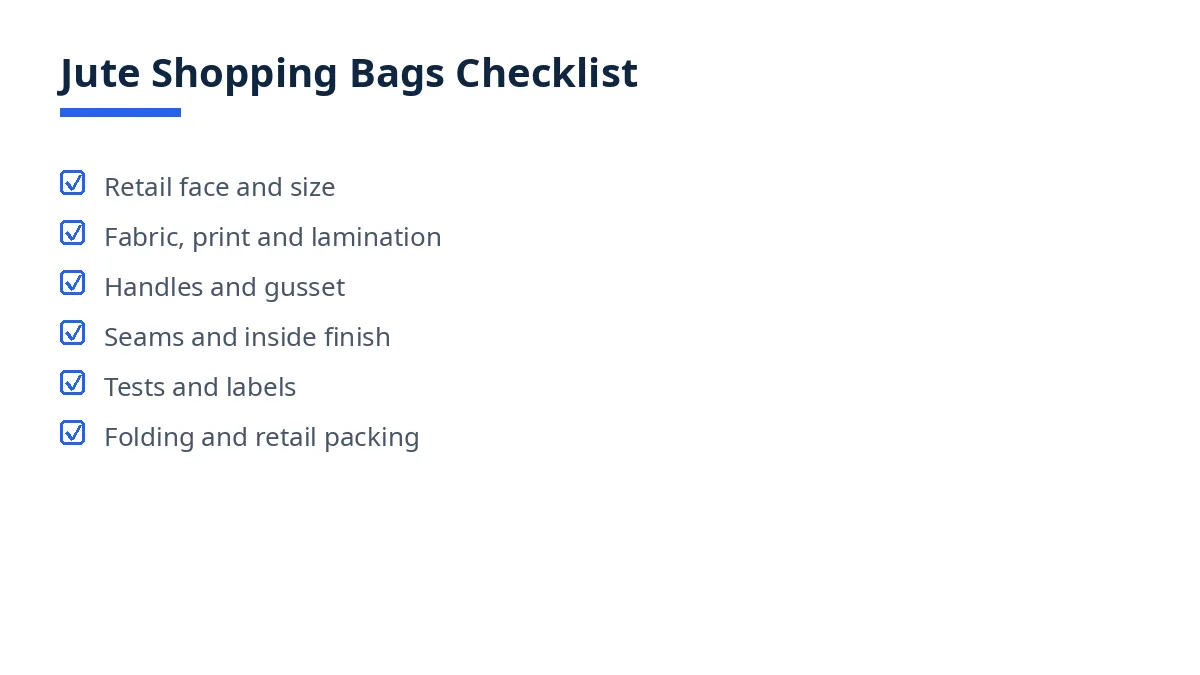
The full checklist (numbered, printable)
Tick each item Pass, Fail, or Not applicable. Record bag, bundle and carton numbers.
Approved bag. Each size, handle type and artwork has its own sealed approved bag, matched to the retail use.
Retail face. Open one bag fully and check the front panel as a customer will see it: clean, even colour, no crease or stain.
Bag dimensions. Measure length, width and handle drop flat, without stretching, against the order and approved bag.
Gusset depth. Measure gusset depth on both sides; check the gusset opens evenly so the bag stands upright.
Standing test. Set the bag down empty; check it stands upright, with a flat base and square corners.
Fabric and weave. Check fabric, weave evenness and yarn against the approved bag, across panels, gusset and base.
Fabric weight, buyer-spec item. Record the fabric-weight method and result against the order value only; check weight is even.
Colour and shade across the lot. Compare colour bag to bag under the agreed light; keep differing dye lots apart.
Print position and artwork. Check artwork position, alignment and spelling against the approved file, including side and gusset print.
Print colour. Check print colour against the approved artwork and colour reference, under the agreed light.
Print durability, buyer-spec item. Record the print-durability method and result against the order value only; include a fold check.
Lamination coverage, buyer-spec item. Where lamination is specified, check the film covers the ordered area, lies flat, and shows no bubbles or lifted edges. Lamination usually involves heat-bonding a transparent LDPE film to the back of the jute cloth.3
Lamination and print interaction. Check print sits cleanly on the laminated surface, without smearing, peeling or colour shift.
Seams and stitching. Check every seam for skipped stitches, open sections, uneven stitching and puckering, against the approved bag. Double stitching or edge binding is often used for jute strength.3
Gusset construction. Check gusset seams, folds and corners for even stitching, secure attachment and a clean fold, on both sides.
Handle type against the order. Check handle type, material and length against the order: loop, stitched, or riveted handles are buyer-spec options; only the specified option passes.
Handle attachment, buyer-spec item. Record the handle-attachment method and result against the order value only; check every attachment point, including rivets where specified.
Handle symmetry and drop. Check both handles match in length, material and fixing, and that the bag hangs level.
Seam strength, buyer-spec item. Record the seam-strength method and result against the order value only, from side, gusset and base seams.
Inside finishing. Turn sampled bags inside out and check inside seams, raw edges, loose threads and lining where specified. Inspectors trim excess threads and remove dust or fibre scraps.3
Inside cleanliness and odour. Check the inside of each sampled bag for dust, fibre scraps, stains and odours untypical of jute, before folding.
Closures and accessories where specified. Check zips, buttons, magnetic closures, pockets and eyelets where specified, for correct type, position and working order.
Labels where specified. Check label content, spelling, fibre composition, country of origin and care instructions against the order, and label position.4
Folding and creasing. Fold sampled bags by the specified method; check the fold is even, artwork is not creased through, and the bag opens cleanly.
Folded presentation. Check the folded bag as a retailer will receive it: flat, clean, handles lying neatly, no crushed gusset or base.
Bundle and carton quantity. Count bags per bundle and per carton against the packing list; no mixed size, handle type, artwork or shade in one bundle.
Packing and marks. Check each bag is packed as specified, individually polybagged for retail or stacked in bundles, and that marks show description, size, handle type, artwork, shade lot and bundle number. Individual polybags suit retail; bulk stacking suits distributors.4
Sampling decision on the finished, packed lot. As a published-table example only, a lot of 91 to 150 shopping bags at General Inspection Level III gives code letter G and a sample of 32 bags.1 With buyer-specified AQL 1.0 for major and AQL 4.0 for minor defects, the published table gives 1 and 2 for major defects and 3 and 4 for minor defects.1 Those are buyer-agreed order values, not standard-mandated values.5
Common failures and how to fix them
Handle pull-away. A handle lifting at one fixing point points to weak attachment; hold the lot and check attachment on a fresh sample.
Gusset collapse. A bag that leans or falls over points to uneven gusset depth or a seam stitched out of square; hold the lot and re-check standing.
Lamination peeling. Film that bubbles or lifts at the panel edge points to a lamination fault; hold the lot and check coverage on a fresh sample.
Print cracking on the fold. Print clean flat but cracking where the bag folds points to an ink, film or folding fault; hold the lot and fold a fresh sample by the specified method.
Print off position. Artwork off centre, or colour shifting between panels, points to registration or colour drift; hold the lot and compare print with the approved artwork file.
Raw inside edges. Inside seams that shed or raw edges that fray point to unfinished inside work; hold the lot and turn a fresh sample inside out.
Shade split. Bags matching under one light and differing under another point to mixed dye lots in one bundle; re-check under a second light and re-sort bundles.
Crushed handles. Handles arriving bent, or artwork creased through the fold, point to a folding or packing fault; hold the carton and check the folding method.
Downloadable template / summary table
No file download is offered with this article. The table below is the template.
Group | What to record | Result |
|---|---|---|
Retail face and size | Front panel, size, handle drop, gusset, standing | Pass/fail |
Fabric, print, lamination | Weave, weight, colour, print, lamination | Pass/fail |
Handles and gusset | Handle type, attachment, symmetry, gusset seams | Pass/fail |
Seams and inside finish | Stitching, strength, inside seams, odour, closures | Pass/fail |
Tests and labels | Test methods and results, labels | Pass/fail |
Folding and retail packing | Fold, presentation, bundle and carton, marks | Pass/fail |
Sampling decision | Lot, level, code, sample, Ac/Re | Pass/fail |
Copy the table into the inspection report with lot number, date and inspector name, and attach photographs of every failed item. A locked spec sheet listing fabric weight, dimensions, handles, print colours, artwork placement, packaging, folding and labelling gives one authoritative reference.4
How Exportain helps
Exportain does not inspect goods itself. A buyer can use this checklist to write the inspection into the purchase order, book an independent inspector, and compare the report with the order. Inspection providers can be found through Exportain, but the inspection contract is between the buyer and the provider. Supplier verification is a document and photo review, not a factory inspection.
FAQs
When should this checklist be used?
Use it at final inspection, when production is complete and bags are mostly packed, and again after any rework, with a fresh sample. Check folding too: a flat pass can fail folded.
Who should complete it?
The buyer's inspector, a third-party inspector, or the supplier quality team can each complete it, but roles must stay separate. Whoever books the inspection receives it.2
What are the most common failures?
The failures that recur here are handle pull-away, gusset collapse, lamination peeling, print cracking on the fold, print off position, raw inside edges, shade splits, and crushed handles. A check that looks only at a flat bag will miss most.
Can a third party do it?
Yes. A pre-shipment inspection is usually arranged through an independent third-party firm, and the buyer sends that firm the purchase order, specification, approved bag details, artwork file and packing requirements.2 Agree who pays for re-inspection.
Next steps on Exportain
Read the AQL acceptance quality limit guide before fixing the sampling plan. Then read the pre-shipment inspection guide for booking and re-inspection.
Sources
- AQL Calculator | Sample Size and ISO 2859-1 Tool. AQMBD (accessed )
- Pre-Shipment Inspection (PSI). Exportain (accessed )
- How Jute Bags Are Made: A Complete Eco-Friendly Guide. Yanxin Bag (accessed )
- The Complete Buyer's Guide to Custom Printed Jute Bags for European Markets 2026. Jucofabs (accessed )
- AQL Meaning: Acceptance Quality Limit, Tables. Exportain (accessed )
About the author
Sourcing from Bangladesh?
Post a request for quotation and suppliers on Exportain can send you their quotes directly.
Post an RFQ