How to Import Cotton T-Shirts From Bangladesh in 2026: Complete Buyer Guide
A step-by-step buyer guide to importing cotton t-shirts from Bangladesh, from specification, supplier checks and samples to inspection, shipping, duty and landed cost.
Short answer
To import cotton t-shirts from Bangladesh, write a full specification, shortlist knitwear suppliers, verify registration and association membership, approve a pre-production sample, agree MOQ, price, payment and Incoterms in a purchase order, inspect against the sample before shipment, classify the garment under HS 610910, check duty in your destination tariff, and clear the shipment with consistent invoice, packing list and transport documents.
On this page
Key takeaways
Start with a precise specification for fabric, sizes, colors, print, labeling and packing so quotations can be compared.
Verify each supplier before paying a deposit, and check any BGMEA or BKMEA membership claim directly with the association.
Approve a pre-production sample in writing and inspect bulk production against it, using agreed AQL limits, before shipment.
MOQ, price and lead time are set by each factory for your specification, so ask each supplier to state its own terms.
Cotton knitted t-shirts fall under HS subheading 610910; check the duty rate in your destination tariff before calculating landed cost.
Learning how to import cotton t-shirts from Bangladesh takes more than a supplier name and a price. You need a clear specification, a supplier you have checked, an approved sample, agreed quality limits, the right trade term, and a realistic plan for shipping, customs and delivery. This guide works through each stage in order.
Bangladesh has a deep knitwear sector, and cotton t-shirts sit inside it. Two factories quoting for the same style can still deliver very different results on fabric, sizing, stitching and packing, so this guide covers specification, verification and inspection as much as finding names.
Key takeaways
Start with a precise specification: fabric composition and weight, colors, sizes, print or embroidery, labeling and packing. A vague brief produces quotations you cannot compare.
Check every supplier before you pay a deposit: registration, export record, capability and references, and confirm which company will produce your order.
Treat the approved pre-production sample as your inspection standard. Record approval in writing and inspect bulk production against it.
Minimum order quantity (MOQ), price and lead time are set by each factory for your specification. Ask each supplier to state its own terms.
Classify the garment correctly and check duty in your destination tariff before you calculate landed cost.
Why source cotton t-shirts from Bangladesh
Cotton t-shirts are knitted garments, and knitwear has its own trade body in Bangladesh. The Bangladesh Knitwear Manufacturers and Exporters Association (BKMEA) represents the knitwear sector, was established in 1996, and currently represents approximately 2,540 knitwear member factories.1
The wider garment industry is represented by the Bangladesh Garment Manufacturers and Exporters Association (BGMEA), which covers woven garments, knitwear and sweaters. BGMEA started its journey in 1983 and reports around 4,500 member factories, around 40 percent of them knitwear and sweater manufacturers.2 Check which association a factory belongs to, and whether its machinery matches knit production.
Bangladesh ready-made garment exports grew 6.1 percent year on year to $10.58 billion in the first quarter (July to September) of fiscal 2026-27, according to Export Promotion Bureau (EPB) data reported by The Business Standard.3 The European Union accounted for $4.9 billion of that total, followed by the United States and the United Kingdom, and knitwear exports rose 6.88 percent in the same period.3 Those figures describe the sector as a whole, not the result any one order will achieve.
The practical advantages are depth of supply and export experience. Factories work to international specifications, labeling rules and packing standards, inside a wider network of fabric mills, dyeing units, print providers, freight forwarders and inspection firms. None of that ensures a good outcome on your order. A low quotation becomes expensive if fabric is substituted, sizes drift or a shipment misses its season, so source for capability first and protect the order with verification, sampling and inspection. For the wider process, see how to import from Bangladesh.
Find and verify suppliers
Finding names is easy. Finding a supplier you can trust with your money and your delivery date is the real work. Build a shortlist, then check each company before you discuss deposits.
How do you build a shortlist?
Define what you need first, then look for suppliers whose capability matches it: t-shirt type, fabric, likely order size, printing or embroidery, and labeling needs. Search supplier directories and trade listings, and review each candidate's product range and export markets. Membership of BGMEA or BKMEA is a useful starting check, and you can read how the two bodies differ in our guide to BGMEA and BKMEA. Shortlist a few serious candidates rather than dozens, and compare them like for like.
What verification checks matter?
Ask for registration details, export credentials where they apply, and the factory address. Confirm whether you deal with the manufacturer or with an intermediary. An intermediary is not automatically a problem, but you need to know who produces your goods and who is responsible if something goes wrong. Ask about fabric sources, whether printing is in-house or subcontracted, and quality checks, and request examples of similar export work. If you are uncertain, start with a trial order.
Warning signs should stop an order: pressure to pay in full in advance to a personal account, reluctance to provide samples or documents, unexplained price changes, and refusal to allow inspection.
MOQ, pricing and samples
Three questions dominate early conversations: the minimum order quantity, the price, and samples. Each answer depends on your exact specification, so treat any general figure online with caution.
What sets the minimum order quantity?
Minimum order quantity (MOQ) is set by each factory and differs by style, fabric, color and size breakdown. Custom fabric, colors, private labels and special packing can all raise it. Ask the supplier to state its MOQ for your specification, per style and per color, and what drives it. If your quantity falls below the minimum, ask whether a trial order or a simpler specification is possible, and accept that the answer may be no. Ordering the wrong product only to meet a minimum is never a saving. Our glossary explains MOQ (minimum order quantity).
How is the price built, and how do you pay?
A price reflects fabric type and weight, construction, printing or embroidery, labels and tags, packing, any testing, quantity, and the trade term quoted. Quotations are comparable only when they cover the same specification, term, packing and inclusions. Ask for an itemized quotation that names fabric composition and weight, the size range, inclusions, exclusions, validity period and payment terms. Do not negotiate on price alone: payment terms, lead time, inspection rights and responsibility for defects are part of the deal.
Agree payment milestones in the purchase order before production. If you pay by letter of credit (LC), the documents the supplier must present become part of your control, because payment turns on documents rather than on the goods. If you pay by bank transfer in stages, tie each stage to a verifiable event, such as sample approval or a passed inspection.
Why do samples and approvals decide the order?
Never skip sampling. Judge fabric hand-feel and weight, stitching, sizing, color, print quality and finishing, but the critical step is the pre-production sample made to your specification. Check it against every point on your brief and size chart, wash it if wash performance matters, and record approval or corrections in writing. Keep the approved sample as your inspection reference. If you change fabric, color, artwork or packing after approval, confirm the change in writing and approve a new sample where the change is material.
Quality control and certifications needed
Quality is not a single final check. It runs from fabric selection through cutting, sewing, finishing and packing. Define the standard, agree how it will be checked, and confirm it was met before the goods leave the factory.
How do you define your quality standard?
Provide a specification that covers fabric composition and weight, measurements per size with tolerances, stitching, color standards, artwork placement, labeling and packing. State which defects count as critical, major and minor, and agree the remedy if inspection fails (rework, re-inspection or sorting) before production starts. Build in fabric checks, inline checks during sewing, and a final random inspection of workmanship, measurements, labeling, packing and quantity. Attend in person, send a representative, or appoint an independent inspector.
Where sampling decides acceptance, use a recognized method rather than an opinion. ISO 2859-1:2026 defines acceptance sampling plans for inspection by attributes and uses the acceptance quality limit (AQL), described by ISO as the maximum average percentage of defective items considered acceptable during random sampling.4 ISO 2859-1 uses AQL to determine sample sizes and acceptance and rejection thresholds.4 Agree an AQL for each defect class in writing before production. Our guide to the acceptance quality limit (AQL) explains how buyers set those limits.
What certifications and compliance do you need?
Requirements depend on what you sell, where you sell it and what claims you make. If you need a particular certification or audit, name it in the purchase order, ask for current evidence, and check that it covers the factory and product in question. Never print a certification claim without valid evidence for that claim.
Separately, confirm the product meets your destination legal requirements for fiber content, care labeling and origin marking. Responsibility for importing compliant goods sits with the importer.
Incoterms, shipping and transit time
How goods move from the factory to your warehouse, and who pays for and controls each leg, is governed by the trade term in your contract.
How do you choose an Incoterms rule?
The Incoterms rules, published by the International Chamber of Commerce (ICC), are eleven three-letter trade terms for contracts for the sale of goods. ICC states that the rules clarify the tasks, costs and risks involved in the delivery of goods from sellers to buyers, and that Incoterms 2020, the current edition, entered into force on 1 January 2020.5 Common choices for t-shirt orders include Ex Works (EXW), Free On Board (FOB) and Cost, Insurance and Freight (CIF).
Name the exact rule, the named place or port, and the Incoterms version in your purchase order, and confirm that the quotation uses the same term. Compare the full set of rules in our guide to Incoterms for shipments from Bangladesh.
How do shipping method and timing work?
Most volume orders ship by sea, either as a full container load (FCL) or as a consolidated less-than-container load (LCL). Air freight suits urgent or small consignments and costs more per kilogram. Transit time varies with destination, route, carrier schedules, port conditions and customs processing, so no single figure can date your shipment. Build your calendar backward from the in-warehouse date, adding production, inspection, documentation, voyage, clearance and delivery, and keep a buffer.
Most sea shipments leave through Chattogram. The Daily Observer, reporting Chittagong Port Authority (CPA) data, describes Chattogram as the country's principal seaport, handling about 92 percent of Bangladesh total seaborne general cargo and nearly 98 percent of containerized imports and exports.6 Confirm carton dimensions and gross weights as soon as packing is planned, because a late change can mean rebooking space or splitting the shipment.
Import duty, taxes and documents
Import charges are one of the most misunderstood parts of importing. The factory price tells you nothing about what your customs authority will charge, so research this before you confirm an order.
How is duty determined for cotton t-shirts?
Duty is determined by classification, customs value, origin, and the rules in force in your destination on the import date. Classification uses the Harmonized System (HS), the international product nomenclature developed by the World Customs Organization (WCO). The WCO states that the HS has more than 5,000 commodity groups, each identified by a six-digit code, and that more than 200 countries and economies use it as a basis for their customs tariffs.7
Within that system, heading 6109 covers T-shirts, singlets and other vests, knitted or crocheted, and subheading 610910 covers the same garments of cotton, knitted or crocheted.8 Your destination then adds its own digits and sets its own rate, so the full code and rate for your market come from its official tariff: the Harmonized Tariff Schedule for the United States, TARIC for the European Union, or the UK Trade Tariff. A small difference in fiber composition or garment type can move a product to a different subheading and rate, so do not guess. If you claim a preferential rate, confirm its conditions and proof-of-origin requirements first. Add import tax (value-added tax or goods and services tax, where it applies) and port and clearance charges in landed cost.
What documents do you need to prepare?
On the Bangladesh export side, goods cannot be loaded until an export declaration, known as a Bill of Export or shipping bill, has been submitted to Bangladesh Customs and approved. Bangladesh Customs lists the documents enclosed with that declaration: the export LC, or the export contract or purchase order where there is no LC; a commercial invoice with a detailed description of the goods; a packing list with quantity, weight and packing information; an EXP form certified by an authorized dealer bank; and a certificate of origin issued by the EPB or a chamber of commerce.9 For ready-made garments exported under a bonded warehouse arrangement, a Utilization Declaration is also listed.9
Names, style descriptions, quantities, weights, and marks should read the same on the invoice, the packing list and the transport document. This matters twice over under an LC. The ICC rules for documentary credits, UCP 600, were approved in 2006 with an implementation date of 1 July 2007, and ICC notes that the UCP is written into virtually every letter of credit.10 Under an LC, banks pay against conforming documents, so a discrepancy can delay payment even when the goods are correct.
Landed cost example
Landed cost is the total cost of getting goods into your warehouse, ready to sell. The table below is a structure you can copy for any quotation. It uses prompts rather than figures, because your duty rate, freight rate and charges come from your own verified sources. Our landed cost guide works through each line in more detail.
Cost element | How to fill it in | Your figure |
|---|---|---|
Goods (per your agreed Incoterms rule) | Supplier quotation for your specification and quantity | Enter quoted total |
International freight | Forwarder quote, or freight included in the price, on the same Incoterms rule | Enter freight total |
Insurance | Premium if you insure the shipment | Enter premium |
Import duty | Customs value multiplied by the verified rate for your classification and origin | Enter calculated duty |
Import tax | Calculated under your destination rules | Enter calculated tax |
Port, handling and clearance | Broker, port and handling charges for your shipment | Enter total charges |
Local delivery to warehouse | Final-leg transport to your premises | Enter delivery cost |
Total landed cost | Sum of all rows above | Enter total |
Landed cost per piece | Total landed cost divided by the number of saleable pieces received | Enter per-piece cost |
Example figures: the numbers here are illustrative only, not a quotation, a freight rate or a duty rate. Suppose 5,000 cotton t-shirts are quoted at $15,000 on FOB terms, with freight of $1,800, insurance of $90, duty calculated at $2,400 for the destination and classification in question, port and clearance charges of $650, and local delivery of $400. The total landed cost is $20,340, or $4.07 per piece, against a factory price of $3.00 per piece. Set selling prices from the landed figure, and re-run the calculation whenever specification, quantity, freight or duty changes.
How to import cotton t-shirts from Bangladesh: step-by-step import checklist
Work through this checklist in order, and do not move on until the stage before it is documented. The roadmap below summarizes the same sequence.
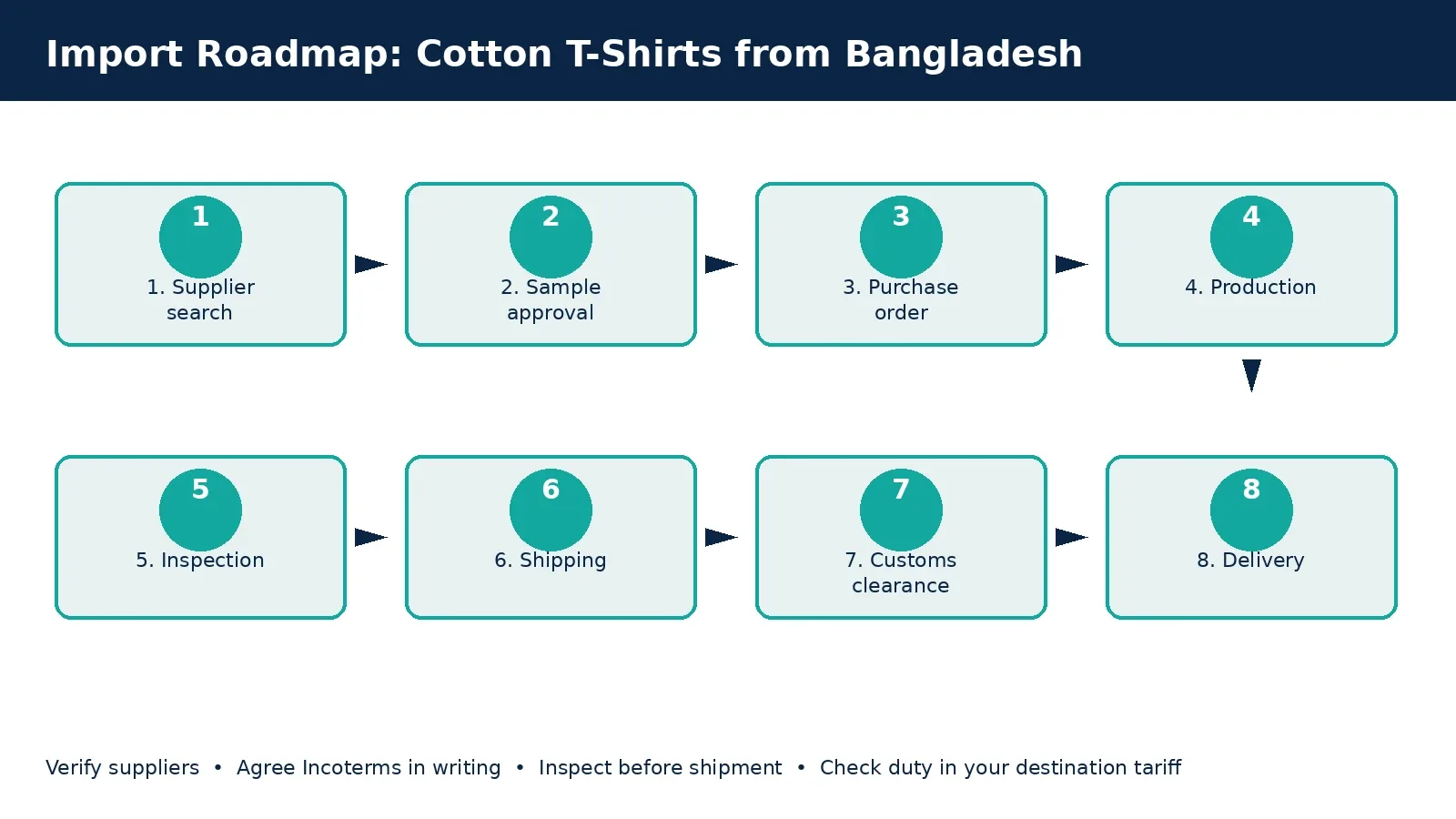
Define the product. Write the full specification: fabric, weight, colors, sizes, print or embroidery, labels and packing.
Research import requirements. Confirm classification, duty, tax, labeling and importer registration from official sources or a broker.
Build a shortlist. Select suppliers whose capability matches your specification and quantity.
Verify each supplier. Check registration, capability, references and who will produce the order.
Request comparable quotations. Use the same specification and Incoterms rule, with inclusions and validity stated.
Order and approve samples. Check the pre-production sample against your specification and approve it in writing.
Agree the contract terms. Record price, payment terms, lead time, inspection rights and remedies in a purchase order.
Monitor production. Follow progress, and resolve specification questions at once, in writing.
Inspect before shipment. Run a final inspection against the approved sample before you authorize shipment.
Ship and clear customs. Check every document for consistency and clear the goods with your broker.
Receive and check. Count cartons, check the goods on arrival, and raise any claim promptly, with evidence.
Review and record. Compare actual landed cost and quality with your plan before you reorder.
How Exportain helps
Exportain is a B2B export marketplace based in Dhaka, Bangladesh. Buyers find Bangladeshi suppliers, exporters and trade service providers on the platform, post requests for quotation (RFQs), receive quotations, message suppliers and place orders. One clear request, with style, fabric, quantity, target market and delivery timing, lets suppliers respond against the same specification.
Exportain is not a party to the contract for your goods, and it does not inspect goods, book freight or clear customs. Those responsibilities stay with you and the supplier. Exportain trust badges are reviews of documents and photos, not factory inspections, certifications or guarantees, so use them as one input to your own verification.
FAQs
What is the typical MOQ for cotton t-shirts from Bangladesh?
There is no single typical MOQ. Each supplier sets its own minimum, based on fabric, colors and sizes, any custom printing, labeling or packing, and production planning. Only the supplier can state its minimum for your exact specification. Ask each shortlisted supplier for its MOQ per style and per color, and compare the answers alongside price and lead time.
How long does shipping take?
Shipping time depends on your destination, the route and carrier schedule, whether the service is direct or transshipped, and how quickly customs clears the goods. Sea freight takes considerably longer than air freight, and production time must be added to any transit estimate. Ask the supplier for a realistic ready date, ask your forwarder for the current schedule on your route, and build a buffer into any date you promise customers.
What import duty applies?
Duty depends on the tariff classification of your t-shirts, their origin, their customs value, and the rules in force in your destination on the import date. Cotton knitted t-shirts fall under HS subheading 610910,8 but the rate is set by your destination tariff, not by the supplier. Check the current rate in the Harmonized Tariff Schedule for the United States, in TARIC for the European Union, or in the UK Trade Tariff, and confirm any preferential claim and its proof-of-origin requirements before you ship.
How do I verify a supplier?
Verify in layers before you commit money. Check registration and export credentials, confirm the factory address, and establish whether you deal with the manufacturer or an intermediary. Test capability with specific questions about fabric, construction, printing and quality control, and check any BGMEA or BKMEA membership claim directly with the association. Request references, review samples carefully, and start with a trial order where you can. Record price, specification, payment terms, lead time and inspection rights in writing.
Next steps on Exportain
When your specification is ready, browse Bangladeshi suppliers to build your shortlist, then post an RFQ with the style, fabric, quantity, target market and delivery timing. Compare quotations on specification, MOQ, payment terms and inspection rights, not on price alone, before you order samples.
Sources
- BKMEA at a Glance. BKMEA (accessed )
- BGMEA at a glance. Bangladesh Garment Manufacturers and Exporters Association (BGMEA) (accessed )
- RMG exports grow 6.1% in Q1. The Business Standard, (accessed )
- ISO 2859-1:2026 — Sampling procedures for inspection by attributes — Part 1: Sampling schemes indexed by acceptance quality limit (AQL) for lot-by-lot inspection. ISO (accessed )
- Incoterms® rules. International Chamber of Commerce (ICC) (accessed )
- CPA sets record in performance. The Daily Observer, (accessed )
- What is the Harmonized System (HS)?. World Customs Organization (accessed )
- Classification Detail — HS Code 6109. United Nations Statistics Division (accessed )
- Customs Clearance Procedures for Export. Bangladesh Customs, National Board of Revenue (accessed )
- ICC's new rules on documentary credits now available. International Chamber of Commerce, (accessed )
- knitwear
- Import Guides
- import cotton t-shirts from bangladesh
- cotton t-shirts bangladesh exporters
- cotton t-shirts wholesale bangladesh
- Bangladesh sourcing
About the author
Sourcing from Bangladesh?
Post a request for quotation and suppliers on Exportain can send you their quotes directly.
Post an RFQ