TT (Telegraphic Transfer)
Definition
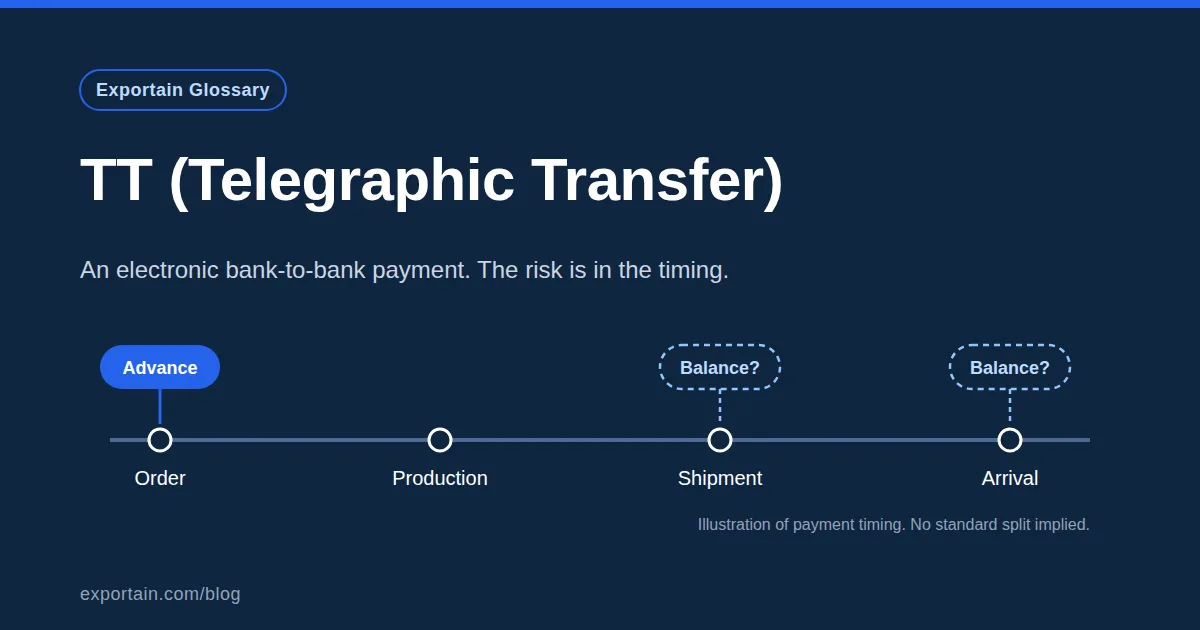
A telegraphic transfer (TT) is an electronic payment from one bank account to another, usually across borders, routed through the SWIFT network or correspondent banks. In a supply contract, TT terms say when the transfers are due: the full amount in advance, or an advance before production or shipment and a balance later, for example against shipping documents. Money paid before shipment puts more risk on the buyer than a letter of credit does.
Published 3 min read
On this page
In practice
Deposit and balance structures
A TT is only the payment method. The commercial risk sits in the timing you agree with the supplier. These are the main ways to structure it:
Structure | When you pay | Who carries more risk |
|---|---|---|
Full advance | Everything before the goods are shipped | You, the buyer |
Advance and balance before shipment | Part at order, the rest before the goods leave | Mostly you |
Advance and balance against documents | Part at order, the rest when the supplier shows shipping documents | Shared |
Balance after arrival | Part up front, the rest after the goods arrive | Mostly the supplier |
For an exporter, cash in advance removes the risk of not being paid1. For a buyer it is the least attractive option. It ties up cash, and you have to trust that the goods will be sent1 2. At the other end of the scale, open account terms, where goods are delivered before payment is due, are among the riskiest options for the exporter2.
A letter of credit sits between these. You pay through the bank only against documents that show the goods were shipped as agreed, but the bank fees and paperwork are heavier2 3. For a first order with a new supplier, weigh the cost of an LC against the size of the advance you would otherwise send by TT.
What happens on the Bangladesh side
Bangladesh Bank's foreign exchange guidelines (2018 edition) say that payment for goods exported from Bangladesh should be received through an authorized dealer bank, in freely convertible foreign currency4. When an exporter receives an advance before shipping, the bank records it with an "Advance Receipt Voucher" declaration. Where part of the invoice was paid in advance, the bank notes this on the export form when it handles the documents for the balance4. The same guidelines also recognize trades where bills are drawn for part of the value and the balance is paid after the goods arrive4.
In practice, your transfer should go to the supplier's own business account at its bank in Bangladesh, in the currency on the proforma invoice.
Before you send a TT
Match the beneficiary details exactly. A wrong name, account number or bank code can get the transfer rejected. The payment is delayed, and the money may come back minus processing fees5.
Expect intermediary banks. Correspondent or intermediary banks may sit between your bank and the supplier's bank5. Ask your bank which charges you pay and which are deducted along the way.
Treat changed bank details as a warning sign. If an email tells you the account has changed, confirm it by phone with a contact you already know before you pay.
Check what Exportain has verified. On a supplier's Exportain profile, a verified "Payment account" line means the business bank account was checked against the supplier's verified company name. See how supplier verification works. Exportain holds money for a goods order only when both parties agree to a funds hold. Otherwise, you pay the supplier directly on the accepted terms6.
Related terms
LC (Letter of Credit): payment by a bank against complying documents.
Pre-shipment inspection: a check worth tying to the balance payment.
How to import from Bangladesh: where payment terms fit in the full order.
Sources
- Cash-in-Advance. International Trade Administration, U.S. Department of Commerce (accessed )
- Methods of Payment. International Trade Administration, U.S. Department of Commerce (accessed )
- Letter of Credit. International Trade Administration, U.S. Department of Commerce (accessed )
- Guidelines for Foreign Exchange Transactions (GFET) 2018, Vol. 1, Chapter 8, Section I: Exports. Bangladesh Bank (accessed )
- Telegraphic Transfer (TT): Meaning, Process & Advantages. DBS Bank India Limited (accessed )
- Buyer protection: What Exportain does to protect buyers. Exportain (accessed )
Reviewed by Naim Islam
About the author
Sourcing from Bangladesh?
Post a request for quotation and suppliers on Exportain can send you their quotes directly.
Post an RFQ