The Ultimate Woven Garments & Denim Sourcing Guide for Bangladesh
A buyer guide to sourcing woven garments and denim from Bangladesh: market data, products and HS headings, supplier verification, MOQ, pricing, lead times, quality checks and duties.
Short answer
Use this woven garments sourcing guide to source woven garments and denim from Bangladesh with confidence in the process: check the latest EPB market data, match jeans, shirts and trousers to the right factory type, verify suppliers in layers, approve fabric and wash samples in writing, and compare MOQ, price and lead time only on the same specification and delivery term.
On this page
Key takeaways
Woven garment exports from Bangladesh reached $4.61 billion in July to September 2026, within garment exports of $10.58 billion, per EPB data.
Most woven apparel sits in HS Chapter 62, with trousers and jeans under headings 6203 and 6204 and shirts under 6205 and 6206.
Fabric drives woven sourcing: its cost, source and approval stage set the MOQ, price and lead time more than sewing capacity does.
There is no single typical MOQ, price or lead time; confirm all three per supplier, per style, in writing, on the same delivery term.
Verify suppliers in layers, approve fabric and wash samples in writing, and inspect packed goods against the approved sample before shipment.
This woven garments sourcing guide is for buyers in the United States, the United Kingdom, the European Union and the United Arab Emirates who want a practical route into Bangladesh's woven apparel supply base. It covers what the country sells, how fabric shapes every order, how to find and verify suppliers, and how minimum order quantity, price and lead time are really set. It states plainly where a figure depends on your product, fabric and destination, and it cuts any number that cannot be checked against a source.
A woven garment is made from fabric woven on a loom, with warp and weft yarns interlaced at right angles, so the cloth has structure and stability and little natural stretch unless elastane is added. Denim is itself a woven fabric, a cotton twill recognised by its diagonal rib. Fabric is usually the largest cost component of a woven garment and often has the longest lead time, so a buyer who understands the fabric decision understands most of the order that follows.
Market overview with latest data
Ready-made garments are the largest part of Bangladesh's export trade, and woven garments are one of its two main halves alongside knitwear. In the first quarter of fiscal 2026-27, covering July to September 2026, ready-made garment exports grew 6.1 percent year on year to $10.58 billion, according to Export Promotion Bureau (EPB) data. Within that total, woven garment exports grew 5.11 percent and knitwear exports grew 6.88 percent during the same quarter.1 A separate EPB release put woven garment exports at $4.61 billion for the quarter and knitwear at $5.96 billion, with total merchandise exports of $13.09 billion, up 6.34 percent year on year.
Destination data in the same release shows where woven programmes are sold. The European Union remained the largest destination, accounting for $4.9 billion, or 46.36 percent of total garment exports, while exports to the United States rose 10.4 percent to $2.22 billion, representing 20.99 percent of the total, and shipments to the United Kingdom grew 5.94 percent to $1.29 billion.1 For your own product, check EPB releases for Bangladeshi totals and destination-level trade data for flows by HS chapter, rather than relying on any single headline number.
Market access shapes the economics behind those figures. As a least developed country, Bangladesh benefits from the European Union's Everything But Arms arrangement, which grants duty-free, quota-free access to the EU for exports of all products except arms and ammunition, and the European Commission records that the EU was Bangladesh's largest trading partner and that textiles accounted for almost 94 percent of EU imports from Bangladesh in 2025.2 That preferential position is tied to least-developed-country status, so buyers planning multi-season programmes should treat the duty position as a live item to confirm for each shipment date, not as a permanent feature of the price.
Three features shape the market for a new buyer. First, scale and experience: factories run high-volume programmes for demanding customers, with teams used to buyer manuals, testing protocols and inspection regimes. Second, product depth in a defined set of woven categories, set out in the next section, which lets a buyer place jeans, shirts and trousers with specialists rather than generalists. Third, fabric supply as the deciding variable: some fabric is woven in Bangladesh and some is imported, and the order plan must allow for the chosen fabric route before cutting can start.
The EPB is the official source of Bangladeshi export statistics. Treat any supplier claim about export volumes or markets served that cannot be checked against a register, a document or a shipment record as unproven.
Main products and production clusters
The woven range concentrates where volume, skill and fabric supply meet. Core products are denim jeans for men, women and children, in basic five-pocket styles as well as fashion fits; denim jackets, shorts and skirts; woven shirts and blouses, from basic oxford and poplin shirts to checked and printed casual shirts; trousers, chinos and cargo pants; shorts and bermudas; dresses and skirts; light jackets and outerwear; school uniforms and workwear; and woven loungewear and nightwear.
Most finished woven apparel is classified in HS Chapter 62, which the World Customs Organization titles "Articles of apparel and clothing accessories, not knitted or crocheted". Within that chapter, heading 6203 covers men's or boys' suits, ensembles, jackets, trousers, breeches and shorts, heading 6204 covers the corresponding women's or girls' garments including dresses and skirts, heading 6205 covers men's or boys' shirts, and heading 6206 covers women's or girls' blouses, shirts and shirt-blouses.3 Treat those headings as a starting point only. Fibre content, gender, age and construction can move an item between headings, and the heading decides duty treatment, so confirm the exact classification with your customs broker before you price an order. The guide to the HS code explains how the system is built.
Products cluster into recognisable groups, and each group has its own buying risks. The denim cluster covers jeans, jackets and shorts, where the wash gives the garment its character: rinse and stone washes, enzyme treatments, whiskering, laser and ozone processes, tinting and distressing. The shirting cluster covers shirts and blouses, where fabric hand feel, collar construction and pattern matching decide quality. The bottoms cluster covers trousers, chinos and shorts outside denim, where waistband construction, pocketing and pressing carry the risk. The dresses, outerwear and workwear clusters add lining, interlining and, for workwear, fabric performance requirements. When you evaluate a supplier, match the factory to the cluster your product sits in, because the machines, fabric routes and quality risks differ by group.
A finished jean shows why the cluster approach matters. It passes through weaving, cutting, sewing, washing and finishing, and the wash stage sits after sewing, so a jean that sews correctly can still fail if the wash shade drifts between lots. When you evaluate a denim supplier, you are evaluating the laundry as much as the sewing lines. Ask which washes are done in-house, see wash standards and approved samples, and agree the acceptable shade range in writing before bulk production starts.
Factories also fall into recognisable types. Large, vertically integrated groups may weave, dye, cut, sew, wash and pack in-house, and they suit big, repeat programmes. Specialist factories focus on a narrower range, such as shirts only, bottoms only or denim only. Smaller units take simpler products and smaller runs, with less in-house compliance infrastructure. Buying houses and agents coordinate sampling, follow-up and inspection for a commission, which can be useful on a first order. Match the factory type to your product, volume and compliance requirements.
How to find and verify suppliers
Start from your specification, not from a supplier list. A woven enquiry that states the product, fabric composition and weight, weave and finish, wash or colour standard for denim, sizes and measurements, quantities per colour and size, labelling and packing requirements, destination and delivery window will receive meaningful replies. A request for the best price for jeans will not, because no two suppliers will price the same garment. The guide to how to write an RFQ lists the fields a complete inquiry needs.
Build a longlist from several channels: association member information, trade data showing which exporters ship your category to your market, referrals, and curated marketplaces. The Bangladesh Garment Manufacturers and Exporters Association (BGMEA) operates an online Membership Management System through which garment factories apply for membership and registered member factories can generate an e-certificate of membership.4 Membership is a first reference point for identity checks; it does not replace your own verification. On Exportain you can review the suppliers directory and post one structured request that suppliers answer against the same specification, which makes their answers comparable. The article on the woven garments industry in Bangladesh gives further background on the sector, and finding suppliers in Bangladesh sets out the wider search process.
Verification works in layers. The first layer is identity and status: confirm the business is a real, operating exporter, check association membership and export registration, and confirm the factory address is where your goods would be made. The ERC certificate guide explains the Export Registration Certificate that Bangladeshi exporters hold. The second layer is trading reality: a genuine exporter can discuss past programmes in specific terms, the markets it ships to and the product types it runs every week. The third layer is capability: ask what is done in-house, covering fabric sourcing, pattern and grading, cutting, sewing, washing and laundry for denim, finishing and packing, and what is subcontracted, because subcontracted steps are where control is most often lost. The fourth layer is compliance: request current audit reports and certificates directly, then check each document's scope, site address and expiry date.
Sampling is the fifth layer, and for woven garments it carries extra weight because fabric and wash cannot be judged from a photograph. Order samples made to your specification in the intended fabric, or the closest available quality with the difference stated in writing. For denim, require a wash sample or leg panel in the target wash before bulk, and approve the shade range in writing. Check measurements against your size chart, check shrinkage results from fabric testing, examine stitching, seam allowances, button and rivet attachment, zip quality and pressing, and confirm labelling and packing on a pre-production sample packed exactly as bulk will be packed. Approve or reject in writing. The approved sample, the wash standard and the written specification together become the production reference an inspector will later compare bulk against, as the guide to pre-shipment inspection sets out.
Finally, protect the transaction. Agree everything in a written purchase order: specification, fabric and wash standard, quantity and tolerance, price and delivery term, delivery window, testing and inspection requirements and payment terms. Treat pressure to pay into an unrelated personal account, or refusal to share basic registration or audit documents, as reasons to walk away.
MOQ, pricing and lead times
Buyers regularly ask for the typical minimum order quantity, price and lead time, and the accurate answer is that there is no single industry standard for any of the three. What can be explained clearly is what drives each number, so you can judge quotations and compare suppliers on an identical basis. The MOQ guide explains how minimums are set and quoted.
What sets the minimum order quantity?
Minimum order quantity is set by the economics of a specific style. Fabric is the biggest driver: a mill supplies fabric in minimum quantities and dye lots, and fabric made to order sets a higher floor than stock fabric a factory already holds. Denim adds the wash: a wash developed for one style has setup and approval costs that very small orders cannot absorb sensibly. Construction matters too, since a basic five-pocket jean is simpler than a multi-panel fashion trouser with several trims. MOQ may be quoted per style, per colour or wash, or per size ratio, and those bases produce very different totals, so always ask which basis applies. Smaller and specialist factories generally allow more flexibility, while large programme factories need larger commitments. The only MOQ that matters is the one your shortlisted suppliers quote for your exact specification, confirmed in writing.
What does the price consist of?
The main cost components are fabric, trims such as buttons, rivets, zips, labels and thread, cutting and sewing labour, washing and finishing for denim, testing, inspection, packing, and the logistics and duty position created by your delivery term and destination. Fabric is usually the largest component, which is why two quotations for what sounds like the same jean can differ widely: fabric weight, composition, source mill and finish may be completely different. A useful quotation names the fabric specification it is priced on, states what is included and excluded, and identifies the delivery term precisely.
Delivery terms decide who pays for which leg, so quotations on different terms are not comparable until you adjust them. The International Chamber of Commerce Incoterms rules are a set of eleven three-letter trade terms that clarify the tasks, costs and risks involved in delivering goods from sellers to buyers, and Incoterms 2020 entered into force on 1 January 2020.5 Compare EXW, FOB and CIF only after adding the missing legs, as the guide to landed cost for imports from Bangladesh sets out.
For scale only, consider this worked comparison. Example figures: two factories quote for the same five-pocket jean, one at $6.20 per piece EXW and one at $6.85 per piece FOB. Adding inland transport, export handling and loading of $0.58 per piece to the EXW quote gives a like-for-like FOB cost of $6.78 per piece, so the real gap is $0.07 per piece, not $0.65. The decision now rests on fabric, wash quality and inspection results rather than on a gap that never existed.
How long does an order take?
Lead time is best understood as a chain, not a single number. The chain runs fabric production or import and fabric approval, trim sourcing, sample and wash approval, cutting, sewing, washing and finishing, inspection, packing and shipment. The fabric stage is frequently the longest, especially where fabric is imported or woven to order, and no sewing capacity can recover time lost before fabric arrives and passes inspection. Wash approval for denim sits inside that chain as its own gate. Seasonal capacity also matters: factories serving large retail programmes fill lines well ahead of peak shipping windows. Build your plan backwards from your required delivery date, put each approval gate in writing with dates, and ask each supplier to quote lead time stage by stage.
Quality, certifications and compliance
Quality is agreed before production, tested during it and verified at the end. Agree the specification in measurable terms: fabric composition and weight with tolerances, shrinkage limits, colourfastness requirements, measurement charts with tolerances, stitch density and seam construction, and for denim the approved wash standard with an acceptable shade range. Require fabric testing before cutting, because a fabric fault discovered after cutting is a production problem, while the same fault at fabric inspection is a manageable delay. During production, inline checks catch measurement drift, wash shade drift and trim errors while they can still be corrected.
A final inspection before shipment, run to a sampling standard named in the purchase order, compares finished, packed goods against the approved sample and specification. ISO 2859-1 is the international standard for sampling procedures for inspection by attributes, and it uses the acceptance quality limit (AQL) to determine sample sizes and acceptance and rejection thresholds for a lot.6 See AQL for how buyers set those limits in practice, and record the agreed AQL values for critical, major and minor defects in the purchase order itself, not in a side message.
Certifications and audits matter only when you check what each one covers. A social audit report covers conditions at a named site at a point in time. A management-system certificate covers the system and site named in its scope. Product and material claims need their own evidence. The Global Organic Textile Standard (GOTS) is a certification for textiles made with organic fibres, and to label a product as GOTS-certified every company involved in its production must be certified by an approved independent certification body, with annual on-site audits and transaction-based verification across the supply chain.7 OEKO-TEX STANDARD 100 is a label for textiles tested for harmful substances, covering textile safety from yarn to finished product, where every item bearing the label is certified as having passed safety tests for the presence of harmful substances.8 A building rating, where held, describes the building, not the garment. Always request the certificate itself, check the number, certified site, product scope and expiry date, and verify it in the scheme owner's register where one exists. If a claim will appear on your product, packaging or marketing, the chain-of-custody paperwork has to follow the actual production lot, so agree it before production starts.
Compliance also includes destination-market product rules. In the European Union, Regulation (EU) No 1007/2011 sets the rules on textile fibre names and the related labelling and marking of fibre composition, with the aim of providing accurate information to consumers.9 Requirements also differ in the United States, the United Kingdom and the United Arab Emirates, especially for children's clothing, where additional safety rules on items such as drawcords can apply. Choosing the correct standard is your responsibility, supported by your testing laboratory and customs broker, so build testing into the timeline and budget from the start. A well-made but wrongly labelled garment is not saleable in the market it was made for.
Shipping, Incoterms and duties
Woven garments and denim are bulky relative to their value, so most programmes move by sea, with air freight used for urgent, small or high-value shipments, launch dates and problem-solving rather than as a default. Transit time depends on destination, routing and whether the service is direct or transshipped, so take the transit estimate for your specific lane from your freight forwarder in writing and build customs clearance and inland delivery on top of it. Order timing should work backwards from your selling season, allowing for the full production chain plus the shipping leg and a realistic buffer.
Incoterms decide who arranges and pays for each part of that journey and where risk passes, so name the term and place precisely in the purchase order. Under FOB, the seller delivers goods on board the vessel at the named port and the buyer arranges main carriage. Under CIF, the seller also arranges carriage and insurance to the named destination port, while risk still passes when goods are on board at origin. Under EXW, the buyer takes on almost everything from the factory gate. The ICC summarises the Incoterms rules as clarifying the tasks, costs and risks involved in the delivery of goods from sellers to buyers.5 The right choice depends on your freight rates, forwarder network and how much control you want. What matters is that price comparisons use the same term, and that insurance, where the buyer arranges it, is in place for the full journey. For the full sequence, read the guide on how to import from Bangladesh alongside this guide.
Duty is where classification and origin meet money. Your product's HS classification sets the duty rate in your destination market, and preferential schemes can reduce or remove duty where goods qualify under the relevant rules of origin and you hold the correct documentation. Bangladesh's access to the EU under Everything But Arms is the clearest current example: the arrangement grants duty-free, quota-free access for all products except arms and ammunition while Bangladesh holds least-developed-country status.2 The position in every market is subject to change as trade policy and the graduation transition develop. For that reason this guide states no duty rate for any product: a rate copied from a general guide can be wrong for your heading, market and shipment date. Confirm the current rate and the origin requirements with your customs broker and your government's official tariff service before you confirm the order.
Build landed cost in full: goods price on the agreed delivery term, freight and insurance where they fall to you, duty, port and clearance charges, destination inland transport, and testing and inspection costs.
Step-by-step buying process
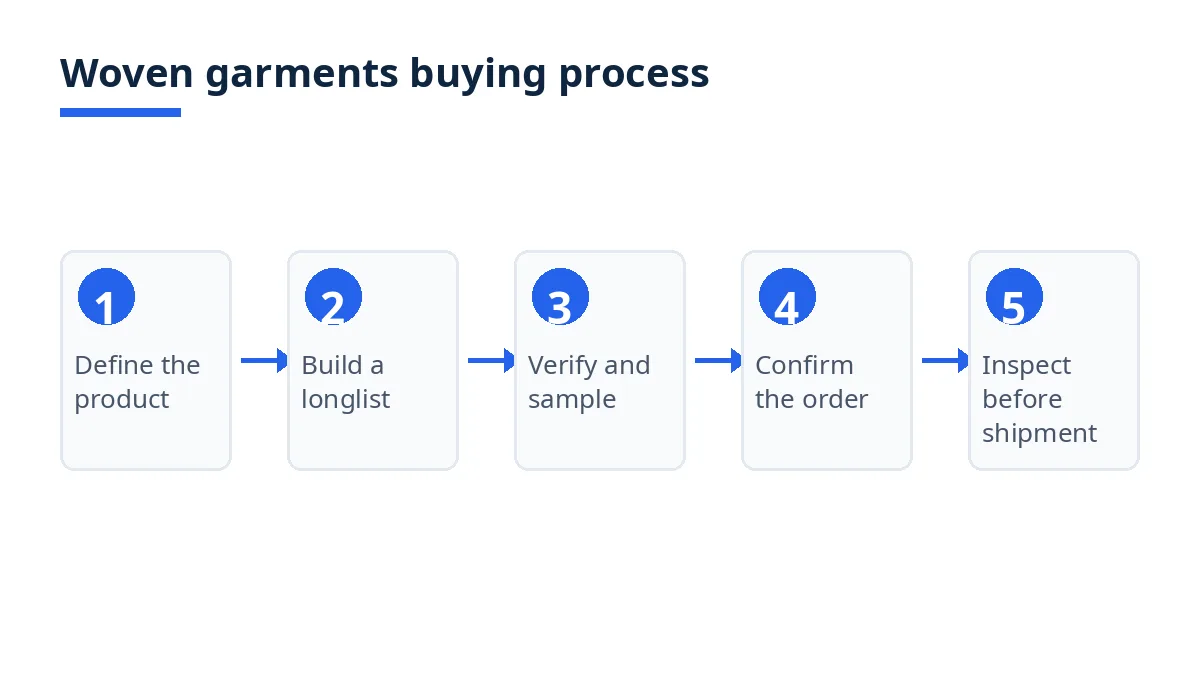
Define the product precisely: garment type, fabric composition, weight and finish, wash and colour standards for denim, size range and measurement chart, quantities per colour, wash and size, labelling, packing, destination and target delivery date.
Build a longlist and send every candidate the identical specification, so quotations can be compared on the same basis.
Verify the shortlist in layers: identity and association status, trading history, in-house capability including laundry for denim, and current audit and certificate documents checked at source.
Sample properly: specification samples in the intended fabric, wash standards or leg panels for denim, shrinkage and fabric test results, and a packed pre-production sample, each approved or rejected in writing.
Confirm commercial terms in a written purchase order: specification, fabric and wash details, price and delivery term, quantity and tolerance, testing and inspection requirements, delivery window and payment terms.
Manage production actively: confirm fabric arrival, wash approval, production start and inspection booking against the dates in the purchase order.
Inspect finished goods against the approved sample before shipment, and release shipment only when documents match the goods.
Ship and clear: confirm transport documents, origin documentation and customs entry details with your broker.
Review the order after delivery: fit, wash feedback and defect patterns are the raw material of a better second order.
Related guides
Keep your market picture current with Exportain's trade intelligence resources and the Bangladesh export data summaries, browse the suppliers directory by product category, and work through the import sequence in the guide on how to import from Bangladesh. Buyers comparing woven with knit programmes should also read the knitwear sourcing guide, and the BGMEA and BKMEA explainer explains the two associations before you rely on an association claim.
FAQs
Is Bangladesh a good place to source woven garments and denim?
Yes, for buyers whose products match the country's strengths. Bangladesh has a large, established woven export base: woven garment exports reached $4.61 billion in July to September 2026 alone, within total garment exports of $10.58 billion for the quarter, per EPB data.1 The fit is strongest for volume woven programmes such as jeans, trousers, shirts, shorts and workwear. The result still depends on matching your product to the right factory, verifying that factory properly and managing fabric and wash approvals carefully.
What is the typical MOQ?
There is no single typical MOQ for woven garments or denim in Bangladesh, because MOQ is set style by style. Fabric minimums and dye lots, wash setup and approval for denim, construction complexity and the factory's size and programme mix all move the figure, and suppliers may quote it per style, per colour or wash, or per size ratio. Smaller and specialist factories are generally more flexible, while large programme factories need larger commitments. Ask each shortlisted supplier to quote the MOQ for your exact specification, state the basis it is quoted on, and confirm it in writing before you rely on it.
How long is the lead time?
Lead time is a chain rather than a single number, and in woven sourcing the fabric stage is often the longest part of it. Fabric production or import and approval, trim sourcing, sampling and wash approval, cutting, sewing, washing and finishing, inspection, packing and then international transit each add time, and imported or made-to-order fabric extends the front of that chain. Seasonal factory loading also affects what is achievable. Ask each supplier to quote lead time stage by stage against your delivery date, agree approval gate dates in writing, and confirm the transit estimate for your specific shipping lane with your freight forwarder.
Which certifications matter?
The certifications that matter are the ones that evidence a claim you or your customer actually need. Social and environmental audit reports address conditions at a named factory site. Material standards such as GOTS address organic fibre content and chain of custody across the production chain, with every company in that chain certified by an approved body.7 OEKO-TEX STANDARD 100 addresses testing of the textile itself for harmful substances, from yarn to finished product.8 Destination-market labelling and product-safety rules apply on top of any voluntary standard. Whatever a supplier offers, request the document itself and check its number, site, product scope and expiry in the scheme owner's register before you rely on it or repeat its claim.
Next steps on Exportain
Browse Bangladeshi suppliers by product category and note the factories whose woven range matches your specification, then read the how to buy guide before you send your first inquiry. When your specification is ready, post an RFQ so suppliers reply against the same requirements, and use the trade intelligence resources to keep your market and duty picture current while you negotiate.
Sources
- RMG exports grow 6.1% in Q1. The Business Standard, (accessed )
- EU trade relations with Bangladesh. European Commission, (accessed )
- Harmonized System, Chapter 62: Articles of apparel and clothing accessories, not knitted or crocheted. World Customs Organization (accessed )
- BGMEA launches Membership Management System to provide faster and simpler services. BGMEA (accessed )
- Incoterms® rules. International Chamber of Commerce (ICC) (accessed )
- ISO 2859-1:2026 - Sampling procedures for inspection by attributes — Part 1: Sampling schemes indexed by acceptance quality limit (AQL) for lot-by-lot inspection. International Organization for Standardization (accessed )
- GOTS – How the system works. Global Standards, (accessed )
- OEKO-TEX - for more sustainability in the textile and leather industry. OEKO-TEX (accessed )
- Regulation (EU) No 1007/2011 on textile fibre names and related labelling and marking of the fibre composition of textile products. European Union, (accessed )
About the author
Sourcing from Bangladesh?
Post a request for quotation and suppliers on Exportain can send you their quotes directly.
Post an RFQ