The Ultimate Knitwear & T-Shirts Sourcing Guide for Bangladesh
Knitwear earned US$21.15 billion in FY2024-25. This pillar guide covers products and clusters, supplier verification, MOQ, pricing, quality, certifications, Incoterms, duties and a step-by-step buying process for buyers sourcing from Bangladesh.
Short answer
A knitwear sourcing guide for Bangladesh helps buyers source T-shirts, polo shirts and other knitted garments in stages: specify the fabric and garment in writing, verify the factory and its certificates, compare quotes on the same specification and Incoterm, approve a pre-production sample, inspect before shipment, and confirm classification and duty in the official tariff source for the destination market before pricing the order.
On this page
Key takeaways
Knitwear exports were US$21.15 billion in fiscal year 2024-25, ahead of woven garments at US$18.18 billion, according to EPB data.
Production addresses cluster in Dhaka, Gazipur, Narayanganj and Chattogram, and BKMEA represents approximately 2,540 knitwear member factories.
There is no single MOQ, price or lead time in knitwear; all three are set per factory against a written fabric and garment specification.
Verify every certificate by number, site, scope and validity in the scheme owner's register, and confirm duty in your destination's official tariff source.
This knitwear sourcing guide is for buyers who want to source T-shirts, polo shirts and other knitted garments from Bangladesh in a controlled, staged way. It covers the market, products and clusters, supplier verification, minimum order quantity (MOQ), pricing and lead times, quality and compliance, shipping and duties, and a step-by-step buying process.
Knitwear is a fabric-first product. Yarn, knit structure, fabric weight, dyeing and finishing shape the finished garment, and small differences show up in fit, hand feel, shrinkage, color consistency and returns. Buyers who specify the fabric as carefully as the style, verify the supplier, and manage production in stages reduce most of that risk before bulk starts.
Market overview with latest data
Readymade garments account for most of Bangladesh's export earnings. In fiscal year 2024-25, merchandise exports were US$48.28 billion, readymade garments earned US$39.34 billion and accounted for 81.49 percent of the total, and knitwear exports rose 9.73 percent to US$21.15 billion, ahead of woven garments at US$18.18 billion, according to Export Promotion Bureau (EPB) data reported by The Financial Express.1 Knitwear is therefore not a side line in Bangladesh. It is the larger of the two garment branches and a routine, high-volume export business.
The sector has its own trade body. The Bangladesh Knitwear Manufacturers and Exporters Association (BKMEA) represents the knitwear sector, was established in 1996, and currently represents approximately 2,540 knitwear member factories.2 The Bangladesh Garment Manufacturers and Exporters Association (BGMEA) covers garment manufacturers and exporters more broadly. For background on both bodies, see BGMEA and BKMEA. Association membership is a useful starting point for a supplier longlist, but membership alone does not prove that a factory fits your product, so treat directories as research tools, not as approval.
Market figures move with demand, yarn prices, energy costs, exchange rates and retail buying patterns. When a figure matters, check the current EPB release and product-level trade data by HS code and destination, rather than an older article or a supplier brochure.
Main products and production clusters
What products do Bangladeshi knitwear factories make?
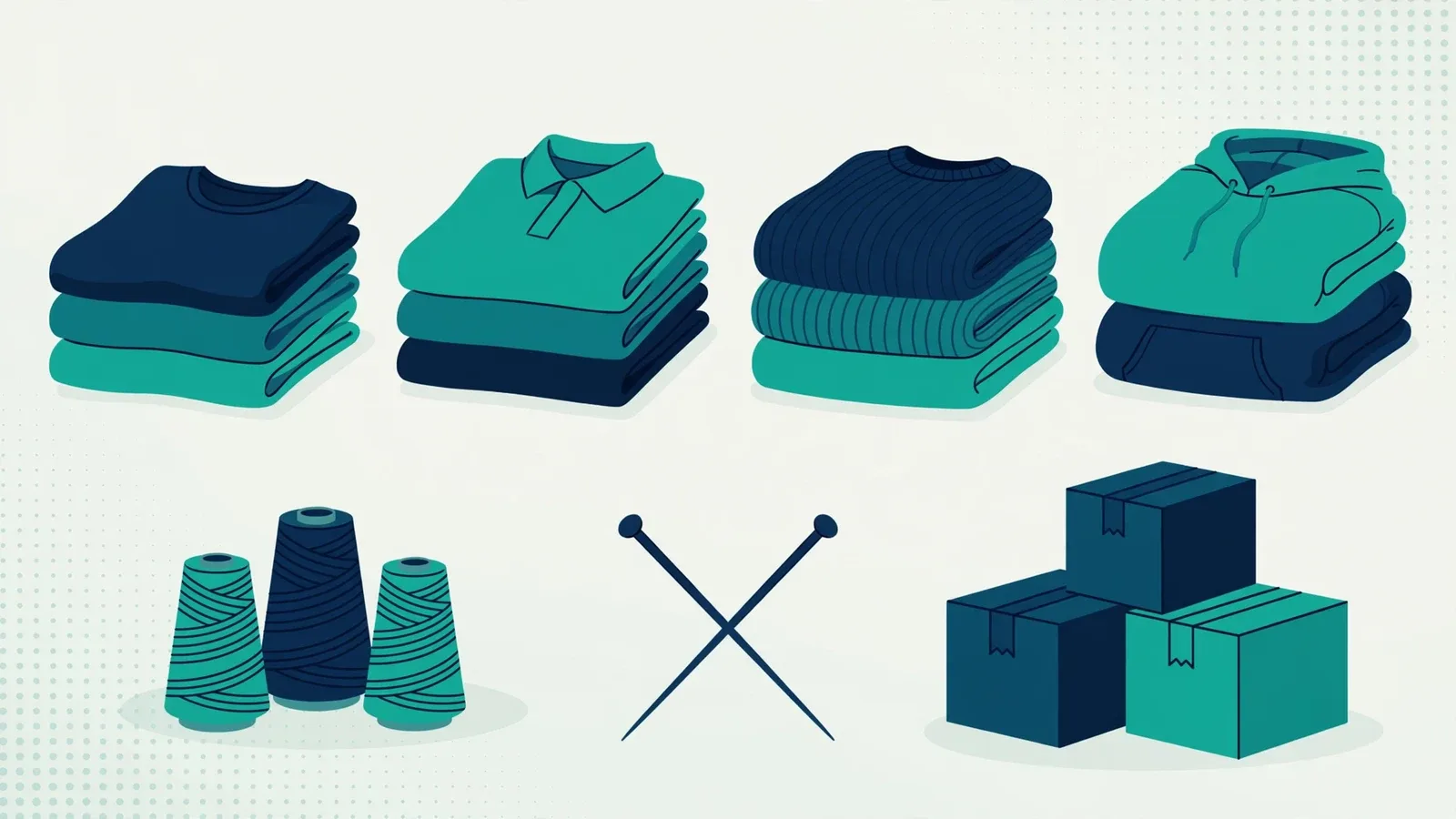
The core range buyers source from Bangladesh includes:
Cotton and cotton-blend T-shirts in single jersey, in crew-neck and V-neck styles, for retail, wholesale, workwear and promotional programs
Polo shirts in pique knit
Sweatshirts, hoodies and jogging bottoms in fleece and loopback fabrics
Knitted tops, dresses and children's garments in jersey, interlock, rib and slub constructions
Sweaters, pullovers and cardigans made by factories that specialize in flat knitting rather than circular-knit jersey
Circular-knit and flat-knit production use different machinery and skills. A factory that is strong in high-volume jersey basics may not be the right factory for sweaters, and a sweater specialist is not a substitute for a jersey factory. Match the factory's actual product specialization to your range before you discuss price.
Why does the fabric specification matter more than the style name?
Two T-shirts that look similar in a photograph can differ in fiber content, yarn count, knit structure, fabric weight, dyeing route and finishing, and they will wash, wear and cost differently. Your specification should therefore state fiber composition, fabric type, fabric weight in grams per square meter (GSM), color references, size range and measurements, construction details, trims, printing or embroidery, labeling and packing.
Fabric weight deserves separate attention. Lighter jersey suits summer basics and promotional garments; heavier jersey, interlock and fleece suit premium basics and workwear. State the GSM and tolerance, request a sample in production fabric, and weigh and wash it. Shrinkage, twisting, pilling and color fastness are cheaper to catch at sample stage than after bulk production.
Where is production concentrated?
A mapping of export-oriented garment factories found 3,485 units in total, with 1,351 in Dhaka, 1,057 in Gazipur, 615 in Narayanganj and 386 in Chattogram, with the rest in other parts of the country.3 Buyers will meet these locations repeatedly in supplier addresses. Greater Dhaka is the commercial center, with factory groups, liaison offices, testing laboratories and service providers. Gazipur, north of Dhaka, holds a dense concentration of large factories. Narayanganj, south-east of the capital, is a historic center of the knitwear industry, with knitting and dyeing capacity. Chattogram is the port city, with further garment production close to the seaport.
A factory inside a strong cluster usually has nearby access to yarn suppliers, dye houses, printing and embroidery units, trims suppliers, laboratories and freight forwarders, which supports faster sampling. Cluster location is context only. It does not replace factory-level verification.
How to find and verify suppliers
How should you build a supplier longlist?
Define the product and the specification first. Then build a longlist from sources you can check: the member directories of BGMEA and BKMEA, B2B sourcing platforms, trade fairs and referrals from buyers with similar products. On Exportain, you can browse suppliers by product category through the suppliers directory and read how badges are awarded in how supplier verification works on Exportain. On Exportain, verification badges are based on reviews of documents and photos. They are not factory inspections or guarantees, so keep your own checks in place even when a profile carries a badge.
What should you verify before you order samples?
Verify each candidate in four layers.
Identity and export standing. Full legal name, factory address, trade license and association membership, and whether the business is a manufacturer, a buying house or a trading intermediary. Intermediaries can add value, but you should always know which factory will actually produce your order. An Export Registration Certificate (ERC) is part of the export standing picture for a Bangladeshi exporter; see ERC — Export Registration Certificate.
Capability. Product specialization, machinery and processes, whether knitting and dyeing are in-house, typical order sizes and main export markets, read against your specification rather than against a general brochure.
Compliance evidence. Audit reports and certificates relevant to your market and product, checked directly. Verify the certificate number in the scheme owner's register, check that the scope covers the factory address and the product type, and confirm the validity dates cover your production period.
Communication and sampling behavior. A serious supplier answers specification questions in detail, raises problems early and quotes against the full specification rather than against a photograph. Sampling behavior predicts how a factory performs under production pressure.
Send the same specification and tech pack to each shortlisted factory, ask each one to quote on the identical basis, and order samples from the strongest two or three. Assess samples against a written checklist covering fabric, measurements, construction, color, trims and wash performance, and record every change requested.
Agree payment terms that keep your exposure staged. Options buyers discuss with their bank include a deposit with the balance against inspection and shipment documents, or a letter of credit where the order size makes it appropriate; see LC — Letter of Credit and TT — Telegraphic Transfer. Record the specification, quantities, price and Incoterm, delivery date, packing and inspection arrangements in a written purchase order or proforma invoice. For a first order, a trial quantity and an independent inspection are proportionate safeguards.
MOQ, pricing and lead times
MOQ, price and lead time have no single standard answer in knitwear. Each one is an outcome of your specification meeting a particular factory's setup. A figure quoted without a specification is an indication only.
What sets the MOQ for knitwear?
Minimum order quantities arise from the fabric and production chain. Yarn must be bought or drawn from stock, fabric must be knitted and dyed in economic batch sizes, and a sewing line must be set up for a style. Quantities are therefore commonly structured per style, per color and sometimes per fabric.
Factories with stock fabrics may accommodate smaller orders in standard fabrics and colors. A custom-dyed color, a special yarn or a certified fiber program will usually need quantities that justify producing the fabric. Ask: "For this specification, in these colors and sizes, what quantity structure do you need, and what would make a smaller order possible?" The answer often contains options, such as fewer colors or a stock fabric, that a headline figure hides.
Factor | Effect on MOQ, price and lead time |
|---|---|
Stock fabric vs custom fabric | Stock fabric can lower MOQ and shorten the fabric stage; custom fabric raises both |
Number of colors and sizes | More colors per style raise dyeing and changeover work per unit |
Fiber and certification program | Certified fiber needs certified supply and chain-of-custody documents |
Printing, embroidery or special finishing | Adds a process stage, a sampling round and a failure point to manage |
Order quantity | Larger quantities spread setup costs over more units |
Factory loading at order date | A busy line can extend the production stage even when fabric is ready |
How is a knitwear price built?
A knitwear price is built from yarn and fabric cost, dyeing and finishing, trims, printing or embroidery, cutting and sewing, washing or treatments where used, testing, packing, and overhead and margin, adjusted for quantity and delivery term. Yarn price movements feed into quotations, which is why quotes carry validity periods.
Give every factory the identical specification, quantity breakdown and delivery term, and ask what each quote includes and excludes. A lower quote that assumes a lighter fabric or fewer checks is a quote for a different product. Cost the whole transaction: samples, testing, inspection, freight, insurance, duties and financing belong in the landed cost.
Example figures. A buyer comparing two quotes for the same T-shirt specification might lay the quotes out like this. The numbers below are illustrative only, not market rates.
Cost line | Quote A | Quote B |
|---|---|---|
Garment price, FOB, per piece | USD 3.10 | USD 2.85 |
Fabric weight priced | 180 GSM | 160 GSM |
Testing included | Yes | No |
Pre-shipment inspection included | No | No |
Quote B is cheaper per piece and more expensive per order once the lighter fabric, separately billed testing and the buyer's inspection cost are added, and it prices a different garment. Compare on specification and total cost, not on the headline price.
What makes up the lead time?
Lead time is a chain: inquiry and costing, sample approval, yarn and fabric production or procurement, dyeing and finishing, trims, cutting and sewing, finishing and packing, inspection, and shipment booking. The clock starts when the order and any advance payment are confirmed and the approved sample is signed off, not when the first inquiry was sent.
Fabric production and dyeing are often the longest stages, in particular for custom colors. Repeat orders in standard fabrics, with an approved sample already held, can move faster. Build your calendar backwards from the delivery date, ask for a stage-by-stage plan with dates, and manage progress against it.
Quality, certifications and compliance
Where do knitwear quality problems start?
Quality in knitwear is usually decided in the fabric. Defects that drive returns, such as shrinkage, spirality or twisting of side seams, color variation, pilling, holes and knitting faults, and measurement drift, usually originate in yarn choice, knitting, dyeing, finishing or cutting rather than in the final sewing stage.
A sound quality plan checks the product at several points:
Fabric inspection and testing before cutting
Approval of a pre-production sample made in bulk fabric
In-line checks during sewing
An audit of finished garments against the approved sample
A final pre-shipment inspection against the order specification, using an agreed sampling method such as AQL; see AQL — Acceptance Quality Limit and pre-shipment inspection
Testing should match your product and market. Buyers commonly test or require evidence on fiber composition, fabric weight, dimensional stability, color fastness, pilling resistance and restricted substances, using accredited laboratories. Children's garments attract additional safety requirements in many markets. Define the test set before production, write it into the order, and require the factory to meet it on bulk fabric, not only on a sample.
Which certifications matter?
A certificate belongs to a specific legal entity, site, scope and validity period. It is not a general badge for a company's marketing, and it does not transfer automatically to a different factory or product.
For organic fiber claims, the Global Organic Textile Standard (GOTS) is a certification for textiles made with organic fibers that combines environmental and human rights requirements with independent certification across the textile processing supply chain, and GOTS certification covers every step from fiber processing and spinning to wet processing, manufacturing and trading.4 To label a product as GOTS-certified, all companies involved in its production must be certified by approved independent certification bodies, and GOTS requires annual on-site audits of certified facilities.4
For harmful-substance testing of the finished textile, OEKO-TEX Standard 100 is a label for textiles tested for harmful substances, covering textile safety from yarn to finished product, and every item bearing the label is certified as having passed safety tests for the presence of harmful substances.5
Buyers also ask about organic and recycled content schemes, and about social and workplace audit evidence. Building and fire safety documentation is a standard part of factory due diligence in Bangladesh. Verify each document the same way: check the number and scope in the scheme's public register, confirm the factory address matches the production site, and confirm validity for the production period. If a claim will appear on your labels, the chain of custody must support it through the whole order.
Compliance also extends to destination rules: fiber-content and care labeling, country-of-origin marking, product safety law and chemical restrictions in your market. These duties are usually the importer's legal responsibility and cannot be delegated to the factory, which manufactures to your specification and supplies test evidence. Buyers new to importing should work through the sequence once with professional support. How to import from Bangladesh gives the importing overview that sits alongside this guide, and sustainable knitwear in Bangladesh covers certified and lower-impact knitwear programs in more depth.
Shipping, Incoterms and duties
How should you plan shipping from Bangladesh?
Plan sea freight as a chain: booking, container loading, export clearance, vessel schedules, transhipment where it applies, destination clearance and onward delivery all sit between the factory's ex-factory date and arrival at your warehouse. Build a realistic door-to-door range for your destination, not the shortest quoted transit, into your delivery plan. Air freight is normally reserved for urgent or sample-volume shipments.
Carton packing matters commercially. Knitwear is light but bulky, so carton dimensions, units per carton and assortment packing affect freight cost per garment. Agree and cost the packing at order stage. Check draft documents against your purchase order before the vessel sails, because corrections after shipment are slower.
What do FOB, CIF and EXW mean for a knitwear order?
Incoterms allocate tasks, costs and risks between seller and buyer. The Incoterms rules are a set of eleven three-letter trade terms first published by the International Chamber of Commerce (ICC) in 1936, and the Incoterms 2020 edition entered into force on 1 January 2020.6 The ICC describes the rules as clarifying the tasks, costs and risks involved in the delivery of goods from sellers to buyers.6 Name the term, the named place or port, and the edition in the contract, for example "FOB Chattogram, Incoterms 2020".
Term | What the seller does | What the buyer does |
|---|---|---|
EXW (Ex Works) | Makes the goods available at the named place, usually the factory | Arranges and pays for loading, transport, export clearance, freight and import formalities |
FOB (Free On Board) | Delivers the goods on board the vessel at the named port of shipment | Arranges and pays for the main carriage and insurance from that point |
CIF (Cost, Insurance and Freight) | Delivers the goods on board, and pays freight and minimum insurance to the named destination port | Arranges destination clearance, duties and onward delivery |
Under EXW, the buyer takes responsibility from the factory gate, including export formalities, which suits only buyers with local arrangements. Under CIF, risk still passes on board at shipment, even though the seller pays freight and insurance to the destination port. See Incoterms for shipments from Bangladesh for the full treatment. An FOB price and an EXW price for the same garment are prices for different scopes of work.
How are duties decided, and where do you check them?
Duties start with classification. The Harmonized System (HS) is a multipurpose international product nomenclature developed by the World Customs Organization (WCO), used by more than 200 countries and economies as a basis for their customs tariffs and for the collection of international trade statistics.7 In the HS, Chapter 61 covers articles of apparel and clothing accessories, knitted or crocheted.8 The heading inside Chapter 61 is set by garment type, fiber and construction. Classification, origin status under the destination's rules of origin, and the trade arrangement in force on arrival together set the duty.
Preferential access can change the rate. The European Union's Everything But Arms scheme grants duty-free and quota-free access for almost all products, except arms and ammunition, to least developed countries, and the scheme is regulated by Regulation (EU) No 978/2012.9 In the United Kingdom, the Developing Countries Trading Scheme (DCTS) means Bangladesh will retain duty-free access for 98 percent of exports, including readymade garments, according to the UK government.10 Other markets apply their own tariff treatment, and arrangements change over time, including as Bangladesh's least developed country status changes.
Do not price an order from an article, including this one. Confirm the classification and current rate in the official tariff source for your destination, and confirm the result with your customs broker. Then build the duty, plus freight, insurance, clearance and delivery, into your landed cost.
Step-by-step buying process
Each step below produces a document or a decision that the next step depends on.
Define the product. Write the full specification: garment type, fabric composition, construction and GSM, colors, size range and measurement chart, trims, printing or embroidery artwork, labels, hangtags and packing.
Research the market. Check trade context in EPB releases and product-level trade data, confirm your market's duty and compliance framework in its official tariff source, and build a target landed cost.
Build a supplier longlist. Use association directories, sourcing platforms and referrals to find factories whose specialization matches your product. Find suppliers in Bangladesh sets out the discovery options.
Verify the shortlist. Confirm legal identity, factory address, association membership and exporter standing, review capability against your specification, verify certificates in the issuing registers, and establish who will actually manufacture the order.
Request comparable quotations. Send the identical specification, quantity breakdown and delivery term to each factory, and ask what each quote includes and excludes. A clear request gets comparable answers; see how to write an RFQ.
Order and assess samples. Assess samples against a written checklist covering fabric, measurements, construction, color, trims and wash performance, and record every change requested.
Approve the pre-production standard. Require a pre-production sample in bulk fabric and materials, approve it in writing, and keep a sealed reference sample.
Place the order in writing. Issue a purchase order or confirm a proforma invoice covering specification, quantities, price and Incoterm, delivery date, packing, labeling, testing, inspection and payment terms.
Monitor production by stages. Agree a stage plan covering fabric, dyeing, cutting, sewing, finishing and packing, and check progress against it in writing.
Inspect before shipment. Arrange an independent pre-shipment inspection against the approved sample and the specification, and agree in advance what happens if the goods fail.
Check documents and ship. Verify the invoice, packing list, bill of lading and origin documentation against the order, pay strictly per the agreed terms, and clear the goods through your broker.
Common mistakes
Specifying the style and not the fabric. Fiber, knit structure, GSM, dyeing and finishing decide how the garment washes and wears. A style photograph is not a specification.
Comparing quotes taken on different bases. Different fabric weights, quantity structures, testing scope or Incoterms produce prices for different products. Put every quote on the same specification and total-cost basis.
Treating a certificate as a general badge. A certificate covers one legal entity, one site, one scope and one validity period. Check all four in the scheme register before you rely on it.
Starting the lead-time clock at the inquiry. The production clock starts at order confirmation and pre-production approval.
Leaving duties and compliance to the factory. Classification, origin, labeling and product safety in your market are your responsibility as importer. Confirm them in official sources before you price the order.
Related guides
The knitwear industry in Bangladesh — capacity, clusters and the structure of the industry behind this guide.
How to source products from Bangladesh — a step-by-step guide for international buyers — the general sourcing process this category guide builds on.
How to import cotton T-shirts from Bangladesh and how to import polo shirts from Bangladesh — product-level guides for the two core knitwear lines.
FAQs
Is Bangladesh a good place to source knitwear & t-shirts?
Bangladesh is a strong option for mainstream knitwear programs when the buyer specifies carefully and verifies the supplier. Knitwear earned US$21.15 billion in fiscal year 2024-25 and was the larger garment branch, according to EPB data.1 BKMEA represents approximately 2,540 knitwear member factories.2 The fit is strongest for cotton and cotton-blend basics such as T-shirts, polo shirts, sweatshirts and children's knitwear at program scale. Capability varies between factories, and duties and compliance depend on your destination market, so match the product to the right factory and manage the order in stages.
What is the typical MOQ?
There is no single typical MOQ across Bangladeshi knitwear. The minimum is set by the fabric and production chain for your product: the yarn and fabric required, whether the fabric is stock or custom production, the number of colors and prints, and the factory's line setup. Quantities are usually structured per style and per color, and smaller orders are more often possible in standard fabrics and colors than for custom-dyed colors or certified fiber programs. Give each factory your specification and ideal quantity, and ask what structure it needs and what changes would make a smaller order workable.
How long is the lead time?
Lead time is a chain of stages, so the useful answer is a stage plan for your order rather than a universal number. The stages are sampling and approval, yarn and fabric production or procurement, dyeing and finishing, trims, sewing, packing, inspection and shipment. Custom colors and certified fabrics extend the fabric stages; repeat orders in standard fabrics can move faster. The clock starts at order confirmation and pre-production approval and ends at shipment, with transit still to follow.
Which certifications matter?
The certifications that matter are the ones your product claim and your destination market require. For an organic fiber claim, look for GOTS certification with chain of custody, because GOTS covers every step of production and requires every company involved to be certified.4 For harmful-substance testing of the finished textile, OEKO-TEX Standard 100 is the widely used label.5 Many buyers also require audit evidence and building and fire safety documentation. Verify every certificate's number, site address, scope and validity in the scheme owner's register. If a claim will appear on your labels, the chain-of-custody documents must cover the actual order.
Next steps on Exportain
Browse suppliers to find Bangladeshi knitwear and T-shirt suppliers by category, read how to buy for the buying process on Exportain, and then post an RFQ with your full specification, quantity breakdown and preferred Incoterm so quotations arrive on a comparable basis.
Sources
- Exports fetch $48.28b in FY25. The Financial Express, (accessed )
- BKMEA at a Glance. BKMEA (accessed )
- 2.7m apparel workers on database. The Financial Express, (accessed )
- Global Standards - GOTS. Global Standards, (accessed )
- OEKO-TEX - for more sustainability in the textile and leather industry. OEKO-TEX (accessed )
- Incoterms® rules. International Chamber of Commerce (ICC) (accessed )
- What is the Harmonized System (HS)?. World Customs Organization (accessed )
- Harmonized System - Chapter 61: Articles of apparel and clothing accessories, knitted or crocheted. World Customs Organization (accessed )
- Everything but arms. European Commission, Access2Markets (accessed )
- UK introduces new landmark trading scheme for developing countries. GOV.UK, (accessed )
About the author
Sourcing from Bangladesh?
Post a request for quotation and suppliers on Exportain can send you their quotes directly.
Post an RFQ