How to Import Polo Shirts From Bangladesh in 2026: Complete Buyer Guide
A complete 2026 buyer guide to importing polo shirts from Bangladesh, from specification, supplier verification and samples to HS classification, duty, documents and landed cost.
Short answer
To import polo shirts from Bangladesh, write a full specification covering fabric, collar and cuff construction, fit, sizes, colors and packing, shortlist knitwear factories that produce polos for export, verify the business and the factory, approve samples, agree the Incoterms 2020 rule and named place, confirm classification and duty, book pre-shipment inspection, and build landed cost line by line before you confirm the order.
On this page
Key takeaways
Define the polo completely before you search: fabric, collar and cuff type, fit, sizes, colors, branding, labeling and packing.
Verify each supplier: registration and export standing, the factory making your order, and its polo experience for your destination.
Compare quotes only on the same specification and the same trade term.
Men's knitted polos are generally classified under HS heading 6105 and women's under 6106; heading 6109 covers T-shirts, singlets and other vests.
Agree MOQ, sample approval, inspection scope and document checks in writing before production, and build landed cost from your own quotations.
Learning how to import polo shirts from Bangladesh starts with a specification, not a price list. Define the fabric, collar and cuff construction, fit, sizing, colors, branding and packing in writing before you search, and suppliers will quote on the same garment, and final inspection will have a reference to check. This guide covers supplier verification, minimum order quantity (MOQ), pricing and samples, quality control, Incoterms® 2020, classification, duty and documents, and a step-by-step checklist.
Key takeaways
Define the polo completely before you search: fabric composition and construction, fabric weight, collar and cuff type, fit and size range, colors, embroidery or print, labeling and packing.
Verify each supplier: registration and export standing, the factory that will make your order, and its polo experience for your destination.
Compare quotes only on the same specification and the same trade term. A lower price on a lighter fabric or different packing is not the same offer.
Classify before you cost. Heading 6105 covers men's or boys' shirts, knitted or crocheted, heading 6106 covers women's or girls' blouses, shirts and shirt-blouses, knitted or crocheted, and heading 6109 covers T-shirts, singlets and other vests.
Agree MOQ, sample approval, inspection scope and document checks in writing before production, and build landed cost from your own quotations and the official tariff.
Why source polo shirts from Bangladesh
Bangladesh has a large knitwear sector organized around knitted garments. The Bangladesh Knitwear Manufacturers and Exporters Association (BKMEA), the apex trade body for the sector, was established in 1996 and represents approximately 2,540 knitwear member factories.1 A polo is a knitted garment, usually in a pique knit with a knitted collar and ribbed cuffs, or in single jersey, so the mills, dyeing and finishing units, and embroidery capacity that support knitwear also support polo programs.
BKMEA reports that knitwear exports rose from US$12,049.81 million in fiscal year 2013-14 to US$25,738.20 million in fiscal year 2022-23, and that in fiscal year 2022-23 knitwear accounted for 46.34 percent of national exports.2 Confirm what a factory does in-house and what it sources from partners, because capability varies.
The wider industry adds destination experience. The Bangladesh Garment Manufacturers and Exporters Association (BGMEA) states that garments with a Made in Bangladesh label reach people in more than 150 countries and that Bangladesh has more than 4,000 factories serving global brands.3 For a polo buyer, that means written specifications, approved samples, in-line checks, final inspection and export documentation are familiar routines for established exporters. Your own verification, sampling and inspection remain necessary.
Find and verify suppliers
Start with a shortlist of suppliers that actually produce knitted polo shirts for export, rather than general traders. Apply the same steps to each candidate so the comparison stays fair.
First, verify the business. Ask for the legal company name, trade license and export registration details, factory address, and your contact name. Check that the name on the quotation, the proforma invoice and the bank account you will pay all match the same registered business. A mismatch that cannot be explained in writing is a reason to pause, whatever the price looks like.
Second, verify the factory behind the offer. Confirm whether the supplier manufactures in its own factory or uses a partner unit, and ask where fabric sourcing, cutting, sewing, finishing and packing will happen. Polo quality is decided in details a catalog photo cannot show: collar and cuff attachment, placket construction, button quality and stitching, side vents, embroidery placement, and shade consistency between batches. Ask for polo samples rather than general knitwear claims.
Third, verify export readiness for your destination. Name your market in the first enquiry and ask the supplier to confirm the labeling, testing and document route for that market. Requirements differ between the United States, the United Kingdom, the European Union and the United Arab Emirates. Keep verification written across business, factory, product, destination and payment identity, and most unsuitable suppliers will filter out before samples or money are involved.
MOQ, pricing and samples
Minimum order quantity is set by each factory, so no single figure applies to polo shirts from Bangladesh. MOQ depends on the factory setup and on your specification. Custom-dyed fabric in your own colors, a weight knitted or sourced for your order, embroidered logos, custom labels and packing, and a wide spread of sizes and colors all push the minimum up. State your specification and target quantity together, and ask each supplier for its minimum for that exact specification in the quote.
Pricing follows the same logic: the unit price is the output of your specification. Fabric normally accounts for the main share of unit cost, so composition, construction and weight move the price more than negotiation. State the fabric weight you want in grams per square meter (GSM) and hold every quote to that weight, because a lighter fabric delivers a different shirt. Construction adds cost in collar and cuffs, placket and buttons, embroidery, prints and finishing. Rebuild each quote against the same specification and trade term, and ask any supplier whose price sits far from the others to explain which input differs.
Samples are where the specification becomes physical. First, approve a sample for fabric, construction, fit and workmanship. Second, once the order is agreed, approve a pre-production sample in the correct colors with the correct branding and labels, and keep it as your inspection reference. Confirm how measurements are taken and what tolerance you will accept, how colors are approved, and where embroidery or print is placed.
What a complete polo specification includes
Fabric: composition, knit construction (pique or jersey), weight in GSM, finish.
Collar and cuffs: collar type (flat knit, ribbed or tipped), cuff construction.
Body: fit, size range and chart with tolerances, placket and buttons, side vents, hem.
Branding: embroidery or print artwork, size, position and colors.
Labels and packing: main, size and care labels, hang tags, polybag, fold, carton marks.
Quality control and certifications needed
Quality control works as a series of agreed checkpoints rather than a single look at finished cartons. Before production, confirm the approved sample, fabric composition and weight, size chart and measurement method, color approvals, and branding artwork and placement. During production, in-line checks catch systematic problems, such as a collar attached off-center, a placket stitch fault or shade variation between panels, while they are still workable to correct. Before shipment, a final inspection on finished, packed goods should cover quantity, workmanship, measurements, color consistency, embroidery and print quality, labels, and packing and carton condition. Our guide to pre-shipment inspection sets out how to scope and book that check.
Set your acceptance standard in the order documents: what counts as a defect, how garments will be selected for checking, and what happens if inspection fails. Rework or re-inspection is easier to agree before production than after a failed report.
Certifications need the same specificity. Your destination may set rules on fiber content labeling, care labeling, origin marking, and chemical or safety restrictions, and your customers may ask for social or environmental standards evidence. BGMEA notes that factories are assessed under schemes that include BSCI, WRAP, SMETA, Higg Index, ISO, OCS, GOTS and OEKO-TEX, among others.3 Ask which certifications or audit reports the specific factory making your polos currently holds, check that any certificate names that factory and is in date, and confirm the testing your destination requires.
Payment terms belong in the same record. Bangladesh export clearance runs against an export letter of credit (LC), or an export contract, purchase order or approved export guarantee where there is no LC.4 Agree the payment instrument and the inspection condition for release before production starts.
Incoterms, shipping and transit time
Incoterms® rules decide who arranges and pays for each part of the journey and where risk passes from seller to buyer, so the term you agree changes both cost and workload. The International Chamber of Commerce (ICC) publishes the rules as eleven three-letter trade terms for contracts for the sale and purchase of goods, and states that the rules clarify the tasks, costs and risks involved in delivery from sellers to buyers.5 The current edition, Incoterms® 2020, entered into force on 1 January 2020.5 Write the rule with its named place and edition, for example FOB Chattogram, Incoterms® 2020, in the quotation, order and invoice. Our guide to Incoterms for shipments from Bangladesh covers each rule for Bangladesh exports.
Under EXW (Ex Works), you take responsibility from the factory gate. Under FOB (Free on Board), the supplier delivers the goods loaded on the vessel at the named Bangladeshi port, and you arrange the main sea freight and everything after it. Under CIF (Cost, Insurance and Freight), the supplier arranges freight and insurance to your destination port, but you still handle import clearance and onward delivery. The ICC notes that under CIF in Incoterms® 2020, Institute Cargo Clauses (C) remains the default insurance cover, with the option to agree a higher level, while CIP requires cover compliant with Institute Cargo Clauses (A) or similar clauses.6 Under DDP (Delivered Duty Paid), the supplier takes on most of the journey including import formalities. Incoterms® 2020 also revised FCA (Free Carrier) so the parties can agree that the buyer instructs the carrier to issue an on-board bill of lading to the seller once goods are loaded, which matters when payment runs through a bank under an LC.6
Polo shirts are light, compressible garments, so orders move by sea in cartons, in full containers or as consolidated less-than-container loads, with air freight reserved for urgent replenishment, samples or small consignments. Transit time is not a fixed number: it depends on your destination port, whether the service is direct or transships through a hub, the carrier schedule at booking, and port conditions at both ends. Ask your forwarder for the current scheduled transit for your port pair, add export handling, clearance and delivery time, and plan backwards from the date you need the goods. Agree freight booking, latest shipment date and document needs in the order.
Import duty, taxes and documents
Import duty depends on how the garment is classified, where it is imported into, and whether a preferential arrangement applies to Bangladeshi-origin goods. Classification follows the Harmonized System (HS).
In the Bangladesh Customs Tariff, Chapter 61 covers articles of apparel and clothing accessories, knitted or crocheted.7 Heading 6105 is men's or boys' shirts, knitted or crocheted: 6105.10 for cotton, 6105.20 for man-made fibers and 6105.90 for other textile materials.7 Heading 6106 is women's or girls' blouses, shirts and shirt-blouses, knitted or crocheted: 6106.10 for cotton, 6106.20 for man-made fibers and 6106.90 for other textile materials.7 Heading 6109 covers T-shirts, singlets and other vests, knitted or crocheted.7 A knitted polo with a collar, placket and buttons is a shirt, so a men's polo is generally classified under heading 6105 and a women's polo under heading 6106, while heading 6109 is the heading to check against for T-shirts.
Two cautions in the same chapter matter for edge cases. Chapter 61 Note 4 states that headings 6105 and 6106 do not cover garments with pockets below the waist, with a ribbed waistband or other means of tightening at the bottom, or with an average of less than 10 stitches per linear centimeter, and that heading 6105 does not cover sleeveless garments.7 Note 5 states that heading 6109 does not cover garments with a drawstring, ribbed waistband or other means of tightening at the bottom.7 Because construction details can move a garment between headings, confirm the classification for your exact garment with your customs broker or your destination official tariff before you cost the order. The World Customs Organization (WCO) publishes the HS heading texts, legal notes and explanatory notes through its WCO Trade Tools platform, the reference set behind national tariffs such as the Bangladesh tariff above.8 Our guide to HS codes and how to classify your product explains the classification steps in full.
Duty rates and import taxes such as VAT are set by the destination, so the only reliable source is its official tariff at the time you import. Preferential schemes for Bangladesh-origin goods exist in some markets, each under its own rules, but eligibility depends on the scheme current terms, rules of origin and proof-of-origin documentation. Do not build a preference into your costing until your broker confirms that your product, origin evidence and the scheme in force at your import date support it. Where no preference applies, the standard tariff rate is your costing basis.
On the export side, Bangladesh Customs states that goods may not be loaded for export unless a Bill of Export, also called a Shipping Bill, has been submitted and approved, specifying the description of goods, value, exporter, foreign buyer and transport operator.4 The documents enclosed with the Bill of Export are the export LC, or the export contract, purchase order or approved export guarantee where there is no LC; a commercial invoice with a detailed description of goods signed by the exporter; a packing list with quantity, weight and packing information; an EXP form certified by an Authorized Dealer; a Certificate of Origin issued by the Export Promotion Bureau or a Chamber of Commerce and Industry; a VAT registration certificate; and a Taxpayer Identification Number (TIN) certificate.4
Landed cost example (table)
Landed cost is the total cost of getting the polos into your warehouse, ready to sell. Buyers who compare only factory prices routinely understate it. Build the calculation below for every quote, using your own figures from the supplier, forwarder and broker.
Example figures: enter your own quoted amounts in the final column. No figure in this table is a market rate.
Cost line | What it covers | Your figure (from) |
|---|---|---|
Goods cost | Unit price x quantity, on the agreed trade term | Supplier quotation for your specification |
Export-side charges not in the term | Handling or documentation costs your term leaves with you | Supplier or forwarder confirmation |
International freight | Sea or air carriage to your port, plus consolidation if any | Forwarder quotation for your port pair |
Insurance | Marine cargo cover, if not included in your term | Insurer or forwarder quotation |
Import duty | Duty under your destination tariff, or confirmed preferential rate | Your broker, from the official tariff |
Import taxes | VAT or sales tax on import, and whether recoverable | Your broker or tax adviser |
Clearance and port charges | Brokerage, port handling, exam fees, storage risk | Broker and port tariff information |
Inland delivery | Transport to warehouse, unloading and put-away | Carrier quotation |
Total landed cost | Sum of every line above | Your calculation |
Landed cost per shirt | Total divided by shirts received | Your calculation |
Work through the table once per supplier and per trade term. The same factory price under two terms can produce two landed costs. Recalculate when any input changes.
Step-by-step import checklist for how to import polo shirts from Bangladesh
Use this checklist as your order file cover sheet.
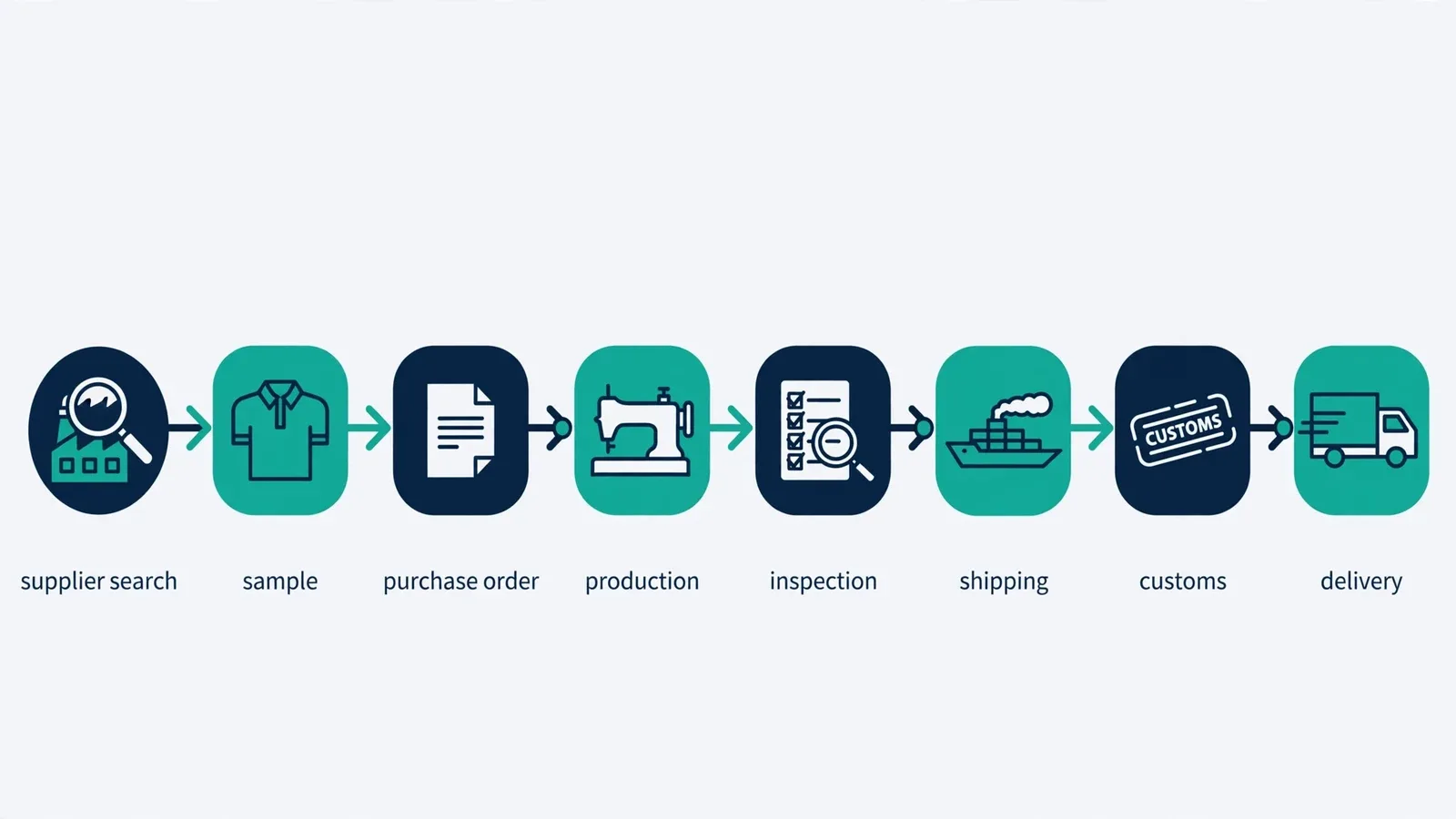
Write the specification: fabric, construction and weight, collar and cuff type, fit, size chart, colors, branding, labels, packing.
Name the destination and confirm its labeling, testing and document requirements with your broker.
Build a shortlist of polo exporters; compare them on the same criteria.
Verify each supplier: business, factory, product and destination experience, payment identity.
Confirm MOQ per supplier for your exact specification.
Compare quotes on the identical specification and trade term; get differences explained in writing.
Approve a sample, then a pre-production sample in the correct colors and branding.
Complete order documents: specification, tolerances, defect standard, inspection scope, latest shipment date.
Agree the trade term with its named place; settle freight terms.
Confirm classification; check duty and taxes in the official tariff, including any preference claim.
Build landed cost line by line from your own quotes before confirming.
Book pre-shipment inspection in time to act on the result.
Check draft documents before sailing; file the final set.
Arrange clearance, receive the goods and check them against the specification.
How Exportain helps
Exportain is a B2B marketplace that connects international buyers with Bangladeshi suppliers, exporters and trade service providers. Buyers can find suppliers, post a request for quotation (RFQ) and receive quotations. For a polo order, you send one written specification covering fabric, construction, sizes, colors, branding and packing, and suppliers answer against the same specification, so replies are comparable.
Exportain is not a party to the contract for goods. It does not inspect goods, book freight or clear customs. Trust badges on Exportain are reviews of documents and photos. They are not factory inspections, certifications or guarantees, and membership never grants a badge. Keep your own verification, sampling, inspection and import checks in place alongside the platform process.
FAQs
What is the typical MOQ for polo shirts from Bangladesh?
There is no single typical MOQ, because each supplier sets its minimum for a given specification. Custom-dyed colors, fabric produced for your order, embroidery, private labels and a wide size and color spread raise the minimum, while a plain style in a stock fabric usually carries a lower one. Ask each supplier for its minimum for your exact specification in the quotation.
How long does shipping take?
Shipping time depends on your destination port, whether the sailing is direct or transships through a hub, the carrier schedule at booking, and handling and clearance at both ends. Sea freight is the standard route, with air freight for samples and urgent consignments. Ask your forwarder for the current scheduled transit for your route, then add export handling, clearance and inland delivery for your planning date.
What import duty applies?
Duty depends on how your exact polo is classified, on your destination official tariff, and on whether a preferential scheme for Bangladeshi-origin goods is in force and your shipment qualifies with the correct origin evidence. A men's knitted polo is generally classified under HS heading 6105 and a women's knitted polo under heading 6106, while heading 6109 covers T-shirts, singlets and other vests.7 Confirm the classification and the current rate with your customs broker or the official tariff before costing the order.
How do I verify a supplier?
Verify in layers. Confirm the registered business identity and export standing, the factory that will produce your order and its polo experience, and that the name on the quotation, invoice and payment account is the same business throughout. Keep answers in writing, and support them with an approved sample, an agreed inspection and document checks before shipment.
Next steps on Exportain
Browse suppliers for knitwear factories, then post your specification at post an RFQ so suppliers quote on identical terms. If you are new to the platform, read how to buy first for the buyer journey and RFQ process.
Sources
- BKMEA at a Glance. BKMEA (accessed )
- Bangladesh Knitwear Sector contribution to the Socio-economic dynamics in the country. Bangladesh Knitwear Manufacturers and Exporters Association (BKMEA) (accessed )
- BGMEA | Home. Bangladesh Garment Manufacturers and Exporters Association (BGMEA) (accessed )
- Customs Clearance Procedures for Export. Bangladesh Customs, National Board of Revenue (accessed )
- Incoterms® rules. International Chamber of Commerce (ICC) (accessed )
- Incoterms® 2020. International Chamber of Commerce (ICC) (accessed )
- Bangladesh Customs Tariff, Chapter 61: Articles of apparel and clothing accessories, knitted or crocheted. National Board of Revenue (accessed )
- Harmonized System | WCO Trade Tools. World Customs Organization (WCO) (accessed )
- polo shirts
- import polo shirts from bangladesh
- polo shirts bangladesh exporters
- polo shirts wholesale bangladesh
- knitwear sourcing
- bangladesh garments
About the author
Sourcing from Bangladesh?
Post a request for quotation and suppliers on Exportain can send you their quotes directly.
Post an RFQ