

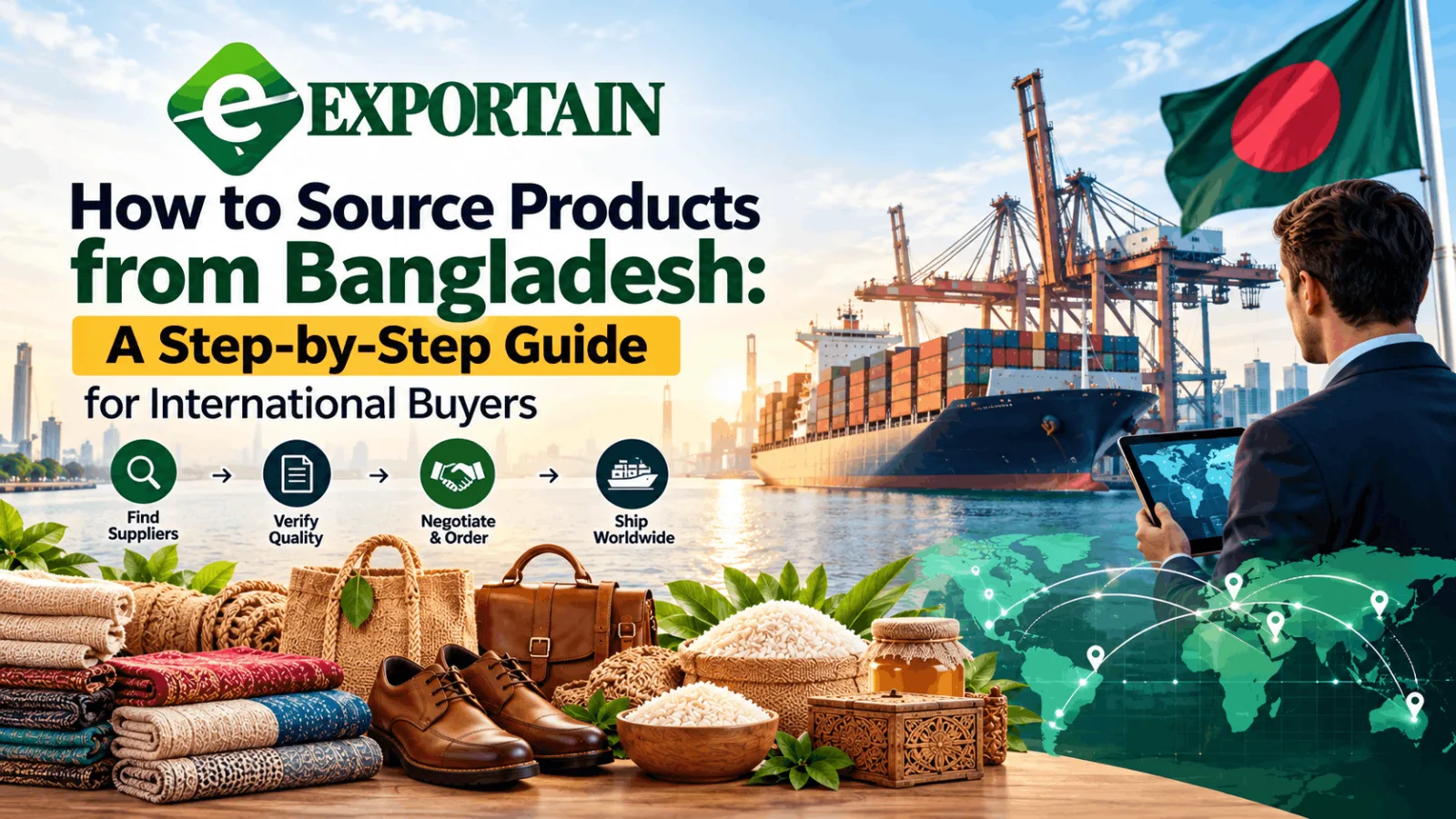
How to Source Products from Bangladesh: A Step-by-Step Guide for International Buyers
A step-by-step guide to sourcing from Bangladesh — verifying suppliers, posting an RFQ, comparing quotations, and shipping your order with confidence.
Published 6 min read
On this page
Bangladesh is the world's second-largest garment exporter, but that's only part of the story. Over the past decade the country has built real export strength in leather and footwear, jute and natural fiber goods, agriculture and frozen seafood, home textiles, light engineering, and ceramics — at price points that are hard to match elsewhere in Asia. For international buyers, that combination of scale, cost, and growing diversification makes Bangladesh one of the more interesting sourcing destinations to explore right now.
The challenge isn't finding a supplier in Bangladesh — it's finding the right one, verifying they can actually deliver, and getting through the paperwork without losing a season to delays. Here's a practical, step-by-step walkthrough of how experienced buyers source from Bangladesh, from the first product brief to the shipment landing at your port, and where a B2B platform like Exportain removes a step entirely.
Step 1: Define what you actually need
Before contacting anyone, write down the product specification in detail: material, size, grade, color, target unit price, required certifications, and your order volume (both your trial order and your expected annual volume). Vague briefs produce vague quotes. Bangladesh is strong in apparel and knitwear, leather and footwear, jute and natural fiber products, home textiles, frozen seafood and agro-processing, and a growing light engineering and ceramics base — knowing which of these your product falls into shapes everything that follows, from which suppliers to approach to which certifications are standard.
Step 2: Find suppliers, then verify them
You can find Bangladeshi suppliers through trade directories, the Export Promotion Bureau, industry associations like BGMEA or BTMA, trade fairs such as the Dhaka sourcing expos, or a B2B marketplace like Exportain that lists Bangladeshi exporters directly, by category, with company and product detail attached. The harder part is verification. At minimum, check for:
A registered business address and an Export Registration Certificate (ERC)
Evidence of past export shipments, not just a sales pitch
Factory or production site photos and, where possible, a virtual or third-party audit
Relevant product certifications (BTMA for textiles, for example, or food safety certificates for agro exports)
Exportain reviews this kind of evidence directly and assigns sellers a verification level — Bronze through Platinum — based on what was actually checked, which saves you from doing this legwork supplier by supplier. Keep in mind that verification confirms identity and basic compliance, not guaranteed delivery performance, and that a paid membership tier is a separate thing from a verification badge.
Step 3: Post a detailed RFQ instead of emailing one supplier
A Request for Quotation (RFQ) sent to multiple qualified suppliers at once gets you comparable offers faster than one-off emails. A strong RFQ includes the product and specification, quantity and unit, target price, destination country and port, preferred Incoterm, required certifications, and your deadline. On Exportain, posting an RFQ puts your requirement in front of matched, relevant suppliers directly, and every quotation that comes back is tied to that same structured request — so you're comparing like with like instead of reconciling five differently formatted emails.
Step 4: Compare quotations and negotiate with the full picture
A quotation should state unit price, MOQ, lead time, Incoterm, payment terms, and validity period — not just a headline price. Compare these side by side, not price alone: a cheaper unit price with a 60-day lead time and a 30% deposit can cost more in practice than a slightly higher price with better terms. Keep negotiation and counter-offers on record rather than scattered across email, WhatsApp, and phone calls. Exportain keeps every quotation version and counter-offer attached to the original RFQ, so the full negotiation history is there if a dispute comes up later.
Step 5: Lock in Incoterms, MOQ, and payment terms before you order
Incoterms determine who pays for and insures each leg of the journey. FOB (Free on Board) is common for smaller buyers, since the supplier only handles the goods to the port of loading and you arrange the rest. CIF includes shipping and insurance to your port. DDP shifts nearly everything to the supplier, including import clearance, so it costs more per unit but is simplest for buyers new to importing. Match the Incoterm to how much logistics experience you actually have. Also confirm MOQ upfront — Bangladeshi factories often have MOQs tied to production line efficiency, and that figure can vary significantly between product categories.
Step 6: Place the order and stay involved during production
Once you accept a quotation, expect a proforma invoice stating the agreed terms, followed by a formal order. For larger or first-time orders, arrange a pre-shipment inspection — either your own representative or a third-party inspection company — rather than relying solely on photos the supplier sends. Exportain's funds hold lets you pay into a held balance that only releases once you confirm the order, so payment isn't a straight wire transfer with no recourse if something goes wrong.
Step 7: Plan shipping and customs before the goods are ready
Most sourcing from Bangladesh ships through Chattogram Port (sea freight) or Hazrat Shahjalal International Airport in Dhaka (air freight). Required export documents typically include a commercial invoice, packing list, certificate of origin, and bill of lading or airway bill, plus any product-specific certificates (fumigation certificates for wood packaging, for example). If you need a freight forwarder, inspection company, or customs agent, Exportain's provider directory lists trade-service businesses by exactly this kind of service, so you're not sourcing your logistics partner through a separate, unrelated search. Confirm your own country's import duty and any required import license well before the shipment leaves, so customs clearance isn't the step that holds everything up.
Common mistakes to avoid
Accepting the first quote without comparing at least two or three suppliers
Treating a paid membership badge or a slick company profile as proof of verification
Skipping a pre-shipment inspection on a first order to save a small fee
Agreeing to payment terms before confirming the Incoterm, since the two directly affect each other
Negotiating entirely over informal chat channels with no written record
Frequently asked questions
What can I import from Bangladesh? Apparel and knitwear lead the country's exports, followed by leather and footwear, jute and natural fiber goods, home textiles, frozen seafood, agricultural products, and a growing range of light engineering and ceramic goods.
What is the minimum order quantity for Bangladeshi suppliers? MOQ varies widely by product and factory, often tied to how efficient a production run is below a certain volume. Always confirm MOQ with a specific supplier rather than assuming an industry-wide number.
Is it safe to pay a Bangladeshi supplier before production? A full upfront wire transfer to an unverified supplier carries real risk. Verified suppliers, a written quotation, and a payment method with recourse — such as a funds hold released on delivery confirmation — substantially reduce that risk.
What is the difference between FOB and CIF when sourcing from Bangladesh? Under FOB, the supplier's responsibility ends once goods are loaded at the port, and the buyer arranges and pays for shipping and insurance from there. Under CIF, the supplier arranges and pays for shipping and insurance to the buyer's destination port.
The bottom line
Sourcing from Bangladesh rewards buyers who treat it like a process, not a transaction: a clear spec, verified suppliers, a structured RFQ, terms agreed in writing, and inspection before payment. Exportain was built around exactly this workflow — RFQs, versioned quotations, verification tiers, and funds holds tied to delivery — so each of these steps happens on one platform instead of across a dozen disconnected emails and chats.
Sourcing from Bangladesh?
Post a request for quotation and suppliers on Exportain can send you their quotes directly.
Post an RFQ