How to Import Baby Clothes From Bangladesh in 2026: Complete Buyer Guide
How to import baby clothes from Bangladesh in 2026: verify suppliers, agree MOQ and samples, meet US and EU safety rules, check duty under headings 6111 and 6209, and price on landed cost.
Short answer
To import baby clothes from Bangladesh, write a precise specification covering fabric, sizes, fastenings, labelling and packing, shortlist factories with checked babywear capability, verify registration and export documents, approve a pre-production sample in every size group, agree testing for your destination children's product rules, confirm classification and duty, inspect before shipment, and calculate landed cost per saleable piece.
On this page
Key takeaways
Ready-made garment exports were $10.58 billion in July to September 2026, up 6.10 percent year on year, per Export Promotion Bureau data.
Knitted babies' garments fall under heading 6111 and babies' garments that are not knitted or crocheted under heading 6209; the subheading depends on fibre and garment type.
US children's products require third-party testing by a CPSC-accepted laboratory and a Children's Product Certificate issued by the importer.
Garments for young children must not have drawstrings or functional cords in the head, neck or upper chest area under EN 14682.
MOQ is set by each factory per style, color or size ratio, so only a quotation on your exact specification gives a usable figure.
Learning how to import baby clothes from Bangladesh starts with a precise specification, a supplier whose babywear capability you have checked, and safety evidence for your destination market. This guide is for buyers in the United States, the United Kingdom, the European Union and the United Arab Emirates. It covers supplier verification, minimum order quantities, sampling, quality control, trade terms, duty, documents and landed cost.
Baby garments are worn against newborn skin, mouthed and washed often, and parents judge them on softness and safety first. Two factories quoting for the same romper can differ sharply on fabric softness, snap strength, sizing and packing, so the checks below matter more than the first price you receive.
Why source baby clothes from Bangladesh
Ready-made garments dominate Bangladesh's export trade, and knitwear is the bigger half of that trade. Ready-made garment exports reached $10.58 billion in July to September 2026, up 6.10 percent year on year, with knitwear at $5.96 billion, up 6.88 percent, according to Export Promotion Bureau data reported by The Financial Express.1 The European Union took 46.36 percent of those apparel shipments, the United States 20.99 percent and the United Kingdom 12.21 percent.1
The knitwear base is broad. The Bangladesh Knitwear Manufacturers and Exporters Association (BKMEA) states that it represents the knitwear sector and currently represents approximately 2,540 knitwear member factories.2 Factories in this sector work with fine cotton yarns, interlock and rib fabrics, small-size grading, envelope necklines and soft seams. See the knitwear industry in Bangladesh and BGMEA and BKMEA.
Scale does not remove selection risk. A low quotation becomes expensive if fabric is substituted, snaps pull off, sizes drift or a shipment misses its season, and baby sizes are outgrown quickly, so late stock loses value fast. Source for babywear capability specifically, then protect the order with verification, sampling, testing and inspection. For the wider process, see how to import from Bangladesh.
Find and verify suppliers
Build a shortlist from your specification, not from a general directory listing. Define the garment types, fabric, likely order size, fastenings, printing and labelling you need, then look for suppliers whose stated capability matches it. Ask specifically about baby production: a factory strong in adult T-shirts may not hold small-size patterns, snap machines or the trim controls babywear requires. Browse suppliers on Exportain and review each candidate's range and export markets. Shortlist a few serious candidates, not dozens.
Which checks matter before you pay a deposit
Ask for the legal business name, registration details, an export licence where applicable and the factory address, and confirm whether you deal with the manufacturer or an intermediary. Names and addresses should match across the documents provided, and any difference should have a written explanation. Ask about fabric sources, whether printing and snap application are in-house or subcontracted, how sizes are graded and what quality and safety checks are routine. Request examples of similar export work and consider a third-party audit for larger orders.
Bangladesh Customs requires an approved Bill of Export before export goods are loaded, and the documents enclosed with it include the export letter of credit or contract, a commercial invoice with a detailed description of the goods, a packing list with quantity, weight and packing information, an EXP form certified by an authorized dealer bank, and a certificate of origin issued by the Export Promotion Bureau or a chamber of commerce.3 A supplier who exports regularly works inside this document system on every shipment, so ask who prepares each document. The export documents from Bangladesh guide lists the full set, and the ERC certificate guide explains the export registration behind it.
Ask how the factory controls small parts and sharps: snap attachment checks, needle detection after sewing and keeping loose trims away from finished garments. Warning signs include pressure to pay in full in advance to a personal account, reluctance to provide samples, documents or test reports, unexplained price changes and refusal to allow inspection. Start with a trial order if you remain uncertain.
MOQ, pricing and samples
Minimum order quantity, price and sampling each depend on your exact specification, so treat any general figure published online with caution.
What is the typical MOQ for baby clothes from Bangladesh
There is no single typical figure, because minimum order quantity (MOQ) is set by each factory and differs by style, fabric, color, print and size breakdown. Baby programmes spread one style across many sizes, from newborn and 0 to 3 months upward, and a factory may state its minimum per style, per color or per size ratio, so ask which basis applies. Custom fabric, colors, private labels, prints and special packing can all raise the minimum. The MOQ guide explains how minimums are structured.
How pricing is built
A price reflects fabric type and weight, construction, fastenings, printing or embroidery, labels and tags, any testing, packing, quantity and the trade term quoted. Quotations are comparable only if they cover the same specification, term, packing and inclusions. Ask for an itemized quotation naming the fabric, size range, inclusions, exclusions, validity period and payment terms. Do not negotiate on price alone: payment terms, lead time, inspection rights, testing responsibility and responsibility for defects are part of the value of the deal. If a price looks unusually low, ask what it leaves out. The guide to how to write an RFQ lists the fields that make quotations comparable.
Samples and approvals
Never skip sampling. Judge softness after washing, fabric weight, stitching, sizing, color, print quality, snap function and finishing. The pre-production sample made to your specification is the critical step: check it against your brief and size chart, wash it as a parent would, work every snap repeatedly and record approval or corrections in writing. Keep the approved sample as your inspection reference, and keep a sealed counter-sample so the factory and the inspector work from the same standard.
Check each size against your measurement chart, not only the middle size, because grading errors appear first at the ends of the size range. Check that necklines stretch and recover and that no rough seam, label edge or print sits where it will rub skin. If you change fabric, color, artwork, trims or packing after approval, confirm the change in writing and approve a new sample where the change is material, because a trim change can also change your test position.
Quality control and certifications needed
Quality is a system that runs from fabric selection through cutting, sewing, finishing and packing. For baby clothes, quality and safety are the same conversation: define the standard, agree how it will be checked and verify it before goods leave.
Defining your quality standard
Provide a specification covering fabric, measurements per size with tolerances, stitching and seam softness, color standards, artwork and print method, fastenings, labelling and packing. State which defects count as critical, major and minor. For babywear, a loose snap, a sharp edge or a detached small part belongs in the most serious category. Agree the remedy if inspection fails before production starts. Build in fabric checks, inline checks and a final random inspection covering workmanship, measurements, fastening security, labelling, packing and quantity. See pre-shipment inspection and AQL for how final inspections are sampled and judged.
What safety rules apply in the United States
Children's products sold in the United States are regulated by the Consumer Product Safety Commission (CPSC). Its business guidance states that children's products must not contain more than 100 ppm total lead in any accessible component part, paint and similar surface coatings must not contain more than 0.009 percent (90 ppm) lead, and children's toys and child care articles must not contain more than 0.1 percent of any regulated phthalate in any accessible plasticized component part.4 The same guidance requires third-party testing by a CPSC-accepted laboratory, a Children's Product Certificate (CPC) issued by the importer or domestic manufacturer, and permanent tracking labels on the product and its packaging.4 Products for children under 3 years of age must not contain small parts or release small parts after use and abuse testing.4 Confirm the current rule set for your exact product from CPSC sources before you finalize the design.
What safety rules apply in the European Union and the United Kingdom
Cords and drawstrings are a separate design risk. Standard EN 14682 provides that garments for young children shall not be designed, manufactured or supplied with drawstrings or functional cords in the head, neck or upper chest area, and decorative cords are not permitted anywhere on the hood or at the back of the neck.5 The simplest compliant design decision for baby garments is to leave drawstrings in the head and neck area out of the product entirely.
Chemicals in clothing are restricted under REACH. Commission Regulation (EU) 2018/1513 added entry 72 to Annex XVII of REACH, under which listed substances classified as carcinogenic, mutagenic or toxic for reproduction must not be placed on the market above the specified concentration limits in clothing, related accessories, skin-contact textiles or footwear for consumers, with limits that include 1 mg/kg for extractable lead and 75 mg/kg for formaldehyde.6 Fibre labelling is a separate duty: Regulation (EU) No 1007/2011 covers textile fibre names and the related labelling and marking of fibre composition.7
Other markets apply their own safety and labelling rules, so treat the summaries above as starting points, not legal advice. Name the rules for your market explicitly, verify that test evidence covers the factory, materials and trims in your order, and never print a safety claim without valid evidence. Voluntary certifications, for example for organic fibre claims, are different from legal requirements: if you need one, name it explicitly and verify that current evidence covers the factory and the product in question.
Incoterms, shipping and transit time
How goods move, and who pays for and controls each leg, is governed by the trade term in your contract, so agree it early. The Incoterms rules published by the International Chamber of Commerce (ICC) are a set of eleven three-letter trade terms for the sale and purchase of goods, and they clarify the tasks, costs and risks involved in delivering goods from sellers to buyers.8 Incoterms 2020 is the most recent version and entered into force on 1 January 2020.8 Common choices for garment orders include Ex Works (EXW), Free on Board (FOB) and Cost, Insurance and Freight (CIF). Name the exact term, the named place and the Incoterms version in your purchase order, and check that the quotation uses the same term. Compare EXW, FOB and CIF, and see Incoterms for shipments from Bangladesh.
Most volume orders ship by sea, as a full container load or as a consolidated less-than-container load, and air freight suits urgent or small consignments. Baby clothes are light but bulky once packed, so carton dimensions affect freight cost: agree packing standards early and confirm final carton measurements before booking. Transit time varies with destination, route, carrier schedules, port conditions and customs processing. Build your calendar backwards from the in-warehouse date, adding production, testing, inspection, documentation, voyage, clearance and delivery, with a buffer, because a late delivery can miss the age window the stock was bought for.
Import duty, taxes and documents
The factory price tells you nothing about what your customs authority will charge, so research import charges before confirming an order. Duty is determined by classification under the Harmonized System, customs value, origin and the rules in force in your destination on the import date.
Knitted or crocheted babies' garments and clothing accessories fall under heading 6111. The United States Harmonized Tariff Schedule notes for that heading define babies' garments and clothing accessories as articles for young children of a body height not exceeding 86 centimeters, and the heading is then divided by fibre.9 Babies' garments that are not knitted or crocheted fall under heading 6209, which the United Nations Statistics Division classification lists as garments and clothing accessories for babies, not knitted or crocheted, with subheadings for cotton, synthetic fibres and other textile materials.10 The precise subheading depends on fibre, garment type and whether the item is imported as part of a set, so do not guess the full code from the heading alone. Check the current rate in your destination's official tariff, and confirm classification with a customs broker before shipment. See how to classify your product.
If you claim a preferential rate for goods originating in Bangladesh, confirm its conditions and proof-of-origin requirements first. Include import tax such as VAT or GST, broker fees and port and handling charges in your landed cost, not only the duty line.
Keep a clean document set: an accurate commercial invoice, a detailed packing list, the transport document, any origin evidence your preference claim requires and the safety documents your market requires, such as the Children's Product Certificate for the United States where it applies. On the Bangladesh side, the export set your supplier files includes the documents Bangladesh Customs lists for the Bill of Export, including the commercial invoice, packing list, certified EXP form and certificate of origin.3 Check the set as a set: names, quantities, size breakdowns, weights and marks should read identically on the invoice, packing list and transport document.
Landed cost example
A landed cost is the total cost of getting goods into your warehouse, ready to sell. The table below uses placeholders, not figures from a real order: fill in your own quotation, freight quote and checked duty and tax treatment.
Cost element | How to fill it in | Your figure |
|---|---|---|
Goods, per your agreed Incoterm | Supplier quotation for your exact specification and quantity | Enter quoted total |
International freight | Quote from your forwarder, matched to the same Incoterm, or the freight included in the price | Enter freight total |
Insurance | Premium if you insure the shipment, based on the insured value and cover chosen | Enter premium |
Testing and certification | Laboratory testing and any certification fees required for your market and claims | Enter testing total |
Import duty | Customs value multiplied by the checked rate for your classification and origin | Enter calculated duty |
Import tax | Calculated under your destination's rules, on the customs value plus duty where applicable | Enter calculated tax |
Port, handling and clearance | Broker, port and delivery charges quoted for your shipment | Enter total charges |
Local delivery to warehouse | Final-leg transport from port or terminal to your premises | Enter delivery cost |
Total landed cost | Sum of all rows above | Enter total |
Landed cost per piece | Total landed cost divided by the number of saleable pieces received | Enter per-piece cost |
Use the per-piece landed cost, not the factory price, to set your selling price, and run the calculation again whenever specification, quantity, freight, testing or duty changes. Divide by saleable pieces, not shipped pieces. The landed cost guide works through the same elements.
Step-by-step import checklist
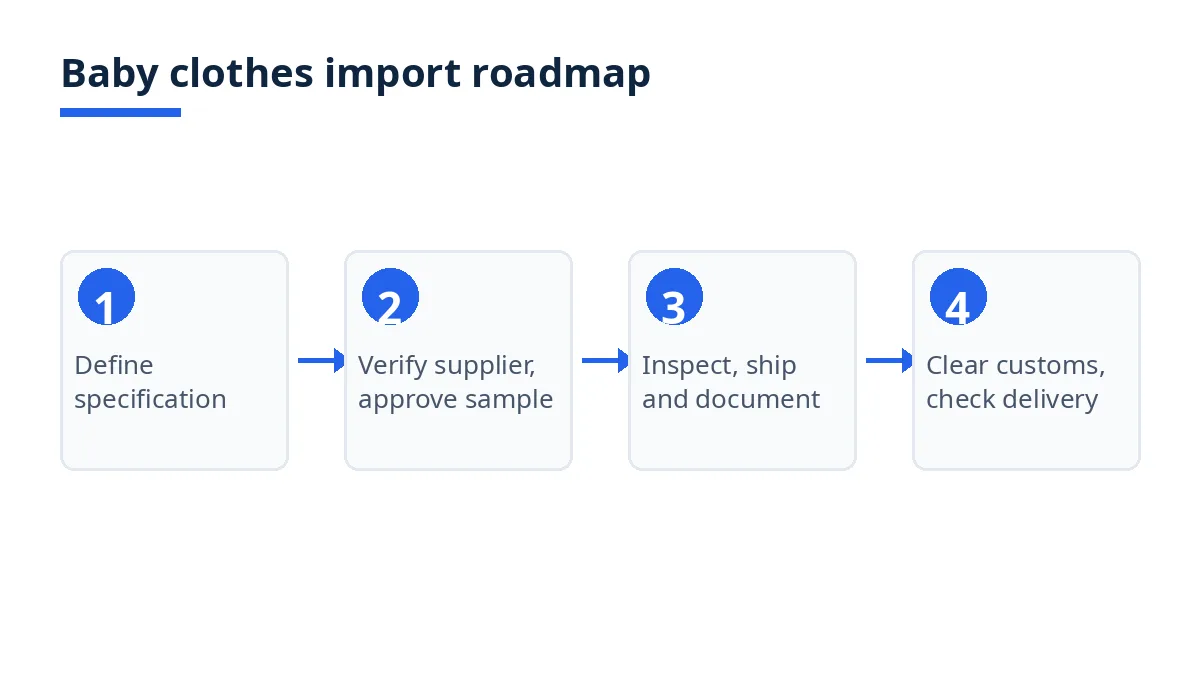
Use this checklist in order, and keep the evidence for each step in the order file.
Define the product: garment types, fabric, colors, sizes by age and height, fastenings, print method, labels, safety requirements and packing.
Research import requirements: classification, duty, tax, children's product safety rules, testing and labelling, from official sources or through a broker.
Build a shortlist of suppliers whose babywear capability matches your specification and quantity.
Verify each supplier: registration, factory address, manufacturer or intermediary status, baby-size and trim capability, and references.
Request comparable quotations on the same specification and the same Incoterm, with inclusions and validity stated.
Order and approve samples in every size group against your specification, in writing.
Agree the contract terms in a purchase order: price, payment terms, lead time, testing, inspection rights and remedies.
Monitor production, resolving specification and trim questions immediately and in writing.
Inspect before shipment against the approved sample, including fastening security and labelling.
Ship and clear customs, checking every document for consistency.
Receive and check the goods, count cartons and raise any claim promptly.
Review actual landed cost and quality against your plan before reordering.
How Exportain helps
Exportain is a B2B marketplace where international buyers find Bangladeshi suppliers, post requests for quotation and compare replies against the same specification. Supplier profiles on Exportain record document and photo checks. Those checks are reviews of documents and photos, not factory inspections, and they do not replace your own verification, sample approval, purchase order or inspection. Exportain is not a party to your contract for goods, and it does not inspect goods, book freight or clear customs. State garment types, fabric, sizes, quantity, target market, timing and your destination's safety requirements in the request itself. Post a free RFQ on Exportain and get quotes from Bangladeshi suppliers: post an RFQ or open the RFQ page.
FAQs
What is the typical MOQ for baby clothes from Bangladesh?
There is no single typical figure. MOQ is set by each supplier and depends on fabric, colors, prints, sizes, custom labelling or packing and production planning, and it may be quoted per style, per color or per size ratio. Only the supplier can state its minimum for your exact specification, so ask each shortlisted supplier for its MOQ and what drives it.
How long does shipping take?
Shipping time depends on destination, route, carrier schedule and customs clearance speed. Sea freight takes considerably longer than air freight, and production, sampling and testing time must be added to any transit estimate. Ask your forwarder for the current schedule and build a buffer into the date you promise customers.
What import duty applies?
Duty depends on the precise classification of your garments, their origin, the customs value and the rules in force on the import date. Knitted baby garments fall under heading 6111 and babies' garments that are not knitted or crocheted fall under heading 6209, but the exact subheading and rate depend on fibre and garment type.9 10 Check the current rate in your destination's official tariff and confirm any preferential claim before you ship.
How do I verify a supplier?
Verify in layers before committing. Check registration and export credentials, confirm the factory address and whether you deal with the manufacturer or an intermediary, and test babywear capability with specific questions about fabrics, small-size grading, snap attachment control, printing and quality control. Ask what safety testing the factory supports for your destination, review samples in every size and start with a trial order where possible. Record price, specification, payment terms, lead time, testing and inspection rights in writing, and arrange inspection against an approved sample before shipment.
Next steps on Exportain
Browse Bangladeshi suppliers by product category and note the factories whose babywear range matches your specification, then read the how to buy guide before you send your first inquiry. When your specification, size chart and safety requirements are ready, post an RFQ so suppliers reply against the same requirements, and use clothing manufacturers in Bangladesh to widen the shortlist.
Sources
- RMG exports rise 6.10pc to US$10.58b in July-Sept of FY27. The Financial Express, (accessed )
- BKMEA at a Glance. BKMEA (accessed )
- Customs Clearance Procedures for Export. Bangladesh Customs, National Board of Revenue (accessed )
- Business Guidance FAQ. U.S. Consumer Product Safety Commission (accessed )
- PRISM: Narrative style risk assessment - non-compliant cords and drawstrings identified in clothing intended for children. GOV.UK (accessed )
- Commission Regulation (EU) 2018/1513 amending Annex XVII to REACH as regards certain CMR substances. European Union, (accessed )
- Regulation (EU) No 1007/2011 on textile fibre names and related labelling and marking of the fibre composition of textile products. European Union, (accessed )
- Incoterms® rules. International Chamber of Commerce (ICC) (accessed )
- Harmonized Tariff Schedule of the United States, Chapter 61: Articles of apparel and clothing accessories, knitted or crocheted. United States International Trade Commission (accessed )
- HS 2012 Classification Detail: Code 6209, babies' garments and clothing accessories, not knitted or crocheted. United Nations Statistics Division (accessed )
About the author
Sourcing from Bangladesh?
Post a request for quotation and suppliers on Exportain can send you their quotes directly.
Post an RFQ