

Ready-Made Garment Manufacturers in Bangladesh: 2026 Guide
How to shortlist ready-made garment manufacturers and exporters in Bangladesh: write the brief first, verify registration, compare itemized quotes, approve samples, and inspect the first order.
Short answer
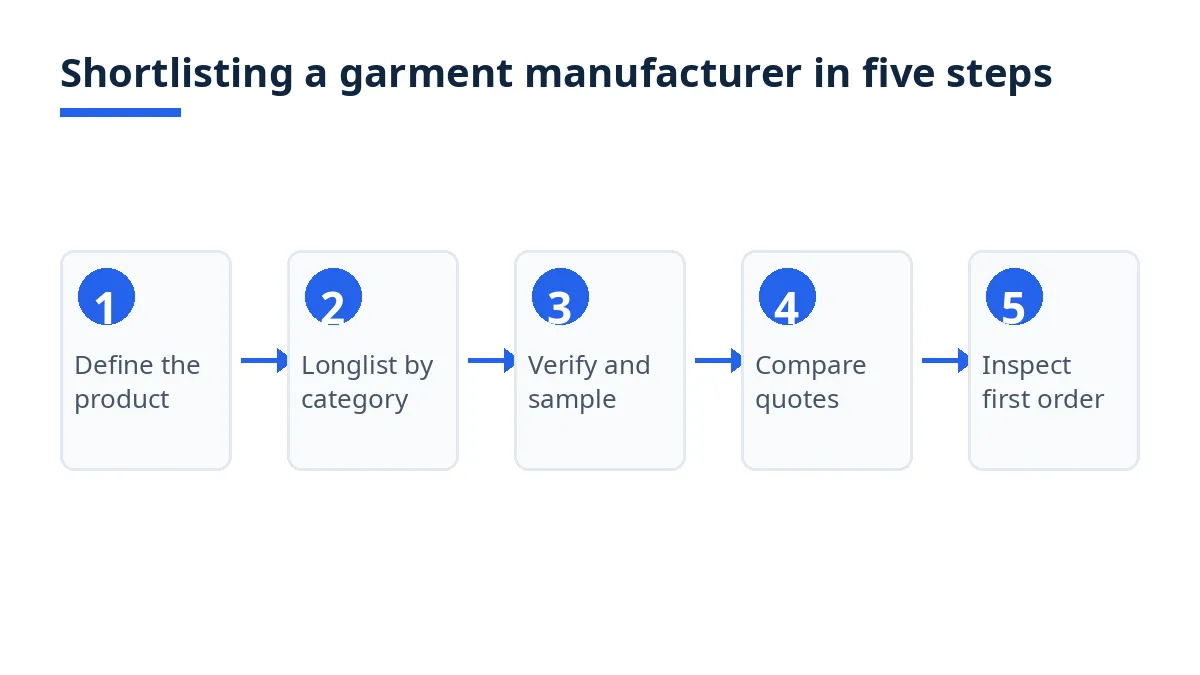
No single ranking identifies the right factory, so shortlist ready-made garment manufacturers and exporters in Bangladesh by fit instead. Send every candidate the same written brief, check the legal name, address and Export Registration Certificate, judge samples against the brief, compare itemized quotations on the same delivery term, and inspect the first order before shipment.
On this page
Key takeaways
Ready-made garment exports were $10.58 billion in July to September 2026, up 6.1 percent year on year, per EPB data.
No ranking picks your factory: match the manufacturer to your product category, then verify its legal name, address and export registration.
An Export Registration Certificate from CCI&E is step one of the export process, and Customs lists it among general export documents.
Compare quotations only on the same specification and delivery term, approve a sample in writing, and inspect the first order before shipment.
Buyers who type best ready made garment manufacturer and exporter bangladesh into a search engine are not really looking for a ranking, because no ranking can tell them which factory will make their garment correctly. The useful answer is a method: define the product in writing, longlist factories that already make that product, verify each candidate, judge samples against the brief, compare quotations on identical terms, and inspect the first order before shipment. This guide sets out that method for importers in the United States, the United Kingdom, the European Union and the United Arab Emirates.
Why this matters for buyers and sellers
Ready-made garments dominate Bangladesh's export trade, so the choice of manufacturer carries unusual weight. In July to September 2026, ready-made garment exports grew 6.1 percent year on year to $10.58 billion, according to Export Promotion Bureau data reported by The Business Standard.1 The European Union accounted for 46.36 percent of those shipments and the United States for 20.99 percent, while knitwear exports rose 6.88 percent and woven garment exports rose 5.11 percent.1
Those figures describe a varied supply base, not a single standard of factory. At one end are vertically integrated groups that knit, dye, wash, print and sew under one roof. At the other are smaller units that make one category, such as T-shirts, polo shirts, hoodies or denim jeans, and make it consistently. Neither model is automatically right for your order.
Three points should shape your search. Specialization is real, so the product decides which factories are candidates at all. Export experience with your destination matters, because a factory that ships there regularly already works to its labeling, testing and documentation expectations. Communication is part of production: a factory that answers technical questions clearly before you order is more likely to raise a problem early, when it can still be fixed.
Step-by-step: how it works
Step 1: Write a complete product brief
Before you contact any factory, document the garment type, fabric composition and weight where known, construction details, size range and measurements, colorways, print or embroidery requirements, labeling and packing, target market, and quantity per style and color. Attach a tech pack or measurement chart where you have one. A precise brief produces accurate quotations, while a photograph alone leaves each factory to guess at a different garment.
Step 2: Build a longlist by category
Search by product category rather than by country alone, and group candidates by what they actually produce: knitwear, woven garments, denim, outerwear, workwear or another specialty. Trade association membership is one sorting signal. The Bangladesh Knitwear Manufacturers and Exporters Association (BKMEA) states that it represents the knitwear sector of Bangladesh and currently represents approximately 2,540 knitwear member factories.2 The Bangladesh Garment Manufacturers and Exporters Association (BGMEA) operates an online Membership Management System through which factories apply for membership and registered member factories can generate an e-certificate of membership.3 Membership supports a factory's claim about itself. It does not replace your own checks. Browse Bangladeshi clothing suppliers and finding suppliers in Bangladesh to start the longlist.
Step 3: Send the same inquiry to every candidate
Give each factory the identical brief, quantity breakdown, destination and delivery term to quote against, and ask each one to state what its price includes and excludes. The guide to how to write an RFQ lists the fields a complete inquiry needs. Identical inquiries produce answers you can compare line by line.
Step 4: Verify identity and capability
For each serious candidate, confirm the legal business name, the factory address, who you are dealing with, and whether the company manufactures itself, exports through a related company, or works as a buying house or trading intermediary. Each model can work, but you need to know which party your contract is with and who controls production. Ask what is made in-house and what is subcontracted, such as washing, printing or embroidery, because subcontracted steps affect quality control and timing.
Export registration is a concrete check. Getting an Export Registration Certificate (ERC) from the Office of the Chief Controller of Imports and Exports (CCI&E) is step one of the export process under the Export Policy 2024-27, and Bangladesh Customs lists the ERC among its general export documents, alongside the sales contract or letter of credit, the EXP form, the invoice, the packing list, the transport document and the certificate of origin.4 Ask for a current ERC and check that its name and address match the business you are contracting with. Read the ERC certificate guide and BGMEA and BKMEA before you rely on either document.
Step 5: Request samples and judge them against the brief
Order samples from the shortlisted factories and check each one against the same written criteria: fabric weight, stitching, measurements against the size chart, color accuracy, print or embroidery quality, and labeling. Record approvals in writing, approve one sample, and keep a sealed reference.
Step 6: Compare quotes on equal terms
Ask every shortlisted factory to quote on the same brief, quantities and delivery term, and list what each quote includes and excludes. A lower unit price that assumes a lighter fabric or leaves out packing, testing or inland transport is not a lower cost. It is a different offer. Note the payment terms proposed and the minimum quantity per style and color, and see MOQ.
Step 7: Place a controlled first order and inspect
Start with a manageable first order, put the approved specification, price, quantities, schedule, payment stages and inspection plan into a purchase order both sides confirm, and agree checkpoints before production starts. For the final check on packed goods, agree the sampling method and defect limits in the order itself. ISO 2859-1 is the international standard for sampling procedures for inspection by attributes, and it uses the acceptance quality limit (AQL) to set sample sizes and acceptance and rejection thresholds for a lot.5 See AQL and pre-shipment inspection. Release the final payment only against the documents and inspection outcome agreed in advance.
Costs, timelines and documents
What does a garment quotation actually cover?
No honest guide can give a universal price for garments from Bangladesh, because cost is built garment by garment. The components are stable: fabric and trims, cutting and sewing, washing, printing or embroidery, labels and packing, sampling, inspection and testing, inland transport and export handling, and freight and insurance where the delivery term puts them on the seller. Fabric choice and garment complexity usually move the price more than negotiation.
Delivery terms decide who pays for which leg of the journey. The International Chamber of Commerce (ICC) describes its Incoterms rules as eleven three-letter trade terms that clarify the tasks, costs and risks involved in delivering goods from sellers to buyers, and Incoterms 2020 entered into force on 1 January 2020.6 Compare EXW, FOB and CIF only after adding the missing legs to each quote, as landed cost for imports from Bangladesh sets out.
Cost element | What to confirm in writing |
|---|---|
Fabric and trims | Composition, weight, and whether any substitute is allowed |
Cutting and sewing | Construction details and what the unit price includes |
Washing, print or embroidery | Whether the work is in-house or done by another unit |
Labels and packing | Exact label wording, piece packing and carton marks |
Sampling, inspection and testing | Charges, who inspects, and who pays for re-inspection |
Inland transport and export handling | The point where the seller's responsibility ends |
Freight and insurance | Named place or port, and the level of cover included |
Example figures: two factories quote for the same polo shirt, one at $4.10 per piece EXW and one at $4.55 per piece FOB. Adding inland transport, export handling and loading of $0.38 per piece to the EXW quote gives a like-for-like FOB cost of $4.48 per piece, so the real gap is $0.07 per piece rather than $0.45. The choice then rests on fabric, construction and sample quality, where it belongs.
Payment terms shape both cost and risk. Tie each payment to evidence: order confirmation, written sample approval, inspection of packed goods, and shipping documents. Never let payments run ahead of evidence that the goods exist and meet the specification, and never act on changed bank details sent in an informal message without checking them through a separate, trusted route.
How long does an order take?
A timeline is a sequence: inquiry and verification, sampling and approval, fabric sourcing, bulk production, inspection, shipment and transit. Each stage depends on the one before it, so a late approval moves every later date. Build the schedule backward from the date you need the goods, confirm it in the purchase order, and treat any promise that skips sampling or inspection as a risk.
Which documents are needed?
Keep three groups in one order file: verification documents (business registration, the ERC and compliance documents the factory shares); order documents (tech pack, written sample approval, purchase order, commercial invoice and packing list); and shipment documents (transport document, certificate of origin where required, and destination declarations). Bangladesh Customs lists the core export set among its general export documents.4 Agree the full list before production ends, and see export documents from Bangladesh.
Bangladesh-specific rules and tips
Match the factory to the product cluster. A factory working inside its own specialty, whether knitwear, woven garments or denim, usually has better access to the fabrics, trims, washing capacity and skilled labor your product needs. Ask where production will actually take place, and cover every location in your inspection plan. See the knitwear industry in Bangladesh and the woven garments industry in Bangladesh.
Plan for the destination market, not only for the factory. In the European Union, Regulation (EU) No 1007/2011 of 27 September 2011 sets the rules on textile fibre names and the related labeling and marking of the fibre composition of textile products.7 Other markets apply their own labeling and product rules, and children's clothing carries additional requirements in several of them. Confirm the exact label wording and testing your destination requires before labels are printed, because a well-made garment with the wrong label is not saleable.
Plan around the production calendar. Capacity tightens in peak periods, and schedules shift around major holidays, including Eid, so confirm holiday dates inside your production window. Keep communication written and in one thread, and confirm anything agreed on a call in writing the same day. Most disputes are about a change that was discussed but never documented.
Mistakes and red flags
The most common mistake is choosing on unit price alone, which ignores fabric quality, rework, delays and inspection failures. The second is starting bulk production without a pre-production sample approved in writing. The third is sending vague specifications, where a photograph without measurements or construction notes invites each side to assume something different. The fourth is paying a large advance to a counterparty whose identity, address and bank details you have not cross-checked.
Pause on red flags: a factory that claims it can make every category equally well, cannot explain what it produces in-house, refuses any visit or video walkthrough, pressures you to pay quickly to hold capacity without documentation, or provides company, address and bank details that do not match. Slow or evasive answers to basic technical questions before an order usually become slower answers after payment.
Skipping inspection on a first order is a related mistake. Inspection is how you learn whether bulk production matches the approved sample while you can still act. Once goods have shipped, your options narrow to acceptance, negotiation or a claim.
Checklist
Product brief and tech pack complete, with fabric, sizes, colors, labeling and packing specified.
Longlist built by product category, with each candidate's range noted.
Identical inquiry, with quantities and destination, sent to every candidate.
Legal name, factory address and contracting party confirmed for each finalist.
Manufacturer, exporter or intermediary model understood, including subcontracted processes.
Export registration and association membership checked against current documents.
Compliance evidence requested for the actual production site, with addresses cross-checked.
Samples measured and judged against the brief, with approvals recorded in writing.
Quotations compared on the same brief, quantity and delivery term.
Payment stages tied to evidence: confirmation, sample approval, inspection and documents.
Inspection plan agreed before production, including sampling standard and defect limits.
Production schedule confirmed in writing, including holiday periods.
Full export document list agreed, with delivery term and destination confirmed.
If several items are still open, you are not ready to pay a deposit.
How Exportain helps
Exportain is a marketplace where buyers find Bangladeshi suppliers, post requests for quotation and compare replies in one place. Browse suppliers by category and use the verification information on each profile to see which document and photo checks have been recorded for that supplier. Those checks are reviews of documents and photos, not factory inspections, and they do not replace your own sample approval, purchase order or inspection. Exportain is not a party to your contract for goods, and it does not inspect goods, book freight or clear customs. The how to buy guide sets out the buyer journey.
FAQs
What should I know first about Ready Made Garment Manufacturer and Exporter Bangladesh?
The right partner depends on your product. Specialization, export experience with your market and communication quality matter more than factory size. Define the garment, fabric, sizes and quantities before you search, verify identity and export registration, and judge the factory on samples and documents.
What are the typical costs and timelines?
Costs are built per garment from fabric and trims, making, finishing, labels and packing, sampling, documentation and freight under your delivery term, so there is no reliable universal price. Timelines run in stages, from quotation and sampling to production, inspection and transit. Ask each factory for an itemized quotation and a stage-by-stage schedule.
Which documents are needed?
Expect a commercial invoice, a packing list, a bill of lading or air waybill, and a certificate of origin where your market requires one, plus any testing or labeling documents your destination requires.4 Before you order, collect the factory's business and export registration, your purchase order or contract, and your written sample approvals.
What are the most common mistakes?
Choosing on unit price alone, starting bulk production without a written approved sample, sending vague specifications, paying large sums to an unverified counterparty, and skipping inspection on the first order. Each mistake removes a check that would have caught a problem while it was still inexpensive to fix.
Next steps on Exportain
Browse Bangladeshi suppliers by category, then read the how to buy guide before your first inquiry. When your brief is ready, post an RFQ so manufacturers reply against the same requirements, and use how to import from Bangladesh to plan shipment and clearance.
Sources
- RMG exports grow 6.1% in Q1. The Business Standard, (accessed )
- BKMEA at a Glance. BKMEA (accessed )
- BGMEA launches Membership Management System to provide faster and simpler services. BGMEA (accessed )
- Start an Export Business in Bangladesh (2026 Guide). Entrepreneurs.bd (accessed )
- ISO 2859-1:2026 - Sampling procedures for inspection by attributes — Part 1: Sampling schemes indexed by acceptance quality limit (AQL) for lot-by-lot inspection. International Organization for Standardization (accessed )
- Incoterms® rules. International Chamber of Commerce (ICC) (accessed )
- Regulation (EU) No 1007/2011 on textile fibre names and related labelling and marking of the fibre composition of textile products. European Union, (accessed )
- export documents
- MOQ
- supplier verification
- quality control
- buyer guide
- Bangladesh sourcing
- Ready-made garments
About the author
Sourcing from Bangladesh?
Post a request for quotation and suppliers on Exportain can send you their quotes directly.
Post an RFQ


