Bangladesh Clothing Suppliers: 2026 Buyer's Guide
A staged method for sourcing clothing from Bangladesh: define the product, verify the supplier, compare quotes by components, approve a checked sample and inspect before shipment.
Short answer
Bangladesh clothing suppliers are garment manufacturers and exporters that sell knitwear, woven garments, denim and home textiles to overseas buyers. Source them in stages: define the product in writing, verify registration, export standing and factory capability, compare quotes on the same specification, approve a checked sample, agree terms in writing, and inspect before shipment.
On this page
Key takeaways
Readymade garments earned US$39.34 billion in fiscal year 2024-25, 81.49 percent of Bangladesh merchandise exports, per EPB data.
Verify registration, export standing and factory capability before price becomes the main topic.
Compare quotes by components on the same specification and delivery term, not by total alone.
Approve a measured sample, agree terms in writing and inspect before shipment.
On Exportain, trust badges are a document and photo review, not a factory inspection.
Your choice among Bangladesh clothing suppliers shapes the quality you receive, the delivery date you can promise your own customers, and whether a fault found during production gets corrected or becomes a claim. This guide is for importers, brands and sourcing agents in the United States, the United Kingdom, the European Union and the United Arab Emirates who buy knitwear, woven garments, denim or home textiles from Bangladesh.
The method is the same wherever you found the supplier: work from a written specification, verify the business before price becomes the main topic, check a sample, agree every term in writing, and inspect before shipment. The checklist at the end turns the method into a reusable record.
Why this matters for buyers and sellers
Readymade garments are the core of Bangladesh exports. In fiscal year 2024-25, merchandise exports were US$48.28 billion and readymade garments earned US$39.34 billion, or 81.49 percent of the total, according to Export Promotion Bureau (EPB) data reported by The Financial Express.1 Within garments, knitwear earned US$21.15 billion and woven garments earned US$18.18 billion.1 A buyer is therefore choosing inside a large, export-oriented industry where capability varies widely, and a low quote on its own says little about the factory behind it.
For buyers, the supplier decision is a risk decision. A factory that cannot hold measurements, control shade between fabric lots or pack to your size ratio creates costs larger than any saving in the unit price: rework, air freight to rescue a delivery date, returns, or stock you cannot sell. A factory that answers technical questions precisely and accepts inspection protects your margin even when its quote is not the lowest.
For sellers, the same process matters from the other side. Overseas buyers must show responsible sourcing to their own customers, and they pass that expectation down the chain. A supplier that keeps its documents current and describes its real capability accurately is easier to approve and reorder from.
Step-by-step: how it works
The diagram below summarises the seven steps. Each step produces a record for your order file.
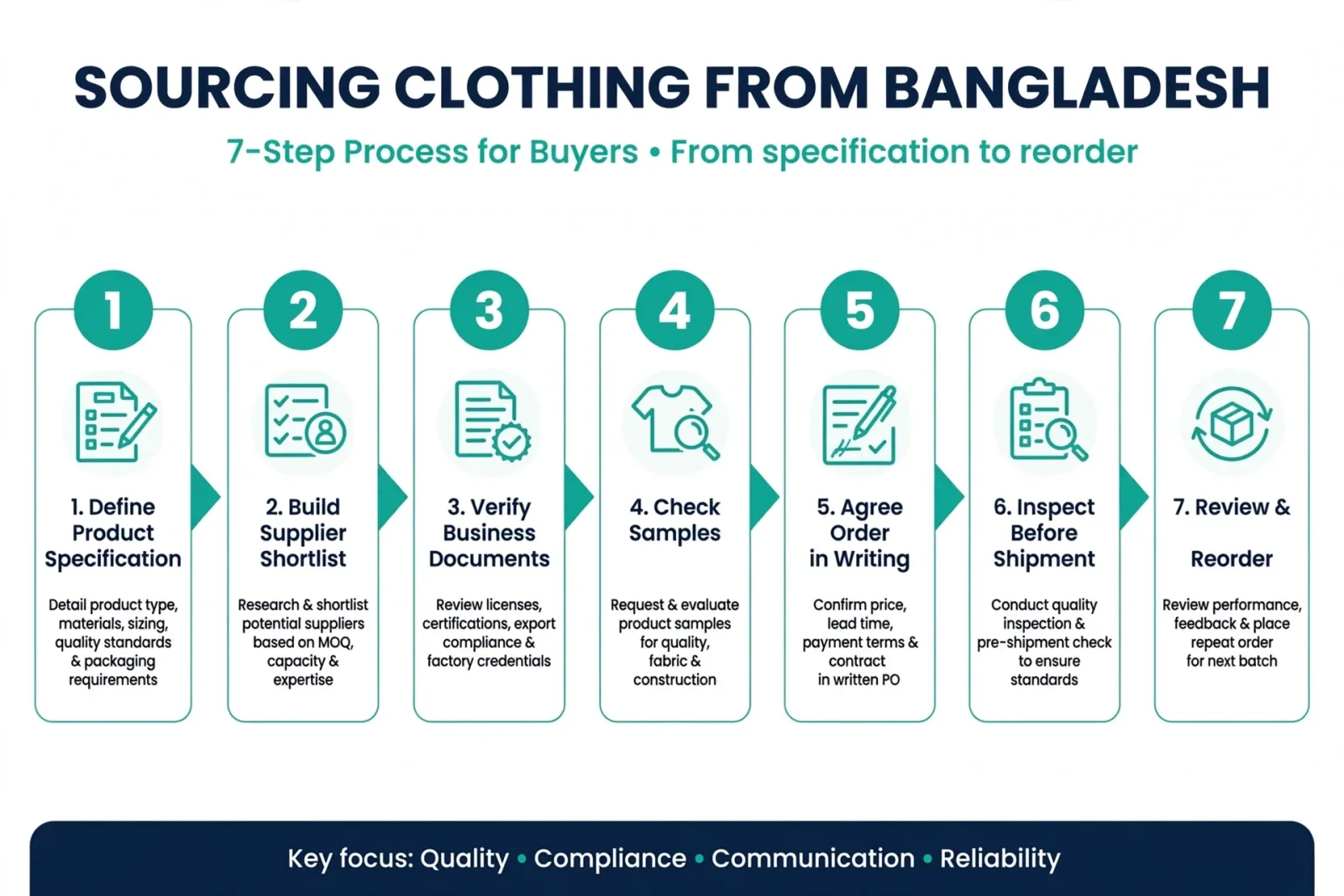
Step 1: Define the product before you search. Write down what you are buying in supplier language: product type, fabric composition and weight, sizes, colors, quantities per style, target delivery window and destination market. A supplier can only judge capability and price against a specification. Vague inquiries get vague quotes that cannot be compared. See how to write an RFQ.
Step 2: Build a longlist, then verify it down to a shortlist. Gather candidates from supplier listings, referrals and trade sources, then run each one through the same checks: business registration, export standing, factory reality, product fit and communication quality. An exporter in Bangladesh holds an Export Registration Certificate (ERC) issued by the Office of the Chief Controller of Imports and Exports (CCI&E) under the Ministry of Commerce, and applications are made through the CCI&E online licensing portal.2 Ask to see a current ERC; the background is in ERC — Export Registration Certificate. Exportain explains its own checks in how supplier verification works on Exportain.
Step 3: Ask capability questions, not only price questions. Ask which categories the factory makes in-house, which operations it subcontracts, what audits or buyer approvals it holds, and which markets it ships to. Ask how its minimum order quantity is structured for your specification; the drivers are in MOQ — minimum order quantity explained. Precise answers show how the supplier will behave in production.
Step 4: Request and check samples against your specification. Pay for samples through a traceable channel, then measure and wash-test them against your tech pack rather than judging by appearance alone, and record the result. A good sample proves the factory understood the specification.
Step 5: Agree everything in writing before production. The purchase order should carry the specification, quantities, the price and what it includes, the delivery term, packing instructions, inspection arrangements and the payment schedule. State the delivery term as an Incoterms® 2020 rule with a named place. The Incoterms® rules are eleven three-letter trade terms published by the International Chamber of Commerce (ICC) that clarify the tasks, costs and risks in the delivery of goods, and Incoterms® 2020 entered into force on 1 January 2020.3 See Incoterms for shipments from Bangladesh. Anything agreed only in chat messages will be disputed from memory later.
Step 6: Monitor production and inspect before shipment. Agree at least one in-process update point and a pre-shipment inspection against the approved sample and the purchase order, using an agreed sampling approach such as AQL — Acceptance Quality Limit. The process is covered in pre-shipment inspection. Problems found at the factory can usually be corrected. Problems found on arrival usually cannot.
Step 7: Review and keep the record. After shipment, record what matched the order and what did not, per supplier. That record turns a first order into a reliable reorder, or tells you when to move on.
Costs, timelines and documents
What is a clothing quote made of?
A clothing quote is a bundle, and reading the bundle is how you compare two quotes fairly. The main components are materials (fabric and trims, often the main share of the price), cutting and making, finishes where specified, testing where your market requires it, packing, inland transport, export documentation and international freight, depending on the delivery term agreed. When two quotes differ, ask each supplier to show the same components. A cheaper quote that silently excludes testing, a finish or part of the freight is not cheaper. It is incomplete, and the missing item reappears later as an extra charge. To price the full transaction, work through landed cost for imports from Bangladesh.
Ask each supplier to confirm, in writing, the fabric composition and weight priced, the operations and finishes included, which tests are included and who pays, the packing included, and the named delivery term and what its freight figure covers.
Example figures. Two quotes for the same T-shirt specification, laid out for comparison. The numbers are illustrative only, not market rates.
Cost line | Quote A | Quote B |
|---|---|---|
Garment price, FOB, per piece | USD 3.10 | USD 2.85 |
Fabric weight priced | 180 GSM | 160 GSM |
Testing included | Yes | No |
Pre-shipment inspection included | No | No |
Quote B prices a lighter garment, with testing billed separately. Once testing and the buyer inspection cost are added, Quote B costs more per order. Compare on specification and total cost.
How is the timeline built?
Timelines are built the same way as costs, in stages. Sampling, fabric procurement, production scheduling, making, finishing, inspection and shipping each occupy their own slot, and the total depends on your product, quantity, fabric availability and the factory's existing commitments. Rather than accepting a single promised date, ask for the schedule in stages: sample approval, fabric in-house, production start, inspection, and handover or vessel departure. Agree in writing what happens if a stage slips.
Which documents should you expect?
The documents fall into three groups. First, identity and eligibility documents, requested at verification: business registration and trade license, a current ERC where applicable, tax identification, chamber or trade-association membership, and a bank reference. Second, order documents: the pro forma invoice or purchase order, the confirmed specification and tech pack, and any testing or compliance reports your destination market requires for the product. Third, shipment documents: commercial invoice, packing list, bill of lading or air waybill, and origin documentation where a preference scheme or your customer requires it. The standard shipment set is listed in export documents from Bangladesh. Keep the three groups together per order.
Bangladesh-specific rules and tips
The Bangladesh garment sector has trade bodies that buyers can use as one signal among several. The Bangladesh Knitwear Manufacturers and Exporters Association (BKMEA) represents the knitwear sector, was established in 1996 and currently represents approximately 2,540 knitwear member factories.4 The Bangladesh Garment Manufacturers and Exporters Association (BGMEA) is a nationwide trade organization of garment manufacturers in Bangladesh, founded in 1983 and based in Dhaka.5 Membership is a useful check where a supplier claims it, alongside registration, factory evidence and references. See BGMEA and BKMEA.
Most containerized garment exports move through Chattogram. Chattogram Port is the country's principal seaport and handles nearly 98 percent of containerized imports and exports, according to Chittagong Port Authority data reported by The Asian Age.6 Inland transport time from factory areas around Dhaka, Gazipur, Narayanganj and Chattogram itself therefore forms part of any realistic schedule. Ask where the factory is located and how goods move to port. A supplier who can explain its own logistics clearly has usually shipped before.
Public holidays, including the Eid periods, affect factory calendars and port working. Exporters attributed part of the June 2025 export decline to the long Eid-ul-Adha holiday.1 Confirm the schedule against the actual calendar for your delivery window.
Match your compliance expectations to your destination market from the start. Buyers selling into the EU, the UK, the USA or the UAE each face their own labeling, fiber-content, product-safety and due-diligence requirements. Origin documentation is commercially important on EU orders because, as a least developed country, Bangladesh benefits from the European Union Everything But Arms arrangement, which grants duty-free, quota-free access to the EU for all exports except arms and ammunition.7 Tell the supplier your market and requirements at inquiry stage. A factory already shipping to your market will recognize them, and that recognition is itself a useful capability signal. Confirm every change to specification or schedule in the same written thread, and keep your own copies of approved samples and documents.
Mistakes and red flags
The most common sourcing mistakes are consistent across buyers and product types. Choosing on unit price alone, before verification, is the first. Skipping the sample stage, or approving a sample without measuring it against the tech pack, is the second. Leaving inspection until goods arrive in your own warehouse is the third, because it converts correctable faults into total losses. The fourth is allowing changes to live only in phone calls and chat messages, where no shared record exists when something is disputed.
Red flags deserve a firmer response, because they predict how a supplier will behave when an order is at risk. Pause or walk away when a supplier refuses to share registration documents, directs payment to a personal account, gives a factory address that cannot be located, pressures you to pay a large share before any sample exists, makes claims it will not evidence, or goes quiet when you ask a technical question. Any one flag can have an innocent explanation. Ask for it, in writing. A supplier that cannot or will not explain should not receive your order, however attractive the quote.
The safer pattern is plain: checked identity, written specification, measured sample, staged payments, and inspection before shipment.
Checklist
Use this checklist for every candidate, and keep the completed version with the order file.
Product defined in writing: type, fabric, sizes, colors, quantities, market and delivery window.
Business identity checked: registration, trade license and export documents seen and current.
Platform verification reviewed where listed, and association membership checked where claimed.
Factory capability confirmed: categories made in-house, subcontracted operations declared, markets named.
Communication tested: technical questions answered precisely, in writing.
Sample received, measured and tested against the tech pack, with the result recorded.
Quote compared by components, not by total alone.
Production schedule received in stages, reviewed against the Bangladesh working calendar.
Purchase order issued in writing with specification, packing, inspection and payment terms.
Inspection arranged before shipment, against the approved sample and purchase order.
Shipment document set agreed in advance, including origin documents where required.
Post-shipment review recorded, so the next order starts from evidence.
A supplier that passes all twelve points is not a guarantee of a perfect order, but you have replaced hope with evidence.
How Exportain helps
Exportain is a B2B marketplace for sourcing from Bangladesh, organized around the process in this guide. Buyers can browse suppliers by product category, read business profiles, and post one request for quotation describing the product, quantities and destination, then compare responses on the same facts. On Exportain, sellers complete verification checks in their seller portal and Exportain staff review every submission. Approved checks earn trust badges shown on the company page, product listings and quotations, and the review is a document and photo review, not a factory inspection.8 Membership plans are a separate product and never grant a trust badge.8 Keep your own checks in place alongside any badge: a badge is evidence about documents and photos, not a promise about an order.
For sellers, Exportain gives Bangladeshi clothing exporters a structured place to present their real capability, including product categories, markets served and business documents, in front of buyers who are looking to source from Bangladesh.
FAQs
What should I know first about Bangladesh clothing suppliers?
Know first that the market is large and varied, so verification, not price, is the correct starting point. Confirm the business is registered and export-active, that it actually makes your product category, and that it can evidence claims about capacity and markets served. Then work from a written specification, check a sample against it, and agree production, inspection and payment stages in writing.
What are the typical costs and timelines?
There is no single typical price or timeline. Costs are a bundle: fabric and trims, cutting and making, finishes, testing where required, packing and freight under the agreed delivery term. Ask what each quote includes and excludes. Timelines are built from stages: sampling, fabric procurement, production, finishing, inspection and shipping. Compare a component breakdown and a stage schedule, not one total and one date.
Which documents are needed?
At verification stage, expect business registration and trade license, a current Export Registration Certificate where applicable, tax identification, trade-association membership evidence and a bank reference. For the order, you need the confirmed purchase order or pro forma invoice, the tech pack and approved specification, and any testing reports your destination market requires. For shipment, the standard set is the commercial invoice, packing list, bill of lading or air waybill, plus origin documentation where required.
What are the most common mistakes?
The most common mistakes are selecting a supplier on unit price before verifying the business, skipping samples or approving them without measuring against the tech pack, agreeing changes verbally instead of in writing, and inspecting only after the goods arrive. Warning signs include refusal to share registration documents, payment requests to personal accounts, factory claims that cannot be checked and pressure to pay before any evidence exists.
Next steps on Exportain
Browse the suppliers directory to build your longlist, read how to buy for the buyer journey, then post an RFQ with your specification, quantities and destination market. Shortlist from the responses using the checklist above.
Sources
- Exports fetch $48.28b in FY25. The Financial Express, (accessed )
- Export Registration Certificate (ERC) In Bangladesh: How To Apply. Bizmend, (accessed )
- Incoterms® rules. International Chamber of Commerce (ICC) (accessed )
- BKMEA at a Glance. BKMEA (accessed )
- Bangladesh Garment Manufacturers and Exporters Association. Wikipedia (accessed )
- Ctg Port reaches all-time high in key performance indicators. The Asian Age (accessed )
- EU trade relations with Bangladesh. European Commission, (accessed )
- Supplier verification: Earn trust badges buyers can see. Exportain (accessed )
About the author
Sourcing from Bangladesh?
Post a request for quotation and suppliers on Exportain can send you their quotes directly.
Post an RFQ