

Sustainable Woven Garments & Denim From Bangladesh: Certifications and Green Factories
How to source sustainable woven garments and denim from Bangladesh: read the market data, check LEED green factories and product certificates by scope, verify every production site, and inspect before shipment.
Short answer
Sustainable woven garments bangladesh means shirts, trousers and denim made in factories that can evidence their environmental and social practices. Buyers check a current certificate for the claim they need, such as GOTS for organic textiles or LEED for the building, confirm the holder, site, scope and expiry, approve a sample in the correct fabric and wash, and inspect before shipment.
On this page
Key takeaways
Woven garment exports were $8.88 billion in July to December of fiscal year 2025-26, per Export Promotion Bureau data.
Bangladesh reached 270 LEED-certified green garment factories in 2025, including 114 Platinum and 137 Gold facilities.
GOTS covers textiles made from at least 70 percent certified organic natural fibres, through processing, manufacturing and labelling.
The Global Recycled Standard covers products with a minimum of 20 percent recycled material, with chain of custody across the supply chain.
A certificate supports a claim only when its holder, site, scope and expiry date match the factory and product in your order.
Sourcing sustainable woven garments bangladesh is a practical buying task, not a marketing claim. It means shirts, trousers and denim made in factories that can show evidence for their environmental and social practices: a current certificate for the product claim, an audit record for the workplace, or a green building certification for the site itself. This guide is for importers in the United States, the United Kingdom, the European Union and the United Arab Emirates who need to separate evidence from assertion before they place an order.
Woven garments are made from fabric produced on looms, then cut and sewn. Denim belongs to the woven family and adds washing, tinting and finishing stages that plain woven products do not need. That difference matters for sustainability, because denim washing uses water and chemicals, and the plant that does the washing may not be the plant that sews the jeans. Know which site does each step, and what evidence covers that site, before you place the order.
The rule that runs through this guide is simple. A claim is only as good as the document behind it, and a document is only useful when you have read its holder, site, scope and expiry date, and checked them against your order.
Market overview with latest data
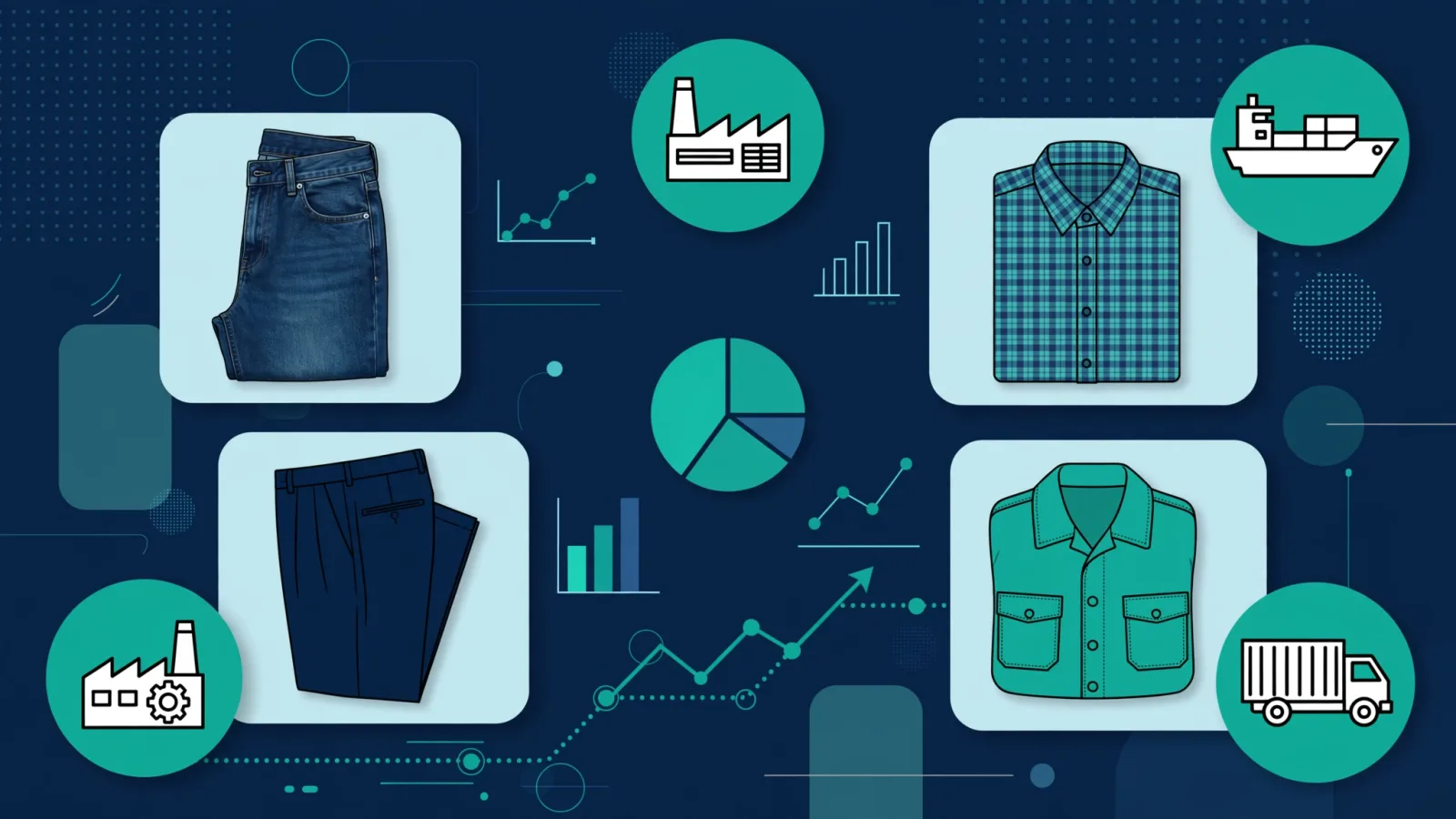
Bangladesh earns most of its export income from ready-made garments, split between knitwear and woven garments. In the first half of fiscal year 2025-26, July to December, ready-made garment exports were $19.36 billion, down 2.63 percent on the same period a year earlier, according to Export Promotion Bureau data reported by New Age. Woven garments accounted for $8.88 billion of that total, down 1.91 percent, while knitwear accounted for $10.48 billion.1 The same report records total Bangladesh export earnings of $48.28 billion in fiscal year 2024-25, up 8.55 percent from $44.47 billion in fiscal year 2023-24, per Export Promotion Bureau data.1
Read those figures as market context, not as a promise about your order. Demand in the main destination markets weakened during the period, and the report links the decline to reciprocal tariffs imposed by the United States and stronger competition in European markets.1 Your verification steps matter more in a soft market, not less, because a factory under pressure may accept a specification or a delivery date it has not fully costed.
Sustainability evidence has become part of how the industry competes. In 2025, Bangladesh added 38 newly LEED-certified green garment factories, taking the total to 270, including 114 Platinum and 137 Gold facilities, according to Bangladesh Sangbad Sangstha reporting of industry figures.2 Of the 38 factories certified in 2025, 22 achieved Platinum, 11 Gold and 5 Silver.2 Those numbers describe buildings across the garment industry, knitwear and woven together. They do not tell you whether a specific factory on your shortlist holds a certificate, or whether the washing plant for your jeans sits inside the certified building. That check is yours.
For product-level trade figures by market, use structured sources rather than articles. The Bangladesh export data guide shows how to read Export Promotion Bureau releases alongside ITC Trade Map and UN Comtrade records for your destination, using the same product codes and period across sources.
Main products and production clusters
The woven category covers a wide range, and a precise product definition is your first sustainability control, because fabric, wash and trims decide most of the footprint of the finished garment.
Core woven products sourced from Bangladesh include shirts and blouses, trousers and chinos, shorts, skirts and dresses in woven fabrics, jackets and light outerwear, and workwear and uniforms. Denim products include jeans, denim jackets, shorts and skirts, and shirts in denim or chambray. Factories work with cotton, cotton blends, polyester blends, viscose and other fibres, and some hold certificates that cover specific fibre claims, such as organic or recycled content, for specific product categories only.
Denim orders carry extra stages. The fabric construction and weight, the wash recipe, and any tinting, abrasion or distressing decide the final shade and hand feel. Each wash is a process batch, so an order split across many washes behaves like several smaller orders for minimums and quality control. Approve the wash on the actual production fabric and judge bulk against a sealed approved sample after washing, not before.
Production is concentrated in and around Dhaka, Gazipur, Narayanganj and Chattogram, the port city through which much export cargo moves. Ask where cutting, sewing, washing and finishing will actually take place for your order. If washing is done by another plant, ask for its name and address, and whether the environmental evidence you are relying on, such as effluent treatment, belongs to that plant or only to the sewing factory. Effluent from denim washing is one of the main environmental points in the order, so a certificate that covers the wrong site leaves the main risk unchecked. The woven garments industry in Bangladesh gives the wider industry background.
Green factories: what LEED certification does and does not show
A green factory claim usually rests on a building certification, and in Bangladesh that is most often LEED. LEED certification supports healthier, more productive workplaces and buildings designed and operated to use less water and energy and fewer natural resources, according to the U.S. Green Building Council.3 Manufacturing facilities can earn LEED certification under rating systems matched to the building stage: LEED for Building Design and Construction covers new builds and major renovations, and LEED for Operations and Maintenance covers existing buildings that have been fully operational and occupied for at least one year.3 As of September 2026, the U.S. Green Building Council records 6,446 LEED-certified and registered industrial manufacturing facilities worldwide.3
That guidance tells you how to read a factory's LEED claim. Ask four questions. Which rating system and level apply: Certified, Silver, Gold or Platinum. Which building the certificate covers, and whether the production building for your order is inside it. Whether the certificate is current, because an Operations and Maintenance award follows a performance cycle. And what the certificate does not cover: LEED assesses the building and its operation, not the organic content of your fabric or the chemical safety of your finished shirt. Treat the building certificate as one layer of evidence, then add the product and workplace layers below.
How to find and verify suppliers
Start with the specification, then search, then verify in layers. A factory cannot quote accurately until the specification exists on paper.
Write down the product, fabric composition and weight, construction, sizes, colours, washes for denim, trims, labels, packing and destination market. Add the sustainability requirements the order genuinely needs: a certified fibre, a chemical standard for the finished product, a building certification, or an audit framework. If a claim will appear on the finished product or a listing, name the scheme in the enquiry, because the certificate must cover that claim before production starts, not after.
Search in more than one place. Use trade data to understand the market, association directories to find member factories, and a marketplace to manage replies against one specification. BGMEA and BKMEA membership is one sorting signal, and the BGMEA and BKMEA guide explains what each covers. On Exportain, browse suppliers by category and use the verification information recorded for each supplier as a starting point. Those checks are reviews of documents and photos, not factory inspections. If you are new to buying from the country, read how to import from Bangladesh alongside this guide.
Verify in layers, and keep a file for each supplier.
Identity and legality. Confirm the legal business name, factory address and export registration. Bangladesh Customs lists the documents enclosed with the Bill of Export, including the export letter of credit or contract, the commercial invoice, the packing list, the EXP form certified by an authorized dealer bank, and the certificate of origin issued by the Export Promotion Bureau or a chamber of commerce.4 The name on the quotation, the certificate and the shipping documents should be the same legal entity, or the relationship should be explained in writing.
Production reality. Establish what the factory makes itself and what it places with another unit, including washing and finishing for denim. Ask for the address of every site that will touch your order.
Certificate check. For every certificate claimed, record the standard, the holder, the certified site, the scope, the certification body and the expiry date. Where the scheme runs a public database or label check, verify the number there. A certificate held by a head office does not certify a factory, and a certificate scoped to knitwear does not certify a woven line.
Audit and compliance evidence. Ask which social or environmental audits the factory has hosted, when, and whether corrective actions were closed. Treat a refusal to discuss audits as a risk signal.
Sample evidence. Judge a pre-production sample made to your specification, in the correct fabric and wash. A showroom sample shows general capability, not control of your product.
Communication record. Keep questions and answers in writing, numbered, against the specification.
Update the file when a certificate is renewed, an audit closes, or a production site changes.
MOQ, pricing and lead times
Buyers ask for three numbers first: the minimum order quantity, the price and the lead time. None of them can be stated honestly as a single figure for the whole woven and denim category, because each is set by the factory for your exact specification.
Minimum order quantity is driven by fabric minimums from the mill, the number of styles, colours and sizes in the order, and line efficiency. Denim adds the wash: each wash is a separate process batch, so five washes across one style raise the effective minimum per wash even when the total quantity looks large. A focused order, one style in one colour and a standard fabric, is usually easier to place in a smaller quantity than a programme split across many colours and washes. State your target quantity in the enquiry and ask each factory to quote its minimum for that specification. The MOQ guide explains how minimums are built.
Pricing is built from identifiable parts: fabric, trims, cutting and sewing, washing and finishing for denim, testing, packing and transport to the point named in your delivery term. Sustainability requirements carry real costs inside that build-up: a certified fabric, an extra chemical test or a transaction certificate is a cost someone has to carry, so ask each factory to separate the base product cost from the compliance cost. Compare quotations only on an identical specification and the same delivery term, as the landed cost guide sets out for the import side.
For scale only, consider this worked comparison. Example figures: two factories quote for the same five-pocket jean, one at $6.20 per piece FOB and one at $5.85 per piece FOB. The lower quote excludes wash approval testing and certified-fabric transaction documents, priced separately at $0.42 per piece on your quantity. Its like-for-like cost is $6.27 per piece, so the higher quote is the cheaper complete offer.
Lead time runs from order confirmation through fabric sourcing, cutting, sewing, washing, finishing, inspection and delivery to port. Fabric is often the longest element: if it must be woven or imported for your order, its timeline sets the pace for everything after it. Ask for a written milestone plan with fabric in-house, cutting, sewing, wash, final inspection and ex-factory dates, and monitor the order against it. A single general figure quoted at enquiry stage is not a plan.
Quality, certifications and compliance
Quality and sustainability meet in production, because a garment that fails inspection becomes waste, rework or an air-freight rescue. Control quality first, then match the certification to the claim you need to make.
Which certifications cover which claim?
Certifications are not interchangeable. A claim is supported only when the certificate's scope covers your product, your site and your claim.
Scheme | What it covers | What it does not cover |
|---|---|---|
GOTS | Organic status of textiles, from fibre to labelling | Conventional products with no organic content |
OEKO-TEX STANDARD 100 | Testing textiles for harmful substances | Organic or recycled content |
GRS | Recycled content of at least 20 percent, with chain of custody | Products below the threshold or outside the chain |
LEED | The building: energy, water, resources, indoor environment | Fibre content or chemical safety of a garment |
ISO 9001 and ISO 14001 | A quality or environmental management system | An individual product |
The Global Organic Textile Standard (GOTS) aims to define requirements to ensure the organic status of textiles, from harvesting of the raw materials, through environmentally and socially responsible manufacturing, up to labelling, in order to provide credible assurance to the end consumer.5 GOTS covers the processing, manufacturing, packaging, labelling, trading and distribution of textiles made from at least 70 percent certified organic natural fibres, and its criteria include environmental management, wastewater treatment and minimum social criteria for the facility.5 A GOTS claim on your garment holds only when each required stage in the chain is certified and the transaction documents follow the goods.
OEKO-TEX STANDARD 100 is a label for textiles tested for harmful substances, covering textile safety from yarn to finished product, and every item bearing the label is certified as having passed safety tests for the presence of harmful substances.6 OEKO-TEX operates a label check so buyers can verify a certificate number against its scope and validity: a number that returns a different product group, company or an expired date does not support your claim. STANDARD 100 tests the product; it does not certify that the fibre is organic or recycled. The related STeP certification certifies production facilities that manufacture textile and leather articles under sustainable production conditions.6
The Global Recycled Standard (GRS) is a voluntary product standard for tracking and verifying the content of recycled materials in a final product, covering products made with a minimum of 20 percent recycled material.7 Owned by Textile Exchange, the standard applies to the full supply chain and addresses traceability, environmental principles, social requirements, chemical content and labelling, with third-party certification of recycled content and chain of custody.7 If your product story is recycled content, collect GRS scope certificates and transaction certificates, style by style.
Management system certificates sit one level back. An ISO 9001 quality system or ISO 14001 environmental system tells you the organisation runs a documented system that an auditor has checked. It does not certify your shirt, your jeans or your recycled claim. Read management certificates as supporting evidence beside product certificates and your own inspection results, never instead of them.
What should you check in woven and denim quality control?
For woven garments, the control points are fabric inspection before cutting, shade continuity, measurements against the size chart, seam strength and appearance, trim attachment, pressing, and packing accuracy. For denim, add wash consistency against the approved wash standard, shade and hand feel after wash, and the placement of any abrasion or distressing. Agree the inspection method before production starts. ISO 2859-1:2026 defines a system of acceptance sampling plans for inspection by attributes, and uses the acceptance quality limit (AQL) to determine sample sizes and acceptance and rejection thresholds for a lot.8 Set the AQL values for critical, major and minor defects in the purchase order, hold a final inspection of packed goods against the approved sample, and keep the report in the order file. The guides to AQL and pre-shipment inspection give the working detail.
Two disciplines close this section. First, never print a certification logo, an organic claim or a recycled-content claim on a product, label or listing unless the underlying certificate covers that product and that claim, with the chain of custody intact. Second, keep voluntary certification separate from legal market requirements. In the European Union, Regulation (EU) No 1007/2011 covers textile fibre names and the related labelling and marking of the fibre composition of textile products.9 Fibre-content labels, care information and product safety rules in your destination market are legal obligations, and they apply whether or not the product carries a voluntary certificate. Confirm the exact label wording before labels are printed.
Shipping, Incoterms and duties
Woven garments and denim are bulky relative to their weight, so packing method and carton dimensions affect freight cost from the start. Discuss carton sizes and the sea and air balance while the order is placed, not after it is packed. Sea freight through Chattogram suits most woven and denim programmes, and air freight from Dhaka suits urgent or small shipments. Schedules change, so ask your freight forwarder for current options for your destination.
Delivery terms decide where the seller's responsibility ends and who arranges and pays for each stage. The ICC's Incoterms rules are a set of eleven three-letter trade terms for contracts for the sale and purchase of goods, and they clarify the tasks, costs and risks involved in delivering goods from sellers to buyers.10 Incoterms 2020, the most recent version, entered into force on 1 January 2020.10 Under FOB, the seller delivers the goods on board the vessel at the named port; under CIF, the seller also arranges freight and minimum insurance to the destination port. Compare FOB, CIF and EXW on your own numbers, state the term with its named place on the purchase order, and compare factory prices only on the same term. The Incoterms guide for shipments from Bangladesh works through the choices for this route.
Duties depend on the product classification, the destination market and any preferential arrangement in force at import. Garment duty treatment differs by fibre, construction and product code, and preference schemes carry rules of origin and document conditions. Do not rely on a general statement that a garment enters a market duty-free. Classify your exact product under the destination tariff, check the rate and the preference conditions through official tariff sources or your customs broker, and confirm which origin documents the exporter will provide. Bangladesh Customs requires an approved Bill of Export before goods are loaded for export, and lists the certificate of origin, issued by the Export Promotion Bureau or a chamber of commerce, among the documents enclosed with it.4
Step-by-step buying process
Define the product and the claim. Write the full specification, including fabric, sizes, colours, washes, trims, labels, packing, destination market, and the certificates the order genuinely requires.
Research the market. Check the latest Export Promotion Bureau figures for your product and market, so price and volume discussions rest on evidence.
Shortlist and enquire. Send the same specification to each candidate whose product mix matches yours. The guide to how to write an RFQ lists the fields a complete enquiry needs, and you can post an RFQ so suppliers reply against the same requirements.
Verify before sampling. Complete the identity, site, certificate and audit checks for each factory you take forward, and record them in the supplier file.
Sample and approve. Order pre-production samples in the correct fabric and, for denim, the correct wash. Approve measurements, construction, shade, hand feel and wash in writing, and keep a sealed approved sample as the reference for inspection.
Confirm the commercial terms in writing. Record price and what it includes, the minimum for the specification, payment terms, the delivery term with its named place, milestone dates and the inspection arrangement on the purchase order.
Monitor production by milestone. Check the fabric in-house date, cutting, sewing progress and the wash approval against the plan.
Inspect before shipment. Carry out or commission a final inspection of packed goods against the approved sample, including measurements, workmanship, wash and shade, labels and packing. Resolve failures before the goods leave.
Control the documents and the shipment. Verify that the invoice, packing list, transport document and any origin or transaction certificates agree with the order, then track the shipment.
Review and record. After delivery, record quality results and milestone accuracy in the supplier file, as the starting point for the next order.
Common mistakes and red flags
The most common mistake is treating a certificate as a general green pass. A building certificate does not certify a fabric claim, a chemical test does not certify recycled content, and a certificate scoped to another site or product family does not certify your order. Read the holder, site, scope and expiry on every document.
A second mistake is leaving the wash plant out of the verification. Denim is where the water and chemical load of the order sits, so a sewing factory with strong evidence and an unnamed washing plant with none is a half-verified order.
A third mistake is choosing on unit price alone, without separating the compliance cost. A quote that excludes testing, certified fabric or transaction documents is a different offer, not a saving. Red flags deserve a pause: inconsistent business details across documents without a written explanation, certificate numbers that cannot be checked, pressure to pay quickly, or payment instructions changed informally during the order. Verify any change of bank details through a separate, trusted route.
FAQs
Is Bangladesh a good place to source woven garments & denim?
Bangladesh is an established source for woven garments and denim, with woven exports of $8.88 billion in the first half of fiscal year 2025-26 per Export Promotion Bureau data, established routes to the United States, the United Kingdom, the European Union and the United Arab Emirates, and 270 LEED-certified green garment factories across the wider industry.1 2 Whether it fits your programme depends on your product and the individual factory, so verify the specific supplier rather than relying on the country's general record.
What is the typical MOQ?
There is no single typical MOQ for woven garments and denim. Each factory sets its minimum for a specific product, driven by fabric minimums, the number of styles, colours and sizes, and, for denim, the number of washes. A focused order in one style, one colour and a standard fabric is usually easier to place in a smaller quantity than a wide programme split many ways. State your target quantity and ask each factory to quote its minimum for your exact specification in writing.
How long is the lead time?
Lead time depends on the factory's loading and, above all, on fabric: whether a suitable fabric is in hand or must be produced or sourced for your order, then production, inspection and delivery to port. Ask the factory for a written milestone plan covering fabric in-house, cutting, sewing, wash, final inspection and ex-factory dates, and monitor the order against those milestones instead of a single general figure.
Which certifications matter?
The certifications that matter are the ones that cover your product, your claim and your market. For an organic claim, GOTS covers textiles made from at least 70 percent certified organic natural fibres through the full chain.5 For chemical safety, OEKO-TEX STANDARD 100 tests textiles for harmful substances from yarn to finished product.6 For a recycled claim, GRS covers products with a minimum of 20 percent recycled material and a certified chain of custody.7 LEED evidences the building, and audit frameworks evidence workplace practice. In every case, check the holder, site, scope and expiry date, and verify the certificate where a public check exists. Destination market rules on fibre labelling and product safety apply in addition to any voluntary certification.9
Next steps on Exportain
Browse suppliers by woven and denim category and note the factories whose range matches your specification, then read the how to buy guide before your first enquiry. When the specification and certificate requirements are written down, post an RFQ so suppliers reply against the same requirements, and use the trade intelligence resources to check the market picture for your destination.
Sources
- Exports fall by 2.19pc in H1 amid weak demand. New Age (accessed )
- Bangladesh sets new global benchmark in green manufacturing with record LEED certifications in 2025. Bangladesh Sangbad Sangstha (BSS), (accessed )
- Applying LEED to manufacturing projects. U.S. Green Building Council (accessed )
- Customs Clearance Procedures for Export. Bangladesh Customs, National Board of Revenue (accessed )
- Global Organic Textile Standard (GOTS) Version 8.0. Global Standard gGmbH, (accessed )
- OEKO-TEX - for more sustainability in the textile and leather industry. OEKO-TEX (accessed )
- Global Recycled Standard. Textile Exchange (accessed )
- ISO 2859-1:2026 - Sampling procedures for inspection by attributes — Part 1: Sampling schemes indexed by acceptance quality limit (AQL) for lot-by-lot inspection. ISO (accessed )
- Regulation (EU) No 1007/2011 on textile fibre names and related labelling and marking of the fibre composition of textile products. European Union, (accessed )
- Incoterms® rules. International Chamber of Commerce (ICC) (accessed )
About the author
Sourcing from Bangladesh?
Post a request for quotation and suppliers on Exportain can send you their quotes directly.
Post an RFQ


