

How to Import Knitted Underwear From Bangladesh in 2026: Complete Buyer Guide
How to import knitted underwear from Bangladesh: define the garment, verify a knitwear supplier, approve samples, agree inspection and Incoterms, and build landed cost from written quotes.
Short answer
To import knitted underwear from Bangladesh, define the garment in a tech pack, classify it under HS 6107 or 6108, verify a knitwear supplier, approve a pre-production sample, agree MOQ, Incoterms and inspection in writing, confirm duty with a broker, and build landed cost from written quotes before you order.
On this page
Key takeaways
Knitwear earned US$21.15 billion in fiscal year 2024-25, within US$39.34 billion of ready-made garment exports, per EPB data.
Men's and boys' knitted underpants and briefs generally fall under HS 6107; women's and girls' briefs and panties under HS 6108.
There is no single typical MOQ, price or transit time for knitted underwear; each is quoted for your exact specification.
Approve a sealed pre-production sample and agree AQL inspection in writing before bulk production starts.
Build landed cost only from written supplier, freight, duty and clearance figures for your order.
Learning how to import knitted underwear from bangladesh starts with a precise specification, not a price request. Underwear is a repeat-purchase basic where fit, fabric, elastic recovery and packing accuracy decide whether a reorder follows. This guide, for buyers in the United States, the United Kingdom, the European Union and the United Arab Emirates, covers supplier verification, minimum order quantity (MOQ), pricing and samples, quality control, Incoterms, shipping, duty, documents and landed cost.
Why source knitted underwear from Bangladesh?
Bangladesh earns most of its export income from ready-made garments, and knitwear is the larger half of that trade. In fiscal year 2024-25, merchandise exports reached US$48.28 billion, ready-made garments accounted for US$39.34 billion or 81.49 percent of the total, and knitwear exports rose 9.73 percent to US$21.15 billion, according to Export Promotion Bureau (EPB) data reported by The Financial Express.1 Knitted underwear sits inside that knitwear base, alongside T-shirts, knit shirts and sweaters.
The industry body for this segment is the Bangladesh Knitwear Manufacturers and Exporters Association (BKMEA), established in 1996, which says it represents approximately 2,540 knitwear member factories.2 See BGMEA and BKMEA. Membership is a starting point for a search, not proof a factory will perform.
For a buyer, the practical value is choice and repeatability. Knitted underwear covers briefs, boxer briefs, trunks, panties and undershirts in cotton, blends and synthetic knits, for men, women and children. Shortlist factories whose current production matches your garment type. A brief that fits well is reordered in the same sizes and colors, so a factory that passes sampling and inspection once can run repeats against the same approved references.
Prices, capacity and quality still vary factory by factory, and preferential access differs by destination and changes over time. Check any claim about duty-free access in an official tariff source, not from a seller. For the wider system, see how to import from Bangladesh and the knitwear industry in Bangladesh.
How do you find and verify suppliers?
Start with a written product definition. State garment type and wearer, fabric composition and weight, size chart and ratios, colors, elastic and waistband type, branding and labels, individual and carton packing, destination, and its labeling rules. Suppliers can only quote accurately against a definition.
Build a shortlist through the supplier directory, association directories and referrals, then compare every supplier on the same specification. Ask each factory: Do you produce this exact garment type, and for which markets? Will production be in your own factory? What is the MOQ per style, color and size? What is included in the unit price? What are the sample and bulk timelines, by stage? Which audit or test reports can you share, and are they current?
Verification separates a suitable factory from a good quotation. Check documents, not conversation: business registration and export credentials, factory address, and consistency between the name on the documents, the quotation, the commercial documents and the payment account. Where possible, visit, send a representative, or hold a live video walkthrough showing cutting, sewing, finishing and packing, not only an office. Examine samples of current similar production: elastic recovery, stitch quality and finishing tell you more than a brochure. Our guide on how supplier verification works on Exportain explains what a document and photo review covers. A platform badge is not a factory inspection and does not replace your own checks.
Watch for warning signs: a price far below every other quote with no explanation, reluctance to identify the production factory, pressure to pay before samples are approved, mismatched names across documents, and promises on duty or certification the supplier cannot control.
What about MOQ, pricing and samples?
Is there a typical MOQ for knitted underwear?
No. There is no single typical MOQ for this category, and a figure quoted without reference to your specification should not be relied on. MOQ reflects the economics of your program: fabric must be knitted or sourced and dyed to your colors, elastic, labels and packaging carry their own minimums, and a sewing line needs enough volume per style to run efficiently. Expect MOQ to be stated per style, and often per color and per size ratio, and to rise with more colors and sizes, custom-dyed fabric, branded elastic and retail-ready packing.
Ask each supplier to state the MOQ in writing for your exact specification, what drives it, and what would change if your quantity is below it. The usual trade-offs are a higher unit price, a narrower color range, or the use of stock fabric. Our explainer on MOQ minimum order quantity covers how the basis of a quoted MOQ changes the real minimum.
Pricing has no reliable published figure to budget from. Unit price reflects fabric composition and weight, pattern consumption, stitch and waistband construction, trims, packing, quantity and the Incoterm quoted. Compare quotations only on an identical basis: same tech pack, packing and Incoterm, with exclusions stated. Ask for the price validity period in writing.
How should samples be approved?
Samples are where the specification becomes real. Use stages: an initial sample for construction and fit, a pre-production sample in the correct fabric, colors, elastic, labels and trims, size-set samples where fit across sizes needs checking, and samples for laboratory testing where composition or colorfastness must be proved. Confirm in writing whether samples and courier costs are charged or credited against a bulk order.
Approve samples formally. Record which sample was approved, on what date, and against which tech pack version. Keep a sealed sample at the factory and one with you, list comments as corrections for bulk, and get the factory's written acceptance. Bulk will follow what is written and approved, not what was discussed on a call.
What quality control and certifications do you need?
Quality control for knitted underwear focuses on what a wearer notices at once: fit, fabric and shade, elastic performance, stitching, labeling and packing accuracy. Build the plan around the approved sample and tech pack, agreed before production: who inspects, at what stage, to what standard, and what happens if goods fail.
Check as a minimum:
Fabric composition and weight, with laboratory testing where composition is declared on labels or to customs
Measurements for every size against the chart and stated tolerances, measured flat without stretching the knit
Shade consistency, including matching between body fabric, elastic and trims
Waistband and leg elastic for even attachment, correct width and recovery after stretching
Stitch quality, seam strength, no skipped stitches and clean trimming
Print placement and color, where a print is part of the design
Labels for size, fiber content, care and any destination-required information
Packing, including the carton ratio against the packing list and carton markings
Stage matters. In-process checks catch drift while correction is still possible. A pre-shipment inspection of finished, packed goods verifies what will ship. Agree an acceptance sampling approach in advance, so sample sizes and limits are fixed before defects are counted. ISO 2859-1 specifies sampling schemes indexed by acceptance quality limit (AQL) for lot-by-lot inspection.3 See AQL acceptance quality limit and pre-shipment inspection. Record findings with measurements and photographs, and require correction and re-inspection of repaired goods.
Certifications need the same discipline. Do not accept website logos as evidence. What you need depends on destination law, your claims and your customers' requirements. If you claim a fiber content, organic status or tested property, you need current evidence for that exact claim and product, in the factory's name. If a retailer requires an audit, name it and ask for a current report you can check with the issuer.
Which Incoterms should you use, and how long does shipping take?
Incoterms are a set of eleven three-letter trade terms published by the International Chamber of Commerce (ICC) that clarify the tasks, costs and risks in the delivery of goods from seller to buyer.4 The current edition, Incoterms 2020, entered into force on 1 January 2020.4 An Incoterm defines where the supplier's responsibility ends and yours begins: the delivery point, the point where risk transfers, and who pays for each leg. It does not define quality or lateness. Those belong in your purchase order terms.
For sea freight from Bangladesh, buyers commonly work on FOB (Free On Board, Chattogram), where the buyer controls the main freight, or on CIF or CFR, where the supplier arranges freight to the destination port. EXW (Ex Works) can look cheaper, but it leaves export-side handling with the buyer, which is hard to manage remotely on a first order. State the rule with its edition, its named place, and who pays for freight, insurance, destination charges and clearance. See our guides to Incoterms for shipments from Bangladesh, FOB Free On Board and CIF cost, insurance and freight for the detail of each rule.
Base freight decisions on packed carton dimensions and weights, not garment weight alone. Ask for a packing list before you book and give it to your forwarder. Sea freight is the normal route for bulk basics. Air freight is normally reserved for urgent replenishment or small consignments, because its cost per kilogram changes the economics of a basic garment.
Transit time has no single reliable number. It depends on route, transshipment, carrier, port conditions, clearance and onward delivery. A forwarder's quote for a specific sailing is the only figure worth planning around, and even that is an estimate. Add buffer and plan backward from your required in-warehouse date. If the chain does not fit, change the order date or freight method. Do not compress inspection to save days.
Agree in the purchase order: Incoterm and named place, port of loading, partial shipments and transshipment, latest shipment date, who books freight, insurance, and the document deadline.
What import duty, taxes and documents apply?
Duty starts with classification. The Harmonized System (HS) is an international nomenclature developed under the World Customs Organization (WCO), with about 5,000 commodity groups identified by a six-digit code.5 Countries then add digits for their own tariffs: the United States expands HS codes to the 8- and 10-digit levels in its Harmonized Tariff Schedule (HTS), and other markets do the same in their own schedules.6
In that system, men's or boys' underpants, briefs, nightshirts, pajamas and similar articles, knitted or crocheted, are classified under heading 6107, and women's or girls' slips, petticoats, briefs, panties, nightdresses, pajamas and similar articles, knitted or crocheted, under heading 6108, with subheadings split by fiber.7 Singlets and undershirts can fall under other headings, including 6109, so a mixed program may use more than one heading.7 These headings are indicative only. Duty depends on the full national tariff line for your garment's exact construction and fiber composition, plus the current rate, preference rules and any additional measures on the import date.
Confirm the code and rate before you set a selling price, in the official source for your market: the USITC Harmonized Tariff Schedule for the United States, the UK Trade Tariff for the United Kingdom, and TARIC for the European Union. TARIC is the European Union database that integrates measures relating to the common customs tariff and commercial and agricultural legislation, so that those measures are applied uniformly across EU countries.8 United Arab Emirates importers should confirm treatment through official UAE customs channels. Never copy a rate from a supplier, or from a previous shipment of a different fiber composition.
Preferential treatment is conditional on scheme rules, rules of origin and correct evidence at import, and Bangladesh's arrangements are changing. The United Nations records that Bangladesh, Lao PDR and Nepal are scheduled to graduate from least developed country (LDC) status on 24 November 2026.9 Check the current position for your product and import date, and ask a broker what evidence a claim would need. If the conditions cannot be met, budget at the standard rate. Your broker, not your supplier, advises on classification and duty.
Import VAT or sales tax treatment, and whether it is recoverable, depends on destination and registration status. Confirm it with your broker or tax adviser and model it as a cash-flow item even where recoverable. Composition testing and label approval belong in the sample stage, not after shipment.
Agree the document set in the purchase order: commercial invoice, packing list with carton contents, dimensions and weights, bill of lading, certificate of origin or preference evidence, inspection or test reports where required, and any labeling documents. Names, quantities, weights and descriptions must match across documents. Mismatches are a common cause of clearance delay. Have your broker confirm draft documents before the vessel arrives. See export documents from Bangladesh.
How do you build a landed cost?
A landed cost example is useful only if it shows the method, because the numbers must come from your own quotations. Do not budget from an example figure in any guide. Build the calculation from your supplier's confirmed unit price, your forwarder's freight quote for your carton volume, your broker's duty calculation on your confirmed tariff line, and your own clearance and delivery charges, before you set a selling price. See landed cost for imports from Bangladesh.
Cost element | How to obtain the figure | Your figure |
|---|---|---|
Goods, per unit | Supplier's written quotation for the exact specification and Incoterm | Insert quoted price |
Packing upgrades, if any | Supplier's written charge for your packing specification | Insert, or record as included |
Inland and export-side charges | Included or excluded depending on your Incoterm; confirm in writing | Insert per Incoterm |
International freight | Forwarder's quotation using your packing list volume and weights | Insert quoted freight |
Insurance | Insurer's or forwarder's quotation for the shipment value and route | Insert quoted premium |
Import duty | Broker's calculation on the confirmed tariff line and current rate | Insert calculated duty |
Import taxes | Broker or tax adviser confirmation for your destination and status | Insert amount and whether recoverable |
Clearance and port charges | Broker's and forwarder's written charges | Insert quoted charges |
Final delivery | Carrier or warehouse quotation from port to your premises | Insert quoted charge |
Total landed cost per unit | Total shipment cost divided by saleable units received | Calculate from the rows above |
Work the calculation per unit and per carton, then test it: what if freight moves, duty is payable at the standard rate, or part of the order needs air freight? If the program only works on the most optimistic version of every line, renegotiate before you order.
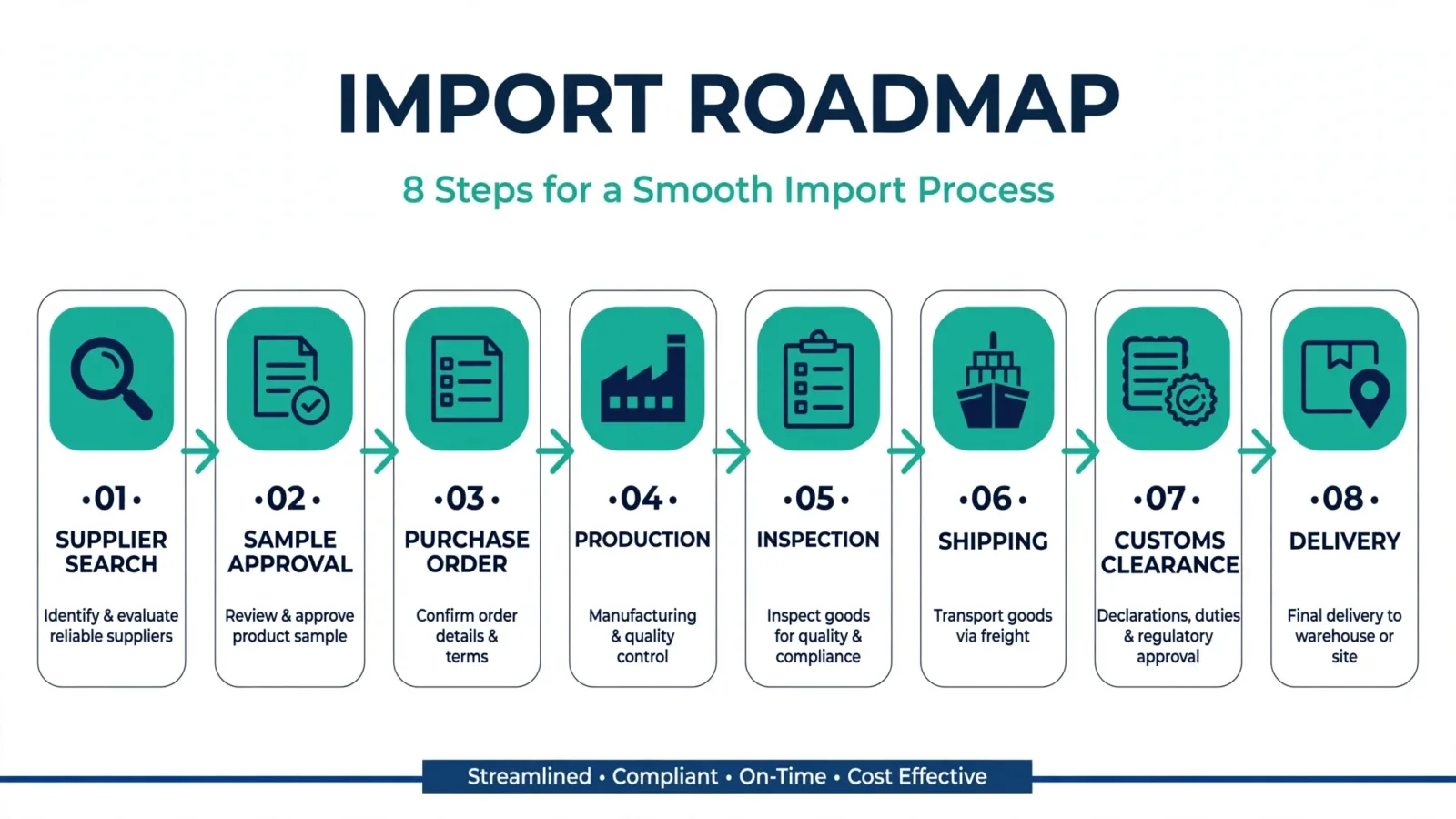
Step-by-step import checklist
Use this checklist in order.
Define the product in a written tech pack: garment types, wearer, fabric composition and weight, size chart, colors, elastic, labels, individual packing and carton packing.
Confirm destination requirements: labeling, fiber and care declarations, any testing duties, and the indicative HS heading for each garment type.
Shortlist suppliers against the same specification and compare written quotations on the same Incoterm basis, including MOQ per style and color. A structured request helps; see how to write an RFQ.
Verify the chosen supplier: business and export documents, production factory, current similar production, and any audit or test evidence your program requires.
Approve samples in stages, ending with a sealed pre-production sample in the correct fabric, colors, elastic, labels and packing, with comments accepted in writing.
Confirm classification and duty with your customs broker in an official tariff source, and build landed cost from written freight, duty and clearance figures.
Place the purchase order covering the specification version, quantities per size and color, price and validity, Incoterm and named place, timelines, inspection, document set, payment terms and the correction process for a failed inspection.
Monitor production against the agreed stages, resolve questions against the approved sample and tech pack only, and carry out in-process checks where required.
Complete a pre-shipment inspection of finished, packed goods, with measurements, photographs and defect counts. Correct and re-inspect any failures.
Check draft shipping documents for consistency, confirm freight on the agreed terms, and give your broker the full document set before arrival.
Clear the goods, pay duty and taxes as assessed, deliver to your warehouse, and check goods in against the packing list and the approved sample.
Review the order: record what matched, what was corrected and what to change in the tech pack, so the repeat order starts from evidence.
In short: specification first, verification before payment, approval before bulk, inspection before shipment, and documents checked before arrival.
FAQs
What is the typical MOQ for knitted underwear from Bangladesh?
There is no single typical MOQ across this category. MOQ is quoted per program, usually per style and often per color, driven by fabric knitting and dyeing, elastic and trim minimums, the size and color range, and packing. A plain core style will be quoted differently from a custom-dyed, multi-size program with branded elastic. Ask each supplier for the MOQ in writing for your exact tech pack, what drives it, and what would change at a lower quantity.
How long does shipping take?
Shipping time has two parts: production time (sampling, approval, fabric preparation, production, inspection and packing, each stated by stage in writing) and transit (your forwarder's estimate for the specific route booked, plus clearance and delivery). Neither part has a single standard number. Get staged dates and a freight quote on your actual carton volume, add buffer, and work backward from your warehouse date.
What import duty applies?
Duty depends on the exact garment, its fiber composition, its full tariff classification and your destination's current tariff, not on the product name alone. Men's and boys' knitted underpants and briefs generally sit under HS heading 6107 and women's and girls' briefs and panties under 6108, with subheadings split by fiber, while undershirts may fall under other headings.7 Confirm the code and current rate with your broker in the official tariff for your market, such as the USITC HTS, EU TARIC or the UK Trade Tariff, before you finalize a selling price, and budget at the standard rate unless a preference claim and its evidence are confirmed.
How do I verify a supplier?
Verify in documents, in product and, where possible, in person or by proxy. Check that registration, export credentials, factory address and the name on the quotation, documents and payment account are consistent. Examine samples of current similar production for stitch quality, elastic recovery and finishing, and confirm any required audit or test report from a current document you can check with the issuer. Keep approvals in writing, and treat unexplained very low prices, unnamed production sites or pressure to pay before sample approval as questions to answer before you order.
Next steps on Exportain
Start by posting your program as a free RFQ with the garment types, fabric, sizes, colors, packing and destination stated, so suppliers quote against the same brief. Browse the supplier directory to build your shortlist, and follow the steps in how to buy on Exportain to keep inquiries, samples and approvals in one written trail.
Sources
- Exports fetch $48.28b in FY25. The Financial Express, (accessed )
- BKMEA at a Glance. BKMEA (accessed )
- SIST ISO 2859-1:2003 - Sampling procedures for inspection by attributes, Part 1: Sampling schemes indexed by acceptance quality limit (AQL). International Organization for Standardization, (accessed )
- Incoterms® rules. International Chamber of Commerce (ICC) (accessed )
- Harmonized System. European Commission, (accessed )
- An Overview of Harmonized System Codes. U.S. Department of Commerce, International Trade Administration, (accessed )
- Harmonized Tariff Schedule of the United States, Chapter 61. U.S. International Trade Commission (accessed )
- EU Customs Tariff (TARIC). European Commission, Taxation and Customs Union (accessed )
- Support for LDC graduation. United Nations (accessed )
- Incoterms
- export documents
- MOQ
- quality control
- HS Codes
- buyer guide
- Bangladesh sourcing
- bangladesh garments
About the author
Sourcing from Bangladesh?
Post a request for quotation and suppliers on Exportain can send you their quotes directly.
Post an RFQ


