

The Industrial Equipment & Lighting Industry in Bangladesh: Capacity, Clusters and Key Players
Engineering product exports were USD 535.56 million in fiscal 2025 on EPB data. This pillar covers transformers, machinery parts and LED lighting, clusters, supplier checks, MOQ and quality.
Short answer
The industrial equipment industry in Bangladesh covers power equipment, machinery and parts, motors and generators, and industrial and domestic lighting, made by large plants and an estimated 50,000 light engineering enterprises. Engineering product exports were USD 535.56 million in fiscal 2025 on EPB data. Buyers source it by fixing a rated specification or drawing, checking the producing site and its test evidence, and agreeing price, minimum quantity and lead time per product in writing.
On this page
Key takeaways
Engineering product exports were USD 535.56 million in fiscal 2025 on EPB data, up 10.03 percent, and grew 26.17 percent to USD 315.52 million in the first half of fiscal 2026.
The industry is built for the home market: domestic demand for engineering products was put at USD 8.2 billion, with nearly half met locally through more than 3,800 types of machinery, parts and tools.
Only 18 percent of light engineering enterprises use CNC or modern process equipment and only 12 percent hold ISO or BDS certification, so machine and test capability must be checked firm by firm.
There is no single typical MOQ, price or lead time in this category; all three are quoted per supplier, per model and per rating against a written specification or drawing.
If you buy transformers, switchgear, machinery parts or industrial lighting for projects, distribution or your own product range, the industrial equipment industry in Bangladesh deserves a place on your sourcing map. It is not a single factory type. Large power equipment plants, thousands of light engineering workshops and newer LED lighting factories operate under the same heading, but they machine, assemble, test and certify in very different ways.
This guide explains how the industry is organised, where its clusters sit, and how an overseas buyer can find, check and work with suppliers. It gives no single typical price, minimum order quantity or lead time, because none exists across a category that runs from a machined spare part to a substation transformer.
Market overview with latest data
Start with the export figures, and read them at the level the Export Promotion Bureau (EPB) reports them. The EPB groups this trade inside engineering products. For the first half of fiscal year 2026, July to December, EPB data put engineering product exports at USD 315.52 million, up 26.17 percent year on year and the strongest growth among the groups reported, supported by higher shipments of electric products, bicycles and copper wire.1 In the same half year, total merchandise exports were USD 23.99 billion, down 2.19 percent, and ready-made garments were USD 19.37 billion.1 Industrial equipment is a diversification line, not yet a large share of national exports.
The full-year picture for fiscal 2025 points the same way. A sector analysis of EPB monthly export data put engineering product exports at USD 535.56 million in fiscal 2025, up 10.03 percent from USD 486.75 million in fiscal 2024, equal to 1.11 percent of total export earnings of USD 48.28 billion.2 The same analysis records an estimated 50,000-plus light engineering enterprises, producing machine parts, agricultural implements, electrical fittings and industrial components.2
Bangladesh Bank tells a complementary story through the banking channel. Its annual publication for 2024-25 records total export receipts for goods of USD 43,559.3 million, of which ready-made garments were USD 37,218.0 million, or 85.4 percent.3 Bangladesh Bank states that its receipts figures can differ from customs-based and EPB figures because of differences in valuation, timing and coverage, since receipts are recorded when proceeds are received through banks.3 Read the EPB series for shipment momentum and the Bangladesh Bank series for money actually received. See Bangladesh export data.
Three structural points sit behind the numbers. First, the domestic market is the anchor. The president of the Bangladesh Engineering Industry Owners Association (BEIOA) put domestic demand for engineering products at USD 8.2 billion, with nearly half met locally through more than 3,800 types of machinery, spare parts, tools, dies, moulds and engineering accessories.4 Export orders usually go to firms whose main volume is domestic. That helps when steady volume keeps workshops staffed, and it hurts when your specification differs from the domestic standard product, because a differing specification is a special run and must be priced as one.
Second, the industry is input-dependent. Steel, cast iron, copper, electrical steel, electronic drivers and LED components are imported in whole or in part for many product lines, so quotations move with metal prices, exchange rates and component lead times. Ask every supplier which inputs it makes, buys domestically and imports.
Third, capability is uneven, and the gap is measurable. The sector analysis found that only 18 percent of light engineering enterprises use CNC or modern process equipment, and only 12 percent hold ISO or BDS certification.2 The industry can make a very wide range of products, but the supplier whose tolerances and paperwork match your market has to be identified firm by firm.
Main products and production clusters
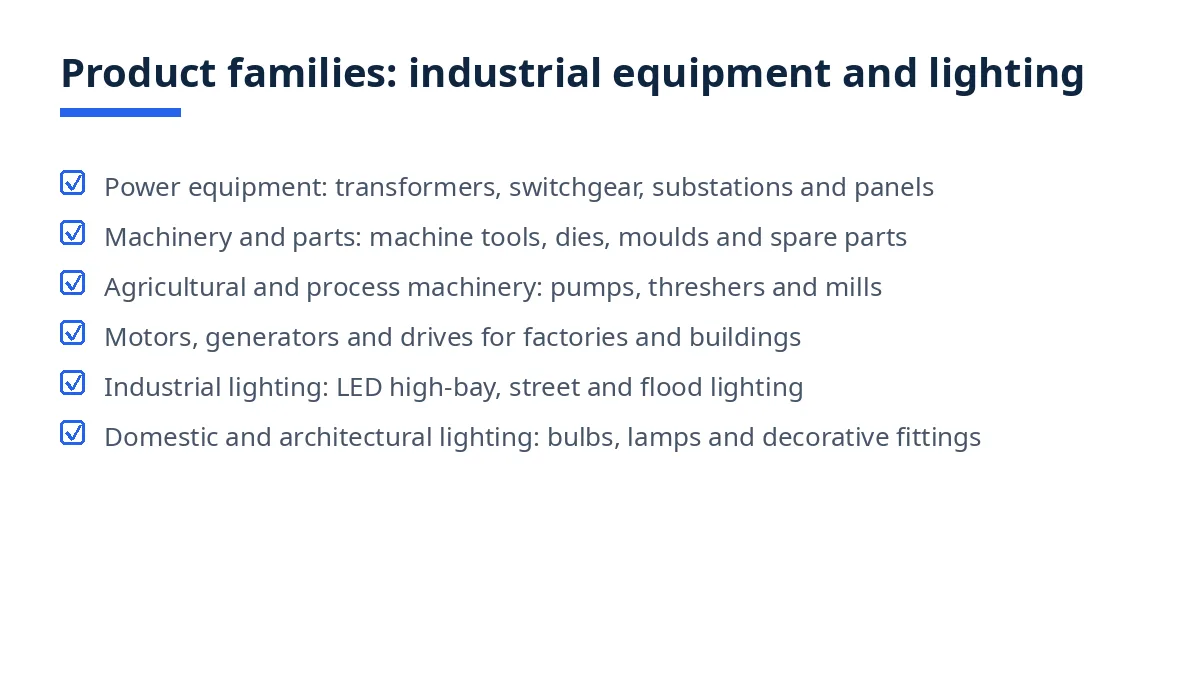
The offer groups into product families. Each family uses different machinery, inputs and tests, and a supplier strong in one family may not produce another. Fix your family first, then look for names.
Power equipment. Transformers, switchgear, substations, control and relay panels, busbar systems and circuit breakers, judged on rated voltage, capacity in kVA or MVA, losses, insulation level and routine test results. A transformer is bought on its test certificate, not on its paintwork, because two units with identical nameplates can carry different losses.
Machinery, parts and tools. Machine parts, spare parts for textile, jute and paper machinery, dies, moulds, gears, shafts and fabricated items, judged on drawing accuracy, material grade, hardness and surface finish. This is the classic work of the workshop clusters, often produced to a sample or a drawing rather than to a catalogue.
Agricultural and process machinery. Rice threshers, mills, centrifugal pumps, tube wells, power tiller parts and feed machines, judged on duty point, material of construction and spare part availability. Much of this production began as import substitution for the home market.
Motors, generators and drives. Single-phase and industrial motors, diesel generators, pumps and voltage regulation equipment, judged on output at the stated duty, fuel or energy consumption, insulation class and noise. Rating plates and test reports must match the exact model and voltage you will sell.
Lighting. LED high-bay lights, street lights, floodlights, bulbs, lamps, battens and decorative fittings, judged on measured lumens, colour temperature, ingress protection and driver quality. A luminaire, a lamp and a bare LED module are three different products with three different price bases. See trade lighting suppliers in Bangladesh.
Where the clusters are
Production is clustered, and the cluster tells you what a supplier is set up to do. Light engineering enterprises spread across the country and clustered in Dhaka, Chattogram, Bogra, Jessore and Khulna, with Dholaikhal and Jinjira in Dhaka becoming the best known sites of the sector.5 The Bogura cluster, centred on an estate of the Bangladesh Small and Cottage Industries Corporation (BSCIC), is associated with foundries and agricultural machinery, while the Dhaka clusters grew around machining, repair work and spare parts.5
Above the workshop tier sit the industrial estates and export processing zones, where larger power equipment and lighting plants operate with their own testing facilities. Heavy goods such as transformers are made close to demand and transport links, because inland transport is a real share of delivered cost. Record not only what a firm makes but where it makes it, because the producing site decides which tests can be witnessed and how the goods reach the port.
How to read key players
Use named companies as evidence of what the industry can produce.
Energypac Engineering Ltd signed a USD 5 million contract with Adex Corporation to supply 15 transformers, each with a capacity of 20/28 MVA, for a power distribution project of the Northern Electricity Supply Company Limited (NESCO), funded by the Asian Development Bank.6 The same report records that the company specialises in designing, manufacturing, supplying, installing and commissioning transformers, substations, switchgear and other electrical systems.6 The useful facts are the product range and the unit size. They say nothing about whether a given rating or price fits your programme, which only a direct enquiry settles.
In lighting, Ecolet (Pvt) Limited signed an agreement with the Bangladesh Export Processing Zones Authority (BEPZA) to invest USD 15.91 million in an LED products facility in the BEPZA Economic Zone at Mirsharai, Chattogram, with an annual capacity of 6 million LED bulbs and lamps, plus decorative lighting.7 The facility will mainly serve export markets, with the United States, the United Kingdom, the European Union and the Middle East named as key destinations, and is expected to create jobs for 306 Bangladeshi nationals.7
The February 2026 Bangladesh Light Engineering Expo, organised by BEIOA with support from the Ministry of Commerce and the World Bank-backed Export Competitiveness for Jobs project, shows the range in one place: its exhibits covered construction and packaging machinery, agricultural equipment, electrical goods, jute and textile machinery parts, automobile components, dies and moulds.4 Beyond these examples, this guide names no further companies, because company claims change with models and markets. Build your long list from the category directory and trade sources, then verify each name directly.
Classification decides the duty line
Classify each product before you negotiate the final price, because the code decides the duty line. Heading 8504 covers electrical transformers, static converters and inductors, and the United Kingdom Integrated Online Tariff splits it by construction and rating, with transformer capacity bands running from not exceeding 1 kVA to exceeding 500 kVA, and a third-country duty of 0.00 percent across the transformer lines shown.8
Product family | Indicative heading | What decides the exact line |
|---|---|---|
Transformers and converters | 8504 | Type of transformer and power handling capacity in kVA |
Switching and protection apparatus | 8536 and 8537 | Voltage, function, and whether the item is a device or an assembled board |
Motors and generators | 8501 and 8502 | Output, current type, and whether the item is a motor or a generating set |
Pumps and compressors | 8413 and 8414 | What is moved, liquid or air, and the duty and drive type |
LED lamps and luminaires | 8539 and 9405 | Whether the item is a lamp with a cap or a complete luminaire |
Read the table as indicative only. Confirm the full national code in the destination tariff, and read the HS code and Harmonized System explainer for the heading structure.
How to find and verify suppliers
Start from your specification, not from a supplier list. For industrial equipment the specification is a rated or drawn document. Write down the product family, the standard or drawing you are buying to, rated voltage and frequency, capacity or duty, materials and grades, dimensions and tolerances, protection ratings, labelling, quantities per model, packing and the test evidence you require. A precise enquiry gets comparable quotes. See how to write an RFQ and finding suppliers in Bangladesh.
Build a shortlist from more than one route: the Exportain category directory, trade data for your HS heading, sector expos and referrals. However you find a name, run the same verification sequence:
Identity. Match the legal name, trade licence details and factory address across the supplier's documents and its online presence. Resolve any inconsistency in writing before you discuss price.
Producing site. Record which plant makes your product and which stages are bought in: castings for parts, cores and windings for transformers, drivers and housings for lighting. Subcontracted stages are common and workable. An unexplained chain is the problem.
Machine and test capability. Ask which machines will produce your order and which tests the site can run in house. Given that only a minority of light engineering enterprises run CNC equipment or hold ISO or BDS certification,2 ask directly, and ask which tolerances the supplier can hold repeatedly, not once.
Test evidence for the exact model. Ask for test reports and certificates that name your model, your rating and the producing site. A certificate for a different capacity is background only.
Export readiness. Ask which markets the supplier ships this family to and which documents it prepares as a routine. See export documents from Bangladesh.
Registration. Ask for the export registration position and read the ERC export registration certificate guide so you know what the certificate shows.
Samples and prototypes. For parts, order a prototype against your drawing and measure it: dimensions, hardness and fit. For rated equipment, witness or commission the routine tests on a sample unit. A sample that is only photographed has not been tested.
Independent checks. For larger programmes, use an independent inspection company for a factory audit or a pre-shipment inspection. Use a video walk-through as a first screen only.
Payment discipline. Agree payment terms that match the risk of a new relationship. Confirm bank details through a second channel before paying, and treat any late change of bank details as a reason to pause and re-verify.
Warning signs include a quote far below every comparable offer for the same specification, refusal to send samples or test reports, pressure to pay quickly to a personal account, reluctance to identify the producing factory, and certificates that name a different company, site, model or rating. Add one more: a workshop willing to copy any part or print any rating you ask for, without asking about material or test evidence, is telling you how it will handle your compliance file.
MOQ, pricing and lead times
Buyers routinely ask for one typical minimum order quantity (MOQ), one typical price and one typical lead time. None of the three exists as a single figure for this category. Each is quoted per supplier, per model and per rating against a written specification or drawing. See MOQ minimum order quantity.
MOQ is driven by the smallest workable lot at each stage: casting and machining lots for parts, core and copper lots for transformers, component reels for lighting, and label print runs for private-label goods. A standard domestic-model pump will normally carry a lower minimum than the same pump built for a different voltage with your label, because the second version is a separate production run. For machined parts, many workshops will machine a small prototype lot to a drawing and price repeat lots separately. Expect minimums per model, per rating and per drawing revision, not only per order.
Pricing is built from material cost, machining or conversion, testing, packing, inland transport and the export margin, then expressed on the agreed delivery term. Steel, copper and aluminium prices move quotations, so export quotes carry validity periods. Compare quotations only on an identical specification sheet, and ask each supplier to state what its price includes, the currency and the validity date.
Delivery terms decide who pays for which leg, so quotations on different terms are not comparable until you adjust them. The Incoterms rules published by the International Chamber of Commerce are eleven three-letter trade terms used in contracts for the sale and purchase of goods, and they clarify the tasks, costs and risks involved in delivering goods from sellers to buyers.9 Incoterms 2020, the current version, entered into force on 1 January 2020.9 Read Incoterms for shipments from Bangladesh and EXW ex works before comparing an ex-works price with a free on board price.
For method only, consider this comparison. Example figures: two transformer suppliers quote for the same specification, one at USD 8,400 per unit EXW and one at USD 8,750 per unit FOB. Adding inland transport, export handling and loading of USD 310 per unit to the EXW quote gives a like-for-like FOB cost of USD 8,710 per unit, so the real gap is USD 40 per unit, not USD 350. Use the same adjustment with the landed cost for imports from Bangladesh method.
Lead times cover material purchase, casting or component supply, production, testing, packing and transport to port, on top of sample approval time. Imported inputs are the usual long pole: a workshop can be free while the order waits for bearings, electrical steel or LED drivers. Build your plan backwards from your required delivery date, add buffer for re-testing, and confirm the production slot and material position in the purchase order.
Quality, certifications and compliance
Industrial equipment fails in ways that cost money and, for power equipment, create safety risk: a transformer whose losses exceed its nameplate values, a machined part whose hardness is wrong for its duty, and a luminaire whose output falls short of the carton claim. A quality plan names each risk and the check that controls it, and attaches the specification or drawing to the purchase order so the standard becomes part of the contract.
Specify measurable quality. For transformers, define capacity, voltage ratio, losses, impedance and temperature rise, and the routine tests each unit must pass. For machined parts, define material grade, dimensions with tolerances, hardness and surface finish on the drawing. For lighting, define measured lumens, colour temperature, power factor and ingress protection. Vague words such as heavy duty cannot be inspected. Numbers and a test method can.
Domestic standards: BSTI. The Bangladesh Standards and Testing Institution (BSTI) operates the national standardisation mark. In October 2023 the mark was made mandatory for 36 further products, taking the mandatory total to 274 products, including lead-acid batteries, uninterruptible power systems (UPS) and single-phase small AC electric motors.10 To use the mark, producers first have their product standards tested at BSTI, and BSTI inspects the factories, collects samples and tests those samples in its laboratories before issuing licences.10 If your product is on the list, ask for the licence for your factory and model. A BSTI licence does not replace your destination market approval.
Destination compliance is yours to define. Many products require CE marking before they can be sold in the European Union, and the Your Europe guidance lists electrical and electronic equipment and some kinds of machinery among the product groups covered by CE marking laws.11 The manufacturer is responsible for ensuring that a product meets all applicable EU requirements and for affixing the CE marking, and where a product is made for you and sold under your own name or brand, you are treated as the manufacturer.11 There is no central EU body that issues permission to use the mark: the manufacturer identifies the relevant requirements, decides whether self-assessment is allowed or a notified body is required, gathers compliance evidence and signs an EU declaration of conformity.11 Write the applicable requirements into your specification.
Test at the right stages. Approve a pre-production sample or prototype in the correct rating, require routine test records from production, then inspect before shipment against the approved sample. Agree the sampling method and defect limits in the order itself. ISO 2859-1:2026 defines a system of acceptance sampling plans for inspection by attributes, indexed by acceptance quality limit (AQL), for lot-by-lot inspection, and the AQL is the maximum average percentage of defective items considered acceptable during random sampling.12 See AQL acceptance quality limit and pre-shipment inspection. Add functional testing: energise packed units, run motors under load, and switch on packed luminaires.
Shipping, Incoterms and duties
Industrial equipment ships in mixed forms: transformers and machinery crated in containers, parts and lighting in palletised cartons by sea, and samples and urgent spares by air. Packing is part of the product decision. Transformers must be protected against moisture and transit shock, machined surfaces against corrosion, and cartons marked with rating information that matches the documents. Agree crate dimensions, gross weights and lifting points before the price is fixed, because oversize units change the freight basis.
Choose the delivery term deliberately. Under EXW, you arrange and pay for almost everything from the factory gate. Under FOB, the supplier delivers the goods on board the vessel at the named Bangladeshi port and you control the main freight. Under CIF, the supplier arranges and pays freight and minimum insurance to your named destination port, while risk still passes when the goods are loaded. Under DAP, the goods are brought to a named place in your country without import clearance, and under DDP, duties and clearance sit with the seller as well. The Incoterms rules exist to clarify exactly these tasks, costs and risks.9 Name the port or place precisely in the purchase order and the invoice.
Duties and market access must be checked, not assumed. Duty depends on the HS classification, your destination tariff and any preferential scheme that applies to Bangladesh at the time of import. Arrangements differ between the EU, the UK, the USA and the UAE, and they change. Classify first: within heading 8504 alone, the United Kingdom lists a third-country duty of 0.00 percent across the transformer lines shown, before any preference.8 Then confirm the current duty in your destination tariff or with your broker, before you calculate landed cost.
Documents decide whether goods move. Bangladesh Customs requires an export declaration, known as a Bill of Export or Shipping Bill, to be submitted and approved before goods are loaded for export, with documents enclosed that include the export letter of credit or, where there is none, the export contract or purchase order, a commercial invoice with a detailed description of the goods, a packing list with quantity, weight and packing information, an EXP form certified by an authorised dealer bank, a certificate of origin issued by the EPB or a chamber of commerce, a VAT registration certificate and a taxpayer identification number.13 Require a consistent set for every shipment, and check names, HS codes, ratings and quantities across every document as soon as drafts arrive.
Step-by-step buying process
Define the range. Fix product families, rated specifications or drawings, standards, labelling, packing and destination.
Research the market. Check current EPB and Bangladesh Bank data before you negotiate, and record which series each figure came from.
Classify each product. Confirm the indicative heading, then the full national code and duty line in your destination tariff.
Shortlist and check suppliers. Run the identity, producing-site, machine capability, test-evidence and registration checks in this guide.
Request comparable quotations. Send the identical specification or drawing to each supplier, and require delivery term, currency, validity, MOQ and lead time.
Sample, prototype and test. Approve samples in your rating, measure prototypes against the drawing, run functional tests, and seal a counter-sample.
Agree the contract. Issue a purchase order with the full specification, tolerances, test and document list, inspection rights, payment terms and delivery term.
Control production. Confirm the production slot and material position, and resolve any substitution request in writing before it happens.
Inspect before shipment. Commission an independent inspection against the sealed sample, including functional tests on packed units, and release shipment only on a pass or an agreed corrective action.
Ship, clear and review. Check document drafts early, clear customs with your broker using the confirmed classification, then review the delivered goods.
Related guides
Use the electrical products industry guide when your enquiry covers cables, appliances or solar alongside industrial equipment, and the industrial electronics supplier guide when electronics content dominates. Use Bangladesh export data to read EPB and receipts figures without mixing the two series.
FAQs
Is Bangladesh a good place to source industrial equipment and lighting?
It can be, when the supplier and the specification are right. Engineering product exports grew 26.17 percent to USD 315.52 million in the first half of fiscal 2026 on EPB data,1 the industry produces more than 3,800 types of machinery, parts and tools for a domestic demand put at USD 8.2 billion,4 and new export-focused LED capacity is being built at Mirsharai.7
What is the typical MOQ?
There is no single typical MOQ for this category. Minimums are set by casting, machining and component lots and by label print runs, and are normally quoted per model, per rating and per drawing revision. Ask each supplier to state its MOQ against your exact specification.
How long is the lead time?
Lead time is product- and material-specific. It covers material purchase, casting or component supply, production, testing, packing and transport to the port, after sample approval. Imported inputs such as bearings, electrical steel and LED drivers are the usual constraint. Require a written lead time for your specification and confirm the production slot in the purchase order.
Which certifications matter?
It depends on your market and your product. In Bangladesh, check the BSTI position first: the mark is mandatory for 274 products, including lead-acid batteries, UPS units and single-phase small AC motors.10 For the European Union, electrical and electronic equipment and some kinds of machinery sit among the product groups covered by CE marking laws, and the manufacturer, which includes a business that has a product made and sells it under its own brand, carries the compliance duty.11 Check the holder, site, scope and expiry date on every certificate a supplier sends.
Next steps on Exportain
Start with how to import from Bangladesh for the full buying sequence, then use finding suppliers in Bangladesh to build a shortlist against your rated specification or drawing.
Sources
- July-Dec: The export draggers and pullers. TOB News, (accessed )
- Bangladesh Light Engineering Sector Analysis. BDPolicyLab, (accessed )
- Annual Export Receipts of Goods and Services 2024-25. Bangladesh Bank (accessed )
- Three-day Light Engineering Expo to begin in Dhaka on February 2. The Financial Express, (accessed )
- Light engineering products: From local workshops to export baskets. The Business Standard, (accessed )
- Energypac signs $5m transformer supply deal with Adex. The Business Standard, (accessed )
- Ecolet to Invest $15.91M in LED Manufacturing in Bangladesh. Invest Bangladesh (accessed )
- Electrical transformers, static converters and inductors - UK Integrated Online Tariff, Heading 8504. GOV.UK (accessed )
- BSTI mark mandatory for 36 more products. The Daily Star, (accessed )
- Incoterms® rules. International Chamber of Commerce (ICC) (accessed )
- CE marking – obtaining the certificate, EU requirements. European Union (accessed )
- ISO 2859-1:2026 - Sampling procedures for inspection by attributes — Part 1: Sampling schemes indexed by acceptance quality limit (AQL) for lot-by-lot inspection. ISO (accessed )
- Customs Clearance Procedures for Export. Bangladesh Customs, National Board of Revenue (accessed )
- Bangladesh Export Data
- Category Pillars
- Supplier Sourcing
- Electrical equipment
- LED lighting
- Industrial equipment
- Light engineering
About the author
Sourcing from Bangladesh?
Post a request for quotation and suppliers on Exportain can send you their quotes directly.
Post an RFQ


