Trade Lighting Suppliers Bangladesh: 2026 Buyer's Guide
How to source trade lighting from Bangladesh: define the photometric specification, verify suppliers, BSTI position and certification, compare landed cost, and check EU and UK conformity before you order.
Short answer
To source trade lighting from Bangladesh, define the fitting specification first, including wattage, luminous flux, colour temperature, colour rendering index and ingress protection. Shortlist suppliers by exact product match, verify registration, BSTI position and product level test evidence, compare itemised quotations on landed cost, test samples for measured light output, and inspect before shipment.
On this page
Key takeaways
Electrical product exports rose 23.82 percent to $206.19 million in FY2025-26 on Export Promotion Bureau data, with LED lighting in the export basket.
An estimated 45 to 50 percent of products in several Bangladesh lighting categories lack BSTI approval, so check the CM licence and test report for the exact model.
From 2026, all lighting appliances in Bangladesh must meet minimum efficiency policies set by BSTI.
EU ecodesign rules cover light sources and separate control gears, while the energy label for luminaires was discontinued in 2019.
No price or lead time is usable without a specification: compare itemised quotations on landed cost and the same delivery term.
Sourcing trade lighting from Bangladesh means buying products where light output, driver quality and safety evidence decide whether an installation performs for years or fails within months. This guide is for buyers in the United States, the United Kingdom, the European Union and the United Arab Emirates. It covers how to define a specification, verify a supplier, compare costs, handle documents and check conformity for your destination.
Trade lighting covers LED bulbs and tube lights, downlights and panel lights, floodlights and spotlights, street and industrial luminaires, and their drivers and control gear. A supplier strong on bulbs may have no track record on floodlights, so every check runs against the exact product you intend to order.
Why this matters for buyers and sellers
Lighting sits inside a fast growing export category. According to Export Promotion Bureau data reported by The Business Standard, exports of electrical products rose 23.82 percent to a record $206.19 million in FY2025-26, from $166.52 million a year earlier, and the category was the largest earner among engineering products.1 The export basket includes LED lighting solutions alongside transformers, cables, switches, sockets and circuit breakers, sold to markets that now apply stricter traceability rules.1
The same reporting notes that many manufacturers source components from China and Vietnam, which makes traceability harder and puts weight on testing evidence rather than on a catalogue claim.1 For a lighting buyer, the LED chip, driver and housing decide efficiency, flicker, lifetime and safety, and those parts are exactly the ones a low price can quietly downgrade.
The domestic market shows why evidence matters. Industry insiders estimate that 45 to 50 percent of products in several lighting categories, including bulbs, tube lights, downlights, panel lights, floodlights and spotlights, are non-branded and lack BSTI approval.2 A supplier that can show certification and test reports for the exact model stands apart from that part of the market.
Step-by-step: how sourcing trade lighting works
Sourcing in this category follows a fixed sequence, and skipping a step moves cost and risk later in the order. The diagram below summarises the six stages, from defining the specification to inspection and shipment.
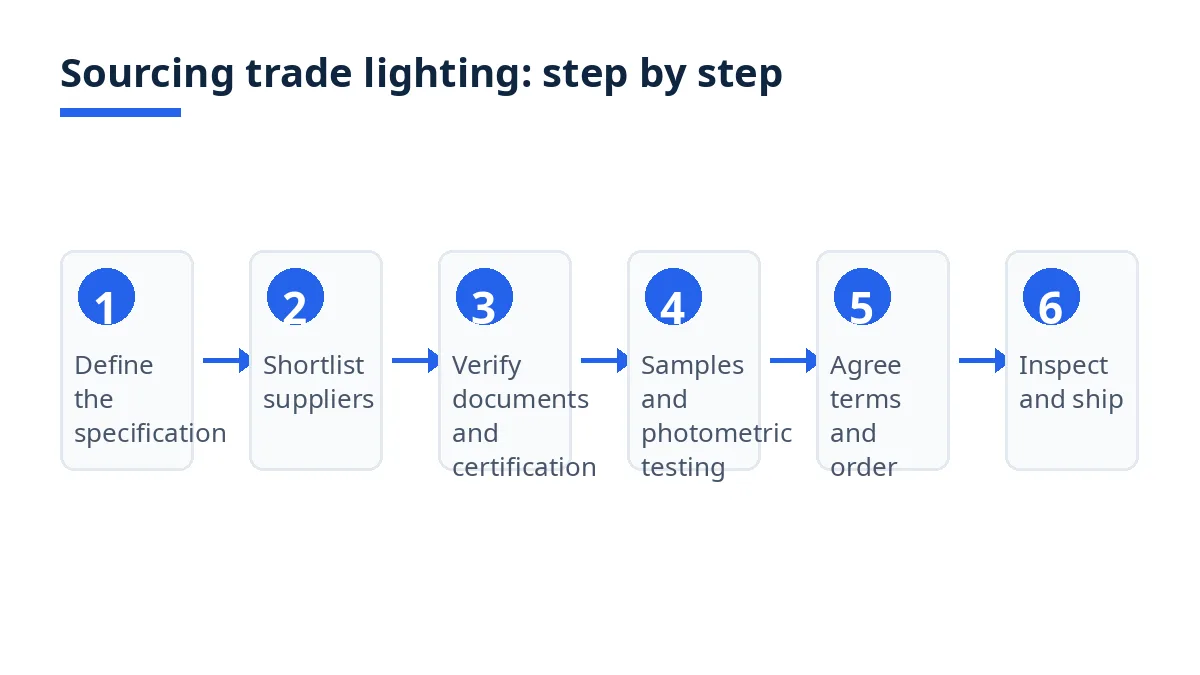
Define the specification. Write the product type, rated voltage and frequency for your market, wattage, luminous flux in lumens, efficacy, colour temperature, colour rendering index, beam angle, ingress protection rating for outdoor use, dimming requirements, quantities, packaging and labelling, and the acceptance tests the goods must pass. Under the EU ecodesign regulation for light sources, luminous flux is the total flux emitted by a light source under conditions specified in applicable standards, and the colour rendering index measures the effect of an illuminant on the colour appearance of objects against a reference illuminant.3 Use those measured terms instead of trade names such as warm white.
Shortlist suppliers by product match. Start from a category search on suppliers and from finding suppliers in Bangladesh, then filter by the exact product line. Note whether each candidate manufactures, assembles from imported kits or only trades, because that affects testing and lead time.
Verify documents and certification. Ask for the legal business name, trade licence, registration, tax identification and export registration, plus the factory address. Names and addresses should match across documents, with any difference explained in writing. Then ask for product evidence: datasheets, photometric files, test reports and certification for the exact model, not a similar model.
Samples and photometric testing. Order samples before any volume commitment. Test the sample against your specification: measured light output, power draw, colour temperature, flicker, build quality, markings and supplied documents. Keep an approved sample as the reference for inspection. For project lighting, ask for the photometric data file used for lighting design, and check that it matches the model you tested.
Agree terms and order. Send every shortlisted supplier the same specification, quantity, destination and delivery term, and require an itemised reply separating unit price, tooling, testing, packaging and freight. Record payment milestones, lead time, inspection rights, warranty, remedies and a rule that the chip, driver or housing does not change without your written approval.
Inspect and ship. Inspect before shipment against the approved sample and purchase order, covering function, light output, markings, quantity, packaging and labelling. The guides to pre-shipment inspection and AQL acceptance quality limit explain how final inspections are sampled and judged. For the wider sequence, see how to import from Bangladesh.
Costs, timelines and documents
There is no usable typical price without a specification. Two fittings both described as a 50 watt floodlight can differ several times in cost because chip grade, driver type, housing material and ingress protection rating dominate the bill of materials. Price is also driven by optics, testing scope, quantity, packaging and the delivery term. Ask each supplier for the same breakdown, then compare totals on the same basis.
Delivery terms change what a price includes. The Incoterms rules published by the International Chamber of Commerce are eleven three-letter trade terms that clarify the tasks, costs and risks involved in delivering goods from sellers to buyers.4 Incoterms 2020 is the most recent version and entered into force on 1 January 2020.4 Name the term, place and version in your purchase order.
Timelines are usually set by components and testing, not by assembly. Ask which components are stocked, which are ordered against your purchase order, and which item has the longest lead time. Add time for approval, testing, production, inspection and transit, and build the calendar backwards from the date you need the goods.
The table below shows how to build a landed cost for one order. The amounts are Example figures only, included to show the structure. Replace every line with your own quotation and checked duty treatment.
Cost element | Example figures | What drives it |
|---|---|---|
Goods, 5,000 LED panel lights, FOB | $21,500 | Chip and driver grade, quantity |
International freight and insurance | $2,100 | Route, volume, weight, term |
Testing and certification | $900 | Standards in scope, retests |
Import duty | $1,720 | Classification, value, origin |
Port, broker and clearance charges | $640 | Port, broker scope, documents |
Local delivery to warehouse | $380 | Distance, unloading needs |
Total landed cost | $27,240 | Sum of the lines above |
Landed cost per panel light | $5.45 | Total divided by saleable units received |
Use the per unit landed cost, not the factory price, when you set your selling price or compare suppliers.
Documents fall into three groups. Company documents include the trade licence, registration, tax identification and export registration. Product documents include datasheets, photometric files, test reports and declarations for your destination. Transaction documents include the invoice, packing list, certificate of origin and transport document.
On the export side, Bangladesh Customs states that goods shall not be allowed to load for export unless an export declaration, known as a Bill of Export or Shipping Bill, is submitted and approved, and that its enclosures include the export letter of credit or approved contract, a commercial invoice, a packing list, an EXP form certified by an authorised dealer bank, a certificate of origin, a VAT registration certificate and a taxpayer identification number.5 Model numbers, quantities and weights should read the same on every document.
Bangladesh-specific rules and tips
Does your lighting product need BSTI certification
For products covered by mandatory certification requirements, a Bangladesh Standards and Testing Institution (BSTI) certification mark (CM) licence indicates that the product has been assessed against prescribed standards.2 Reporting advises buyers to check CM licence information before purchase, and to check wattage and lumen information rather than relying on packaging claims.2 Ask whether your exact product is listed, ask for the licence covering that product and factory, and check that model and rating match your order.
Efficiency rules are tightening as well. CLASP and BSTI have agreed to collaborate on mandatory efficiency policies for lighting appliances such as LED products, and from 2026 all lighting appliances in Bangladesh must meet minimum efficiency policies set by BSTI.6 A supplier preparing for that change should show measured efficacy data for your model.
What conformity does your destination market require
Conformity is product and market specific, and the importer carries duties that cannot be handed to the supplier by contract wording alone. For the European Union, Commission Regulation (EU) 2019/2020 lays down ecodesign requirements for light sources and separate control gears, including inside a containing product such as a luminaire.3 It also requires that light sources and control gears in containing products can be replaced with common tools and without permanent damage, unless a technical justification is provided in the technical documentation.3
Energy labelling follows a separate rule. The European Commission states that the energy label for luminaires has been discontinued since 25 December 2019 under Delegated Regulation (EU) 2019/2015, but a luminaire that meets the definition of a light source must still be registered in EPREL and bear an EU energy label.7 Check whether your product is a light source, a containing product or both.
For CE marking, the European Commission states that the manufacturer is responsible for the conformity assessment, the technical documentation, the EU declaration of conformity and affixing the CE marking, and that a product can be traded on the European Economic Area market only after those steps.8 Its six steps run from identifying the applicable directives and standards to testing the product and drawing up the declaration.8 Ask for the declaration, its test reports and rating label photos, and check that the model matches your order.
For Great Britain, GOV.UK states that businesses have the flexibility to choose UKCA or CE marking to place goods on the market in Great Britain, and its product table lists electrical equipment and ecodesign products as UKCA or CE for the Great Britain market, with CE applying in Northern Ireland.9 Confirm which marking route your importer will use before production starts.
Other destinations apply their own safety marks, voltage rules and labelling duties. Name the rules for your market in the specification.
Mistakes and red flags
Buying on unit price alone, without a chip and driver breakdown. A lower price often means a lower grade chip or driver inside the same housing, with lower efficacy and a shorter life.
Trusting the lumen figure on the box. Reporting on the Bangladesh market advises buyers not to rely solely on packaging claims, and to check wattage and lumen information.2 Ask for the test report behind the figure.
Accepting test evidence for a similar model. Ratings, reports and certificates must match the model, rating and factory in your order.
Allowing silent component substitution. Lock the chip, driver and housing in the purchase order, with changes only by your written approval.
Skipping samples and inspection to protect a delivery date. A tested sample and an inspection cost less than a failed installation.
Leaving destination conformity to the supplier. Check declarations, ecodesign status and label duties yourself, or through a testing body you appoint.
Paying to an account whose name does not match the contracting company, or paying in full in advance without milestones tied to inspection.
Red flags include inconsistent registration documents, undated test reports, a photometric file that does not match the sample, refusal of third party inspection, pressure for urgent full payment, and a price far below comparable quotations with no explanation. One flag calls for a written explanation. Several together are a reason to stop.
Checklist
Use this checklist in order, and keep the evidence in the order file.
Specification written, with wattage, luminous flux, colour data, ratings, quantities and acceptance tests.
Classification checked, and duty and tax treatment confirmed for your destination.
Shortlist built by exact product match, with maker, assembler or trader status noted.
Supplier legal identity checked, with name, address and bank details consistent.
BSTI position checked, and the CM licence and test evidence reviewed for the exact model.
Destination conformity checked: ecodesign status, label duty, declaration, reports and rating label.
Itemised quotations compared on the same specification and delivery term.
Samples tested for light output and power draw, with approval recorded in writing.
Purchase order covers milestones, component substitution, inspection, warranty and remedies.
Longest lead component identified, and the timeline built around it.
Pre-shipment inspection completed against the approved sample.
Document set checked for consistency before shipment.
How Exportain helps
Exportain is a B2B marketplace where buyers find Bangladeshi suppliers, post requests for quotation and compare replies against the same specification. Read how supplier verification works on Exportain and the trust center first. Trust badges are document and photo reviews, not factory inspections or guarantees, and they do not replace your own checks. Exportain is not a party to your contract for goods, and it does not inspect goods, book freight or clear customs.
FAQs
What should I know first about Trade Lighting Suppliers Bangladesh?
Know the exact specification first. Product type, wattage, luminous flux, colour temperature, standards, quantity and acceptance tests decide which suppliers can quote and which certificates matter. In detail, chip and driver grade drives price, imported components drive lead time and destination rules drive testing. Verification runs in layers: legal identity, factory capability, product evidence and a tested sample.
What are the typical costs and timelines?
There are no typical figures that are safe to budget from. Cost follows chip and driver grade, quantity, testing scope and delivery term, and time follows the longest lead component. In detail, compare itemised breakdowns on landed cost per saleable unit, and build timelines from stocked versus ordered components plus production and transit. The Example figures table above shows the structure, not a market rate.
Which documents are needed?
You need company, product and transaction documents: a trade licence and registration, datasheets, photometric files and test evidence, and an invoice, packing list, origin certificate and transport document. In detail, Bangladesh Customs lists the Bill of Export enclosures as the export letter of credit or approved contract, commercial invoice, packing list, EXP form, certificate of origin, VAT certificate and taxpayer identification number.5 Add the conformity documents your destination requires.
What are the most common mistakes?
The most common mistakes are buying on price alone and skipping the sample stage. In brief, compare full breakdowns, test a sample against measured light output, lock component approvals in writing and check conformity yourself. In detail, buyers also accept evidence for a similar model and trust packaging figures. The checklist above prevents each one.
Next steps on Exportain
Browse suppliers by lighting category and note which profiles match your product line, then post a structured request on RFQs with your specification, standards and destination market attached. Before you send it, read the trust center so you know what badges do and do not cover.
Sources
- Electrical, electronics exports hit record growth amid rising EU compliance hurdles. The Business Standard, (accessed )
- Uncertified LED bulbs grab half of Tk3,000cr market, squeezing compliant manufacturers. The Business Standard, (accessed )
- Commission Regulation (EU) 2019/2020 laying down ecodesign requirements for light sources and separate control gears. European Union, (accessed )
- Incoterms® rules. International Chamber of Commerce (accessed )
- Customs Clearance Procedures for Export. Bangladesh Customs, National Board of Revenue (accessed )
- Driving Energy-Efficient Lighting in Bangladesh. CLASP (accessed )
- Some online marketplaces are asking for energy labels for luminaires. Is this required by law?. European Commission, (accessed )
- Manufacturers - Internal Market, Industry, Entrepreneurship and SMEs. European Commission (accessed )
- Product regulations by sector and current approaches to product marking: UKCA and CE regimes. GOV.UK (accessed )
About the author
Sourcing from Bangladesh?
Post a request for quotation and suppliers on Exportain can send you their quotes directly.
Post an RFQ