

Industrial Electronics Supplier Bangladesh: 2026 Buyer's Guide
How to source industrial electronics from Bangladesh: define the specification, verify suppliers and certification, compare landed cost, and check EU conformity before you order.
Short answer
To source from an industrial electronics supplier in Bangladesh, define the exact product specification first, including ratings, standards and acceptance tests. Shortlist suppliers by product match, verify registration and export documents, check certification and test evidence for that item, compare itemised quotations on the same delivery term, approve samples, and inspect a pilot batch before placing a volume order.
On this page
Key takeaways
Electrical product exports rose 23.82 percent to $206.19 million in FY2025-26, per Export Promotion Bureau data reported in 2026.
Match the supplier to the exact product: capability in cables does not prove capability in control panels or board assembly.
Verify in layers: legal identity, factory capability, product level test evidence, then a sample or pilot batch before volume.
No price or lead time is usable without a specification: compare itemised quotations on landed cost and the same delivery term.
BSTI mandatory certification covers listed electrical and electronics products, and EU buyers must also check CE and ecodesign duties.
Sourcing industrial electronics from Bangladesh means buying products where a specification error can stop a production line, void a warranty or fail a market inspection. This guide is for buyers in the United States, the United Kingdom, the European Union and the United Arab Emirates. It covers how to define the product, verify a supplier, compare costs, handle documents and check conformity for your destination.
Industrial electronics covers drives and controllers, transformers and power supplies, switchgear and circuit breakers, control panels, sensors, wire and cable, board assemblies, batteries and industrial lighting. A supplier strong on cable may have no track record on control panels, so every check is run against the exact item you intend to order.
Why this matters for buyers and sellers
Electrical products are now the largest part of Bangladesh engineering exports. According to Export Promotion Bureau data reported by The Business Standard, exports of electrical products rose 23.82 percent to a record $206.19 million in FY2025-26, from $166.52 million a year earlier, and the category was the largest earner among engineering products, while engineering exports overall rose 21.77 percent to $652.15 million.1 A second report based on Export Promotion Bureau data put electrical and electronic equipment at $189.29 million in the July to May period of FY2025-26, up 22.23 percent, within engineering exports of $598.12 million.2
The reported export basket includes power transformers, electric cables and insulated wires, switches, sockets, circuit breakers and LED lighting, alongside appliances, batteries, transistors and semiconductor devices, exported to more than 60 countries.1 2
For buyers, growth improves choice but does not remove selection risk. Local value addition ranges between 30 percent and 70 percent by product category, and a substantial share of components, including semiconductors, printed circuit boards and integrated circuits, is still imported.2 You need to know which parts are made in house, which are bought in, what testing happens before dispatch and what evidence supports the rating on the nameplate.
Step-by-step: how sourcing works
Sourcing in this category follows a fixed sequence, and skipping a step moves cost and risk later in the order, where both are harder to control. The diagram below summarises the six stages, from defining the specification to inspection and shipment.
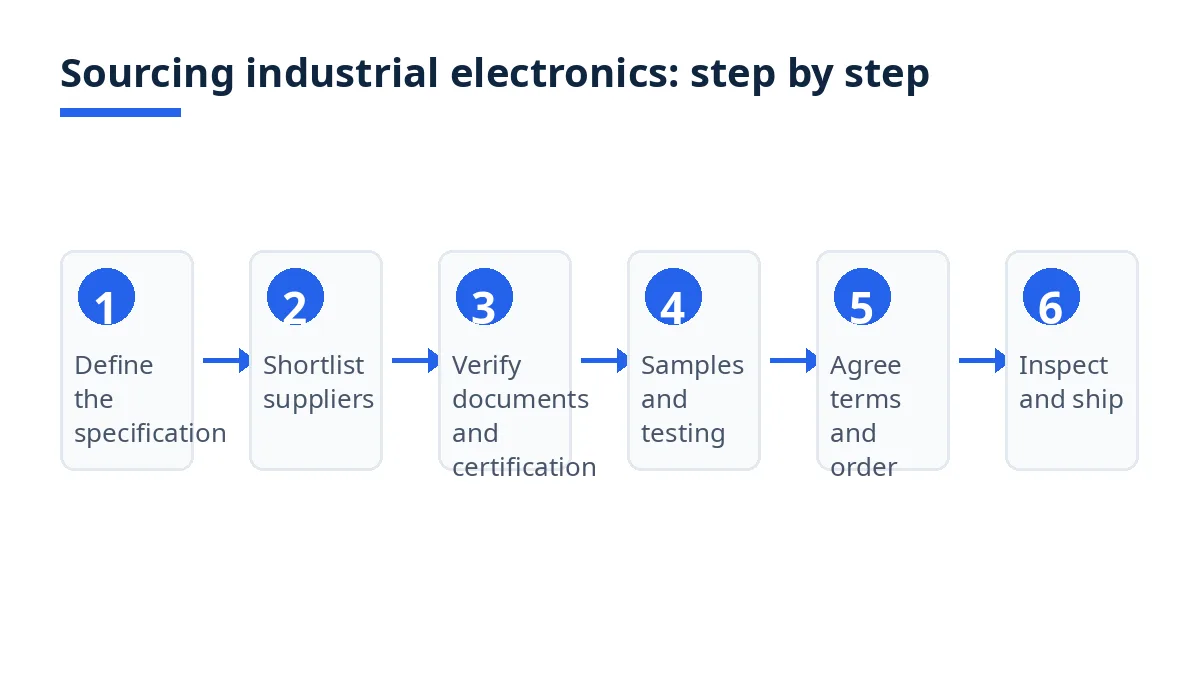
Define the specification. Write the product type, rated voltage and frequency for your market, current and load ratings, enclosure rating where relevant, operating environment, the standards the product must meet, quantities, packaging and labelling, and the acceptance tests the goods must pass. Attach drawings where you have them. A vague enquiry produces quotations that cannot be compared.
Shortlist suppliers by product match. Start from a category search on suppliers and from finding suppliers in Bangladesh, then filter by the exact product line. Note whether each candidate manufactures, assembles or only trades, because that affects testing, lead time and accountability.
Verify documents and certification. Ask for the legal business name, trade licence, registration, tax identification and export registration, plus the factory address. Names and addresses should match across documents, with any difference explained in writing. Then ask for product level evidence: datasheets, test reports and any certification covering the exact model, not a similar model.
Samples and testing. Order samples or a pilot batch before any volume commitment. Test the sample against your specification: ratings, function, build quality, markings and the documents supplied with it. Keep an approved sample as the reference for inspection. For high value or high safety risk orders, use independent testing in proportion to the risk.
Agree terms and order. Send every shortlisted supplier the same specification, quantity, destination and delivery term, and require an itemised reply separating unit price, tooling or setup if any, testing, packaging and freight. Record payment milestones, lead time, inspection rights, warranty, remedies and a rule that no critical component changes without your written approval.
Inspect and ship. Inspect before shipment against the approved sample and purchase order, covering function, ratings and markings, quantity, packaging and labelling. The guides to pre-shipment inspection and AQL acceptance quality limit explain how final inspections are sampled and judged.
For the wider import sequence, see how to import from Bangladesh.
Costs, timelines and documents
There is no usable typical price without a specification. Two products both described as a control panel can differ several times in cost because the brand and grade of contactors, drives and controllers dominate the bill of materials. Price is driven by component grade and origin, metal content, enclosure rating, testing scope, quantity, customisation, packaging and the delivery term quoted. Ask each supplier for the same breakdown, then compare totals on the same basis.
Delivery terms change what a price includes. The Incoterms rules published by the International Chamber of Commerce are a set of eleven three-letter trade terms for the sale and purchase of goods, and they clarify the tasks, costs and risks involved in delivering goods from sellers to buyers.3 Incoterms 2020 is the most recent version and entered into force on 1 January 2020.3 Name the term, place and version in your purchase order.
Timelines are usually set by components, not by assembly. Many manufacturers source components and raw materials from China and Vietnam, so lead time depends on those supply chains as well as on local capacity, and traceability is harder where inputs are imported.1 Ask which components are stocked, which are ordered against your purchase order, and which item has the longest lead time. Build your calendar backwards from the date you need the goods, adding production, testing, inspection, documentation, transit and clearance, with a buffer for rework.
The table below shows how to build a landed cost for one order. The amounts are Example figures only, included to show the structure. Replace every line with your own quotation, freight quote and checked duty and tax treatment.
Cost element | Example figures | What drives it |
|---|---|---|
Goods, 100 control panels, FOB | $18,000 | Component grade, quantity, customisation |
International freight and insurance | $1,900 | Route, volume, weight, delivery term |
Testing and certification | $850 | Standards in scope, laboratory, retests |
Import duty | $1,440 | Classification, customs value, origin |
Port, broker and clearance charges | $620 | Port, broker scope, document accuracy |
Local delivery to warehouse | $310 | Distance and unloading requirements |
Total landed cost | $23,120 | Sum of the lines above |
Landed cost per panel | $231.20 | Total divided by saleable units received |
Use the per unit landed cost, not the factory price, when you set your selling price or compare suppliers, and run the calculation again when specification, quantity, freight or duty changes.
Documents fall into three groups. Company documents include the trade licence, registration, tax identification and export registration. Product documents include datasheets, manuals, wiring diagrams where relevant, test reports and declarations for your destination. Transaction documents include the commercial invoice, packing list, certificate of origin and transport document.
On the Bangladesh export side, Bangladesh Customs states that goods shall not be allowed to load for export unless an export declaration, known as a Bill of Export or Shipping Bill, is submitted and approved, and that the documents enclosed with it include the export letter of credit or, where there is none, the export contract, purchase order or approved export guarantee, a commercial invoice with a detailed description, a packing list, an EXP form certified by an authorised dealer bank, a certificate of origin issued by the Export Promotion Bureau or a chamber of commerce, a VAT registration certificate and a taxpayer identification number.4 Descriptions, model numbers, quantities and weights should read the same on every document.
Bangladesh-specific rules and tips
Does your product need BSTI certification
The Bangladesh Standards and Testing Institution (BSTI) operates a mandatory certification marks scheme for listed products. Reporting states that 27 electrical and electronics products were among the categories required to follow the Bangladesh Standard mark, and that BSTI inspects manufacturing units and tests samples to support the mark.5 Ask whether your exact product is listed, ask for the licence covering that product and factory, and check that model and rating match your order.
Where does the sector sit in investment policy
The Bangladesh Investment Development Authority (BIDA) heatmap places electronics and assembly in Category C, for sectors with growth potential that need customised deals to address input challenges, while semiconductors sit in Category D for longer term policy development.6 Assembly capability is present and expanding, while some inputs and testing capacity are still developing. Plan lead times accordingly.
What conformity does your destination market require
Conformity is product and market specific, and the importer carries duties that cannot be handed to the supplier by contract wording alone. For the European Union, the European Commission states that the manufacturer is responsible for the conformity assessment, the technical documentation, the EU declaration of conformity and affixing the CE marking, and that a product can be traded on the European Economic Area market only after those steps.7 The Commission sets out six steps: identify the applicable directives and harmonised standards, verify product specific requirements, identify whether a notified body assessment is necessary, test the product, draw up and keep the technical documentation, and affix the CE marking and draw up the declaration.7 Ask for the declaration, its test reports and rating label photos, and check that the model number matches your order.
The Ecodesign for Sustainable Products Regulation (ESPR) has been in force since 18 July 2024, covers virtually all physical goods on the EU market with limited exceptions, and enables requirements on durability, circularity and footprint, with a Digital Product Passport storing information including technical performance, materials and origins, repair, recycling capability and lifecycle impacts.8 Product specific requirements arrive through later rules per category, so check whether your group has one before you finalise a design.8
Other destinations apply their own safety marks, voltage rules and labelling duties. Name the rules for your market in the specification and confirm them before production starts.
Mistakes and red flags
Buying on unit price alone, without a component level breakdown. A lower price often means a lower grade drive, contactor or power supply inside the same enclosure.
Accepting test evidence for a similar model. Ratings, reports and certificates must match the model, rating and factory in your order.
Allowing silent component substitution. Lock critical component brands and grades in the purchase order, with changes only by your written approval.
Skipping samples and inspection to protect a delivery date. A pilot batch and a pre-shipment inspection cost less than a failed installation or a recall.
Leaving destination conformity to the supplier. Check declarations and reports yourself, or through a testing body you appoint.
Paying to an account whose name does not match the contracting company, or paying in full in advance without milestones tied to inspection.
Red flags include missing or inconsistent registration documents, a factory address that cannot be supported by a live video walk through, undated or incomplete test reports, refusal of third party inspection, pressure for urgent full payment, and a price far below comparable quotations with no explanation of scope. One flag calls for a written explanation. Several together are a reason to stop and choose another supplier.
Checklist
Use this checklist in order, and keep the evidence for each step in the order file.
Specification written, with ratings, standards, quantities, packaging and acceptance tests.
Classification checked, and duty and tax treatment confirmed for your destination.
Shortlist built by exact product match, with manufacturer, assembler or trader status noted.
Supplier legal identity checked, with company name, address and bank details consistent.
BSTI position checked where the product is listed, and test evidence reviewed for the exact model.
Destination conformity checked, including declaration, test reports and rating label.
Itemised quotations compared on the same specification and delivery term.
Samples or a pilot batch tested, with approval recorded in writing.
Purchase order covers payment milestones, component substitution, inspection, warranty and remedies.
Longest lead component identified, and the timeline built around it.
Pre-shipment inspection completed against the approved sample.
Export and import document set checked for consistency before shipment.
How Exportain helps
Exportain is a B2B marketplace where buyers find Bangladeshi suppliers, post requests for quotation and compare replies against the same specification. Read how supplier verification works on Exportain and the trust center first. Trust badges are document and photo reviews, not factory inspections, certifications or guarantees, and they do not replace your own checks, sample testing or inspection. Exportain is not a party to your contract for goods, and it does not inspect goods, book freight or clear customs.
FAQs
What should I know first about Industrial Electronics Supplier Bangladesh?
Know the exact specification first. Product, ratings, standards, quantity and acceptance tests decide which suppliers can quote and which certificates matter. In detail, component grade drives price, imported components drive lead time and destination rules drive testing, so write those items before contact. Verification then runs in layers: legal identity, factory capability, product level evidence and a pilot batch.
What are the typical costs and timelines?
There are no typical figures that are safe to budget from. Cost follows component grade, quantity, testing scope and delivery term, and time follows the longest lead component. In detail, compare itemised breakdowns on landed cost per saleable unit, and build timelines from stocked versus ordered components plus production, testing, inspection and transit. The Example figures table above shows the calculation structure, not a market rate.
Which documents are needed?
You need company, product and transaction documents: a trade licence and registration, datasheets and test evidence, and an invoice, packing list, origin certificate and transport document. In detail, Bangladesh Customs lists the Bill of Export enclosures as the export letter of credit or approved contract, purchase order or guarantee, commercial invoice, packing list, EXP form certified by an authorised dealer bank, certificate of origin, VAT registration certificate and taxpayer identification number.4 Add the conformity documents your destination requires.
What are the most common mistakes?
The most common mistakes are buying on price alone and skipping the pilot stage. In brief, compare full breakdowns, test a sample, lock component approvals in writing and check conformity yourself. In detail, buyers also accept evidence for a similar model, allow component changes without approval, and pay to a mismatched account. The checklist above prevents each one.
Next steps on Exportain
Browse suppliers by electrical and electronics category and note which profiles match your exact product line, then post a structured request on RFQs with your specification, standards and destination market attached. Before you send the request, read the trust center so you know what profile badges do and do not cover.
Sources
- Electrical, electronics exports hit record growth amid rising EU compliance hurdles. The Business Standard, (accessed )
- Bicycles to circuit boards: Bangladesh's electrical exports spark new manufacturing era. The Business Standard, (accessed )
- Incoterms® rules. International Chamber of Commerce (accessed )
- Customs Clearance Procedures for Export. Bangladesh Customs, National Board of Revenue (accessed )
- BSTI restricts sale of 28 products. The Financial Express (accessed )
- BIDA unveils heatmap to woo foreign investment. The Financial Express, (accessed )
- Manufacturers - Internal Market, Industry, Entrepreneurship and SMEs. European Commission (accessed )
- Ecodesign for Sustainable Products Regulation. European Commission (accessed )
- supplier verification
- Bangladesh sourcing
- Industrial electronics
- Electrical equipment
- BSTI certification
- CE marking
About the author
Sourcing from Bangladesh?
Post a request for quotation and suppliers on Exportain can send you their quotes directly.
Post an RFQ


