The Home Textiles & Towels Industry in Bangladesh: Capacity, Clusters and Key Players
Home textile exports were USD 871.57 million on the EPB shipment series in 2024-25. This guide covers products and clusters, supplier verification, MOQ and pricing, certifications, duties and the buying process.
Short answer
The home textiles industry in Bangladesh produces terry towels, bed linen, table and kitchen linen and other household textiles for export, mainly in cotton and cotton blends. Buyers source it by defining a measurable specification, checking the supplier and its export documents, approving samples and lab results, agreeing MOQ, price and lead time per product in writing, and inspecting packed goods before shipment.
On this page
Key takeaways
Home textile exports were USD 871.57 million on the EPB shipment series in 2024-25, up 2.42 percent, while Bangladesh Bank receipts for the category were USD 453.8 million.
Home textile exports rose 11.94 percent in July to September 2026 on EPB data, after two weaker years linked to yarn prices, gas prices and gas supply.
The core offer is terry towels under HS 630260, bed linen under HS 630210 to 630239, and table, toilet and kitchen linen in heading 6302.
There is no single typical MOQ, price or lead time; all three are quoted per supplier, per product and per colour against a written specification.
If you buy towels, bed linen or other household textiles for retail, hospitality or distribution, the home textiles industry in bangladesh belongs on your sourcing map. Bangladesh is known first for ready-made garments, but alongside the garment sector sits a separate home textiles industry in bangladesh that spins, weaves, dyes, finishes and stitches terry towels and household linen for export buyers in the United States, the United Kingdom, the European Union and other markets.
This guide explains how that industry is organised, which products it makes, where production sits, and how an overseas buyer can find, check and work with suppliers in a disciplined way. It gives no single typical price, minimum order quantity or lead time, because none exists for this category.
Market overview with latest data
Home textiles are the household branch of the textile industry: products made for bedrooms, bathrooms, kitchens and living spaces rather than products worn as clothing. The export offer covers bed sheets and pillow covers, curtains and cushions, and various types of terry towels, and the sector exports to 131 countries, with the USA, Germany, France, the UK and Canada named as major markets.1 The sector also sits inside a much larger textile base that already ships at scale.
Bangladesh Bank records export receipts through the banking channel, and its annual publication for 2024-25 puts home textiles receipts at USD 453.8 million and terry towel receipts at USD 18.7 million.2 In the same series, ready-made garments were USD 37,218.0 million, or 85.4 percent of goods receipts, and home textiles receipts rose 3.2 percent year on year while terry towel receipts rose 14.0 percent.2 Bangladesh Bank states that its receipts figures can differ from customs-based and Export Promotion Bureau (EPB) figures because of differences in valuation, timing and coverage, since receipts are recorded when proceeds are received through banks.2 Read the two series as different lenses, not as a contradiction to average away.
The EPB series, which follows shipments, tells a larger story. EPB data put home textile export earnings at USD 871.57 million in fiscal year 2024-25, up 2.42 percent on the previous year, after USD 1.62 billion in 2021-22, USD 1.09 billion in 2022-23 and USD 850 million in 2023-24.1 The same report records USD 139 million in July to August, up 12.68 percent on USD 123.38 million a year earlier, and attributes the two weak years to a sharp rise in yarn prices, higher gas prices and inadequate gas supply.1 EPB data reported for July to September 2026 show home textile exports up 11.94 percent in the quarter and up 13.52 percent year on year in September.3 In the same quarter, the United States took USD 2.59 billion of merchandise exports overall and the United Kingdom USD 1.37 billion.3
Two structural points sit behind those numbers. First, capacity is deep but unevenly integrated. A 2026 United States Department of Agriculture report using Bangladesh Textile Mills Association data listed 526 spinning mills, 990 fabric-manufacturing units and 342 dyeing, printing and finishing facilities.4 Some home textile mills run spinning, weaving, dyeing and finishing, and stitching under one group, while many smaller makers buy yarn or greige fabric and concentrate on weaving, processing or making up. What matters is whether the supplier controls, or openly manages, the stages that decide your product quality. Second, the industry is cotton-centred and import-dependent for fibre. Domestic cotton cultivation supplies less than 2 percent of textile-industry demand, so the sector depends heavily on imported raw cotton.4 Fibre prices, exchange rates, dyeing capacity and energy supply therefore move quotations and lead times in this category.
The sector is also more concentrated than the company count suggests. Although there are over 150 companies in the home textile sector, only 50 to 60 were engaged in exports in the period reported.1 A shortlist built from directories alone will include firms that do not export your product at all. For a wider view of how export figures are compiled, see Bangladesh export data.
Main products and production clusters
The export offer groups into a small number of product families. Each family uses different looms, finishing routes and quality tests, and a supplier strong in one family may not produce another at all.
Terry towels and towelling. Bath towels, hand towels, face towels, bath mats, kitchen towels in terry construction, and towelling fabric itself. Buyers judge this family on weight per square metre (GSM), pile height and evenness, absorbency, colour fastness and edge stitching. Hospitality towels are specified for repeated laundering and may differ from retail towels, so state the end use in the enquiry. Toilet and kitchen linen of terry towelling or similar terry fabrics of cotton sits in subheading 630260.5
Bed linen and bedroom textiles. Flat and fitted sheets, pillowcases, duvet covers and bedding sets, bedspreads and quilts. Buyers specify fibre, yarn count, weave such as plain, percale or sateen, finished dimensions and shrinkage allowance. Bed linen is split by whether it is knitted or crocheted, printed or not printed, and by fibre, under subheadings 630210 to 630239.5
Table, kitchen and living textiles. Tablecloths and napkins, tea towels, curtains and cushion covers. Table linen sits under subheadings 630240 to 630259, and other toilet and kitchen linen under 630291 to 630299, again split by fibre and construction.5 These lines often carry more colours and prints, which raises the weight of colour approval and print strike-offs.
Heading 6302 as a whole covers bed linen, table linen, toilet linen and kitchen linen.5 The United Kingdom tariff listing for heading 6302 shows a third-country duty of 12.00 percent for most lines in the heading, and 6.00 percent for certain nonwoven lines of man-made fibres, before any preference.6 Your rate depends on the exact commodity code, the origin evidence and the scheme in force on the import date, as the duties section explains. See HS code and the Harmonised System for how headings are built.
How to read key players. The specialist trade body is the Bangladesh Terry Towel and Linen Manufacturers and Exporters Association (BTTLMEA). A 2020 industry report recorded that the association was formed in 1990 and then had 110 members, most of which manufactured terry towels, with 10 to 12 firms producing home textiles only.7 The same report noted that in larger composite towel factories, spinning, dyeing, weaving and finishing are done under the same roof, which it linked to lower production cost than in smaller units using older technology.7 Use association lists to build a long list, then verify each company directly, since ownership and export specialisation change over time. For wider context, BGMEA and BKMEA explains what each garment body covers.
Production clusters. Bangladesh apparel production is concentrated in large manufacturing clusters around Dhaka, Gazipur, Narayanganj and Chattogram, supported by spinning, knitting, weaving, dyeing, finishing, accessories, packaging and logistics businesses.4 Home textile production sits within that same geography. Treat the cluster map as orientation only: the address that matters is the plant that will weave, dye and stitch your order. Confirm it in writing and cover it in your inspection plan.
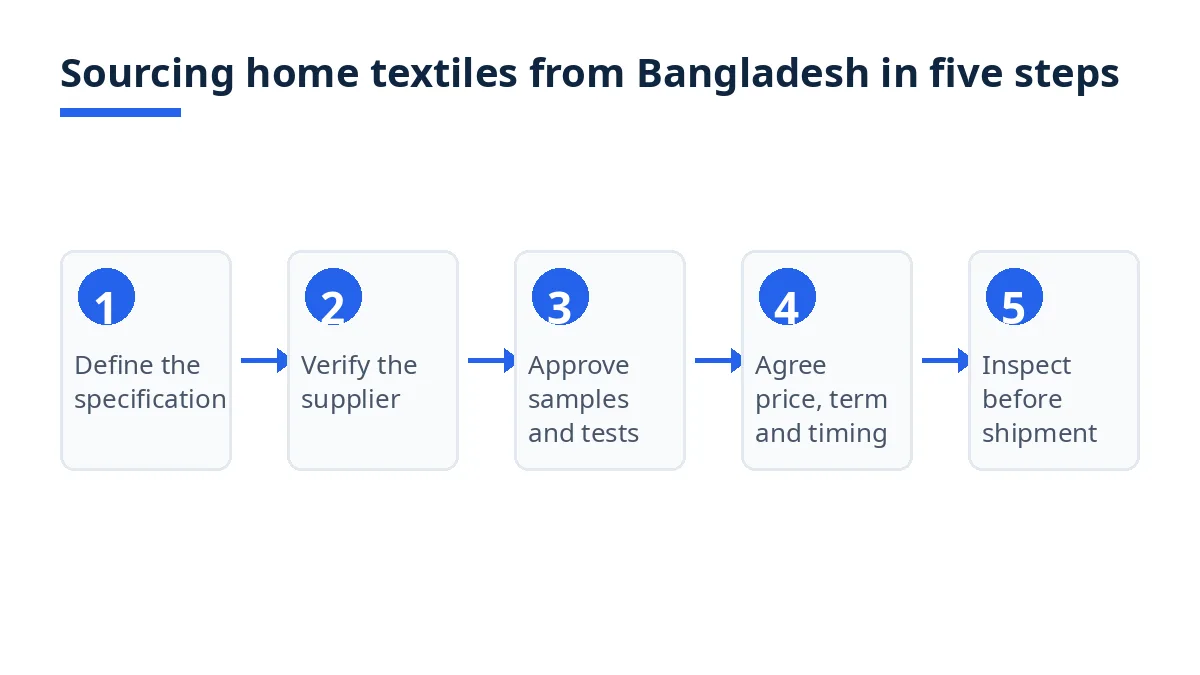
The production chain runs in a fixed order: fibre and yarn sourcing, weaving, dyeing and finishing, cutting and stitching, inspection, pressing and packing. Ask any supplier which steps happen in its own plant and which are done by another unit. Subcontracted dyeing or finishing is common and workable. An unexplained chain is the problem, because colour, absorbency and shrinkage are decided in stages a buyer cannot see in a finished sample alone.
How to find and verify suppliers
Start from your specification, not from a supplier list. Write down the product family, fabric construction, GSM or thread count where relevant, finished sizes, colours, quantities per colour and size, packing, labelling, target market and required test standards. A precise enquiry gets comparable quotes. A vague one gets prices for different products that only look comparable. See how to write an RFQ and finding suppliers in Bangladesh.
Build a shortlist from more than one route: association member lists, trade data for the relevant HS headings, referrals from other buyers, and supplier platforms. However you find a name, run the same verification sequence:
Identity. Match the legal name, trade licence details and factory address across the documents the supplier provides, its association listing and its online presence. Resolve any inconsistency in writing before you discuss price.
Specialisation. Confirm the supplier produces your product family in its own or clearly identified facilities, and record which processes are subcontracted and where.
Export readiness. Ask which markets the supplier ships to and which documents it prepares as a routine. Bangladesh Customs requires an export declaration, known as a Bill of Export or Shipping Bill, before goods are loaded for export, with documents enclosed that include the export letter of credit or, where there is none, the export contract or purchase order, a commercial invoice with a detailed description of the goods, a packing list with quantity, weight and packing information, an EXP form certified by an authorised dealer bank, a certificate of origin issued by the EPB or a chamber of commerce, a VAT registration certificate and a taxpayer identification number.8 A supplier that handles exports regularly will recognise that list at once. See export documents from Bangladesh.
Registration. Ask for the export registration position and read the ERC export registration certificate guide so you know what the certificate shows and what it does not show.
Samples. Order samples in your specification, including your colours, and test them: dimensions before and after washing, weight, absorbency for towels, colour fastness and stitching quality. Approve a physical sample in writing and keep a sealed counter-sample.
Independent checks. For larger programmes, use an independent inspection company for a factory audit or a pre-shipment inspection. Use a video walk-through and a live call as a first screen only, never as a substitute for documents and samples.
Payment discipline. Agree payment terms that match the risk of a new relationship. Confirm bank details through a second, independent channel before paying, and treat any late change of bank details as a reason to pause and re-verify.
Warning signs include a quote far below every comparable offer for the same specification, refusal to send samples, pressure to pay quickly to a personal account, reluctance to identify the producing factory, and certificates that name a different company, site or scope. Any one of these should pause the order until it is explained in writing.
MOQ, pricing and lead times
Buyers routinely ask for one typical minimum order quantity (MOQ), one typical price and one typical lead time. None of the three exists as a single figure. Each is quoted per supplier, per product and per colour against a written specification. See MOQ minimum order quantity.
MOQ is driven by the smallest workable lot at each stage: yarn and fabric lots, dye-lot size for each colour, and the cutting and stitching run. A plain white towel in a standard construction will normally carry a lower minimum than a multi-colour printed bedding set, because each colour and print adds its own lot. Expect minimums per design, per colour and per size, not only per order. You can lower a minimum by simplifying colours, consolidating sizes or accepting a stock fabric that meets your specification.
Pricing is built from fibre and yarn cost, weaving, dyeing and finishing, stitching, trims and packing, testing, inland transport and the export margin, then expressed on the agreed delivery term. Because the sector depends on imported raw cotton, yarn prices move with international fibre markets and exchange rates, so quotations carry validity periods.4 Compare quotations only on an identical specification sheet, and ask each supplier to state what its price includes and excludes, the currency and the validity date, in writing.
Delivery terms decide who pays for which leg, so quotations on different terms are not comparable until you adjust them. The Incoterms rules published by the International Chamber of Commerce are eleven three-letter trade terms used in contracts for the sale and purchase of goods, and they clarify the tasks, costs and risks involved in delivering goods from sellers to buyers.9 Incoterms 2020, the current version, entered into force on 1 January 2020.9 Read Incoterms for shipments from Bangladesh and EXW ex works before you compare an ex-works price with a free on board price.
For method only, consider this comparison. Example figures: two mills quote for the same towel specification, one at USD 3.90 per kilogram EXW and one at USD 4.22 per kilogram FOB. Adding inland transport, export handling and loading of USD 0.28 per kilogram to the EXW quote gives a like-for-like FOB cost of USD 4.18 per kilogram, so the real gap is USD 0.04 per kilogram, not USD 0.32. The decision then rests on dyeing quality, absorbency results and inspection history. Use the same adjustment with the landed cost for imports from Bangladesh method before you set a selling price.
Lead times cover yarn or fabric availability, weaving, dyeing and finishing queues, making up, inspection, packing and transport to port, on top of sample approval time. Custom colours, prints and private-label packing add stages. Build your plan backwards from your required in-store date, add buffer for re-dyeing or re-inspection, and confirm the production slot in the purchase order. For repeat programmes, agree a rolling forecast so the mill can plan dyeing capacity.
Quality, certifications and compliance
Home textiles fail in predictable ways: towels that lose absorbency or shed lint, colours that bleed or fade unevenly, sheets that shrink out of size, stitching that opens in laundering, and cartons whose contents do not match the packing list. A quality plan names each risk and the check that controls it before production starts, and attaches the specification to the purchase order so the standard becomes part of the contract.
Specify measurable quality. For towels, define GSM and its tolerance, dimensions and tolerance, fibre composition, absorbency expectation, and colour fastness to washing and rubbing. For bed linen, define composition, construction, finished dimensions after washing, shrinkage limits, seam strength and appearance after laundering. Add workmanship standards for stitch density, hemming and label placement, plus packing standards. Vague words such as soft, thick or premium cannot be inspected. Numbers and a sealed sample can.
Test at the right stages. Approve lab dips or print strike-offs for colour, then a pre-production sample in the correct fabric, then testing by an accredited laboratory against the standards your market requires. Inspect during production for large programmes and always before shipment, against the approved sample and specification. Agree the sampling method and defect limits in the order itself. See AQL acceptance quality limit and pre-shipment inspection. Keep reports and retain samples from each shipment so repeat orders can be matched to a physical standard.
Certifications buyers commonly ask about. Listing a framework below does not mean a given supplier holds it. Verify the actual certificate for your factory, site and product every time.
OEKO-TEX Standard 100. An independent testing and certification system for textile raw materials, intermediate and finished products and their accessories, confirming that products have been tested for harmful substances.10 Its criteria depend above all on intended use, across four product classes: Class I for babies and young children up to three years, Class II for textiles in direct skin contact, which expressly includes bed linen and towels, Class III for textiles with limited skin contact, and Class IV for furnishing materials such as table linen and curtains.10 A certificate is awarded only if all components of an item meet the criteria, and a Standard 100 certificate is valid for 12 months.10 A Class IV certificate for curtains therefore says nothing about a towel programme that belongs in Class II.
GOTS (Global Organic Textile Standard). GOTS applies only where organic fibre is claimed. Certified products must contain a minimum of 70 percent certified organic fibres, with two label grades: Organic at at least 95 percent, and Made with Organic Materials at at least 70 percent.11 GOTS also sets environmental and chemical criteria across processing, including wastewater treatment and chemical input restrictions, and social criteria covering safe and hygienic working conditions and the prohibition of child labour and forced labour.11 Certification is carried out by accredited bodies through on-site audits, and chain-of-custody records must follow the goods.11 If an organic claim will appear on your packaging, require that evidence before the claim is printed.
Social audits and ISO 9001. Many European and United Kingdom buyers also ask for a recent social audit report for the actual factory site, and some suppliers hold ISO 9001 certification. Treat both as context. Neither replaces your specification, sampling, testing or inspection, and a report for a different site or year does not cover your order.
Destination compliance is yours to define. In the European Union, Regulation (EU) No 1007/2011 of 27 September 2011 lays down rules on textile fibre names and the related labelling and marking of the fibre composition of textile products, with the aim of providing accurate information to consumers.12 Fibre content, care instructions, origin marking and chemical restrictions must be written into your specification in the exact wording your market requires, before labels are printed. A well-made towel with the wrong fibre label is not saleable stock.
Shipping, Incoterms and duties
Most home textile exports move by sea in full or shared containers, with samples and urgent small consignments moving by air. Towels and linen are bulky relative to their weight, so pressing, folding and packing choices affect freight cost per unit. Discuss compressed packing, carton dimensions and palletisation with the supplier and your forwarder before the price is fixed. The sequence in how to import from Bangladesh places this stage inside the wider import process.
Choose the delivery term deliberately. Under EXW, you arrange and pay for almost everything from the factory gate. Under FOB, the supplier delivers the goods on board the vessel at the named Bangladeshi port and you control the main freight. Under CIF, the supplier arranges and pays freight and minimum insurance to your named destination port, while risk still passes when the goods are loaded. Under DAP, the goods are brought to a named place in your country without import clearance, and under DDP, duties and clearance sit with the seller as well, a term to use only with a seller whose arrangements in your market you have checked. The Incoterms rules exist to clarify exactly these tasks, costs and risks in the delivery of goods from sellers to buyers.9 Name the port or place precisely, state who pays destination charges, and record the term, with its place, in the purchase order and the invoice.
Duties and market access must be checked, not assumed. Duty depends on HS classification, your destination tariff and any preferential scheme that applies to Bangladesh at the time of import. Arrangements differ between the EU, the UK, the USA and the UAE, and they change over time. Classify your exact product first: bed linen, towels and kitchen linen sit in different subheadings of heading 6302, and the United Kingdom listing for that heading shows third-country duty of 12.00 percent for most lines and 6.00 percent for certain nonwoven man-made fibre lines, before any preference.6 Then confirm the current duty and any preference conditions, including rules of origin and the proof required, in your destination official tariff or with your broker, before you calculate landed cost.
Documents decide whether goods move. Bangladesh Customs requires the Bill of Export to be approved before export loading, supported by the invoice, packing list, EXP form, certificate of origin and the other documents listed in the verification section.8 Require a consistent set for every shipment, and check names, addresses, HS codes, weights and quantities across every document as soon as drafts arrive. Correcting documents after a vessel sails is slower and more expensive than checking them before it leaves.
Step-by-step buying process
Define the range. Fix product families, specifications, quantities per colour and size, labelling, packing, destination and delivery window.
Research the market. Check current EPB and Bangladesh Bank data for your headings before you negotiate, and record which series each figure came from.
Shortlist and check suppliers. Run the identity, specialisation, registration and export-document checks in this guide, and record what you checked and when.
Request comparable quotations. Send the identical specification sheet to each supplier, and require delivery term, currency, validity, MOQ per colour and size, and lead time in writing.
Sample and test. Approve physical samples, colours and packing mock-ups, run wash, absorbency and fastness tests where the product demands them, and seal a counter-sample.
Agree the contract. Issue a purchase order with the full specification, tolerances, inspection rights, document list, payment terms tied to re-checked bank details, and the agreed delivery term and named place.
Control production. Confirm the production and dyeing slot, and resolve any request to substitute yarn, fabric or trims in writing before it happens.
Inspect before shipment. Commission an independent inspection against the sealed sample and specification, including packing, marking and quantity counts, and release shipment only on a pass or an agreed corrective action.
Ship, clear and review. Track the shipment, check document drafts early, clear customs with your broker using the confirmed classification and duty, then review the delivered goods against the specification.
Related guides
Work outward from this pillar in a deliberate order. Use Bangladesh export data to read EPB and receipts figures without mixing the two series. Use the MOQ minimum order quantity guide when a minimum looks high, to test whether colour, size or fabric choices are driving it. Buyers comparing this category with an adjacent one can read the knitwear industry in Bangladesh pillar for the garment side of the same textile base.
FAQs
Is Bangladesh a good place to source home textiles & towels?
It can be, when the supplier and the specification are right. Bangladesh has a dedicated terry towel and home textile base, a specialist association in BTTLMEA, and export earnings that recovered to USD 871.57 million on the EPB shipment series in 2024-25 after two weaker years.1 Results still depend on checking the individual factory, approving samples and controlling quality.
What is the typical MOQ?
There is no single typical MOQ for this category. Minimums are set by dye-lot and fabric-lot sizes and are normally quoted per design, per colour and per size. Plain standard-construction towels usually carry lower minimums than multi-colour or printed bedding programmes. Ask each supplier to state its MOQ against your exact specification, and lower it by simplifying colours, consolidating sizes or using a stock fabric that meets your standard.
How long is the lead time?
Lead time is product- and season-specific. It covers fabric or yarn availability, weaving, dyeing and finishing queues, making up, inspection, packing and transport to the port, after sample approval. Custom colours, prints and private-label packing add time. Require a written lead time for your specification, confirm the production slot in the purchase order, and build buffer for re-testing or re-inspection.
Which certifications matter?
It depends on your market, your customers and the claims on your packaging. For harmful-substance testing, buyers commonly ask about OEKO-TEX Standard 100, in the product class that matches the article, with Class II covering bed linen and towels in direct skin contact.10 For organic claims, GOTS applies, with its 70 percent minimum and its 95 percent Organic label grade.11 For workplace standards, ask for a recent social audit report for the actual factory site. In every case, check the holder, site, scope and expiry date.
Next steps on Exportain
Browse suppliers by product category and note the mills whose range matches your specification, then read the how to buy guide before you send your first enquiry. When your specification is ready, post an RFQ so suppliers reply against the same requirements.
Sources
- Home textile sector rebounds after a two-year slump. TOB News, (accessed )
- Annual Export Receipts of Goods and Services 2024-25. Bangladesh Bank (accessed )
- Export growth picks up as garment rebounds. The Daily Star, (accessed )
- Textile industry in Bangladesh. Wikipedia (accessed )
- HS 2017 - Code 6302: Bed linen, table linen, toilet linen and kitchen linen. United Nations Statistics Division (accessed )
- Bed linen, table linen, toilet linen and kitchen linen - UK Integrated Online Tariff, Heading 6302. GOV.UK (accessed )
- Terry towel sector in big crisis. The Business Standard (accessed )
- Customs Clearance Procedures for Export. Bangladesh Customs, National Board of Revenue (accessed )
- Incoterms® rules. International Chamber of Commerce (ICC) (accessed )
- OEKO-TEX STANDARD 100 for textiles tested for harmful substances. Hohenstein (accessed )
- GOTS - All key features at a glance. Global Standards (accessed )
- Regulation (EU) No 1007/2011 on textile fibre names and related labelling and marking of the fibre composition of textile products. European Union, (accessed )
- quality control
- Bangladesh Export Data
- Category Pillars
- Supplier Sourcing
- Home textiles Bangladesh
- Terry towels
- Bed linen
About the author
Sourcing from Bangladesh?
Post a request for quotation and suppliers on Exportain can send you their quotes directly.
Post an RFQ